AntiGravity + Opus 4.5 Real-World Test: The Best Alternative After Getting Banned from Claude Code
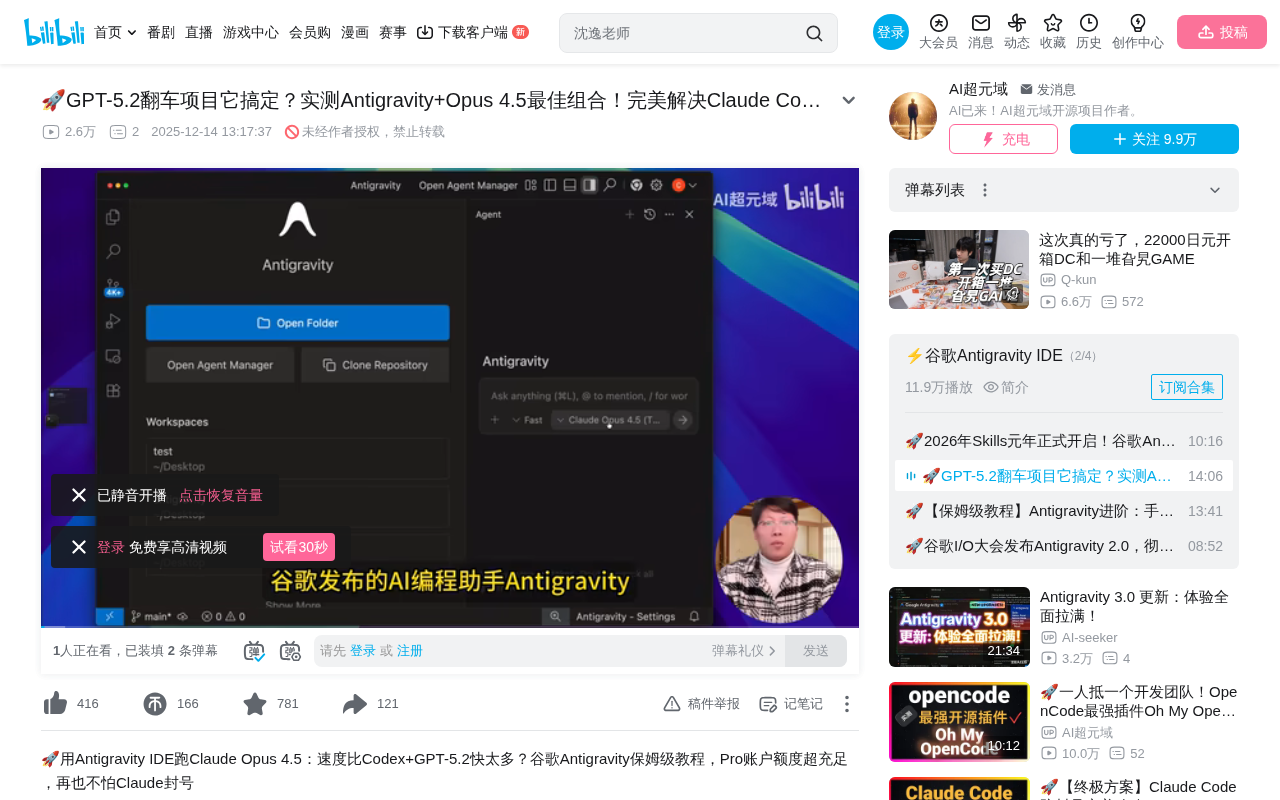
AntiGravity supports Claude Opus 4.5, solving Claude Code ban issues with generous quotas.
Google's AI coding assistant AntiGravity now supports Claude Opus 4.5, offering a stable alternative for developers plagued by Claude Code account bans. Real-world testing shows Opus 4.5 in AntiGravity successfully completed an agent framework refactoring task that GPT-5.2 failed, and built a feature-rich pet adoption platform MVP from scratch in just 10 minutes. With flexible multi-model switching, MCP integration, and multi-agent collaboration, the Pro account provides generous quotas and a superior development experience compared to both Claude Code and Codex.
Introduction: Breaking Free from the Claude Code Ban Dilemma
For AI coding users, Claude Opus 4.5 is undoubtedly one of the most powerful code generation models available today. However, a persistent headache plagues countless users—using Opus 4.5 in Claude Code often results in account bans within less than a day. This leaves many developers with a powerful tool they can't actually use.
The good news is that Google's AI coding assistant AntiGravity recently added support for Claude Opus 4.5, offering a viable alternative path. According to in-depth testing by a Bilibili content creator, using Opus 4.5 in AntiGravity not only handles complex project development but also provides generous quotas—a Pro account is more than sufficient. More importantly, AntiGravity supports multi-agent collaborative work, enabling simultaneous frontend and backend development to dramatically boost productivity.
AntiGravity Environment Configuration Guide
Basic Installation and Rules File Setup
AntiGravity currently supports all three major operating systems: macOS, Windows, and Linux. After installation, the first step is configuring the global rules file.
Click the three dots in the upper right corner to access "Customize," then fill in development standards related to your tech stack in the global rules file. In this test, the rules file contains two main sections:
- Python Development Standards: Specifies Python 3.11, virtual environment creation methods, run command conventions, code style requirements, dependency management commands, etc.
- Next.js Development Standards: Specifies Next.js 14, Tailwind CSS styling framework, Supabase backend database, authentication methods, storage approaches, project structure constraints, etc.
Once these rules files are configured, AntiGravity strictly follows these standards throughout development, ensuring consistent code quality.
Supabase MCP Integration

A major highlight of AntiGravity is its support for MCP (Model Context Protocol) integration. After searching for Supabase and installing the corresponding MCP, you simply set up the Access Token, and AntiGravity can directly operate the Supabase database through MCP.
A quick explanation of Supabase's positioning: it's essentially a backend-as-a-service platform that bundles database services, authentication systems, file storage, real-time updates, and more into one package. Developers can quickly build and launch products without building a backend from scratch—making it especially suitable for MVPs, startup prototypes, and small teams iterating rapidly.
Test 1: Agent Framework Refactoring—A Project Where GPT-5.2 Failed
Test Task
The first test case is quite representative: refactoring a travel planning agent written in Microsoft's agent framework into Google's ADK (Agent Development Kit) framework, while switching the LLM API to Mistral AI with the model set to Mistral Large 3.
This same test was previously attempted in OpenAI's Codex using GPT-5.2, but GPT-5.2 failed to produce correct code.
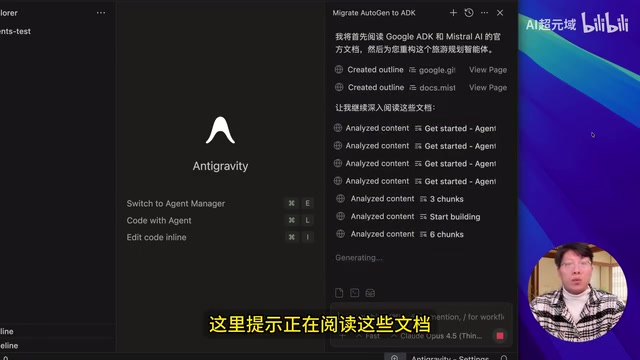
Execution Process and Results
In AntiGravity, selecting the Claude Opus 4.5 Thinking model with Fast mode (suitable for relatively simple tasks), the complete prompt with requirements was pasted directly. The execution process demonstrated several notable advantages:
- Extremely fast: Document reading and code generation speed far exceeded GPT-5.2 in Codex
- Standards compliance: Automatically created a VENV virtual environment, strictly following the rules file requirements
- First-try success: The project refactoring completed in one pass without iterative debugging
After launching the WebUI and testing with "Plan a three-day trip to Nepal," the output contained three sections: a three-day travel plan, local specialty activities, and common local phrases—essentially matching the original Microsoft agent framework's logic and workflow. This was a task GPT-5.2 couldn't complete, yet Opus 4.5 handled it effortlessly in AntiGravity.
Test 2: Building a Pet Adoption Platform MVP from Scratch in 10 Minutes
Dual-Model Strategy for Planning and Execution
The second test is more challenging: developing a modern pet adoption platform MVP from scratch. This test was also previously attempted with GPT-5.2, with poor results.
This demonstrates a clever AntiGravity technique—the dual-model strategy:
- Planning phase: Use Claude Sonnet 4.5 Thinking model + Planning mode to create a detailed development plan
- Execution phase: Switch to Claude Opus 4.5 model to implement the plan step by step
- Simple tasks: Use Gemini 3 Pro for handling things like setting up databases through Supabase MCP
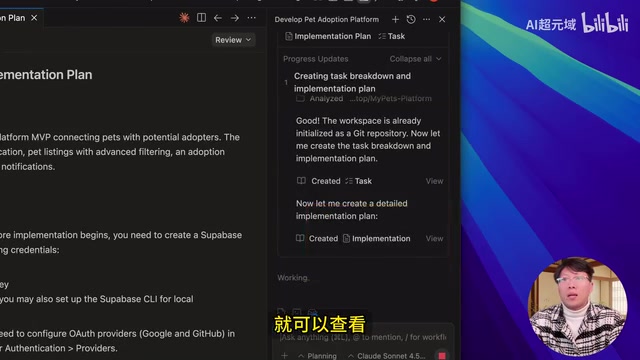
This approach of flexibly switching models based on task complexity ensures quality while optimizing quota usage.
Development Results
After approximately 10 minutes, AntiGravity completed the entire project. After automatically creating the database project and executing migration files through Supabase MCP, the project ran successfully.

The resulting pet adoption platform is feature-rich:
- Homepage: Attractive navigation bar and adoption step instructions
- Authentication system: Email registration/login, Google login, GitHub login
- User dashboard: Profile, adoption applications, settings, and other complete features
- Posting system: Upload pet photos, fill in detailed information (name, species, breed, age, gender, size, coat color, location, health status, personality, etc.)
- Browsing system: Pet listing display and detail pages with dynamic effects
During testing, an image display bug was encountered (a permissions issue). After feeding the browser element information back to AntiGravity, it fixed the problem in one shot. The overall result was significantly better than GPT-5.2's implementation.
Quota and Usability Analysis
After completing two full project developments, a key question remains: has the Opus 4.5 quota been exhausted?
The test results are reassuring—after opening a new window, Opus 4.5 was still fully functional, even invoking web search capabilities and outputting complete agent code examples with documentation links. This demonstrates that under AntiGravity's Pro account, Opus 4.5 quotas are quite generous, fully capable of supporting daily project development needs.
This stands in stark contrast to the frequent bans experienced in Claude Code. For developers who need deep access to Opus 4.5, AntiGravity genuinely provides a more stable and reliable option.
Summary and Recommendations
The AntiGravity + Claude Opus 4.5 combination demonstrates powerful practical value. It not only solves the Claude Code ban pain point but also delivers a more efficient development experience through multi-agent collaboration, MCP integration, and flexible model switching.
For different scenarios, the following model pairing strategy is recommended:
| Scenario | Recommended Model | Chat Mode |
|---|---|---|
| Complex project planning | Claude Sonnet 4.5 Thinking | Planning |
| Core code development | Claude Opus 4.5 | Fast/Planning |
| Simple task handling | Gemini 3 Pro | Fast |
If you're struggling with Claude Code's ban issues or disappointed with GPT-5.2's coding capabilities, AntiGravity is worth trying.
Related articles
 Product Reviews
Qoder vs Cursor Real-World Comparison: Which $20/Month AI IDE Is Better?
Hands-on comparison of Qoder vs Cursor AI IDEs: Agent autonomy, human interaction count, and architecture decisions. Qoder needed only 2 interactions vs Cursor's 8.
 Product Reviews
Cursor Cloud Agent Demo: Eliminating Bottlenecks Across the Entire Software Development Lifecycle
Deep analysis of Cursor's Cloud Agent demo showing how cloud VMs, automated test artifacts, and a full-chain control plane systematically eliminate human bottlenecks across the software development lifecycle.
 Product Reviews
Cursor 3.0 Deep Dive: Multi-Agent Parallelism, Design Mode, and Best-of-N Model Comparison
Cursor 3.0 evolves from an AI coding assistant into an Agent fleet command center. Explore multi-agent parallelism, Design Mode, and Best-of-N model comparison.