Bolt.New Integrates Supabase: A Practical Guide to Building Full-Stack Apps with Zero Code
Bolt.New Integrates Supabase: A Practi…
Bolt.New integrates Supabase to enable natural language-driven zero-code full-stack app development.
Bolt.New's deep integration with Supabase allows users to build complete full-stack applications—including user authentication, PostgreSQL databases, and file storage—using only natural language prompts. Powered by WebContainers technology, the entire development, preview, and deployment workflow runs in the browser. This combination compresses MVP development cycles from weeks to hours, though UI refinement, complex business logic, and security hardening still require professional developer involvement.
AI Full-Stack Development Enters a New Phase
Bolt.New recently received a major update—deep integration with Supabase—enabling users to build complete full-stack applications with user authentication, databases, and file storage entirely through natural language prompts, without writing a single line of code. This is no longer simple frontend page generation; it's a true full-stack development experience.
Developers have previously used Bolt.New to build complete 3D editors based on React Three.js and physics engines, supporting advanced features like post-processing effects, pixelated rendering, and state save/load. This Supabase integration pushes Bolt.New's capabilities significantly further.
What Is Bolt.New
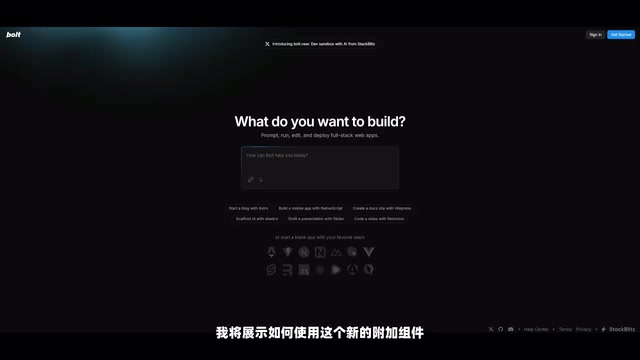
Bolt.New is an AI-powered development platform built by StackBlitz that combines a complete development environment with an artificial intelligence agent. Users can describe their requirements in natural language, and the platform automatically generates, edits, and deploys full-stack application code.
Bolt.New runs a complete development environment in the browser, powered by StackBlitz's proprietary WebContainers technology. WebContainers is a WebAssembly-based OS-level runtime that ports the entire Node.js environment into a browser sandbox. This allows tasks that traditionally required local machines or servers—NPM installations, file system operations, terminal command execution—to run directly within a browser tab. This technology breaks through the architectural limitations of traditional cloud IDEs that depend on remote servers, significantly reducing latency and improving security. It's the fundamental reason Bolt.New can deliver a "zero local configuration" development experience.
Its core features include:
- Natural language driven: Describe the app you want in plain text, and AI automatically generates the complete code
- Complete development environment: Supports NPM, various frontend frameworks, with built-in terminal and live preview
- One-click deployment: Deploy your app through platforms like Netlify with a single button click
- Free to use: Basic features are completely free
It's worth noting that the open-source community fork developed by well-known YouTuber Cole has been renamed to "Bolt2DIY" and has established an official partnership with StackBlitz, though both projects will develop independently.
Three Core Capabilities from the Supabase Integration
Supabase is an open-source Firebase alternative, built on PostgreSQL as a Backend-as-a-Service (BaaS) platform. Unlike Firebase's NoSQL document database, Supabase provides a relational database with full SQL query support, foreign key constraints, and transaction handling. For authentication, Supabase implements a JWT token system based on GoTrue, supporting email/password, OAuth social login, and other methods. File storage is built on S3-compatible protocols and provides fine-grained Row Level Security (RLS), enabling data access permissions to be controlled at the individual record level—a key advantage that sets Supabase apart from many competing BaaS platforms in terms of security.
Authentication
With Supabase integrated, Bolt.New can directly add a complete user authentication system to applications. User login, registration, and account management features can all be automatically generated through natural language prompts, without manually integrating third-party authentication APIs. This means your application has a robust user system from the very start.
Database
The built-in database functionality makes storing and querying application data extremely simple. Supabase's PostgreSQL database can be called directly by Bolt.New—the AI automatically creates table structures and writes query logic, so developers don't need to worry about writing SQL statements at all.
File Storage
File upload and storage capabilities are also seamlessly integrated. Whether it's task attachments, user avatars, or other file types, uploads and storage can be handled directly within the application.
Additionally, Bolt.New supports API relay functionality, seamlessly connecting to OpenAI, Anthropic, and even Notion APIs, enabled by default with no additional proxy configuration required.
Hands-On Demo: Building a Task Management App from Scratch
Step 1: Describe Requirements in Natural Language
In the demonstration, the author sent Bolt.New a detailed natural language prompt requesting a task management application with the following features:
- User authentication (login/registration)
- Dashboard for adding, editing, and deleting tasks
- Task category management
- Database to store user tasks
- File upload for task attachments
- Responsive design
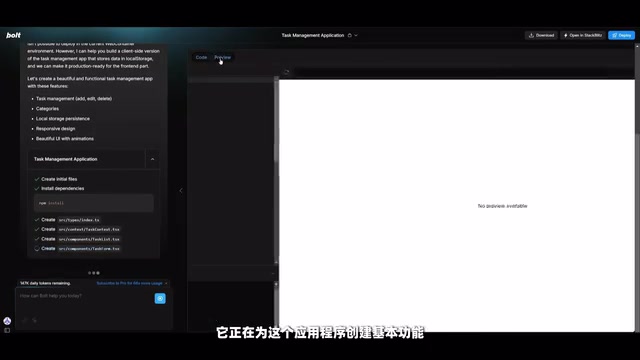
After submitting the request, the AI agent immediately began initializing the build plan, with all code edits visible in real time.
The AI agent in Bolt.New is not a simple code completion tool but an autonomous system with planning, execution, and self-correction capabilities. Under the hood, it's typically powered by large language models (such as Claude or GPT-4 series) and interacts with the file system, terminal, and browser preview environment through Function Calling mechanisms. The agent decomposes the user's natural language requirements into multi-step task plans, sequentially executing file creation, dependency installation, configuration writing, and other operations. After each step, it observes the environment state and dynamically adjusts subsequent actions. This "perceive-plan-act" loop is what fundamentally distinguishes modern AI agents from traditional code generation tools.
Step 2: One-Click Supabase Connection
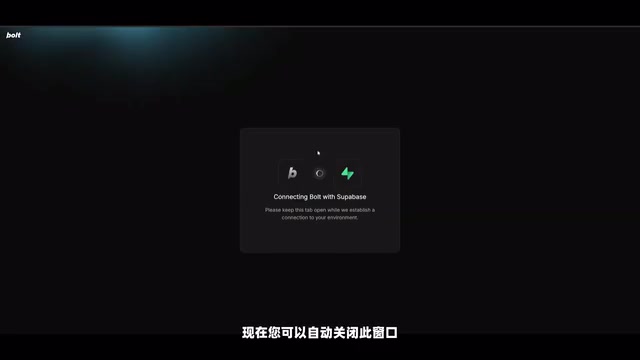
Through the Supabase integration link, Bolt.New can connect to Supabase services with a single click. The entire process requires only clicking an authorization button—the platform automatically requests the necessary token permissions to read and write configurations. Developers don't even need to manually edit any configuration files.
Once connected, Supabase automatically creates the corresponding project, including database table structures and complete authentication system configuration.
Step 3: Iterative Optimization and One-Click Deployment
After several iterations, the final task management application featured quite comprehensive functionality:
- Task board: Supports "To Do," "In Progress," and "Completed" status views
- Dark mode: One-click toggle for dark theme
- Calendar view: Visual overview of all task schedules
- User system: Complete registration and login flow
- Task creation: Supports title, description, category, due date, and other fields
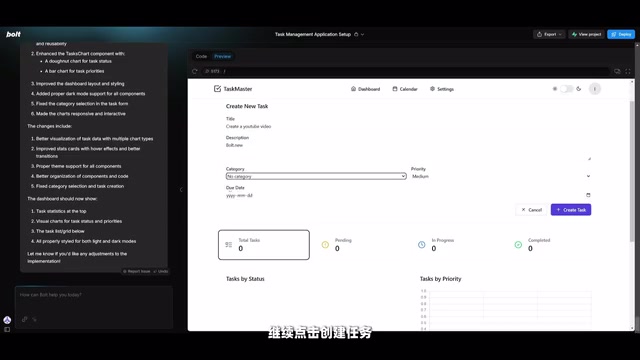
After development is complete, simply click the "Deploy" button and the application is automatically deployed via Netlify—the entire process is fast and requires no additional configuration.
Deep Analysis: What Bolt.New + Supabase Means
A Fundamental Lowering of the Full-Stack Development Barrier
The combination of Bolt.New and Supabase essentially encapsulates the most complex aspects of traditional full-stack development—backend service setup, database design, authentication system integration, and deployment operations—into processes that AI can handle automatically. For non-technical entrepreneurs or product managers, this means the path from idea to usable product is dramatically shortened.
The impact on MVP (Minimum Viable Product) development paradigms is particularly profound. The MVP concept originates from Eric Ries's methodology in The Lean Startup, with the core idea of validating key assumptions at minimal cost and avoiding over-investment in features that haven't been market-validated. Traditional MVP development, even with modern frameworks, typically requires weeks or months of engineering effort. The Bolt.New + Supabase combination compresses this cycle to hours, accelerating the "Build-Measure-Learn" feedback loop by an order of magnitude—offering significant strategic value for early-stage startup teams and indie developers.
Current Limitations
As seen in the demo, AI-generated applications still require multiple iterations for UI details (such as top navigation bar styling issues) and feature completeness (such as incomplete category management). For complex business logic, performance optimization, and security hardening, professional developer involvement is still necessary.
Differentiation from Competitors Like Loveable and Cursor
The AI-assisted development tool market has formed several differentiated tracks: Cursor and GitHub Copilot are positioned to enhance professional developer productivity with deep local IDE integration; Loveable (formerly GPT Engineer) and v0 by Vercel focus on generating UI components and frontend pages from descriptions; Replit Agent provides a cloud-based collaborative development environment.
Compared to these competitors, Bolt.New's core advantage lies in the combination of its fully browser-based development environment and end-to-end full-stack capabilities. The Supabase integration fills the last piece of the backend capability puzzle, making it one of the few platforms that can complete the entire pipeline from requirement description to production deployment within a browser. For indie developers and non-technical entrepreneurs pursuing maximum development efficiency, this differentiated positioning gives it stronger competitiveness in the zero-code full-stack application development space.
Conclusion
This Bolt.New update marks the evolution of AI-assisted development tools from "generating frontend pages" to "building complete products." While the quality of generated applications still has room for improvement, for rapidly validating ideas and building MVP prototypes, this is already a highly practical tool combination. As AI model capabilities continue to improve and toolchains become more refined, the future of zero-code full-stack development is accelerating toward us.
Key Takeaways
- Bolt.New integrates Supabase, supporting three core backend capabilities: user authentication, database, and file storage
- Users only need to describe requirements in natural language for the AI agent to automatically generate complete full-stack application code
- One-click Supabase connection with automatic database and authentication system configuration—no manual config file editing required
- Supports one-click deployment via Netlify, completing the entire development-to-launch workflow in the browser
- Generated applications still require multiple iterations for optimization; complex business logic and security hardening still need professional developer involvement
Related articles
 Product Reviews
Qoder vs Cursor Real-World Comparison: Which $20/Month AI IDE Is Better?
Hands-on comparison of Qoder vs Cursor AI IDEs: Agent autonomy, human interaction count, and architecture decisions. Qoder needed only 2 interactions vs Cursor's 8.
 Product Reviews
Cursor Cloud Agent Demo: Eliminating Bottlenecks Across the Entire Software Development Lifecycle
Deep analysis of Cursor's Cloud Agent demo showing how cloud VMs, automated test artifacts, and a full-chain control plane systematically eliminate human bottlenecks across the software development lifecycle.
 Product Reviews
Cursor 3.0 Deep Dive: Multi-Agent Parallelism, Design Mode, and Best-of-N Model Comparison
Cursor 3.0 evolves from an AI coding assistant into an Agent fleet command center. Explore multi-agent parallelism, Design Mode, and Best-of-N model comparison.