Cursor 3.0 Deep Dive: Rust Rewrite, In-House Model & Agent Orchestration Platform Fully Explained

Cursor 3.0 rewrites its core in Rust and transforms into an AI agent orchestration platform to counter Claude Code.
Facing intense competition from Claude Code, Cursor releases a fully restructured 3.0 version with three core upgrades: a Rust rewrite that completely eliminates VS Code dependency, an in-house Composer 2 model that surpasses Claude Opus while cutting costs by 86%, and Agent Windows enabling multi-agent parallel orchestration. Cursor repositions itself from a code editor to an AI agent orchestration platform, while building a cross-product tool ecosystem through the MCP protocol.
Background: Fierce Competition in the AI Coding Arena
Cursor rose to prominence quickly as a VS Code fork, with annualized revenue once surpassing $2.1 billion, making it the benchmark product in the AI coding space. The essence of this competition is the battle between AI capability providers (model companies) and tool-layer products: the AI coding assistant market has experienced explosive growth since GitHub Copilot's commercialization in 2022. Copilot leveraged the Microsoft/GitHub ecosystem to accumulate over 1.8 million paying users, but its completion-based interaction paradigm has gradually been challenged by more proactive Agent modes. Cursor, through deep modifications to VS Code and a more aggressive AI integration strategy, achieved a leap from zero to $2.1 billion in annualized revenue in 2024. However, after Anthropic's Claude Code entered the market aggressively, reaching $2.5 billion in annualized revenue, it directly created a crushing competitive dynamic—Claude Code took a fundamentally different approach, centering on a terminal CLI, targeting advanced developers directly, and leveraging Claude's advantages in long-context understanding and code reasoning to rapidly capture market share. Facing customer churn and fundraising difficulties, the Cursor team launched an intensive counterattack, releasing the fully restructured Cursor 3.0.
This restructuring isn't a simple version iteration—it's a fundamental shift in product positioning. Cursor is no longer just a code editor; it aims to become an orchestration and scheduling platform for AI agents.
Cursor 3.0's Three Core Upgrades: Performance, Model & Architecture
Rewritten in Rust, Fully Breaking Free from VS Code
The biggest technical transformation in Cursor 3.0 is the complete rewrite of its underlying architecture in Rust, fully eliminating its dependency on VS Code. This means Cursor is no longer a "modded version" of VS Code but a completely independent product.
Rust is a systems-level programming language developed by Mozilla Research, with a core design philosophy of guaranteeing memory safety without sacrificing performance. Unlike C/C++, Rust eliminates common memory errors such as null pointers and data races at compile time through its Ownership and Borrow Checker mechanisms, achieving automatic memory management without a garbage collector (GC). This is particularly critical for AI coding tools—when an IDE needs to simultaneously handle code parsing, streaming AI inference output, file system monitoring, and multi-Agent concurrent scheduling, the GC pauses and memory overhead of traditional JavaScript/Electron architectures cause noticeable stuttering, while Rust's zero-cost abstractions and GC-free nature can compress latency to sub-millisecond levels. The performance advantages of Rust are highly intuitive—memory safety, high concurrency, and low latency are all crucial characteristics for a programming tool that needs to respond to AI inference results in real time.
In-House Composer 2 Model: Surpassing Performance, Plummeting Costs
The Cursor team released their in-house Composer 2 model, which directly surpasses Claude Opus 4.6 in benchmark tests, with multiple tests approaching GPT 5.4 levels. More critically, costs have dropped dramatically—reportedly by 86%, with performance improvements exceeding 90% in heavy-use scenarios.
Understanding this achievement requires familiarity with the complexity of AI model evaluation systems. Current mainstream code capability benchmarks include HumanEval (function-level code generation), SWE-bench (real GitHub Issue fixes), LiveCodeBench (competitive programming), and others, with significant differences in focus across benchmarks. SWE-bench is considered the most practically relevant by the industry due to its proximity to real engineering scenarios, but even so, there remains a notable gap between benchmark scores and actual development experience. The key advantage of in-house models lies in inference cost control: through knowledge distillation, quantization, and dedicated hardware optimization, companies can transfer the capabilities of general-purpose large models to smaller, faster, and cheaper specialized models—this is precisely the technical pathway behind Cursor's claimed 86% cost reduction. This means users can access stronger AI coding capabilities at lower prices, making this cost advantage highly attractive for developers who frequently use AI-assisted programming.
Evolving from Editor to Agent Orchestration Hub
Cursor had previously rolled out Automatic automation features, self-hosted cloud agents, and other capabilities. In version 3.0, these capabilities are integrated into a complete agent orchestration platform.
Agent Orchestration is a core topic in current AI engineering. Single Agents face bottlenecks such as context window limitations and insufficient task decomposition capabilities when handling complex software engineering tasks, making multi-Agent collaborative architectures the mainstream solution. Typical orchestration patterns include: Orchestrator-Worker, where a planning Agent decomposes tasks and distributes them to specialized Agents for execution; Pipeline, where Agents process outputs sequentially; and Parallel, where multiple Agents simultaneously handle independent subtasks before aggregating results. Cursor 3.0's Agent Windows essentially implements lightweight parallel orchestration—users no longer need to write code line by line but instead issue instructions and review results, with AI agents completing the entire workflow from code generation to deployment.
Agent Windows: Cursor 3.0's New Interaction Paradigm
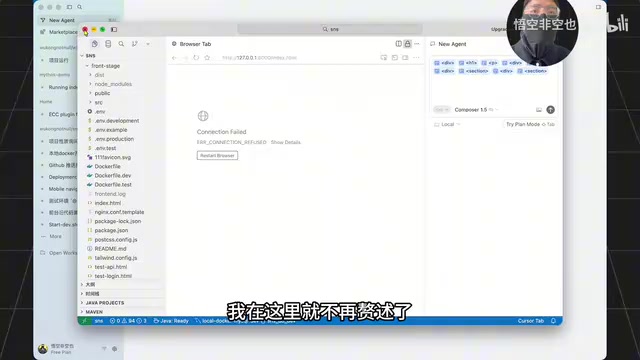
Cursor 3.0 offers two interface modes: the traditional Edit Windows (editor mode) and the brand-new Agent Windows (agent mode). Edit Windows retains a layout similar to VS Code—file tree on the left, editor in the center, Agent dialog on the right—making it easy for existing users to transition smoothly.
Agent Windows is the core highlight of 3.0. The entire interface consists of three parts: left sidebar, center dialog, and right sidebar, with an extremely clean design. Multiple projects can be opened within a single window, supporting local projects, GitHub repositories, and SSH connections, greatly improving efficiency for parallel multi-project development.
Multiple Agents can be created under each project, with each conversation window being an independent Agent, and all Agents support parallel execution. This means you can simultaneously have one Agent writing frontend code, another handling backend logic, and a third running tests—truly achieving concurrent multi-task development.
Model Selection & Plugin Ecosystem
Free Multi-Model Switching
For conversation modes, Cursor 3.0 offers three options:
- Plan (Planning Mode): Suitable for complex tasks where AI needs to plan before executing
- Debug (Debug Mode): Focused on code debugging and troubleshooting
- Ask (Conversation Mode): For everyday code consultation and Q&A
Beyond the in-house Composer 2, model support includes Claude, GPT, Gemini, and other mainstream market models. Users can also add custom models via API Key.
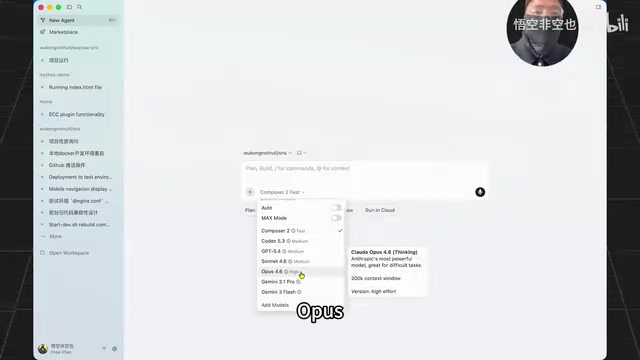
Marketplace Plugin Store
The right sidebar provides a Marketplace recommending various Plugins, Skills, and MCP services. Plugins are categorized by function, covering payments, productivity tools, and many other domains, including commonly used plugins like Redis and Notion—click to add them to Cursor instantly.
Notably, Cursor 3.0 achieves excellent ecosystem interoperability with Claude Code—Skills, Plugins, and Hugas configured in Claude Code automatically sync to Cursor, reducing migration costs for users.
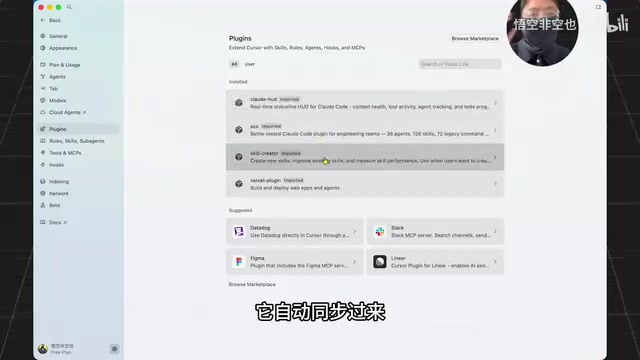
MCP (Model Context Protocol) is an open standard protocol released by Anthropic in late 2024, designed to solve the integration fragmentation problem between AI models and external tools/data sources. Before MCP, every AI application needed to develop separate integration code for each external service, resulting in extremely high maintenance costs. MCP defines a standardized Server/Client architecture that allows any protocol-compliant tool to be called by any MCP-supporting AI client—similar to a USB interface standard for the AI domain. MCP configuration is organized by project, with each project independently managing its required MCP services—this isolation design avoids global configuration chaos while reducing Token consumption through the official recommendation of no more than 10 MCPs per project (each MCP's tool descriptions consume context window space). The ecosystem interoperability between Cursor and Claude Code is essentially building a developer tool ecosystem alliance based on MCP, expanding the user base of the entire AI coding tool market by reducing migration costs.
Design Mode Upgrade: Irregular Region Selection Explained
Cursor 3.0's built-in browser Design Mode received an important upgrade. In previous versions, users could only select fixed-area elements on the page; now it supports irregular region selection, representing a qualitative leap for frontend UI fine-tuning.

Specific operations:
- Swipe Selection: Swipe to select regions of any shape, such as a horizontal line
- Shift + Drag: Hold Shift and drag to precisely select multiple discrete elements
- Command + L: Use the shortcut to add the selected region to the dialog
After selecting a region, simply type your requirement in the dialog (e.g., "delete this area"), and the AI can precisely modify the selected portion. This interaction method makes UI fine-tuning in frontend development exceptionally efficient—no need to locate elements in code; just "circle" them in the visual interface and tell the AI what to change.
Summary: Cursor 3.0 Redefines AI Coding Tools
Cursor 3.0's restructuring is essentially a redefinition of the "AI coding tool" category. It's no longer content being a smarter code editor—it aims to become the scheduling hub between developers and AI agents.
From the performance leap brought by the Rust rewrite, to Composer 2's cost advantages, to Agent Windows' entirely new interaction paradigm, every step responds to competitive market pressure.
Of course, the challenges facing Cursor remain severe. Claude Code's advantages in underlying model capabilities, GitHub Copilot's ecosystem moat, and the influx of increasingly numerous new players are all intensifying competition in this space. But Cursor 3.0 has proven at least one thing: In the AI era, a product's moat doesn't lie in first-mover advantage, but in the ability to rapidly evolve and redefine the rules of the game.
Key Takeaways
- Cursor 3.0 rewrites its underlying architecture in Rust, completely breaking free from VS Code dependency through ownership mechanisms and GC-free design, with dramatically improved performance
- The in-house Composer 2 model surpasses Claude Opus 4.6 in benchmarks, achieving 86% cost reduction through knowledge distillation and other techniques
- The new Agent Windows mode supports multi-project, multi-agent parallel execution, transforming from an editor into a lightweight agent orchestration platform
- The built-in browser design mode upgrade supports irregular region selection, significantly improving frontend UI fine-tuning efficiency
- Deep integration of the MCP open protocol enables automatic synchronization of plugins, skills, and other configurations with the Claude Code ecosystem, building a cross-product tool ecosystem alliance
Related articles
 Product Reviews
Qoder vs Cursor Real-World Comparison: Which $20/Month AI IDE Is Better?
Hands-on comparison of Qoder vs Cursor AI IDEs: Agent autonomy, human interaction count, and architecture decisions. Qoder needed only 2 interactions vs Cursor's 8.
 Product Reviews
Cursor Cloud Agent Demo: Eliminating Bottlenecks Across the Entire Software Development Lifecycle
Deep analysis of Cursor's Cloud Agent demo showing how cloud VMs, automated test artifacts, and a full-chain control plane systematically eliminate human bottlenecks across the software development lifecycle.
 Product Reviews
Cursor 3.0 Deep Dive: Multi-Agent Parallelism, Design Mode, and Best-of-N Model Comparison
Cursor 3.0 evolves from an AI coding assistant into an Agent fleet command center. Explore multi-agent parallelism, Design Mode, and Best-of-N model comparison.