Deep Dive into Cursor's Pay-Per-Use Refill Plan: Is Using Official Pro Accounts at 65% Off Reliable?
Deep Dive into Cursor's Pay-Per-Use Re…
Analysis of a Cursor pay-per-use refill scheme's mechanics, advantages, and risks
This article analyzes a new Cursor refill scheme that assigns official Pro accounts through account rotation, billing at 65% off actual Token consumption — distinct from traditional monthly subscriptions. The scheme doesn't modify the client, supports all models, provides transparent billing details, and features non-expiring balances. However, it remains fundamentally account sharing, carrying risks of ToS violations, potential bans, data security concerns, and sustainability issues.
Introduction: Chaos in the Cursor Refill Market and a New Approach
As the hottest AI programming tool on the market, Cursor has made "hard to get" the new normal. Cursor is a deeply customized AI programming IDE based on VS Code, developed by Anysphere. With its Agent mode, Composer multi-file editing, and deep codebase understanding capabilities, it rapidly became one of the most popular AI programming tools in the developer community during 2024-2025. Its Pro tier pricing of $20/month creates a significant price barrier in the Chinese developer market — which is the fundamental reason the refill market exists. The refill (renewal/sharing) market around Cursor has grown wildly — from 7-day trial accounts, API proxies, frontend modifications to Talk model impersonation, all kinds of schemes are mixed together. Recently, a refill plugin scheme appeared on Bilibili claiming "pay-per-use, use official Pro accounts at 65% off," sparking considerable attention and discussion.
This article will analyze the operational logic of this scheme based on publicly available information, its differences from traditional refill approaches, and the risk factors users should be aware of.
Core Mechanism of the Cursor Pay-Per-Use Plan: Usage-Based Billing + Account Rotation
Basic Principle
The underlying logic of this scheme is similar to other refill plugins on the market — they all achieve continued Cursor usage through account rotation (automatically switching account credentials).
The Technical Essence of Account Rotation: Account Rotation/Fingerprint Spoofing is a technique that uses automated scripts to batch-manage and switch account credentials. In the Cursor context, the client identifies the currently logged-in account through locally stored JWT Tokens or Session Cookies. The core of an account rotation plugin is hijacking or replacing these credential files, making the client "believe" it's logged into a different account. This technology was first widely used in social media marketing tools and game assist programs before being introduced to the AI tool sharing market. The technical barrier isn't high, but scaling operations requires solving engineering problems like account pool management, concurrent scheduling, and ban detection.
But the key difference lies in the billing model change:
- Traditional refill: Monthly/quarterly subscription with unlimited usage within a fixed period
- This scheme: Billed by actual Token consumption, discounted based on official billing
Tokens are the basic units that large language models use to process text — typically one English word equals about 1-2 Tokens, while Chinese characters equal about 1.5-2 Tokens. Cursor officially uses a "Fast Request" quota system for Pro accounts, throttling or charging per-use when exceeded. The arbitrage opportunity for pay-per-use schemes comes from: potential bulk purchase discounts when buying official accounts in volume, and the resource reuse efficiency from off-peak usage patterns across different users in the account pool. Understanding this cost structure helps assess the sustainability of 65% off pricing — the deeper the discount, the thinner the operator's profit margin, and the higher the requirements for account pool scale and scheduling efficiency.
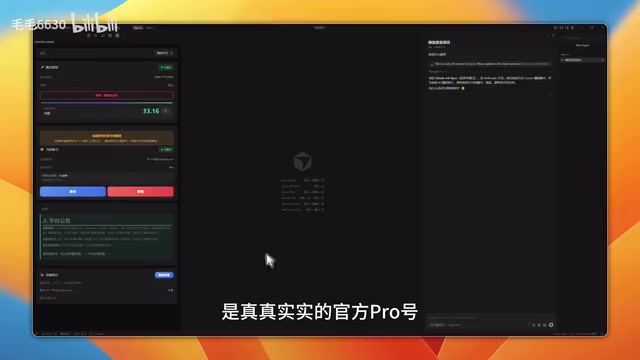
Specifically, the system assigns users a dedicated official Pro ($20/month), Ultra ($60/month), or even Enterprise ($200/month) level account. After each conversation ends, the official system generates a bill, and the system deducts from the user's balance at the current discount (currently 65% off, with a maximum of 75% off).
Fundamental Difference from API Proxies
This scheme repeatedly emphasizes that it is not an API proxy, nor a frontend modification. The plugin only handles two things:
- Account injection: Automatically binds an official Pro account to the user's Cursor client
- Billing management: Records consumption and charges at the discounted rate
This means users are using the complete official Cursor service — all model calls go through Cursor's official channels. Users can freely update Cursor to the latest version without waiting for plugin compatibility patches — this is indeed a clear advantage over schemes that require modifying the Cursor client.
Fee Transparency and Backend Management Features
Fully Transparent Billing Details
One standout selling point of this scheme is consumption transparency. The user dashboard provides detailed data panels:
- Current balance, today's consumption, cumulative charges
- Time, account, model, official cost, and actual charge for each request
- Cumulative savings amount and percentage
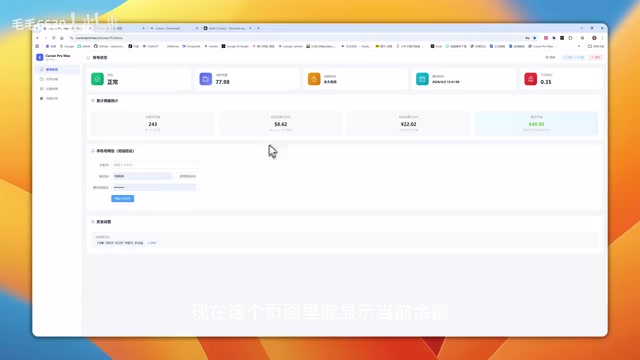
At 65% off, for example, if the official bill shows a conversation cost $1, the user only pays $0.35 — equivalent to saving 65%.
Tiered Discounts and Top-Up System
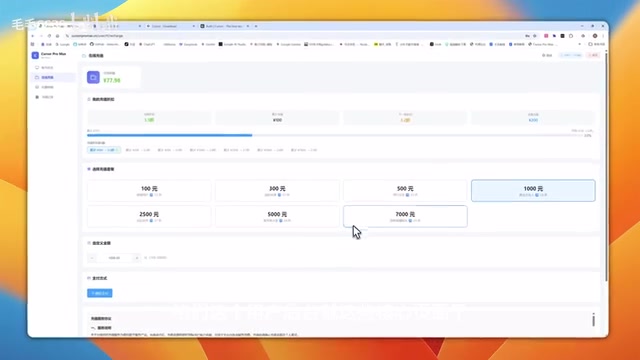
The discount isn't fixed but uses a cumulative top-up tier system:
- Initial discount: 65% off (3.5折)
- Upgradeable after cumulative top-ups reach certain thresholds, e.g., topping up 300 RMB can reduce it to 68% off (3.2折)
- Maximum discount: 75% off (2.5折)
You might not have noticed that top-ups are calculated cumulatively — no large one-time payment is required. Low-intensity users can top up 100 RMB at a time, and the system will automatically upgrade their membership tier.
Available Models and Actual Usage Experience
Full Cursor Model Support
Since official Pro/Ultra/Enterprise accounts are used, theoretically all models provided by Cursor are available, including:
- Claude Sonnet 4 / Claude Opus (Thinking mode)
- GPT-5.4 / Codex 5.3
- Gemini 3.4 / Gemini Pro
This stands in stark contrast to schemes that use Talk models or low-cost models like GPT-4o to impersonate premium models.
Balance Never Expires
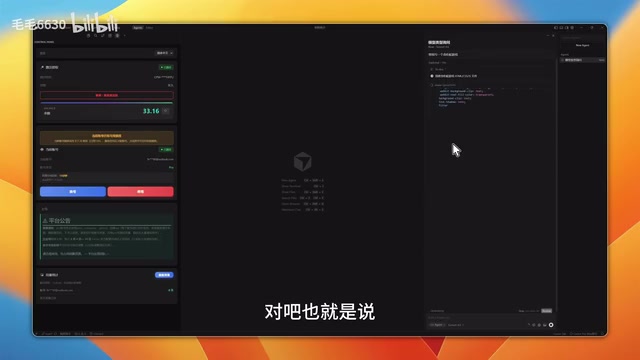
Another differentiating feature is that balances never expire. The pain point of traditional monthly subscriptions is: if you don't use up your quota for the month, or if the account gets banned, the remaining time is wasted. With the pay-per-use model, users' topped-up balances can be used across months or even years — no usage means no charges.
The system also performs intelligent scheduling — if it detects that a user hasn't been active for a day or two, it automatically releases the current account to other users, then assigns a new account when the user starts a conversation again. This "dedicated but not wasteful" mechanism is essentially dynamic scheduling of an account resource pool.
Account Resource Pool Scheduling Principle: Account Pool scheduling applies cloud computing resource pooling concepts to account management scenarios. Its core logic is similar to database connection pooling: maintaining a set of available resources (accounts), allocating them on demand to requestors, and returning them to the pool for others after use. In the Cursor refill scenario, the scheduling system needs to address key issues including account health monitoring (detecting bans), timing of user session binding/unbinding with accounts, and account isolation during multi-user concurrency. This scheme claims users "exclusively own" their account, meaning one account is only assigned to one user at any given time. Compared to crude schemes where multiple people simultaneously share the same account, this does offer improvements in stability and privacy, but it also means the account pool size directly determines the service capacity ceiling.
Risks and Considerations
Issues That Require Rational Assessment
Despite certain advantages in transparency and flexibility, users should still be aware of the following risks:
- Compliance risk: Cursor's Terms of Service explicitly prohibit account sharing, resale, and unauthorized automated access. From a legal perspective, violating ToS constitutes breach of contract, and Cursor has the right to unilaterally terminate account services without refund. From a technical perspective, Cursor continuously strengthens risk control measures, including device fingerprinting, abnormal login behavior detection, and IP reputation scoring. Historically, similar ChatGPT shared account markets have experienced multiple waves of mass bans. Regardless of packaging, account sharing/resale fundamentally violates Cursor's Terms of Service and carries the risk of official bans.
- Data security: The plugin needs to write account information to the Cursor client, and users' code and conversation content theoretically passes through third-party accounts. For developers handling commercial project code, the intellectual property and data security risks of code and conversations flowing through third-party infrastructure cannot be ignored.
- Sustainability: This scheme relies on price differentials from bulk purchasing official accounts. If Cursor strengthens risk controls or adjusts pricing strategies, the model may become unsustainable. With domestic AI programming tools (such as Tongyi Lingma, Doubao MarsCode) rapidly catching up, and Cursor potentially introducing regional pricing strategies, the long-term landscape of this market still faces considerable uncertainty.
- "How long will 100 RMB last" has no standard answer: Consumption speed depends entirely on the models used and project complexity — heavy users may burn through it quickly.
How to Distinguish Real from Fake Cursor Refill Schemes
Based on information from the video, here are several reference dimensions for evaluating refill scheme quality:
- Does it require a specific Cursor version: Schemes that lock you to a version typically modify the client and carry higher risk
- Can it correctly identify the model: Directly ask the AI "what model are you" — confused answers may indicate proxying or impersonation
- Does it provide detailed billing breakdowns: Higher transparency means more credible schemes
- Is it still advertising 7-day trial accounts: Cursor officially discontinued the trial policy — be wary of those still promoting it
Conclusion
This pay-per-use Cursor refill scheme is indeed more flexible and transparent than traditional monthly subscriptions as a business model. For users with irregular usage patterns who don't want to pay for idle time, the pay-per-use logic makes sense. But fundamentally, it remains an account pool-based sharing scheme, and users need to weigh convenience against potential risks.
For developers with limited budgets who need access to Cursor's advanced features, such schemes can serve as a transitional choice. But in the long run, keeping an eye on Cursor's official pricing adjustments and the development of domestic alternatives may be a more prudent strategy.
Key Takeaways
- The scheme assigns official Pro/Ultra/Enterprise accounts through account rotation, billing at 65% off (up to 75% off) actual Token consumption, differentiating from traditional monthly subscription refills
- The plugin only handles account injection and billing management without modifying the Cursor client — users can freely update to the latest version and use all official models
- The user dashboard provides complete consumption details, real-time balance, and a tiered discount system — balances never expire and support cross-month usage
- The system employs dynamic account resource pool scheduling — users get dedicated accounts that are automatically released when idle, reducing resource waste
- Despite higher transparency, account sharing fundamentally violates Cursor's Terms of Service, carrying risks of bans and data security concerns
Related articles
 Product Reviews
Qoder vs Cursor Real-World Comparison: Which $20/Month AI IDE Is Better?
Hands-on comparison of Qoder vs Cursor AI IDEs: Agent autonomy, human interaction count, and architecture decisions. Qoder needed only 2 interactions vs Cursor's 8.
 Product Reviews
Cursor Cloud Agent Demo: Eliminating Bottlenecks Across the Entire Software Development Lifecycle
Deep analysis of Cursor's Cloud Agent demo showing how cloud VMs, automated test artifacts, and a full-chain control plane systematically eliminate human bottlenecks across the software development lifecycle.
 Product Reviews
Cursor 3.0 Deep Dive: Multi-Agent Parallelism, Design Mode, and Best-of-N Model Comparison
Cursor 3.0 evolves from an AI coding assistant into an Agent fleet command center. Explore multi-agent parallelism, Design Mode, and Best-of-N model comparison.