Delete Your CLAUDE.md: Research Shows Agent Config Files Are Hurting AI Coding

Research shows AgentMD config files make AI coding tools perform worse and cost more
A new study found that the CLAUDE.md and AGENTS.md files developers commonly use actually degrade AI coding tool performance: developer-written files improve performance by only 4%, LLM-generated files decrease it by 3%, and costs rise over 20%. Tech YouTuber Theo validated these findings through hands-on testing and proposed a "less is more" philosophy: only add rules when the model repeatedly makes mistakes, and invest your energy in improving code architecture, tests, and type systems rather than perfecting prompt files.
Key Finding: AgentMD Files Make AI Perform Worse
A new study has revealed a shocking truth: the CLAUDE.md and AGENTS.md configuration files that the developer community has treated as gospel are actually making AI coding tools perform worse.
Popular tech YouTuber Theo dove deep into this research in his latest video, combining it with his own hands-on experience to propose a fundamentally different philosophy for AI coding context management. The data shows that across mainstream models like Sonnet 4.5, GPT 5.2, 5.1 Mini, and Qwen 3, using AgentMD or CloudMD files consistently degraded model performance.

The Data: 20% Higher Costs, Worse Results
The study evaluated coding Agent task completion across two complementary scenarios: running standard benchmark tasks on popular repositories using LLM-generated context files, and collecting real issues from repositories containing developer-submitted context files.
Three conditions were tested:
- Developer-written instruction files
- Complete removal of instruction files
- Agent-generated instruction files before task execution
The results were surprising: developer-provided files improved performance by only 4% compared to omitting them entirely, while LLM-generated context files actually decreased performance by 3%. More critically, context files caused Agents to perform more exploration, testing, and reasoning, increasing costs by over 20%.
The study's conclusion is clear: skip LLM-generated context files and keep only the bare minimum of essential information (such as specific toolchain configurations).
Understanding Context Management: Why Extra Information Hurts Models
To understand why AgentMD files backfire, you first need to understand AI's context hierarchy.
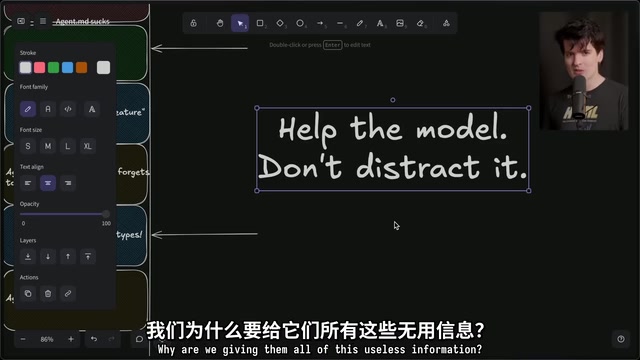
The Context Hierarchy
When you send a message to an AI, the actual context contains multiple layers:
- Provider instructions (highest priority): Safety constraints from the model provider
- System prompt: Defines the Agent's role and behavior
- Developer messages: Where AgentMD/CloudMD file content lives
- User messages: Your actual questions and conversation history
AgentMD file content sits between the system prompt and user messages as the "developer message" layer. This means its content is processed by the model during every single token generation, regardless of whether the current task needs that information.
The "Pink Elephant" Effect
Theo used a brilliant analogy: "Don't think about a pink elephant" — and now you're definitely thinking about a pink elephant. LLMs work the same way. If you tell it in your AgentMD "don't use tRPC," it will actually think about tRPC more. If you mention a certain tech stack exists in the project, even if it's just legacy code, the model will tend to use it.
Real-World Validation: Testing With and Without AgentMD
Theo ran a live comparison test on his own project, Lawn (a video review platform).
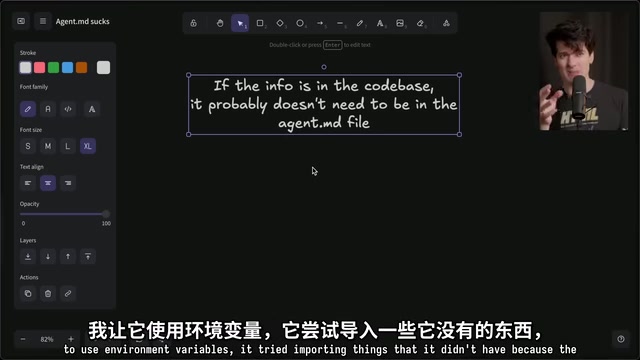
The Test
He first used the /init command to have Claude Code auto-generate a CloudMD file, then asked the same question under both conditions — with and without the file: "What optimizations can be made to this app's video pipeline?"
Results:
- Without AgentMD: Completed in 1 minute 11 seconds; the Agent autonomously explored the codebase to find answers
- With AgentMD: Completed in 1 minute 29 seconds; while it identified filenames faster, total time was longer
This closely aligns with the study's "20% cost increase" conclusion. More importantly, the information in the auto-generated AgentMD file was exactly what the Agent could quickly discover by exploring the codebase on its own — making it redundant work.
The Danger of Stale Information
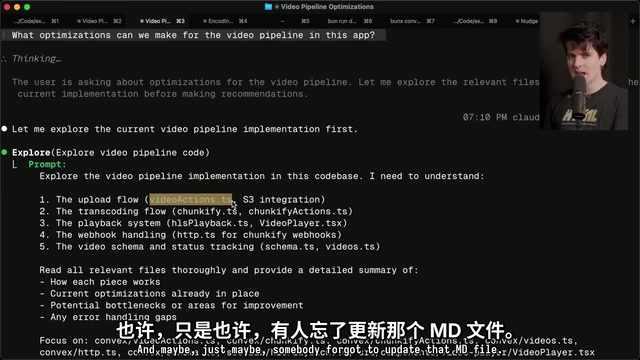
Worse than the time cost is this: AgentMD files go stale. When the codebase structure changes but the file isn't updated, it doesn't just fail to help the Agent — it actively misleads it into placing files in wrong locations and using deprecated patterns. Multiple developers confirmed this in the comments.
Theo's AgentMD Philosophy: Less Is More
Core Principles
- If the information can be found in the codebase, don't put it in AgentMD — models are already excellent at exploring codebases through bash commands and tools
- Only add rules when the model consistently makes the same mistake — AgentMD is a correction tool, not a manual
- Re-evaluate after every model upgrade — newer models often solve problems that plagued older ones
A Clever "Deception" Strategy
Theo shared a unique trick: adding this instruction to AgentMD —
"If you encounter anything surprising in the project, alert the developer and suggest documenting it in the AgentMD file."
His real intent isn't to have the Agent modify the file — it's to leverage the Agent's feedback to discover architectural issues in the codebase. When the Agent expresses confusion, it usually means the code structure needs improvement, not more documentation.
Other practical tips include:
- Telling the Agent "this project has no users, feel free to modify the schema" to prevent it from spending time on data migrations
- When the Agent gets stuck on step 2, directly requesting step 3 and letting it resolve the step 2 blocker on its own
- Reducing MCP servers, cursor rules, and other external context sources to narrow the debugging scope
The Right Investment: Improve Your Code, Not Your Prompts
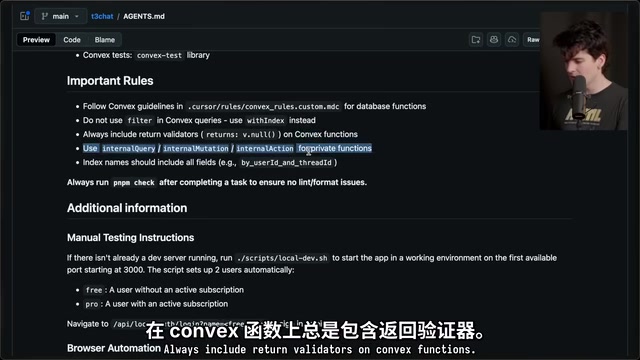
Theo's core advice: instead of spending time perfecting AgentMD files, invest your energy in:
- Better unit and integration tests: Give the Agent clear feedback signals
- Cleaner code architecture: If the Agent can't find things, your file organization has problems
- Better type systems: TypeScript's type checking is itself the best "Agent guide"
- Sensible command configuration: Integrate type checking into existing commands instead of telling the Agent to "remember to check types"
At its core, this is an engineering philosophy of "make the right thing easy to do and the wrong thing hard to do." Good code architecture is the best Agent guide there is, while AgentMD files are at best a temporary band-aid solution.
Conclusion
This research and Theo's practical experience point to the same conclusion: the key to context management isn't giving the model more information — it's giving it more precise information. In the age of AI-assisted programming, codebase readability and architectural clarity matter more than ever — not just for human developers, but for AI Agents to work efficiently.
Related articles
 Expert Opinions
Windsurf CEO Deep Dive Interview: Speed Is the Only Moat
Windsurf CEO Varun Mohan shares insights on AI coding IDE pivots, product methodology, async Agent challenges, and differentiation strategy vs Cursor. Speed is the only moat.
 Expert Opinions
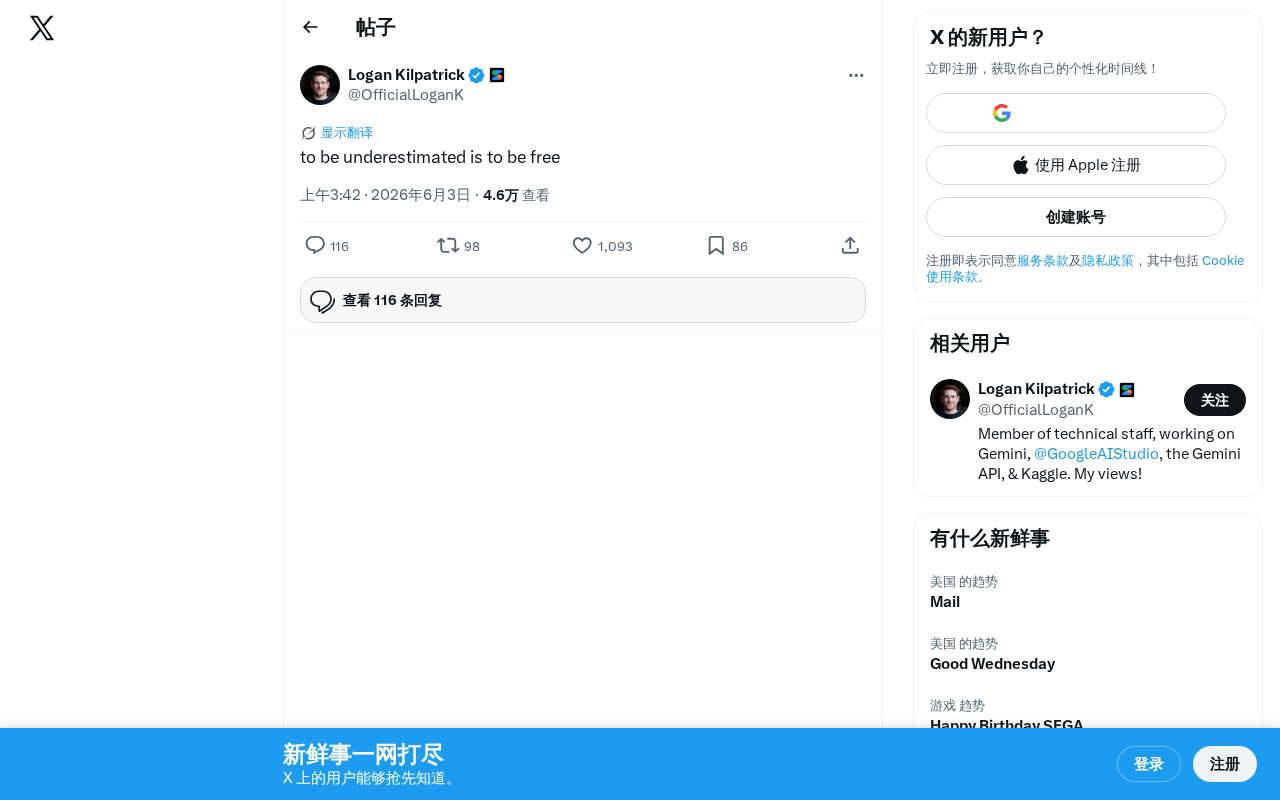
Being Underestimated Is Freedom: A Contrarian Competition Philosophy for the AI Era
Exploring the contrarian strategy of 'being underestimated is freedom' in AI. From OpenAI to DeepSeek to Cursor, why staying under the radar beats standing in the spotlight.
How the Protestant Work Ethic Was Hija…
How the Protestant Work Ethic Was Hijacked: From Protecting Workers to Oppressing Them
Philosopher Elizabeth Anderson reveals how the Protestant work ethic was twisted from a worker-protecting ideal into a tool of oppression—and what it means for the AI era.