DLSS 4.5 Deep Integration with UE5 and Multilingual AI Characters: Major NVIDIA RTX Game Development Update

NVIDIA launches DLSS 4.5 with deep UE5 integration and multilingual AI character interaction for game development.
NVIDIA announced a major RTX technology update featuring DLSS 4.5's deep native integration with Unreal Engine 5, optimizing compatibility with Lumen global illumination and Nanite virtualized geometry to make high-cost rendering features viable on mid-range hardware. Simultaneously, multilingual AI character interaction capabilities support NPC dynamic dialogue generation and real-time multilingual speech synthesis, dramatically reducing localization costs. These updates reflect NVIDIA's hardware+software vertical integration strategy for an AI game development technology stack.
NVIDIA recently announced a major RTX technology update, bringing developers deep DLSS 4.5 integration with Unreal Engine 5 (UE5) and multilingual AI character interaction capabilities. These updates mark AI-driven game development's transition from concept to practical implementation.
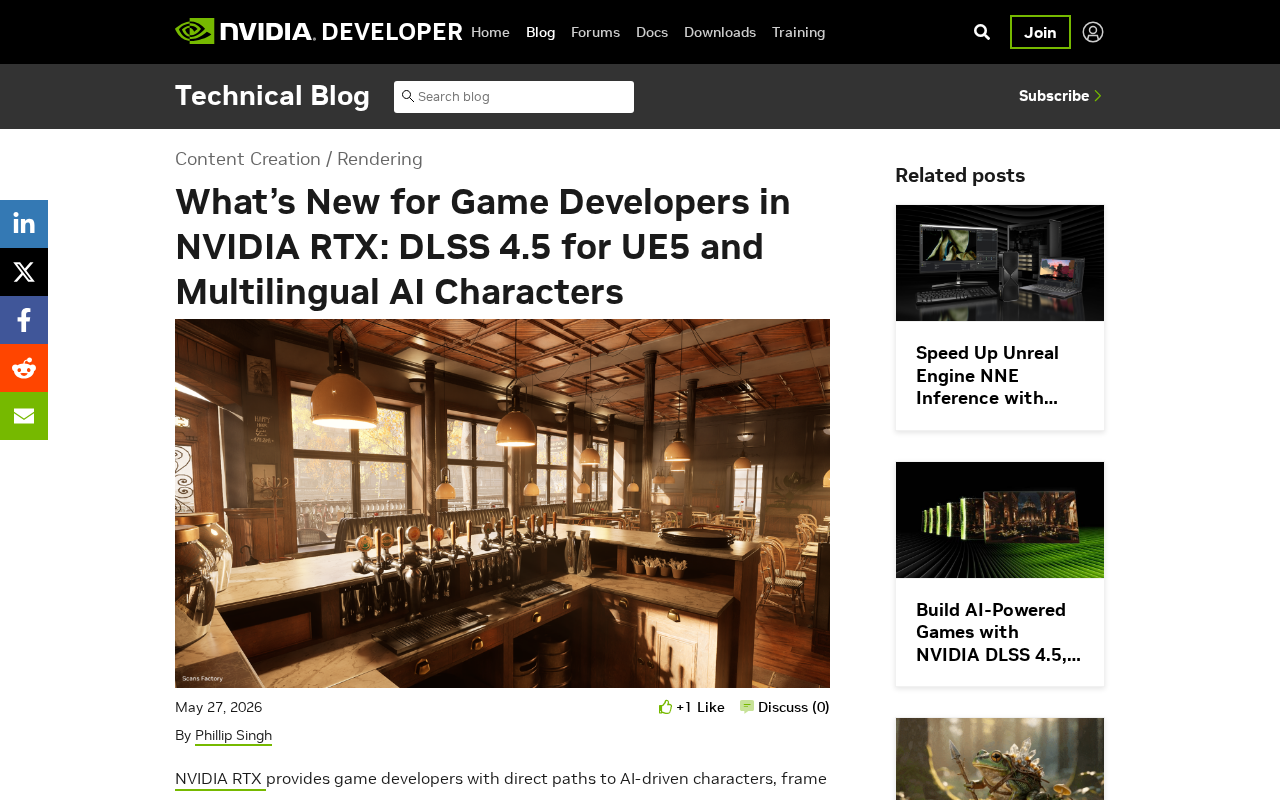
DLSS 4.5 Full UE5 Integration: A Performance Powerhouse for Developers
Frame Generation Technology Reaches a Key Breakthrough
DLSS (Deep Learning Super Sampling) has undergone a fundamental transformation since its debut with the RTX 20 series in 2018, evolving from rule-driven to deep learning-driven approaches. DLSS 1.0 relied on neural networks trained individually for each game, making deployment costly; DLSS 2.0 introduced a universal temporal super-resolution network enabling cross-game reuse; DLSS 3.0 on RTX 40 series introduced frame generation powered by the Optical Flow Accelerator, inserting AI-generated frames between two real rendered frames to extend frame rate improvements to 2-4x. This upgrade to version 4.5 highlights native deep integration with Unreal Engine 5, further optimizing compatibility with UE5's Lumen global illumination and Nanite virtualized geometry systems.
To understand the importance of this integration, consider UE5's rendering architecture. Officially released in 2022, UE5's core technologies Nanite and Lumen fundamentally changed real-time rendering workflows: Nanite is a virtualized micro-polygon geometry system allowing developers to import film-quality assets without manually creating LOD (Level of Detail); Lumen is a fully dynamic global illumination and reflection system that responds to scene and light source changes in real time. Both technologies carry significant computational overhead—even flagship GPUs face frame rate pressure at 4K resolution. This is why DLSS 4.5's deep UE5 integration is not merely a performance optimization tool but a key enabling technology that makes Lumen and Nanite viable on mid-range hardware, directly impacting the target audience reach of UE5 projects.
For game developers, DLSS 4.5's UE5 integration significantly lowers the technical barrier to entry. Previously, integrating DLSS into custom rendering pipelines often required extensive engineering adaptation, but now NVIDIA provides a more direct path, allowing developers to focus on game content creation itself.
Continued Ray-Traced Rendering Performance Improvements
RTX technology's other core pillar—ray-traced rendering—also received further optimization in this update. Ray tracing is a rendering algorithm that simulates the physical propagation paths of light, calculating precise shadows, reflections, refractions, and global illumination by tracing ray paths from the camera as they interact with scene objects. Compared to traditional rasterization, ray tracing naturally handles complex optical phenomena like multiple bounces, soft shadows, and caustics, but its computational complexity grows approximately linearly with scene geometry count. NVIDIA's RTX architecture introduced dedicated RT Core hardware units that offload ray-scene intersection calculations to specialized hardware through BVH (Bounding Volume Hierarchy) acceleration structures, making real-time ray tracing possible.
Combined with DLSS 4.5's super-resolution capabilities, developers can render ray-traced effects at lower native resolutions, then AI-upscale to target resolution, achieving a better balance between visual fidelity and performance. This strategy of "performing expensive ray tracing at lower resolution, then recovering detail via AI super-resolution" has become the industry-recognized approach for balancing performance and quality, and is the core reason the "AI-assisted rendering" paradigm is becoming an industry standard. DLSS technology has been validated in hundreds of games, and version 4.5 further solidifies NVIDIA's leadership in real-time rendering AI acceleration.
Multilingual AI Characters: Redefining Game Interaction
From Fixed Scripts to Dynamic AI Dialogue
Traditional game NPC dialogue systems evolved from simple conditional decision trees to Behavior Trees and Finite State Machines (FSM). Their shared limitation is that all dialogue content must be pre-written by writers and recorded by voice actors, directly linking content volume to development costs. Large Language Models (LLMs) offer a new path for dynamic dialogue generation: NPCs can generate real-time responses based on character settings (System Prompt), current game state, and player input, theoretically enabling infinite dialogue variations.
In this update, NVIDIA RTX provides developers with AI-driven character interaction solutions where NPCs can generate dynamic dialogue based on LLMs with real-time speech synthesis in multiple languages. Deploying LLM inference on local GPUs faces significant latency and VRAM challenges—a 7-billion parameter model on an RTX 4090 has inference latency of approximately 50-200ms, creating pressure on real-time conversation experiences. NVIDIA's ACE (Avatar Cloud Engine) technology stack addresses this through model quantization, inference optimization, and streaming output, making local AI character inference a viable solution. This means a game character can engage in natural conversation with players in Chinese, English, Japanese, and other languages without separately recording voice for each language.
The Profound Impact of Multilingual AI Characters on the Gaming Industry
Game multilingual localization traditionally splits into subtitle localization and full voice localization, with the latter costing 10-20x more than the former. For a mid-scale RPG, full voice localization supporting 5 languages typically costs millions of dollars and requires months of recording and post-production. AI text-to-speech (TTS) technology has made breakthrough progress in recent years: neural network-based TTS systems can now generate near-human-quality speech with emotion control and speaking style transfer. NVIDIA builds on this by integrating real-time voice cloning capabilities, allowing developers to create unique voice profiles for NPCs from minimal reference audio, then apply those profiles to real-time speech synthesis in any language, compressing the marginal cost of multilingual voice acting to near zero.
The maturation of multilingual AI character technology will reshape game development on multiple levels:
- Dramatically reduced localization costs: Traditional full voice localization requires hiring voice actors for each language; AI speech synthesis can significantly compress this expense
- Enhanced player immersion: Dynamically generated dialogue means NPCs are no longer "broken records"—each interaction can produce different responses
- Expanded global market reach: Lower multilingual support costs mean small and mid-sized studios can also release products for global markets
Of course, this technological path also raises ethical discussions about voice actor career protection and voice copyright, with multiple countries and regions currently developing regulatory frameworks. Additionally, AI-generated character dialogue still faces challenges in emotional expression nuance and narrative consistency. Finding the balance between open AI interaction and carefully designed narrative experiences will be an ongoing challenge for developers.
NVIDIA RTX Technology Ecosystem: The Big Picture
NVIDIA's hardware+software vertical integration strategy traces back to the 2006 release of the CUDA (Compute Unified Device Architecture) platform. By transforming GPUs from graphics-specific chips into general-purpose parallel computing platforms, NVIDIA built a complete technology stack spanning hardware (GPU chips), driver layer (CUDA Runtime), middleware (cuDNN, TensorRT), and application frameworks (DLSS SDK, ACE SDK). This vertical integration enables NVIDIA to reserve dedicated compute units (Tensor Core, RT Core) for specific AI workloads at the hardware design stage, then fully leverage their potential through software layers.
This update is a concentrated manifestation of that strategy: systematically embedding AI capabilities into every aspect of game development. From DLSS frame generation and super-resolution at the rendering level, to AI character dialogue at the interaction level, to ray tracing acceleration at the foundational level, RTX is building a complete AI game development technology stack. Competitively, while AMD and Intel offer similar super-resolution technologies (FSR and XeSS), their lack of dedicated hardware acceleration units creates a clear performance gap in compute-intensive features like frame generation—closing this gap requires multiple hardware generation cycles.
What you might not have noticed is that these technologies don't exist in isolation. DLSS performance optimization frees up compute resources for ray tracing and real-time AI character inference, while AI characters' multilingual capabilities depend on efficient GPU inference. This synergy between technologies is the core advantage of NVIDIA's hardware+software vertical integration strategy.
Key Areas Game Developers Should Focus On
For game development teams currently using or planning to use UE5, consider focusing on:
- Evaluate DLSS 4.5 integration early, especially for AAA projects pursuing high visual quality—frame generation can significantly improve player experience while making high-cost features like Lumen and Nanite viable on broader hardware
- Explore practical AI character use cases—no need to rush full replacement of traditional dialogue systems; start with auxiliary NPCs or open-world random events to gradually accumulate LLM inference tuning experience in game scenarios
- Monitor RTX hardware coverage—while RTX GPU market share continues growing, you still need reasonable fallback solutions for non-RTX users; also track AI voice-related copyright and ethical regulations to proactively mitigate compliance risks
As AI technology penetrates deeper into game development, developers who master these tools will gain a competitive edge in next-generation games.
Key Takeaways
- DLSS 4.5 achieves deep native integration with Unreal Engine 5, lowering the barrier for developers to access frame generation and super-resolution technology, making high-cost features like Lumen and Nanite viable on mid-range hardware
- Multilingual AI character technology supports NPC dynamic dialogue generation and multilingual real-time speech synthesis, potentially dramatically reducing game localization costs, while raising ethical discussions about voice actor rights and voice copyright
- NVIDIA is building a complete AI game development technology stack covering rendering, interaction, and inference—dedicated hardware units like Tensor Core and RT Core combined with software frameworks like DLSS and ACE create hard-to-replicate synergies
- AI-driven game characters improve immersion but still face challenges in emotional expression nuance and narrative consistency; latency optimization for local LLM inference remains an engineering challenge
- Developers are advised to explore AI character applications starting with auxiliary scenarios, provide reasonable fallback solutions for non-RTX users, and proactively monitor regulatory frameworks around AI voice
Related articles
 Product Reviews
Qoder vs Cursor Real-World Comparison: Which $20/Month AI IDE Is Better?
Hands-on comparison of Qoder vs Cursor AI IDEs: Agent autonomy, human interaction count, and architecture decisions. Qoder needed only 2 interactions vs Cursor's 8.
 Product Reviews
Cursor Cloud Agent Demo: Eliminating Bottlenecks Across the Entire Software Development Lifecycle
Deep analysis of Cursor's Cloud Agent demo showing how cloud VMs, automated test artifacts, and a full-chain control plane systematically eliminate human bottlenecks across the software development lifecycle.
 Product Reviews
Cursor 3.0 Deep Dive: Multi-Agent Parallelism, Design Mode, and Best-of-N Model Comparison
Cursor 3.0 evolves from an AI coding assistant into an Agent fleet command center. Explore multi-agent parallelism, Design Mode, and Best-of-N model comparison.