Kimi K2.6 In-Depth Review: A Complete Breakdown of Its Coding and Agent Capabilities

Kimi K2.6 open-source model surpasses GPT-5.4 in coding and Agent collaboration, ranking #1 among open-source models.
Moonshot AI released open-source model Kimi K2.6, featuring a 1T-parameter MoE architecture (32B activated) with 256K context. Scoring 58.6% on SWE-Bench Pro to surpass GPT-5.4, it demonstrates 12+ hours of autonomous long-range coding capability. It supports emergent multi-agent collaboration with 300 parallel sub-agents, and its visual development can deliver full-stack projects directly from screenshots. API pricing is just one-third of Claude 3.5 Sonnet, though hallucination control and thinking costs still need improvement.
Article
Moonshot AI has just released and open-sourced Kimi K2.6, a model that demonstrates remarkable capabilities across multiple dimensions including coding, Agent collaboration, and visual development. This article provides a comprehensive deep dive into K2.6 from the perspectives of architecture design, engineering capabilities, intelligent agent collaboration, visual development, and cost-effectiveness—to see whether it can truly go head-to-head with GPT-5.4.
Architecture & Foundational Capabilities: MoE Architecture + 256K Ultra-Long Context
K2.6's underlying architecture employs a Mixture of Experts (MoE) system, with total parameters reaching the 1 trillion level, but only 32B parameters are actually activated during inference.
About the MoE Architecture: Mixture of Experts (MoE) is a sparse-activation neural network design paradigm whose core idea originates from the "mixture of experts" theory proposed by Jacobs et al. in 1991. In modern large language models, MoE uses a "Router" network to dynamically determine which "expert" sub-networks should be activated for each input token, rather than having all parameters participate in every computation. This allows a model to have an extremely large total parameter count while only activating a small fraction during each inference pass, thereby dramatically reducing computational costs while maintaining high performance. K2.6's ratio of 1T total parameters to 32B activated parameters means its sparsity is approximately 97%, which aligns with the design philosophy of Google's Switch Transformer, Mistral's Mixtral series, and DeepSeek-V3.
This means K2.6 can achieve large-model-level performance at relatively low computational cost during inference. Additionally, K2.6 supports a 256K ultra-long context window, providing ample "working memory" for long-range coding and complex task processing.
The core driver behind this performance leap is extreme Post Training optimization.
About Post Training: Post Training refers to a series of refinement techniques applied after a large model completes its base pre-training, aimed at further improving the model's performance on specific dimensions. Key methods include: Supervised Fine-Tuning (SFT), Reinforcement Learning from Human Feedback (RLHF), Direct Preference Optimization (DPO), and the recently emerging reinforcement learning based on Process Reward Models (PRM). K2.6's "adaptive output length" capability is precisely trained during the Post Training phase through carefully designed reward signals—the model learns to "restrain" its redundant output on simple questions while fully expanding its reasoning chain on complex ones. This capability is known in the industry as "Length Calibration."
In everyday use, K2.6 solves the common problem of models "padding their word count"—it adaptively adjusts output length based on question complexity. For example, for a simple software recommendation question, it will deliver a concise answer in about 200 words; but for writing a detailed manual, it can provide in-depth content spanning several pages. This adaptive capability significantly reduces the reader's cognitive load while maintaining accuracy.
Coding & Engineering Capabilities: #1 Open-Source on SWE-Bench Pro
On the SWE-Bench Pro test, which measures real-world software engineering capabilities, K2.6 scored an impressive 58.6%—not only firmly holding the #1 position among open-source models, but even surpassing GPT-5.4's 57.7% and Claude Opus 4.6's 53.4%.
About SWE-Bench Pro: SWE-Bench (Software Engineering Benchmark) is a professional software engineering evaluation benchmark proposed by Princeton University in 2023. Its core design philosophy involves extracting Issues and corresponding fix PRs from real GitHub repositories, requiring models to autonomously locate bugs and generate patches that pass tests—without knowing the answers in advance. Compared to traditional code generation tasks (like HumanEval), SWE-Bench is much closer to real engineering scenarios because it requires models to understand large codebase context, cross-file dependencies, and testing frameworks. SWE-Bench Pro is its upgraded version with increased task difficulty and evaluation rigor, widely regarded in the industry as the gold standard for measuring a model's "real engineering capability" rather than "competitive programming ability."
This marks K2.6's evolution from merely "writing code" to truly "doing engineering."
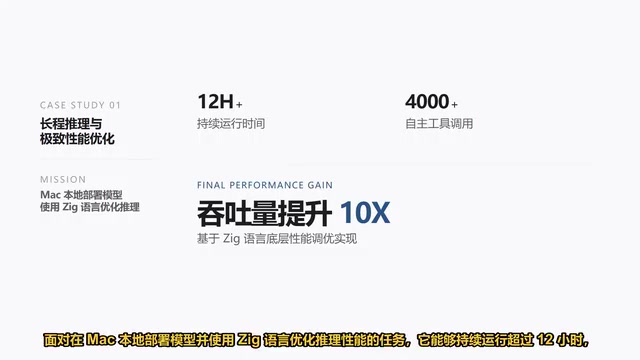
Long-Range Reasoning Test: 12 Hours of Autonomous Execution, 10x Throughput Improvement
In long-range reasoning tests, K2.6 demonstrated exceptional engineering execution. When faced with the complex task of "deploying a model locally on Mac and using Zig to optimize inference performance," it ran continuously for over 12 hours, autonomously completing more than 4,000 tool calls, ultimately improving inference throughput by over 10x.
Financial-Grade Refactoring: 13 Hours to Conquer an 8-Year-Old Matching Engine
When handling financial-grade refactoring tasks, K2.6 demonstrated deep engineering thinking. Facing a complex financial matching engine with 8 years of history, it autonomously executed for 13 hours, precisely identified performance bottlenecks by analyzing system flame graphs, and modified the core thread topology structure, ultimately improving the system's peak throughput by 133%. This capability goes far beyond simple code generation—it represents genuine system-level performance optimization thinking.
Logical Reasoning & Spatial Perception: Human-Level Chain-of-Thought Exploration
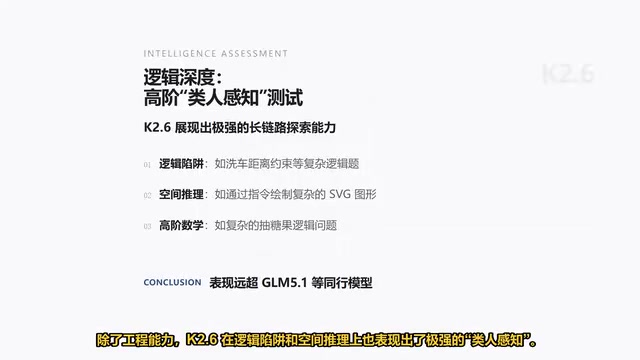
Beyond engineering capabilities, K2.6 also demonstrates extremely strong "human-like perception" in logical traps and spatial reasoning. Whether handling logic problems like car distance constraints, drawing complex SVG graphics through instructions, or solving advanced mathematical logic problems, it consistently shows powerful chain-of-thought exploration capabilities, significantly outperforming models at the same level such as GLM-5.1.
Swarm Intelligence Agent Capabilities: Emergent Collaboration with 300 Parallel Sub-Agents
K2.6's swarm intelligence capabilities represent a qualitative leap—it supports 300 parallel sub-agents collaborating over 4,000 steps, enabling true multi-agent emergence.
About Multi-Agent Emergence: "Emergence" in Multi-Agent Systems (MAS) refers to the phenomenon where multiple relatively simple individuals, through local interactions, produce complex behaviors or strategies at the macro level that no single individual could have pre-planned. In the AI field, this concept was originally used to describe new capabilities that large models suddenly acquire after scaling, such as chain-of-thought reasoning. K2.6's 300 parallel sub-agent architecture draws on the design philosophy of Stanford's "Generative Agents" experiment and the AutoGen framework, but dramatically scales up both the number of agents and steps. "Strategic Emergence"—where agents spontaneously propose compromise solutions during games—is a frontier research topic in current multi-agent research, indicating that the model possesses preliminary game-theoretic reasoning capabilities rather than merely executing preset scripts.
In an experiment called the "AI Yalta Conference," researchers had K2.6 role-play as AI company CEOs including Sam Altman, Yang Zhilin, and Dario Amodei in a debate. The results were stunning: the model exhibited extremely high "linguistic fingerprint fidelity"—for example, Altman's "guru-like mysticism" and Yang Zhilin's "Chinese-English code-switching" were precisely captured.
More importantly, genuine logical games emerged between agents. For instance, the agent representing the AI safety stance, after being criticized by the open-source faction, proactively proposed a "tiered open-source capability" compromise—something completely impossible with preset scripts. This represents true strategic emergence among multiple agents.
Visual Development: Full-Stack Closed Loop from Screenshot to Delivery
K2.6 achieves a complete closed loop from screenshot to delivery in visual development. Simply feed it a high-resolution long screenshot of a website, and it will automatically decompose requirements, write documentation, complete frontend development, and even call drawing tools to fill in missing web assets. Within minutes, it can deliver a complete frontend project with high fidelity.
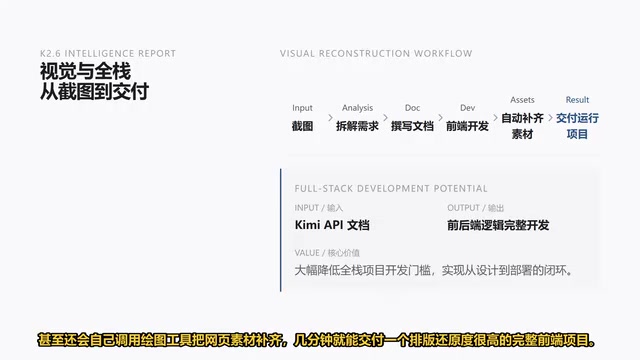
Going further, just feed it the Kimi API documentation and it can handle the backend logic as well, achieving full-stack development from frontend to backend. This dramatically lowers the development barrier for projects and represents a massive efficiency boost for small-to-medium teams and independent developers.
Limitations & Shortcomings: Thinking Cost and Hallucination Issues
Of course, K2.6 has some areas that require attention:
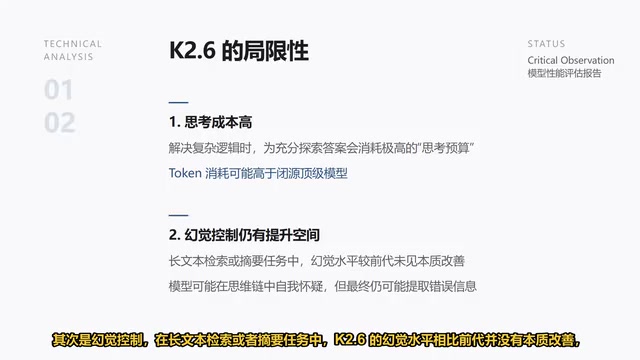
High Thinking Cost: When solving complex long-chain reasoning tasks, K2.6 consumes a relatively high thinking budget to fully explore answers, and token consumption may be higher than lower-end models.
Hallucination Control Still Needs Improvement: In long-turn retrieval or summarization tasks, K2.6's hallucination levels haven't fundamentally improved compared to its predecessors.
About the Hallucination Problem: The "hallucination" problem in large language models refers to the model generating content that appears reasonable but is actually factually incorrect. This phenomenon is rooted in the autoregressive generation mechanism of language models—the model is essentially predicting "the next most likely token" rather than retrieving and verifying facts. In long-turn retrieval or summarization tasks, hallucination is particularly prominent because as context length increases, the model needs to integrate multiple segments of information under "attention dispersion," making it more prone to information confusion or fabrication. Currently, the industry mainly mitigates this through Retrieval-Augmented Generation (RAG), Chain-of-Thought Verification, and factual consistency reward training, but no fundamental solution exists yet. The "self-doubt" phenomenon that K2.6 exhibits in its chain of thought actually reflects a degree of metacognitive ability, but it may still ultimately output incorrect conclusions, indicating that its internal verification mechanism is not yet complete.
The model sometimes "doubts itself" within its chain of thought but may still end up extracting incorrect information. This is a common problem across all current large models, but requires special attention in production environments.
Cost-Effectiveness & Deployment Recommendations
In terms of cost, K2.6 offers outstanding value. Its API pricing is approximately one-third that of Claude 3.5 Sonnet and one-fifth that of Claude Opus—truly offering more bang for your buck.
Here are deployment recommendations for different scenarios:
- Short-to-medium range coding or frontend development: Recommend switching directly to K2.6 for excellent cost-effectiveness
- Ultra-long-range complex tasks: For now, keep Claude Opus-level models as a backup option
- Small-to-medium team deployment: In the short term, the API route will be more cost-effective than local deployment
Conclusion
From K2.0's stunning debut to K2.6's all-around explosion, Moonshot AI has carved out a bloody path in the Agent and Coding tracks. K2.6 is no longer just a "fun toy"—it has become a true "cyber colleague" that can sit beside you, help you fix code, and do engineering work. Especially within the open-source ecosystem, K2.6 achieves engineering capabilities surpassing closed-source top-tier models with the efficiency of 32B activated parameters, which will have a profound impact on the landscape of the entire AI programming field.
Key Takeaways
- K2.6 surpasses GPT-5.4 and Claude Opus 4 with a 58.6% score on SWE-Bench Pro, ranking #1 among open-source models
- Supports 300 parallel sub-agents collaborating over 4,000 steps, achieving emergent multi-agent logical games
- Visual development achieves a closed loop from screenshot to full-stack delivery, dramatically lowering project development barriers
- API pricing is only one-third that of Claude 3.5 Sonnet, offering exceptional cost-effectiveness
- Hallucination control and thinking cost for long-range reasoning remain areas that need attention
Related articles
 Product Reviews
Qoder vs Cursor Real-World Comparison: Which $20/Month AI IDE Is Better?
Hands-on comparison of Qoder vs Cursor AI IDEs: Agent autonomy, human interaction count, and architecture decisions. Qoder needed only 2 interactions vs Cursor's 8.
 Product Reviews
Cursor Cloud Agent Demo: Eliminating Bottlenecks Across the Entire Software Development Lifecycle
Deep analysis of Cursor's Cloud Agent demo showing how cloud VMs, automated test artifacts, and a full-chain control plane systematically eliminate human bottlenecks across the software development lifecycle.
 Product Reviews
Cursor 3.0 Deep Dive: Multi-Agent Parallelism, Design Mode, and Best-of-N Model Comparison
Cursor 3.0 evolves from an AI coding assistant into an Agent fleet command center. Explore multi-agent parallelism, Design Mode, and Best-of-N model comparison.