Kimi K2.6 In-Depth Review: Comprehensive Evaluation of Coding, Multi-Agent, and Frontend Development Capabilities
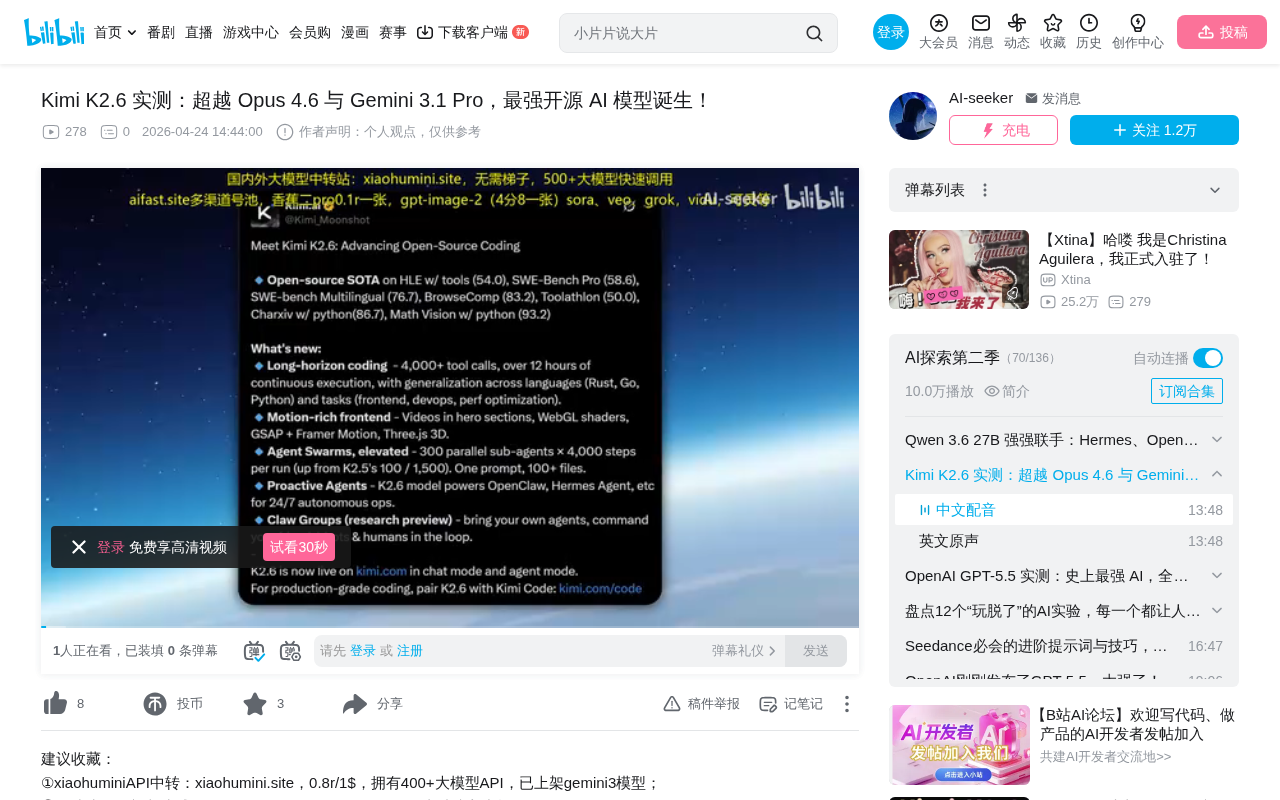
Kimi K2.6 open-source model demonstrates top-tier versatility across coding, multi-agent collaboration, and more.
Moonshot AI's open-source Kimi K2.6 features four modes—Instant, Thinking, Agent, and Agent Cluster—delivering frontend development capabilities (macOS simulation, 3D/SVG generation) that partially surpass Claude Opus 4. Its multi-agent architecture enables parallel processing of long-horizon complex tasks. Priced at just $0.95/million input tokens with a 256K context window, it offers far superior cost-effectiveness compared to closed-source alternatives, with multiple access and open-source deployment options available.
Moonshot AI's latest release, Kimi K2.6, is generating widespread attention. As an open-source model, it not only delivers impressive coding capabilities but also demonstrates remarkable strength across multiple dimensions including long-horizon task execution, multi-agent collaboration, and frontend development. This article provides an in-depth analysis of Kimi K2.6's real-world performance through multiple hands-on testing scenarios.
Kimi K2.6 Is More Than a Coding Model: It's a Versatile AI Engine
Moonshot AI, founded in 2023, is one of the fastest-growing unicorns in China's AI landscape. Its founder, Yang Zhilin, previously contributed to cutting-edge research at Google Brain and Tsinghua University. The Kimi model series initially gained recognition for its ultra-long context processing capabilities, with early versions supporting 2-million-character context input—pioneering breakthroughs in long-text understanding in China. The K2 series marks Moonshot AI's strategic transformation from a "long-text specialist" to a "versatile agent engine," and K2.6 represents the most mature milestone on this trajectory.
What's most impressive about Kimi K2.6 is how far it transcends the "coding model" label. It can execute a wide range of complex tasks—from building quantitative strategies and generating financial models to processing structured data and creating McKinsey-style presentation decks.
A particularly compelling case: someone used Kimi K2.6 to identify 30 retail stores in Los Angeles without official websites from Google Maps, then crafted high-converting landing pages tailored for each business. This demonstrates a complete capability loop from opportunity discovery to end-to-end execution—not simple code generation, but a genuine end-to-end business solution.
It's worth noting that open-sourcing high-performance models is a critical strategic choice in today's AI competitive landscape. Meta's LLaMA series proved that the open-source route can rapidly build developer ecosystems, while later entrants like Mistral and DeepSeek have also established strong community influence through open-sourcing. For Moonshot AI, open-sourcing Kimi K2.6 means model weights are available on Hugging Face, allowing developers to deploy locally, fine-tune, and build upon it. This not only alleviates data privacy concerns for enterprise users but also provides a transparent channel for community validation of model capabilities, helping build trust among global developers.
Four Professional Modes: Covering All Scenarios
Kimi K2.6 comes with four built-in professional modes, each deeply optimized for different scenarios:
- Instant Mode: Prioritizes ultra-fast responses, ideal for simple and quick tasks
- Thinking Mode: Designed for complex deep research, providing more thorough reasoning capabilities
- Agent Mode: Focuses on specialized skills such as research, slides, web pages, documents, and spreadsheet generation, with the ability to invoke various external tools
- Agent Cluster Mode: Multiple agents collaborate in parallel to handle long-horizon complex tasks
This layered design is highly pragmatic. Users can select the appropriate mode based on task complexity, achieving the optimal balance between efficiency and quality.
Frontend Development Capabilities: Kimi K2.6 Delivers Stunning Results
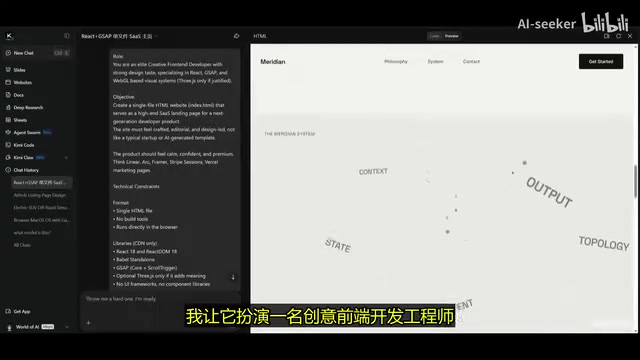
In frontend development testing, Kimi K2.6's performance is nothing short of stunning—in certain scenarios even surpassing Claude Opus 4.
macOS-Style Web Operating System
In the classic macOS web simulation task, Kimi K2.6 generated an extremely polished macOS-style operating system replica. The dock, launchpad—everything was present, with each app icon meticulously generated as SVG. Even more impressive, it faithfully reproduced Safari browser, VSCode (complete with settings menu and dark mode toggle), Terminal, Notes app, PDF reader, and multiple other applications. It even autonomously generated a Minecraft clone where users can freely walk around and break blocks.
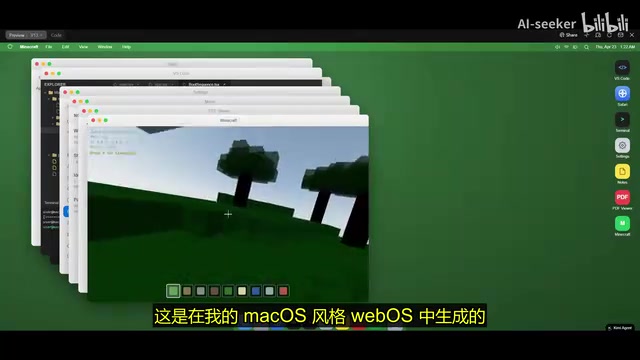
This kind of autonomous creativity that exceeds expectations perfectly demonstrates the model's deep task comprehension capabilities.
3D and SVG Generation Capabilities
SVG (Scalable Vector Graphics) and WebGL/Three.js 3D scene code generation serve as high-difficulty benchmarks for measuring a model's spatial reasoning and code synthesis abilities. SVG is essentially a declarative language using XML to describe geometric shapes, paths, and transformation matrices—generating realistic images requires the model to understand complex concepts like Bézier curves, color gradients, and layering relationships. 3D scenes go even further, requiring the model to master vertex coordinates, normal vectors, lighting models (such as Phong or PBR), and animation interpolation—all core computer graphics knowledge.
In 3D scene testing, Kimi K2.6 generated an electric SUV off-road simulation program that not only covered all components but autonomously added slow-motion mode and multi-angle camera switching. The ability to independently infer and add these features shows the model isn't merely reproducing instructions—it's performing creative functional inference, which is a hallmark of advanced reasoning capabilities. In the 360-degree product showcase component test, it generated a 3D headphone model with auto-rotation and lighting effects—a level most open-source models cannot achieve.
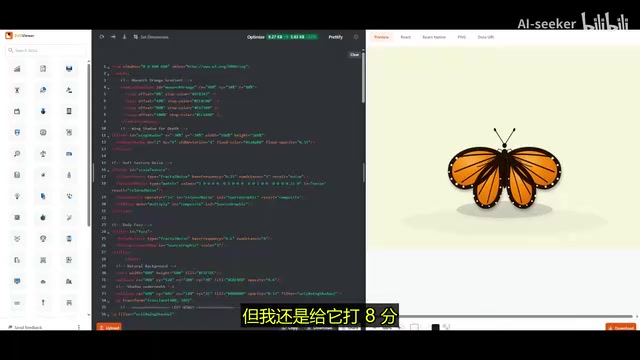
In SVG drawing, Kimi K2.6 performs equally well. Whether it's a realistic butterfly or a landscape painting with flying birds, both demonstrate exceptionally high detail fidelity.
Long-Horizon Tasks and Multi-Agent Collaboration
Kimi K2.6's core differentiating advantage lies in its long-horizon task execution capabilities. This is powered by a Multi-Agent System (MAS) architecture: an "Orchestrator" agent handles task decomposition and scheduling, breaking complex objectives into subtasks and distributing them to multiple "Worker" agents for parallel processing. Each agent can invoke different external tools (such as web search, code execution, file read/write) and report results back to the orchestrator for integration. The core advantage of this architecture is parallelism and specialized division of labor, compressing tasks that would otherwise require hours of sequential execution down to minutes.
The model can drive autonomous agents running continuously for days, handling monitoring, event response, and other real-world tasks while performing cross-platform operations without human intervention. Compared to K2.5, API processing capabilities are stronger, operation is more stable, and task completion rates have improved significantly.
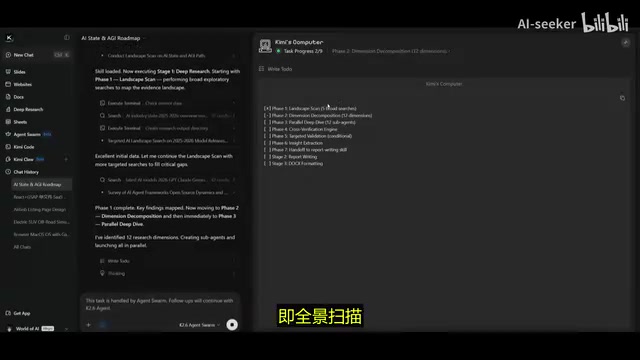
Hands-On Test: Generating an AI Market Analysis Report with Kimi K2.6
In a comprehensive test, Kimi K2.6 was asked to act as a senior AI analyst and generate a market analysis report covering industry status, key players, generative AI trends, real-world application cases, and AGI predictions.
In Agent Cluster mode, the model automatically formulated a plan and dispatched multiple agents to execute tasks in parallel. It even created a dedicated AI research agent, allowing users to track each agent's progress in real time. The final output was a complete report of approximately 20,000 words across five chapters, including an executive summary, cited resources, charts, and diagrams. Work that would take a human several hours was completed in minutes.
Even more noteworthy: someone used Agent Cluster mode to generate a complete Linux system, including user authentication, terminal, text editor, and all functional components—fully demonstrating the power of multi-agent parallel processing.
Kimi K2.6 Pricing and Access Methods
In terms of pricing, Kimi K2.6 demonstrates extremely strong competitiveness:
| Item | Price |
|---|---|
| Input Tokens | $0.95 / million |
| Output Tokens | $4 / million |
| Cache Hit | $0.16 / million |
| Context Window | 256K |
The 256K context window (approximately 200,000 Chinese characters or a medium-length novel) carries significant practical engineering implications. It means the model can "see" an entire medium-sized codebase, a complete legal contract, or multi-turn conversation history in a single pass, without relying on external memory mechanisms like Retrieval-Augmented Generation (RAG). On the pricing dimension, $0.95/million input tokens is far below GPT-4o ($2.5) and Claude Opus 4 ($15), while the cache hit price of $0.16/million offers significant cost advantages for long-horizon agent tasks that repeatedly reference the same context, dramatically improving the economic feasibility of enterprise-scale deployments.
Access methods are also highly flexible: direct use via Kimi.com, API calls, KimiCode or the open-source coding agent KiloCode, routing through OpenRouter, or obtaining model weights on Hugging Face.
Conclusion: Is Kimi K2.6 Worth Your Attention?
The arrival of Kimi K2.6 marks a new phase for open-source models in terms of comprehensive capabilities. It's no longer a breakthrough in just one dimension—it simultaneously achieves top-tier performance across frontend development, long-horizon task execution, multi-agent collaboration, and 3D/SVG generation.
For developers and enterprise users, Kimi K2.6 offers a choice that combines high performance with exceptional cost-effectiveness. Its Agent Cluster mode's multi-task parallel processing capabilities, in particular, open up entirely new possibilities for automating complex business scenarios. In the competition between open-source models and closed-source giants, Kimi K2.6 is undoubtedly a formidable competitor that deserves serious consideration.
Key Takeaways
- Kimi K2.6 features four built-in professional modes (Instant, Thinking, Agent, Agent Cluster), covering all scenarios from quick responses to long-horizon complex tasks
- Frontend development capabilities are stunning, with performance surpassing Claude Opus 4 in some scenarios across macOS simulation, 3D rendering, and SVG drawing tests
- Agent Cluster mode is built on a Multi-Agent System (MAS) architecture, supporting orchestrator-worker collaboration that can run continuously for days handling complex long-horizon tasks without human intervention
- Pricing is extremely competitive at just $0.95/million input tokens, combined with a 256K context window (~200,000 Chinese characters), offering far superior cost-effectiveness compared to equivalent closed-source models
- Multiple access methods are supported, including Kimi.com, API, KiloCode, and Hugging Face open-source weights, forming a comprehensive ecosystem
Related articles
 Product Reviews
Qoder vs Cursor Real-World Comparison: Which $20/Month AI IDE Is Better?
Hands-on comparison of Qoder vs Cursor AI IDEs: Agent autonomy, human interaction count, and architecture decisions. Qoder needed only 2 interactions vs Cursor's 8.
 Product Reviews
Cursor Cloud Agent Demo: Eliminating Bottlenecks Across the Entire Software Development Lifecycle
Deep analysis of Cursor's Cloud Agent demo showing how cloud VMs, automated test artifacts, and a full-chain control plane systematically eliminate human bottlenecks across the software development lifecycle.
 Product Reviews
Cursor 3.0 Deep Dive: Multi-Agent Parallelism, Design Mode, and Best-of-N Model Comparison
Cursor 3.0 evolves from an AI coding assistant into an Agent fleet command center. Explore multi-agent parallelism, Design Mode, and Best-of-N model comparison.