Pair AI Integrates 6 Major Tools to Build an AI Coding Super Editor

Pair AI integrates 6 AI coding tools into one open-source super editor
Pair AI returns from controversy by natively integrating Roo Code/Cline, SuperMaven, Perplexity search, Memo memory system, and Continue into a single VS Code-based editor. Fully open source with a free tier supporting own API keys, paid plans start at $15/month—lower than Cursor's $20—differentiating itself as a "super editor" in the AI IDE competition.
From Controversy to Comeback: Pair AI's Return
Pair AI is not a new face. Five months ago, this AI IDE built as a VS Code fork attracted widespread attention, but subsequently fell into a slump due to controversy. Now, Pair AI is back with a disruptive upgrade—no longer just a simple fork of Continue Dev, but a native integration of 6 major AI coding tools into a single editor, creating a true "Super AI Editor."
Technical Background: VS Code Fork Development Model VS Code (Visual Studio Code) is Microsoft's open-source code editor, with its core architecture built on the Electron framework, allowing developers to create "forks" based on it. This model means developers can inherit VS Code's complete plugin ecosystem, keyboard shortcuts, and user interface while deeply customizing underlying functionality. Cursor, Windsurf, and Pair AI all take this route—essentially injecting an AI capability layer on top of VS Code's open-source codebase. The advantage of this strategy is extremely low user migration cost (virtually zero learning curve) and direct reuse of tens of thousands of existing VS Code plugins. However, the challenge lies in continuously keeping up with Microsoft's upstream updates while maintaining differentiated features, leading to rapid technical debt accumulation.
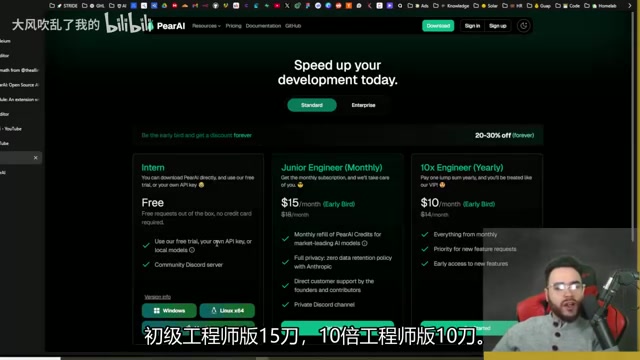
Notably, well-known tech podcast host Charlemagne personally tested it, calling it "a tool for improving engineer productivity." Pair AI is now fully open source, starting at just $15/month, directly competing with Cursor ($20/month) and Windsurf ($10/month).
Core Upgrade: Native Integration of 6 AI Coding Tools
The biggest highlight of this upgrade is that Pair AI is no longer a single-function AI editor, but integrates six best-in-class AI tools from their respective domains into one.
Autonomous Coding Powered by Roo Code / Cline
Pair AI's agent module is powered by Roo Code/Cline, an autonomous coding assistant with full access to the development environment. With user authorization, it can perform closed-loop development operations like feature iteration and bug fixing—functionally similar to Cursor's Composer and Windsurf's Cascade.
Open Source Ecosystem Background: Continue Dev and Roo Code/Cline Continue Dev is a fully open-source AI coding assistant framework that allows developers to freely connect any LLM (Large Language Model), making it one of the most influential projects in the current open-source AI IDE ecosystem. Cline (formerly Claude Dev) is an open-source project focused on "autonomous coding agents" that can invoke terminal commands, read/write files, and perform browser operations to achieve truly closed-loop development. Roo Code is a community fork of Cline, adding more modes and customization capabilities on top of the original. These "Agentic Coding" tools represent the latest paradigm in AI-assisted programming—evolving from "code completion" to "task execution," where AI no longer just suggests code but actively completes entire development task chains.
Intelligent Code Prediction from SuperMaven
Integrating SuperMaven's intelligent code completion and prediction capabilities, it provides real-time code suggestions during the coding process, significantly boosting coding efficiency.
SuperMaven's Technical Principles SuperMaven was founded by a former core engineer of GitHub Copilot. Its core technical breakthrough lies in its proprietary "Babble architecture," supporting ultra-long context window processing of up to 1 million tokens. Traditional code completion tools (like early Copilot) were limited by context windows and could only reference local code in the current file. SuperMaven can incorporate the entire code repository's structure into its prediction scope, making completion suggestions more aligned with the project's overall style and architectural conventions. Its inference speed is also specifically optimized with extremely low latency, approaching real-time response at "the speed of thought." This makes its performance in large engineering projects significantly superior to code completion generated directly by general-purpose LLMs, making it one of the products with the highest technical barriers in the standalone code completion space.
Perplexity AI Search Directly Embedded in the Development Environment
This is an extremely rare feature among other AI IDEs—directly integrating the Perplexity search engine within the development environment. Developers can instantly query the latest documentation, library information, and even answer non-programming questions. Search results have clearly labeled sources, beautiful formatting, and can be converted into chat context or stored as memory modules.
Perplexity AI's Retrieval-Augmented Generation Technology Perplexity AI is currently the most representative "AI search engine," with its underlying RAG (Retrieval-Augmented Generation) technology architecture. Unlike traditional search engines that return link lists, Perplexity crawls web content in real-time, combines it with LLM analysis, and outputs structured answers with cited sources. For developers, this capability is particularly critical—technical documentation, latest version APIs of libraries, and Stack Overflow discussions update frequently, while LLM training data has a knowledge cutoff point. Embedding Perplexity directly into the IDE means developers can access "real-time" technical information without leaving the editor, effectively compensating for the core deficiency of outdated LLM knowledge—a truly rare design among current AI IDE products.
Memo Memory System Makes AI Understand You Better Over Time
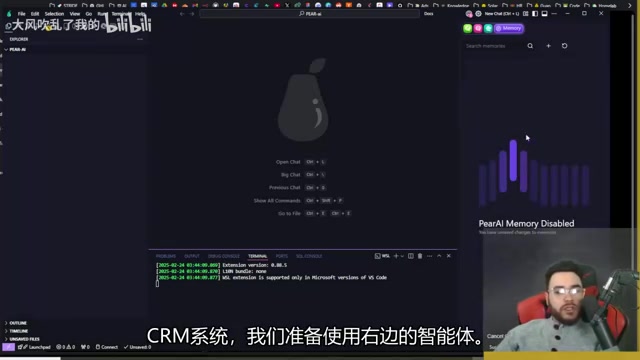
The Memo-powered memory module is a self-optimizing memory layer. When using Pair AI for chat-based coding, the system automatically memorizes coding information and context, and users can also manually add memories. As usage time grows, the knowledge base gradually accumulates, making the AI increasingly understand your project.
Technical Implementation of AI Memory Systems The "AI memory system" represented by Memo is one of the important research directions in current agent studies. Its technical implementation typically consists of two layers: short-term memory relies on the LLM's context window to maintain coherence within a single conversation; long-term memory requires external storage mechanisms, with common solutions including vector databases (such as Chroma, Pinecone) for storing semanticized memory fragments, and structured knowledge graphs. When users interact with AI, the system automatically extracts key information (such as project tech stack, code style preferences, common patterns) and writes it to long-term memory. In subsequent conversations, relevant memories are recalled through semantic retrieval and injected into the context. This mechanism enables AI assistants to accumulate project knowledge across sessions, gradually evolving from a "general assistant" to a "project-specific assistant"—a key technical pathway for overcoming the stateless limitation of LLMs.
Chat and Inline Editing Powered by Continue
The chat functionality is powered by Continue, supporting inline editing, adding selected content to chat context, viewing codebase directory structures, and more. The context menu offers multiple options including files, codebase, diff comparisons, and terminal.
Hands-On Test: Building a CRM System from Scratch
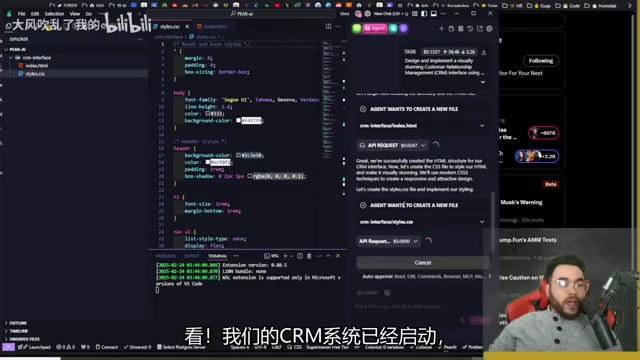
To verify Pair AI's actual performance, we used it to create a modern-style CRM system from scratch using only HTML and CSS.
Agent Workflow and Configuration Options
After entering requirements in the Pair agent, the system offers multiple configuration options:
- Code Mode: Directly generates code
- Architect Mode: Designs architecture first, then implements
- Q&A Mode: Interactive development
- Custom Mode: Flexible prompt configuration
There's also a practical "Prompt Enhancement Button" that automatically optimizes your instructions, lowering the barrier for prompt writing.
CRM System Generation Results
The agent automatically completed multiple steps and successfully created a CRM system containing the following modules:
- Dashboard: Data overview and visualization
- Contact Management: Address book and customer information
- Task List: To-do management
- Data Analytics: Business metrics display
All pages feature dynamic effects, menu navigation works properly, and the overall visual quality is quite impressive.
Supported AI Models and API Configuration
In terms of model selection, Pair AI supports multiple mainstream models:
- Claude Sonnet 3.5
- GPT-4o
- Meta Llama 3.1
- And other open-source models
Users can also switch API providers and enter their own API keys to use third-party services like OpenRouter, offering high flexibility. OpenRouter, as an AI model aggregation platform, allows developers to call dozens of models from different vendors through a unified interface with pay-per-use billing, avoiding the cost of subscribing to multiple platforms.
Pricing Comparison: Pair AI vs Cursor vs Windsurf
| Tool | Monthly Fee | Highlights |
|---|---|---|
| Pair AI (Junior Engineer) | $15 | 6-tool integration |
| Pair AI (10x Engineer) | $10 | Early bird price |
| Cursor | $20 | Composer feature |
| Windsurf | $10 | Cascade feature |
| Pair AI (Free) | $0 | Supports own API keys and local models |
From a pricing perspective, Pair AI's free tier already supports using your own API keys and local models. The paid version, despite integrating 6 major tools, is still priced lower than Cursor—offering genuinely outstanding value for money.
Differentiation Strategy: Opportunities and Challenges of a Super Editor
Pair AI's market strategy is crystal clear: not pursuing perfection in a single function, but achieving native integration of the best tools across domains. This "super editor" approach stands out uniquely in the current AI IDE competition.
From a technical roadmap perspective, Roo Code/Cline, SuperMaven, Perplexity, Memo, and Continue have each been market-validated in their respective niches. Pair AI integrates them into a unified development environment, eliminating the cost of switching between multiple tools. This integration strategy has precedent in the software industry—similar to how JetBrains deeply integrates database tools, version control, and debuggers into its IDE, with the core value being the flow state improvement from "uninterrupted context."
The Perplexity search integration is particularly impressive, solving the pain point of developers frequently switching to browsers to look up documentation while coding. The Memo memory system enables the AI assistant to continuously learn project context, becoming increasingly precise with deeper usage.
Of course, the integration strategy also faces challenges: maintaining update synchronization across modules, handling interaction conflicts between different tools, and long-term technical maintenance costs are all issues requiring ongoing attention. Especially when upstream open-source projects (like Cline, Continue) release major version updates, Pair AI needs to quickly adapt—a continuous test of engineering capability for a small team.
Conclusion: A New AI Coding Option Worth Trying
Pair AI's upgrade is genuinely impressive. Transforming from a controversial VS Code fork into a super editor integrating 6 major AI coding tools, the product vision is clear and execution is solid. For developers pursuing efficiency who don't want to constantly switch between multiple tools, Pair AI is worth a try. The project is fully open source, the free version provides access to core features, and the entry barrier is extremely low.
Key Takeaways
- Pair AI integrates 6 major AI coding tools—Roo Code/Cline, SuperMaven, Perplexity, Memo, and Continue—into a natively unified super editor
- Highly competitive pricing: free tier supports own API keys, paid plans start at $15/month, lower than Cursor's $20/month
- Built-in Perplexity search engine is a unique differentiator, using RAG technology to fetch the latest documentation in real-time, compensating for LLM knowledge cutoff limitations
- Memo memory system achieves cross-session long-term memory through vector databases, enabling the AI assistant to increasingly understand project context over time
- The project is fully open source, built as a VS Code fork, supporting multiple mainstream AI models and third-party API providers
Related articles
 Product Reviews
Qoder vs Cursor Real-World Comparison: Which $20/Month AI IDE Is Better?
Hands-on comparison of Qoder vs Cursor AI IDEs: Agent autonomy, human interaction count, and architecture decisions. Qoder needed only 2 interactions vs Cursor's 8.
 Product Reviews
Cursor Cloud Agent Demo: Eliminating Bottlenecks Across the Entire Software Development Lifecycle
Deep analysis of Cursor's Cloud Agent demo showing how cloud VMs, automated test artifacts, and a full-chain control plane systematically eliminate human bottlenecks across the software development lifecycle.
 Product Reviews
Cursor 3.0 Deep Dive: Multi-Agent Parallelism, Design Mode, and Best-of-N Model Comparison
Cursor 3.0 evolves from an AI coding assistant into an Agent fleet command center. Explore multi-agent parallelism, Design Mode, and Best-of-N model comparison.