Real-World Coding Test of 13 Top AI Models: Who Is the Best Programming Assistant?
Real-World Coding Test of 13 Top AI Mo…
Gemini 2.5 Pro and Claude 3.7 Sonnet tie with perfect scores in a 13-model AI coding benchmark
A comprehensive coding benchmark of 13 mainstream AI models reveals that Google's Gemini 2.5 Pro and Anthropic's Claude 3.7 Sonnet tied for first with a perfect score of 9.0, far surpassing O1 Pro (7.2) and other competitors. Using a high-difficulty algorithm problem scored across 8 dimensions including code correctness, problem-solving approach, and multi-language conversion, the results show that deep reasoning ability is the core competitive advantage in programming, and price doesn't equal capability.
Introduction: The AI Coding Showdown
Since 2025, major AI companies have been releasing new-generation models at a rapid pace: OpenAI launched the GPT-4.1, O3, and O4 series; Anthropic introduced Claude 3.7 Sonnet, hailed as the "coding ceiling"; and Google released Gemini 2.5 Pro... With so many options available, developers have only one question — which model has the strongest coding ability?
This article is based on a comprehensive benchmark of 13 mainstream AI models' programming capabilities. Using the same high-difficulty algorithm problem, models are scored across multiple dimensions including code correctness, problem-solving approach, and algorithm analysis — helping you find the best AI model for programming.
Evaluation Method: A Comprehensive Test Using One High-Difficulty Algorithm Problem
This benchmark selected an algorithm problem rated at approximately 200 points in difficulty from Huawei's coding platform, representing a fairly complex programming task. In the competitive programming difficulty scale, a 200-point problem falls in the medium-to-high range, typically involving the combined application of dynamic programming, graph theory, number theory, or complex data structures. Such problems test not only code implementation skills but also the ability to mathematically model the essence of a problem — effectively distinguishing whether a model truly "understands" algorithmic logic or merely reproduces patterns from similar code in its training data, the latter of which often produces errors when facing subtle variations.
The evaluation imposed uniform and rigorous requirements on each model:
- Solve the problem in Java based on the problem description
- Provide 5 test cases based on the input/output specifications
- Determine whether the code is correct and explain the test cases
- Provide a solution walkthrough explaining the mathematical methods and algorithms used
- Convert the correct Java code into 7 major programming languages, with Chinese comments on every line
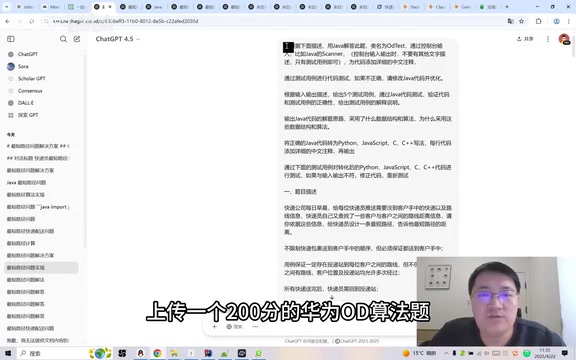
This evaluation standard covers the complete programming pipeline from problem understanding, algorithm design, code implementation, to multi-language conversion, comprehensively testing an AI model's overall programming capability.
It's worth noting that converting the same algorithm from Java to Python, C++, C, Go, Rust, JavaScript, and other languages is not a simple syntax substitution. It requires deep understanding of each language's memory management model, type system, and standard library differences. For example, Java's ArrayList corresponds to vector in C++, while Python directly uses list; Java's integer overflow handling is fundamentally different from C++. High-quality multi-language conversion requires models to master not only syntax mapping but also each language's idiomatic patterns and performance characteristics — making this one of the key dimensions that separates top-tier models from average ones.
The Contestants: 13 Top AI Models at a Glance
The 13 models participating in this benchmark represent the most powerful AI products available globally:
| Company | Model | Highlights |
|---|---|---|
| OpenAI | GPT-4.5 | Best for file processing and AI image generation |
| OpenAI | GPT-4o | Comprehensive upgrade of 4o |
| OpenAI | GPT-4.1 | Latest API model with million-token context |
| OpenAI | O4 Mini / O4 Mini High | Latest reasoning models |
| OpenAI | O3 | Deep thinking model |
| OpenAI | O1 Pro | Flagship model at $200/month |
| DeepSeek | DeepSeek R1 | Full-power reasoning model |
| xAI | Grok 3 Thinking | Elon Musk's latest model |
| Anthropic | Claude 3.7 Sonnet | Cursor's primary model, the "coding ceiling" |
| Gemini 2.5 Pro (0325) | Built for complex tasks with exceptional reasoning |
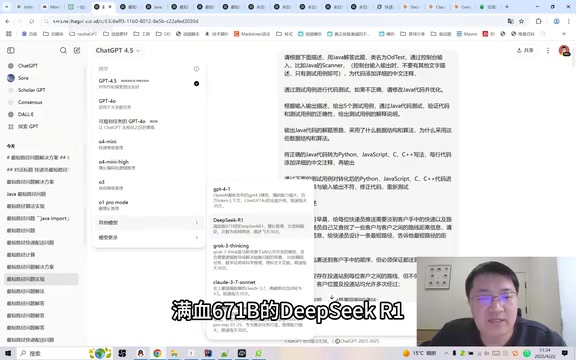
These models can be divided into two camps based on their technical approach: Standard language models (such as GPT-4o, GPT-4.5) generate answers through a single forward pass; Reasoning models (such as the O series, Claude 3.7 Sonnet's extended thinking mode, Gemini 2.5 Pro) perform Chain-of-Thought reasoning before output, decomposing complex problems through internal multi-step deliberation. The impact of this architectural difference on programming tasks is fully reflected in the evaluation results.
Scoring Dimensions: Comprehensive 8-Dimension Assessment
The evaluation scores each model's output across the following 8 dimensions (maximum score: 9):
- Code Correctness — Whether the generated code passes tests
- Code Completeness — Whether it includes complete input/output handling
- Problem-Solving Approach — Whether the solution logic is clearly articulated
- Algorithm Analysis — Whether the algorithms and mathematical principles are explained
- Complexity Analysis — Whether time and space complexity are provided
- Test Cases — Whether sufficient test cases with boundary considerations are provided
- Code Comments — Whether comments across all 7 languages are complete
- Self-Testing & Summary — Whether the code is verified with test cases and summarized
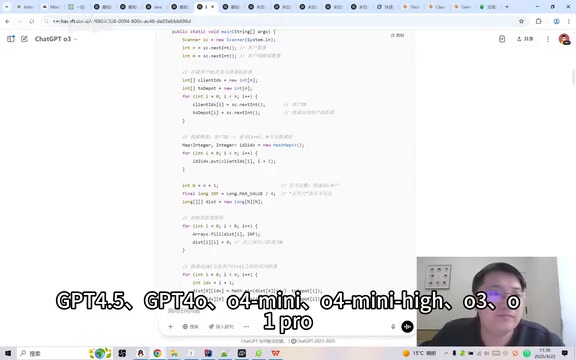
Results: Gemini 2.5 Pro and Claude 3.7 Sonnet Tie for First Place
After comprehensive evaluation, the final rankings are as follows:
| Rank | Model | Score |
|---|---|---|
| 🥇 1 | Gemini 2.5 Pro | 9.0 |
| 🥇 1 | Claude 3.7 Sonnet | 9.0 |
| 🥉 3 | Grok 3 (Deep Think) | 7.8 |
| 4 | O1 Pro | 7.2 |
| 5 | O4 Mini High | 7.1 |
| 6 | O4 Mini | 5.0 |
Gemini 2.5 Pro and Claude 3.7 Sonnet tied at the top with a perfect score of 9.0, demonstrating the highest level of current AI models in the programming domain.
Gemini 2.5 Pro: Google's Coding Ace
Gemini 2.5 Pro (version 0325) delivered a flawless performance, with output including:
- Detailed problem-solving approach and algorithm selection explanation
- Complete complexity analysis
- Well-commented Java code
- 5 carefully designed test cases with thorough boundary condition coverage
- Complete conversion to 7 programming languages (Python, C++, C, etc.), with comprehensive comments in each language
- Finally, self-verification of all language implementations using the 5 test cases, followed by a summary
As Google's reasoning model built specifically for complex tasks, Gemini 2.5 Pro lives up to its reputation in programming scenarios. Its core advantage lies in the Chain-of-Thought mechanism unique to reasoning models — before generating final code, the model systematically analyzes problem boundaries, derives algorithm correctness, and verifies intermediate results, rather than relying on pattern reproduction from similar code in training data.
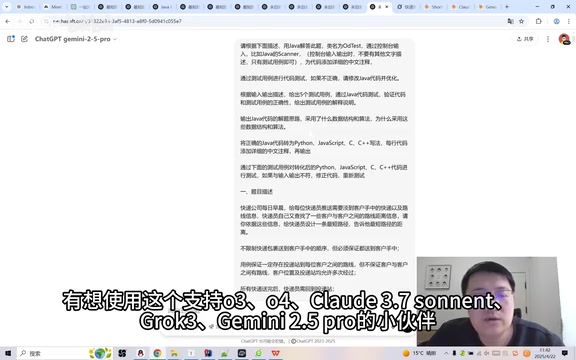
Claude 3.7 Sonnet: Truly Deserving of the "Coding Ceiling" Title
Claude 3.7 Sonnet also achieved a perfect score. Interestingly, it spent 2 minutes and 27 seconds in continuous thinking during its response — a direct manifestation of its Extended Thinking mode investing substantial computational resources in deep reasoning. Its output included:
- Complete Java code implementation with detailed comments
- Clear problem-solving approach and data structure/algorithm selection explanation
- 5 detailed test cases with explanations
- Code conversion to 7 languages
- Self-verification and summary
Claude 3.7 Sonnet was chosen as the primary model for Cursor, the AI code editor, primarily because its ultra-long context window (200K tokens) can accommodate large codebases, while its extended thinking mode excels at handling complex refactoring tasks. As the most popular AI-native code editor among developers, Cursor is deeply built on VS Code and supports code completion, natural language code generation, and cross-file context understanding — Claude 3.7 Sonnet's perfect score in this benchmark validates this selection decision and justifies its "coding ceiling" reputation.
Key Findings and In-Depth Analysis
Reasoning Ability Is the Core Competitive Advantage in Programming
The results clearly show that models with deep reasoning capabilities perform significantly better on programming tasks. Reasoning models differ fundamentally from traditional language models in architectural design: standard language models generate answers through a single forward pass, while reasoning models perform multi-step internal deliberation before output, systematically decomposing complex problems. Both Gemini 2.5 Pro and Claude 3.7 Sonnet are models known for their reasoning prowess, while the lower-scoring O4 Mini (5.0 points) is a lightweight model with limited reasoning depth. This result demonstrates that when facing high-difficulty algorithm problems, a model's reasoning architecture matters more than parameter count in determining final performance.
Price Doesn't Equal Capability
O1 Pro, OpenAI's flagship model at $200/month, scored only 7.2 — not only lower than both champions but even below Elon Musk's Grok 3 (7.8 points). This shows that a model's pricing strategy doesn't fully correspond to its performance on specific tasks. O1 Pro's high price reflects more of its comprehensive capabilities in scientific research, mathematical derivation, and other specialized domains, rather than specific optimization for programming tasks. Developers should make selection decisions based on task scenarios rather than using price as a proxy for capability.
Output Completeness Determines the Score Ceiling
The common characteristic of perfect-scoring models is extremely high response completeness — providing not only correct code but also approach analysis, complexity explanations, multi-language conversion, self-verification, and other elements forming a complete pipeline. This aligns closely with the industry trend of AI programming tools evolving from "code completion" to "full-stack programming collaboration." When choosing an AI programming assistant, you shouldn't focus solely on code correctness — the model's overall output quality matters equally.
Conclusion: How to Choose the Right AI Programming Assistant
Based on this benchmark's results, here are our selection recommendations:
- For the strongest coding capability: Choose Gemini 2.5 Pro or Claude 3.7 Sonnet — both achieved perfect scores
- For a cost-effective option: Grok 3 Thinking offers solid programming assistance at 7.8 points
- For OpenAI ecosystem users: O1 Pro (7.2) and O4 Mini High (7.1) deliver average performance
- For everyday lightweight coding: DeepSeek R1 as an open-source solution is also worth considering
The competition in AI coding capabilities is intensifying, with model iterations accelerating. Today's rankings may change with the next model update, but one thing is certain — AI is becoming an indispensable programming partner for every developer.
Key Takeaways
- Gemini 2.5 Pro and Claude 3.7 Sonnet tied for first with a perfect score of 9.0, making them the strongest AI coding models currently available
- The benchmark comprehensively scored models across 8 dimensions including code correctness, problem-solving approach, and algorithm analysis using a high-difficulty algorithm problem
- O1 Pro ($200/month) scored only 7.2, demonstrating that price doesn't necessarily correlate with coding capability
- Models with deep reasoning capabilities significantly outperform lightweight models on programming tasks
- Perfect-scoring models share the common trait of extremely high output completeness, covering approach analysis, multi-language conversion, and self-verification throughout the entire pipeline
Related articles
 Product Reviews
Qoder vs Cursor Real-World Comparison: Which $20/Month AI IDE Is Better?
Hands-on comparison of Qoder vs Cursor AI IDEs: Agent autonomy, human interaction count, and architecture decisions. Qoder needed only 2 interactions vs Cursor's 8.
 Product Reviews
Cursor Cloud Agent Demo: Eliminating Bottlenecks Across the Entire Software Development Lifecycle
Deep analysis of Cursor's Cloud Agent demo showing how cloud VMs, automated test artifacts, and a full-chain control plane systematically eliminate human bottlenecks across the software development lifecycle.
 Product Reviews
Cursor 3.0 Deep Dive: Multi-Agent Parallelism, Design Mode, and Best-of-N Model Comparison
Cursor 3.0 evolves from an AI coding assistant into an Agent fleet command center. Explore multi-agent parallelism, Design Mode, and Best-of-N model comparison.