Warp 2.0 Deep Dive: An AI Development Environment with Multi-Agent Parallelism
Warp 2.0 Deep Dive: An AI Development …
Warp 2.0 redefines AI programming with multi-agent orchestration, moving from assisted coding to autonomous development.
Warp 2.0 positions itself as an ADE (Agent Development Environment), integrating a terminal editor, AI coding platform, multi-agent parallel orchestration, and team collaboration. Its standout feature is multi-agent parallel development, simultaneously handling authentication, frontend, and database modules. In a hands-on demo, a complete SaaS app with payment integration and data visualization was built using only natural language instructions. Compared to Cursor and Claude Code, Warp offers a more complete full-stack development environment, though code quality controllability, business model sustainability, and ecosystem maturity remain open questions.
From Code Completion to Agent Development Environments
The AI programming landscape is undergoing a profound transformation. Over the past few years, we've evolved from simple code completion tools to AI systems capable of building entire applications and automating complete development workflows. Developers who adopted agent-driven approaches early are gaining a massive competitive advantage.
Against this backdrop, the release of Warp 2.0 has attracted widespread attention. It calls itself an ADE (Agent Development Environment) rather than a traditional IDE. This positioning alone sends a clear signal: the competition in AI programming tools has escalated from "assisted coding" to "autonomous development."
The Paradigm Shift from IDE to ADE: The fundamental difference between an Agent Development Environment (ADE) and a traditional Integrated Development Environment (IDE) lies in the shift of the execution subject. IDEs were born in the 1970s with a design philosophy of "tools serving humans"—editors, debuggers, and compilers were all instruments to amplify human coding capabilities. The core assumption of an ADE is that AI agents can act as independent execution entities, autonomously completing the entire pipeline from requirement understanding to code generation, testing, and deployment. This transition is analogous to the leap from "calculators" to "autonomous driving," where the developer's role evolves from "operator" to "supervisor." Under this paradigm, a developer's core competitive advantage is no longer "typing speed" or "syntax memorization," but system design ability, requirement decomposition skills, and critical review capability over AI outputs.
Warp's Four Core Capabilities
Warp integrates four core functions into a unified development environment, forming its key competitive advantage over traditional IDEs and AI coding tools.
World-Class Terminal Editor
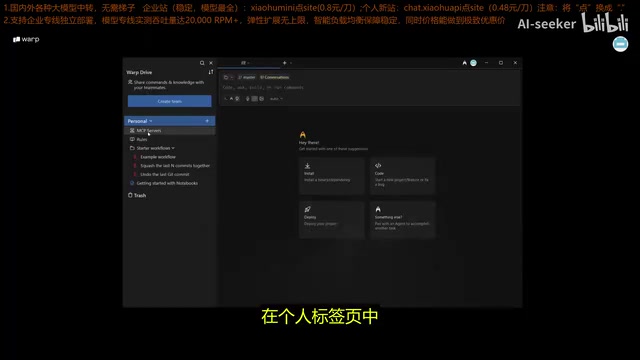
Warp features a powerful built-in input editor with auto-completion, providing CLI capabilities anytime, anywhere. Developers no longer need to constantly switch between terminal and editor—all command-line operations happen within the same interface, significantly reducing context-switching overhead.
AI Coding Platform
As a code generation platform, Warp integrates seamlessly with existing codebases and supports reviewing and approving code diffs before merging. This is crucial—it doesn't blindly generate code but lets developers retain ultimate review authority and decision-making power.
Multi-Agent Orchestration System
This is Warp's most groundbreaking feature. It can run multiple agents in parallel while monitoring their progress in real-time on a unified dashboard. Developers can simultaneously have different agents handle authentication systems, frontend interfaces, database integrations, and other modules, dramatically shortening development cycles.
Technical Principles of Multi-Agent Orchestration: Multi-Agent Orchestration is one of the most cutting-edge architectural patterns in current AI engineering. Its core concept draws from distributed systems design: decomposing complex tasks into mutually independent subtasks, processed in parallel by different specialized agents, then integrating results through a coordination layer. Technically, this typically involves constructing a Task Graph, state-sharing mechanisms between agents, and conflict resolution strategies—for example, how to merge changes when two agents simultaneously modify the same configuration file. Open-source projects like OpenAI's Swarm framework, Microsoft's AutoGen, and LangGraph are all exploring this direction. Warp's innovation lies in encapsulating this complex orchestration logic within a terminal interface familiar to developers, enabling those without deep understanding of underlying AI architecture to benefit from multi-agent collaboration.
Team Collaboration-Driven
Warp provides collaboration features where team members can share prompts, reuse workflows, and collaboratively manage agent sessions. This elevates AI programming from a personal tool to team-level infrastructure.
Hands-On: Building a Production-Grade SaaS Application from Scratch
To validate Warp's real-world capabilities, the video author used it to build a complete e-commerce analytics dashboard—a project that would typically take a team several weeks to complete.
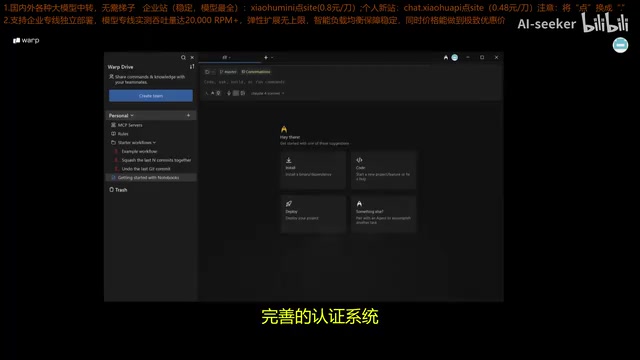
Multi-Agent Parallel Development Workflow
The entire development process fully leveraged Warp's multi-agent orchestration capabilities:
- Agent 1: Responsible for creating the Next.js project foundation with Tailwind, React Query, and Chart.js
- Agent 2: Simultaneously building a complete authentication system using NextAuth and Prisma
- Agent 3: Developing frontend UI components and data visualization interfaces in parallel
Tech Stack Selection Context: The tech stack chosen in the demo exhibits distinct characteristics of modern full-stack development: Next.js provides an integrated solution for server-side rendering and API routes, Tailwind CSS enables rapid styling through atomic CSS classes, React Query handles server-state management and caching, Chart.js provides lightweight data visualization, NextAuth manages OAuth authentication flows, Prisma serves as a type-safe ORM layer, Supabase offers PostgreSQL-based Backend-as-a-Service (BaaS), and Stripe is the industry-standard payment interface. This combination represents the most mainstream production-grade choices in the 2024 JavaScript ecosystem. The fact that AI agents can proficiently handle this stack also reflects the deep coverage of mainstream open-source ecosystems in large model training data—these frameworks have massive amounts of public code examples and documentation, giving models higher accuracy and lower hallucination risk when generating related code.
Developers simply issue instructions in natural language, such as "Can you start building an e-commerce data analytics platform? Make sure the interface is modern and clean," and the agents autonomously execute the tasks.
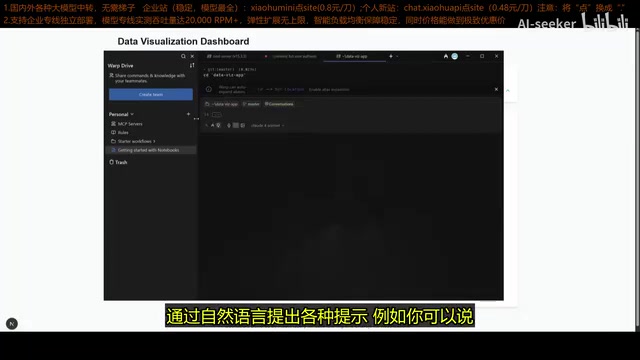
Final Deliverables
The final generated application included multiple production-grade functional modules:
- Complete authentication system: Supporting Google login and account registration
- Database integration: Connected to Supabase, handling all data storage
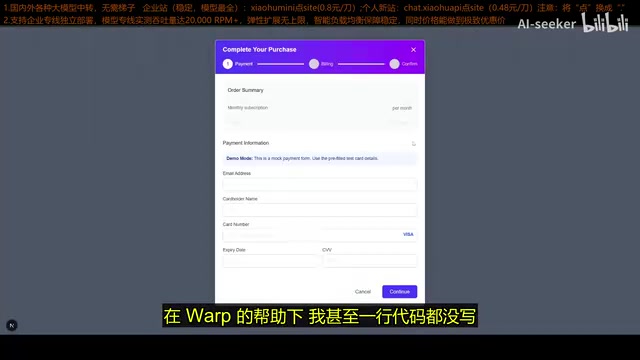
- Stripe payment integration: Order processing and payment gateway fully connected
- Interactive data visualization: Tracking key metrics including total revenue, order volume, customer data, and inventory pricing
- Modern UI: Landing page with animations and an analytics dashboard
Interestingly, the author claimed that throughout the entire process, not a single line of code was written manually—all work was completed through natural language instructions and autonomous agent execution.
Warp vs Cursor vs Claude Code: How Do They Differ?
These three mainstream AI programming tools represent three different technical approaches, each with distinct strengths.
Cursor: AI-Enhanced Code Editor
Cursor excels at chat-based code editing, but fundamentally developers are still manually writing most of the code, running terminal commands themselves, and managing the development workflow. It's more like a "super-intelligent editor," suited for developers who prefer traditional coding but want AI assistance.
Claude Code: CLI-Driven Coding Assistant
Claude Code provides powerful coding capabilities through the command line but lacks agent orchestration or multi-agent parallelism. It's an excellent point tool but not a complete development environment.
Warp: Full-Stack Agent Development Environment
Warp's differentiation lies in three areas:
- Multi-agent orchestration spanning the full development stack—not a single agent, but multiple agents collaborating in parallel
- Unified environment—CLI, code editing, and agent management all in one place
- Production-grade automation—not just prototyping, but a complete workflow oriented toward real deployment
A Sober Assessment: Several Issues Worth Noting
Despite Warp 2.0's impressive capabilities, several questions deserve deeper consideration before actual adoption.
Code Quality and Maintainability: AI-generated code looks perfect in demos, but in real production environments, code maintainability, security, and performance optimization still require human review. "Not writing a single line of code" sounds enticing, but for mission-critical business systems, the risks of this approach cannot be ignored.
Systemic Risks of AI Code Quality: The quality issues with AI-generated code go beyond "occasional mistakes"—they involve several systemic risk dimensions: First, security vulnerabilities—research shows that LLM-generated code has significantly higher error rates in SQL injection prevention, XSS protection, and hardcoded secrets compared to experienced human developers. Second, technical debt—AI tends to generate code that "works" but lacks proper abstraction design, potentially making long-term maintenance costs far exceed the time initially saved. Third, hallucinated dependencies—AI may reference non-existent library versions or deprecated APIs, creating hidden risks in dependency management. A 2023 Stanford University study found that developers using AI coding assistants actually showed a declining trend in security awareness, as they tended to over-trust AI outputs. This makes Warp's emphasis on "pre-merge review" not an optional feature but a mandatory one—especially on critical paths involving user data, payment flows, and access control.
Sustainability of the Free Model: Warp is currently in public beta, offering free usage. But as user scale grows and model invocation costs accumulate, its business model and pricing strategy will directly impact developers' long-term choices.
Evolution of AI Programming Tool Business Models: The business models of AI programming tools are undergoing a deep shift from "subscription-based software" toward "compute consumption billing." Cursor uses a fixed $20/month subscription but caps requests for heavy users; GitHub Copilot also uses subscriptions but charges per seat for enterprise editions. Warp's current free strategy is backed by its $120 million in completed funding, but as costs of multi-agent parallel model invocations surge dramatically (each complex task may consume several dollars in API costs), long-term pricing pressure is significant. Industry observers predict that AI programming tools may ultimately move toward a hybrid model of "free basic features + usage-based billing for advanced agent capabilities," similar to cloud computing's evolution from annual packages to pay-as-you-go. For teams heavily reliant on multi-agent parallel capabilities, future usage costs may far exceed current expectations.
Learning Curve and Ecosystem Maturity: As an entirely new development paradigm, ADE requires developers to readapt their workflows. Compared to mature ecosystems like VS Code, Warp's plugin ecosystem and community support still need time to develop.
Conclusion
Warp 2.0 represents an important direction in the evolution of AI programming tools: from assisted coding to agent-driven autonomous development. The multi-agent parallel orchestration capability is genuinely impressive, pushing development efficiency gains from "writing code faster" to a new level of "advancing multiple tasks simultaneously."
For teams and individual developers looking to boost development efficiency, Warp is worth trying. On the other hand, calling it a "Cursor killer" may be premature—different tools suit different scenarios, and the competitive landscape in AI programming is far from settled. The real winners are developers who skillfully leverage these tools while maintaining critical review capability over AI outputs.
Key Takeaways
- Warp 2.0 positions itself as an ADE (Agent Development Environment), integrating four core functions: terminal editor, AI coding platform, multi-agent orchestration, and team collaboration
- Multi-agent parallel orchestration is Warp's biggest differentiator, capable of simultaneously running multiple agents to handle authentication, frontend, database, and other modules
- The hands-on demo built a complete e-commerce analytics dashboard with authentication, Stripe payment integration, and data visualization using purely natural language instructions
- Compared to Cursor's editor enhancement and Claude Code's CLI coding, Warp provides a unified agent development environment spanning the full stack
- Currently in free public beta, but code quality controllability, business model sustainability, and ecosystem maturity still require observation
Related articles
 Product Reviews
Qoder vs Cursor Real-World Comparison: Which $20/Month AI IDE Is Better?
Hands-on comparison of Qoder vs Cursor AI IDEs: Agent autonomy, human interaction count, and architecture decisions. Qoder needed only 2 interactions vs Cursor's 8.
 Product Reviews
Cursor Cloud Agent Demo: Eliminating Bottlenecks Across the Entire Software Development Lifecycle
Deep analysis of Cursor's Cloud Agent demo showing how cloud VMs, automated test artifacts, and a full-chain control plane systematically eliminate human bottlenecks across the software development lifecycle.
 Product Reviews
Cursor 3.0 Deep Dive: Multi-Agent Parallelism, Design Mode, and Best-of-N Model Comparison
Cursor 3.0 evolves from an AI coding assistant into an Agent fleet command center. Explore multi-agent parallelism, Design Mode, and Best-of-N model comparison.