6 Developer Tools Roundup: AI Coding Cost Tracking, Agent Virtual File Systems, and More

This week's tech roundup covers six developer tools spanning AI coding cost management, Agent file systems, and SSH tunnels.
This roundup introduces six developer tools: CodeBurn tracks AI coding token consumption and spending for cost transparency; Mirage provides AI Agents with a unified virtual file system, reusing file system interfaces instead of new protocols; Boring centrally manages SSH tunnels via TOML files; PeerTrace offers a high-performance file tree rendering component; DataTab leverages OpenType ligature substitution to achieve data visualization through fonts; and Flu is a four-layer TypeScript Agent framework. The overall trend points toward AI cost management becoming essential and Agent integration methods continuing to evolve.
Overview
This week's tech roundup focuses on the developer tool ecosystem, covering six areas: AI coding cost management, Agent file system abstraction, SSH tunnel management, file tree rendering, font-level data visualization, and Agent frameworks. These tools reflect the core concerns of the current developer community: cost transparency for AI tools, elegant integration between Agents and the external world, and continuous optimization of the developer experience.
CodeBurn: Making AI Coding Costs No Longer a Black Box
CodeBurn is an open-source terminal dashboard specifically designed to track token consumption and spending from AI coding tools. It supports over 18 tools, including mainstream AI coding assistants like Claude Code and Cursor.
Token Economics Background
Tokens are the basic billing unit for large language models. One token corresponds to roughly 3/4 of an English word or one Chinese character. Take Claude Code as an example: a single complex code refactoring conversation can consume tens of thousands of tokens, translating to several dollars at current API pricing. When development teams conduct dozens or even hundreds of AI-assisted coding sessions daily, monthly token spending can easily exceed four figures — making cost observability critically important.
Core Capabilities
- Multi-dimensional breakdown: Split spending by model, project, and provider, clearly showing where every cent goes
- Efficiency metrics: Provides key metrics like first-attempt success rate, throughput tracking, and cache hit rates
- Optimization suggestions: Built-in Optimize command scans for waste patterns and grades projects from A to F
- Data export: Supports CSV and JSON report exports; macOS users can view real-time spending in the menu bar
As AI coding tools become widespread, token costs are becoming a new expense category for development teams. CodeBurn addresses exactly this "token spending black box anxiety" — making it transparent and controllable where money goes, whether it's worth it, and what's being wasted. In the future, tools like this will likely evolve into something similar to FinOps in the cloud cost management space, specifically optimizing Agent operational costs. FinOps (Financial Operations) is a cost management methodology that emerged in cloud computing, emphasizing collaboration between engineering, finance, and business teams to control cloud spending through three pillars: observability, optimization, and governance. CodeBurn brings this philosophy to AI coding, essentially acknowledging that token consumption has evolved from experimental spending into production costs requiring systematic management.
Mirage: Giving AI Agents a Unified Virtual File System
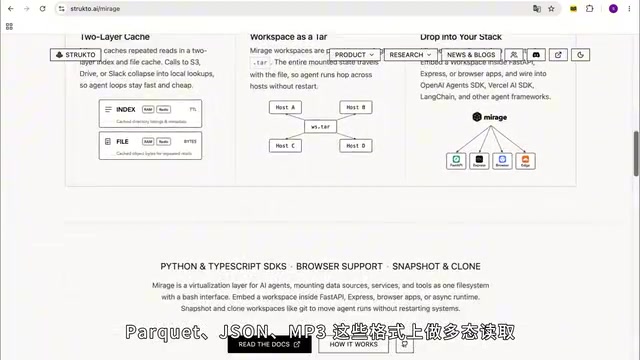
Mirage is a virtual file system that provides AI Agents with a unified file system interface. It mounts heterogeneous backends like S3, Google Drive, GitHub, SQLite, Postgres, and Redis under a single root directory, allowing Agents to operate across services using familiar cat and grep pipelines.
Technical Origins of Virtual File Systems
A Virtual File System (VFS) is an abstraction layer in the operating system kernel that provides upper-layer applications with a unified file operation interface, shielding differences in underlying storage media. Linux's FUSE (Filesystem in Userspace) framework allows developers to implement file systems in user space without modifying kernel code. The Plan 9 operating system proposed the radical philosophy of "everything is a file" as early as the 1990s, abstracting networks, devices, and even processes as file system operations — Mirage can be seen as a revival of this philosophy in the Agent era.
Design Philosophy
- Polymorphic reads: Supports unified reading across CSV, Parquet, JSON, MP3, and other formats
- Version management: Workspaces can snapshot, clone, and rollback like Git, and be packaged as TAR for cross-host migration
- Zero learning curve: Since LLMs are already familiar with Bash, just disguise everything as files
After the MCP protocol, the community has been exploring more elegant ways for Agents to interface with the external world. MCP (Model Context Protocol) is an open protocol released by Anthropic in late 2024, aimed at standardizing connections between AI models and external data sources and tools. It adopts a client-server architecture and defines three core primitives: Resources, Tools, and Prompts. The core problem it solves is the M×N integration dilemma — M AI applications need to connect to N external services, which traditionally requires M×N adapters, while MCP simplifies this to M+N.
Mirage takes a different path: rather than defining a new protocol, it reuses the file system — a universal interface with decades of history. The approach is clever: it eliminates the cost of Agents learning various tool APIs by directly reusing the file system, the oldest abstraction available. The advantage is strong generalization and reusability for Agents; the disadvantage is potential performance issues and semantic complexity — not all operations are well-suited for file system expression.
Boring: The Ultimate Command-Line SSH Tunnel Management Solution
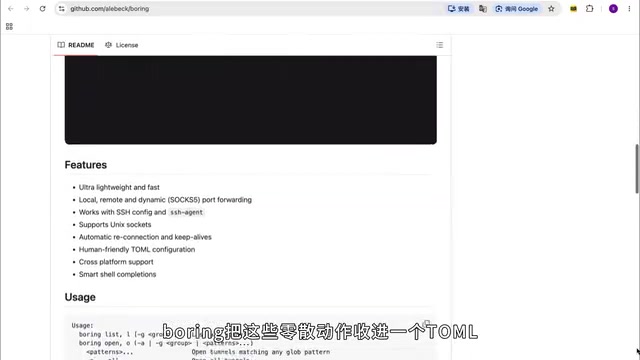
Boring is a command-line SSH tunnel manager that uses TOML files to centrally manage local port forwarding, remote forwarding, and SOCKS dynamic proxies.
SSH Tunnels and Port Forwarding Principles
SSH tunnels are encrypted channels established through the SSH protocol that forward local port traffic to remote servers, or conversely map remote ports to the local machine. Local forwarding (-L) is commonly used for secure access to intranet databases, remote forwarding (-R) exposes local services to the internet, and dynamic forwarding (-D) creates a SOCKS proxy for global traffic forwarding. In microservice architectures and cloud-native environments, developers often need to maintain multiple tunnels simultaneously to access services across different environments, with manual management complexity growing linearly with the number of tunnels.
Pain Points Solved
Traditional approaches either involve typing long ssh -L parameter strings in the shell or cobbling together daemons with AutoSSH plus SystemD. AutoSSH is a tool that monitors SSH connections and automatically reconnects, but it requires pairing with process managers like SystemD for production-grade reliability, resulting in scattered configuration and difficult debugging. Boring consolidates these scattered actions into a single TOML configuration file, providing:
- Direct reading of SSH config, compatible with SSH Agent
- Support for forwarding Unix sockets
- Built-in keepalive and automatic reconnection on disconnection
- Group batch start/stop
- Bash/ZSH/Fish tab completion
TOML (Tom's Obvious Minimal Language) is a semantically clear configuration file format that avoids indentation-sensitivity errors compared to YAML, supports comments unlike JSON, and is particularly suitable for human writing and maintenance. For developers who maintain multiple tunnels long-term, Boring is a practical efficiency tool that reduces ops-level tunnel management to the complexity of a single configuration file.
PeerTrace: An Out-of-the-Box High-Performance File Tree Rendering Library
PeerTrace is a file tree rendering library open-sourced by the PeerComputer team, aimed at providing web applications with an out-of-the-box, high-performance file tree component.
Feature Highlights
- Git status coloring for intuitive display of file changes
- Hundreds of built-in file icons
- Configurable layout with a thorough CSS variable override system
With AI generating massive amounts of code today, there are increasingly more Code Review and Web IDE projects. An out-of-the-box file tree component saves considerably more effort than assembling one yourself with React or Arborist. The team's previously released DeepUI library follows a similar design philosophy — do one thing, but do it to perfection.
DataTab: Data Visualization Through Fonts
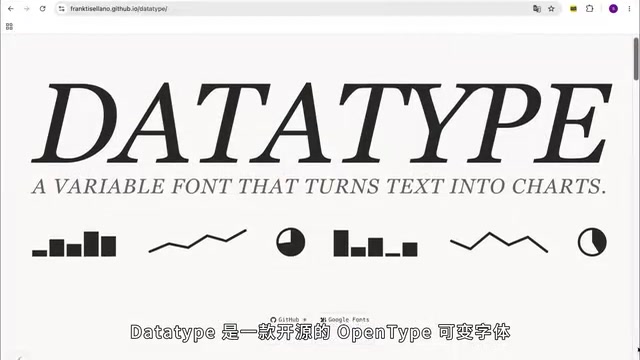
DataTab is an open-source OpenType variable font that renders plain text expressions directly into charts. Writing specific syntax in documents renders bar charts, line charts, and pie charts — no JavaScript, no images, no dependency on any rendering library. It's all accomplished through the font's ligature substitution mechanism.
OpenType Variable Fonts and Ligature Substitution Mechanism
OpenType Variable Fonts are a font technology jointly introduced in 2016 by Apple, Google, Microsoft, and Adobe. They allow a single font file to contain multiple design axes (such as weight, width, and slant), generating infinite style variations through continuous interpolation. Ligature Substitution is a feature in OpenType's GSUB table, originally used to replace specific character sequences with a single glyph — for example, replacing "fi" with a connected form, or in programming fonts replacing ">=" with "≥". DataTab cleverly exploits this mechanism by recognizing text sequences like [bar:50,30,80] as trigger conditions and replacing them with pre-designed chart glyphs. The elegance of this approach is that it's completed entirely at the font rendering layer, requiring no runtime code, and therefore works in any environment that supports OpenType.
Engineering Ingenuity
The font itself has two variable axes — width and weight — that can adjust chart density and thickness. This is a highly imaginative engineering concept, compressing data visualization into a single WOFF2 file.
Suitable scenarios: Emails, PDFs, terminals, static reports, and other environments where JavaScript can't run.
Limitations: No interactivity, data range is limited to 0-100, with a maximum of 20 data points. Think of it as the ultimate expression of a technical concept, rather than a general-purpose solution.
Flu: A New Attempt at a TypeScript Agent Framework
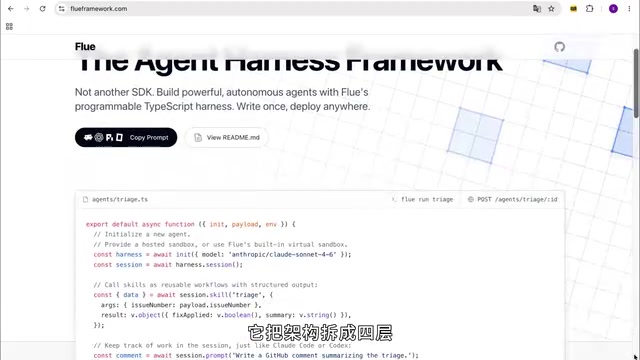
Flu is a TypeScript Agent Harness framework launched by the Astra team, featuring a four-layer architecture design.
Background on Agent Framework Architecture Evolution
Current mainstream Agent frameworks roughly fall into three schools: orchestration frameworks represented by LangChain/LangGraph, which emphasize defining Agent workflows through graph structures; multi-Agent collaboration frameworks represented by AutoGen, which focus on message passing and role division between Agents; and Harness-type frameworks like Flu, which focus on providing a complete runtime environment for individual Agents. The term "Harness" comes from the Test Harness concept in testing, referring to infrastructure that provides inputs, captures outputs, and manages the execution environment for the system under test. Flu's four-layer architecture design cleanly separates concerns, with the sandbox layer reflecting the growing emphasis on Agent security — preventing Agents from executing dangerous system commands or accessing unauthorized network resources.
Four-Layer Architecture
- Model layer: Manages Tokens, Prompts, and Tools
- Tool layer: Manages Skills, Memory, and Sessions
- Sandbox layer: Manages Bash, networking, and permissions
- File system layer: Provides infrastructure like Read, Grep, and Glob
It supports deployment to Node.js, Cloudflare Workers, and various other environments. The project's API design shows some innovation, but it still leans toward the programming paradigm. In today's model-driven landscape, this framework may be better suited for scenarios where models (rather than human developers) write business logic — overall an interesting attempt, but its applicable scenarios still need exploration.
Summary
This week's six tools reveal several clear trends: cost management for AI coding tools is becoming a hard requirement; the ways Agents interface with external systems continue to evolve; and the developer tool philosophy of "do one thing and do it perfectly" remains effective. Notably, creative projects like DataTab remind us that sometimes the most elegant solutions come from reimagining underlying technologies.
Related articles
 Product Reviews
Qoder vs Cursor Real-World Comparison: Which $20/Month AI IDE Is Better?
Hands-on comparison of Qoder vs Cursor AI IDEs: Agent autonomy, human interaction count, and architecture decisions. Qoder needed only 2 interactions vs Cursor's 8.
 Product Reviews
Cursor Cloud Agent Demo: Eliminating Bottlenecks Across the Entire Software Development Lifecycle
Deep analysis of Cursor's Cloud Agent demo showing how cloud VMs, automated test artifacts, and a full-chain control plane systematically eliminate human bottlenecks across the software development lifecycle.
 Product Reviews
Cursor 3.0 Deep Dive: Multi-Agent Parallelism, Design Mode, and Best-of-N Model Comparison
Cursor 3.0 evolves from an AI coding assistant into an Agent fleet command center. Explore multi-agent parallelism, Design Mode, and Best-of-N model comparison.