89K Stars: Deep Dive into the Open-Source Tool That Lets AI Agents Take Over Your Browser

An 89K-star open-source project lets AI agents take over browsers for autonomous web automation.
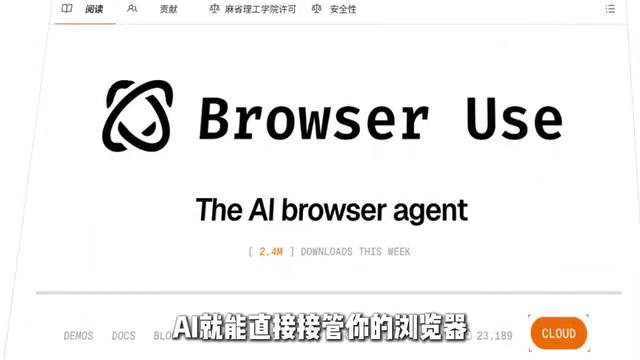
A GitHub open-source project with 89K stars uses an Agent Loop architecture to let LLMs autonomously control browsers, performing clicks, form filling, data extraction, and other comprehensive web operations. Unlike traditional scripting tools, it makes autonomous decisions based on the ReAct paradigm, flexibly adapting to dynamic web changes — and it only takes a few lines of Python code to get started, embodying the industry trend of AI shifting from conversational to agentic.
An Open-Source Project That Lets AI Truly "Take Action"
On GitHub, an AI browser automation project is accumulating stars at an astonishing pace, having already surpassed 89K. The core concept is remarkably intuitive — give Large Language Models (LLMs) a pair of hands, so AI no longer just "talks" to answer questions but can actually take over the browser and operate web pages just like a human.
Background: The Evolution of LLM Tool-Calling Capabilities Large language models were originally designed as pure text generation systems, but with OpenAI's introduction of Function Calling and Anthropic's Tool Use mechanism, LLMs gained the ability to invoke external tools. This breakthrough means LLMs are no longer limited to text output — they can trigger real-world operations like querying databases, calling APIs, and even controlling browsers. It's precisely this leap from "saying" to "doing" that laid the technical foundation for browser automation agents.
With just a single natural language instruction — like "Help me put together a parts list for a custom PC" — the AI can automatically open a browser, search for information, compare specifications, fill out forms, and ultimately deliver precise results that meet your requirements. The entire process is fully autonomous, requiring no human intervention.
Core Capabilities: Not Scripts, But Intelligent Agents
Autonomous Decision-Making via the Agent Loop
Traditional browser automation tools (like Selenium and Playwright) are essentially executing pre-written scripts — developers must define every step in advance. Selenium was born in 2004, and Playwright was released by Microsoft in 2020; both are driven by the WebDriver protocol or CDP (Chrome DevTools Protocol). Their fundamental limitation is that all operation paths must be hardcoded by developers beforehand. Once page structure changes (e.g., element IDs are modified or layouts are adjusted), scripts break immediately. Maintenance costs are extremely high, and they're completely unable to handle tasks requiring semantic understanding, such as "find the lowest-priced version of this product."
This project takes a completely different approach: it builds a complete Agent Loop that allows the LLM to autonomously determine what to do next at each step based on the current page state.
Deep Dive: The ReAct Architecture of the Agent Loop The Agent Loop typically follows the ReAct (Reasoning + Acting) paradigm of "perceive-reason-act." In the browser context, the Agent first "perceives" the current page's DOM structure and screenshots, then the LLM "reasons" about the most appropriate next action (e.g., "a login popup has appeared, I should close it first"), and finally "acts" by executing clicks, inputs, and other commands, feeding the results back into the next iteration of the loop. This closed-loop design gives AI the ability to handle dynamic scenarios — precisely the fundamental weakness of traditional scripting tools.

This means the AI can cope with dynamically changing web environments. Page layout changed? A popup appeared? A CAPTCHA showed up? The Agent adapts flexibly like a real person, rather than crashing like a script would.
Comprehensive Web Operation Capabilities
The project covers virtually all common browser operation scenarios:
- Clicking buttons: Precisely locating page elements and executing clicks
- Filling forms: Automatically identifying input fields and entering relevant information
- Scrolling pages: Intelligently scrolling to load more content
- Extracting data: Scraping structured information from web pages
- Multi-tab parallelism: Handling multiple browser tabs simultaneously, dramatically improving efficiency
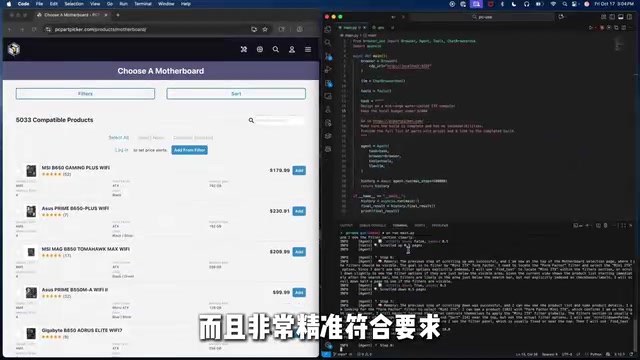
More notably, the project claims to bypass 99% of anti-bot mechanisms. For use cases like data collection and competitive analysis, this is an extremely attractive feature.
Technical Analysis: Why AI Agents Can Bypass Anti-Bot Mechanisms Modern websites' anti-bot mechanisms primarily include: User-Agent detection, behavioral fingerprinting (mouse trajectories, click intervals), CAPTCHAs, IP rate limiting, and JavaScript challenges (such as Cloudflare Bot Management). AI Agents can bypass most of these mechanisms because they drive real browser instances (rather than simulating HTTP requests), and their behavioral patterns closely resemble those of real humans — including random pause durations, natural mouse movement trajectories, and a complete JavaScript execution environment — effectively evading detection systems based on behavioral characteristics.
Extremely Low Barrier to Entry: Launch with Just a Few Lines of Code
For developers, one of the project's biggest highlights is its simplicity. You only need a few lines of Python code to launch a complete browser Agent — even programming beginners can quickly get their first automation task running.
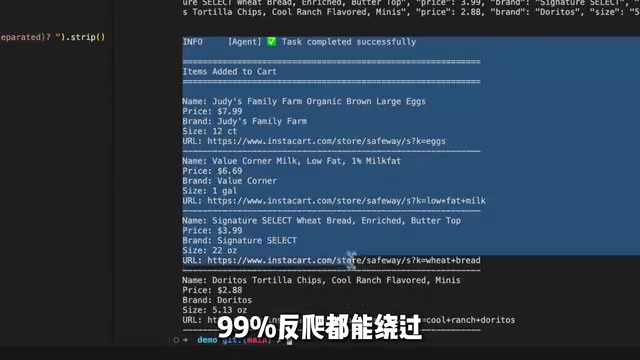
This low-barrier design is a key reason the project has rapidly accumulated 89K stars. It encapsulates complex AI Agent architecture, browser automation logic, LLM invocation, and other technical details, allowing users to focus solely on their business needs. This design philosophy of "pushing complexity down while surfacing usability" is a common trait of excellent open-source tools — similar to how Hugging Face once wrapped complex model loading into a few lines of code, dramatically lowering the development barrier for AI applications.
Use Cases and Value Analysis
Practical Application Directions
The application scenarios for this type of AI browser Agent are extremely broad:
- E-commerce price comparison and procurement: Automatically browsing multiple e-commerce platforms to compare prices and specifications
- Data collection and monitoring: Periodically scraping key data from target websites
- Form automation: Batch-filling repetitive forms for registrations, sign-ups, etc.
- Information research: Automatically searching and organizing web information on specific topics
- Test automation: Serving as an intelligent testing tool for web applications
A Microcosm of Technology Trends
The explosive popularity of this project is no accident — it reflects an important trend in AI: the shift from conversational AI to agentic AI.
Industry Context: The Rise of Agentic AI Before 2023, the dominant form of AI products was chatbots — users ask questions, AI answers. Starting in 2024, "action-oriented AI" represented by Devin (AI software engineer), OpenAI Operator (browser Agent), and Claude Computer Use began emerging in rapid succession. The technical foundation for this shift is the co-maturation of multimodal capabilities (AI can "see" screenshots) and tool-calling abilities. Gartner defines systems capable of autonomously completing multi-step tasks as "Agentic AI" and predicts it will become the dominant paradigm for enterprise AI deployment by 2026. Major companies are racing to establish positions in this space, and the browser — as the core gateway for human-internet interaction — naturally becomes the ideal battleground for Agent capabilities.
All major companies are pushing AI Agent deployment, and the browser, as the core gateway for human-internet interaction, naturally serves as the best showcase for Agent capabilities. When LLMs no longer just generate text but can truly control the digital world, the boundaries of automation will be dramatically expanded. This 89K-star project is powerful proof of this trend.
Summary
The reason this open-source project has garnered such high attention on GitHub is that it solves a real pain point: enabling AI to leap from "saying" to "doing." Standing at the technical inflection point where LLM tool-calling capabilities have matured and multimodal perception has broken through, it wraps complex Agent architecture into a few lines of Python code, letting LLMs take over browsers and autonomously complete complex web operation tasks. This is extremely attractive to both developers and general users. If you're interested in AI browser automation, this project is well worth deep exploration and hands-on experimentation.
Related articles
 Product Reviews
Qoder vs Cursor Real-World Comparison: Which $20/Month AI IDE Is Better?
Hands-on comparison of Qoder vs Cursor AI IDEs: Agent autonomy, human interaction count, and architecture decisions. Qoder needed only 2 interactions vs Cursor's 8.
 Product Reviews
Cursor Cloud Agent Demo: Eliminating Bottlenecks Across the Entire Software Development Lifecycle
Deep analysis of Cursor's Cloud Agent demo showing how cloud VMs, automated test artifacts, and a full-chain control plane systematically eliminate human bottlenecks across the software development lifecycle.
 Product Reviews
Cursor 3.0 Deep Dive: Multi-Agent Parallelism, Design Mode, and Best-of-N Model Comparison
Cursor 3.0 evolves from an AI coding assistant into an Agent fleet command center. Explore multi-agent parallelism, Design Mode, and Best-of-N model comparison.