AgentMemory: An Open-Source Solution for Giving AI Coding Assistants Permanent Memory

AgentMemory provides a unified cross-session, cross-tool persistent memory layer for AI coding assistants
AgentMemory is an open-source project that solves the pain points of AI coding assistants losing memory across sessions and lacking memory interoperability across tools. Built on local SQLite storage and the MCP protocol, it supports 16 tools including Claude Code and Cursor, delivering automatic recording, intelligent compression (~1900 tokens per session), and 95.2% retrieval accuracy—eliminating the need to repeatedly explain project context to AI.
The Pain Point: AI Coding Assistants' "Amnesia"
Every developer who uses AI for coding has experienced this scenario: close the terminal and reopen it, and the AI has completely forgotten everything you discussed. You're forced to re-explain the project architecture, tech stack choices, and file structure—wasting 15 minutes every day on repetitive communication.
The root cause lies in the context window mechanism of large language models. Even the latest Claude or GPT-4 models, despite having single-conversation context windows expanded to 128K or more tokens, still cannot retain memory across sessions. When a new session begins, the model's state is completely reset, and previous conversation content isn't automatically carried into the new context. This is the fundamental reason developers need to repeatedly explain project backgrounds.
What's even more frustrating is that existing memory solutions are siloed. Claude's CLAUDE.md file and Cursor's .cursorrules file are essentially static prompt injection mechanisms—they're read and injected into the system prompt at the start of each session. The limitations of this approach are: file size is restricted (typically 200 lines max) because overly long system prompts consume precious context window space; these files require manual maintenance and can't automatically capture new knowledge as projects evolve; most critically, they use tool-specific formats with no interoperability standards. Once you switch tools, all accumulated memory is wiped clean, and you start from scratch.
What Is AgentMemory: A Unified Persistent Memory Layer for AI Coding
Core Philosophy
AgentMemory is an open-source project aimed at equipping all AI coding agents with a unified persistent memory layer. It's not tied to any specific tool but serves as a universal memory infrastructure, enabling different AI coding assistants to share the same memory.
Core features include:
- One-command startup: Run via NPX with zero configuration cost. NPX is a package execution tool in the Node.js ecosystem that allows users to directly run command-line tools from npm packages without global installation. When you execute an npx command, it temporarily downloads and runs the specified package without leaving permanent installation traces on your system. This distribution method dramatically lowers the barrier to entry—developers don't need to worry about dependency management, version conflicts, or other issues.
- Automatic recording: Every operation is automatically logged without manual maintenance
- Intelligent compression: Compresses operation history into structured memory, consuming only ~1900 tokens per session
- Millisecond-level recall: Local SQLite storage with no dependency on external databases
Retrieval Accuracy and Performance
According to the LongMEM Eval benchmark, AgentMemory achieves a retrieval accuracy of 95.2%, outperforming the comparable project Mem0 by 27 percentage points. LongMEM Eval is a benchmark framework specifically designed to evaluate the retrieval capabilities of AI memory systems. It simulates real-world long-term interaction scenarios, testing memory system recall accuracy across different time spans and information densities. Evaluation dimensions typically include exact match rate, semantic relevance, and timeliness. A 95.2% accuracy rate means that in 100 memory retrievals, approximately 95 will accurately find the needed contextual information—when your AI assistant needs to recall previous context, it almost never misses critical information.
Regarding token consumption, each session requires only about 1900 tokens. Tokens are the basic unit of measurement for how large language models process text—roughly 1-2 tokens per English word and about 1.5-2 tokens per Chinese character. A session consumption of 1900 tokens means the memory context injected by AgentMemory is extremely concise—equivalent to about 1000 English words or 500 Chinese characters, yet capable of carrying an entire project's key contextual information. This high compression ratio is achieved through structured storage and intelligent summarization algorithms. Compared to manually pasting context, it saves 92%. Based on current mainstream API pricing (e.g., GPT-4o input at ~$2.5/million tokens), the estimated annual usage cost is only about $1.50.
Practical Use Cases
Cross-Session Memory Retention
Here's a concrete example: on day one you configure JWT authentication, on day two you add rate-limiting middleware. When you start a new session on day three, the agent already knows where your middleware is and how your test files are organized—zero re-explanation needed.
This is especially valuable for large projects. When a project exceeds several hundred files, traditional rules files simply can't carry enough contextual information. AgentMemory solves this through intelligent compression and structured storage. Rather than simply saving the full text of conversation history, it extracts key decisions, architectural changes, file relationships, and other structured information, injecting it in the most concise form into new sessions when needed.
Cross-Tool Memory Sharing
AgentMemory currently supports 16 mainstream AI coding tools including Claude Code, Cursor, and Codex. This means project understanding accumulated in Cursor can seamlessly transfer to Claude Code, freeing you from being locked into a single tool. This cross-tool compatibility is extremely valuable in practice—many developers switch tools based on different task types, for example using Cursor for daily coding and Claude Code for complex refactoring, and project memory continuity shouldn't be interrupted by tool switching.
Technical Architecture Highlights
From a technical implementation perspective, AgentMemory has several noteworthy design choices:
-
Local-first: Uses SQLite as the storage engine with data kept entirely local, eliminating privacy concerns. SQLite is an embedded relational database engine that stores the entire database in a single file without requiring a separate server process. Compared to databases like Redis or PostgreSQL that need independent deployment, SQLite's zero-configuration nature makes it ideal as a storage backend for local tools. It supports full SQL query capabilities, can handle TB-scale data in a single file, offers extremely high read performance (microsecond-level), and provides ACID transaction guarantees. For developers, this means all project memories exist as a single database file on local disk—easy to back up and migrate while completely avoiding data leakage risks.
-
Structured memory: Rather than simple text storage, it compresses memories into structured formats to improve retrieval efficiency. This is similar to how the human brain's memory works—we don't memorize every conversation word for word but extract key information to form conceptual networks. AgentMemory uses algorithms to distill lengthy conversation histories into project architecture graphs, technical decision records, file dependency relationships, and other structured data, enabling precise targeting during retrieval rather than full-text scanning.
-
Unified MCP protocol: Interfaces with various tools through the MCP (Model Context Protocol), enabling universal compatibility with a single integration. MCP is an open protocol standard released by Anthropic in late 2024, designed to establish a unified communication interface between AI models and external tools/data sources. Before MCP, every AI tool needed custom integration code for each external service, resulting in N×M integration complexity. MCP reduces this to N+M through a standardized client-server architecture—similar to how the USB protocol unified peripheral interfaces. AgentMemory's choice of MCP as its interface protocol means any AI coding tool that supports MCP can gain persistent memory capabilities in a plug-and-play fashion without custom development for each tool.
Community Traction and Usage Recommendations
The project has already earned over 6,000 stars on GitHub and continues to grow rapidly. This reflects the developer community's strong demand for memory capabilities in AI coding tools. From an industry trend perspective, AI coding assistants are evolving from "single-conversation tools" to "long-term collaboration partners," and persistent memory is the critical infrastructure for this transformation.
However, it's worth noting that as a relatively new open-source project, its long-term stability in complex, large-scale projects still needs time to be validated. Particularly as memory data volume continues to grow, the effectiveness of the intelligent compression algorithm, whether retrieval accuracy degrades, and SQLite single-file performance under extreme conditions are all metrics that need to be observed in actual use. It's recommended that developers try it on personal projects first, accumulate experience, and then consider introducing it into team workflows.
Summary
AgentMemory addresses a real and widespread pain point in the AI coding assistant space. Its open-source nature, local storage strategy, and cross-tool compatibility make it one of the most noteworthy AI development tool enhancement solutions available today. As the MCP protocol ecosystem continues to expand and more AI coding tools integrate with it, the value of this kind of unified memory layer will only grow. For developers who pair-program with AI every day, this might be the most direct step toward improved efficiency.
Related articles
 Product Reviews
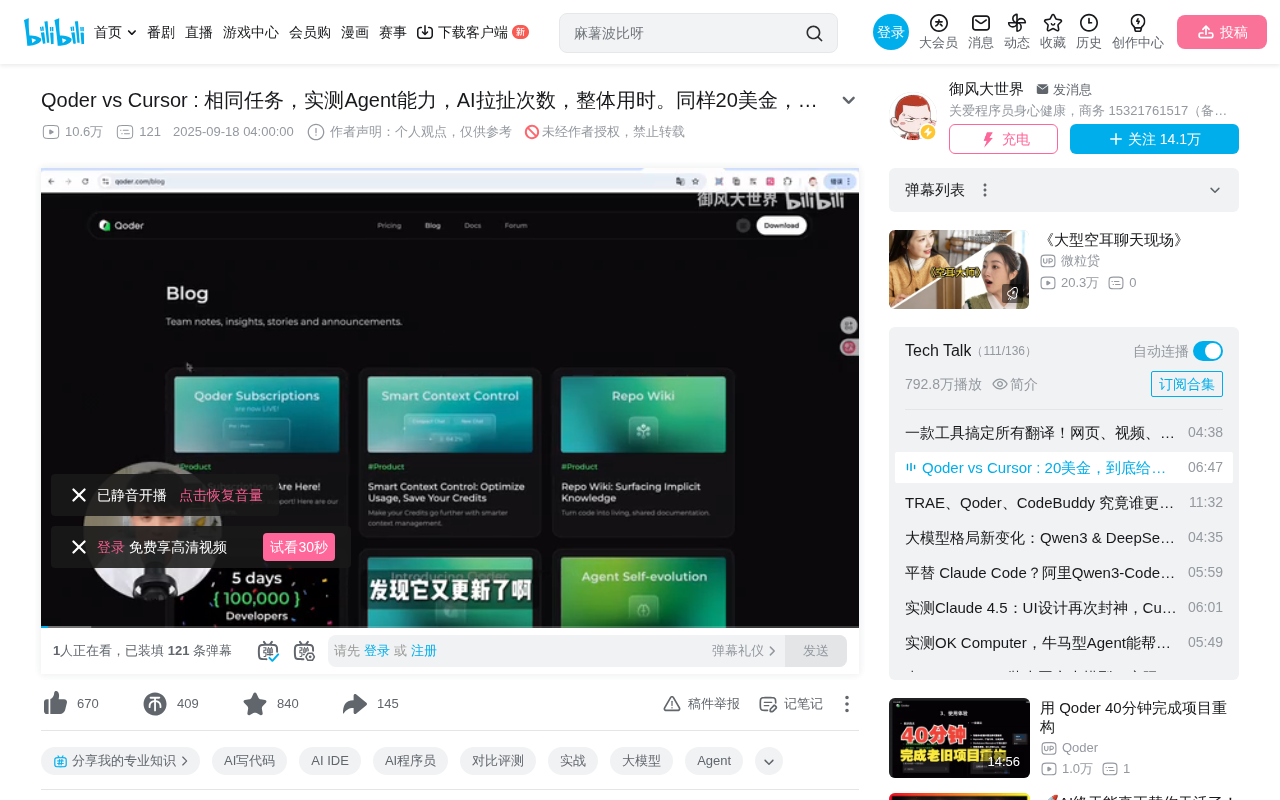
Qoder vs Cursor Real-World Comparison: Which $20/Month AI IDE Is Better?
Hands-on comparison of Qoder vs Cursor AI IDEs: Agent autonomy, human interaction count, and architecture decisions. Qoder needed only 2 interactions vs Cursor's 8.
 Product Reviews
Cursor Cloud Agent Demo: Eliminating Bottlenecks Across the Entire Software Development Lifecycle
Deep analysis of Cursor's Cloud Agent demo showing how cloud VMs, automated test artifacts, and a full-chain control plane systematically eliminate human bottlenecks across the software development lifecycle.
 Product Reviews
Cursor 3.0 Deep Dive: Multi-Agent Parallelism, Design Mode, and Best-of-N Model Comparison
Cursor 3.0 evolves from an AI coding assistant into an Agent fleet command center. Explore multi-agent parallelism, Design Mode, and Best-of-N model comparison.