AI Builds Mortal Kombat from Scratch: Claude vs. Codex vs. Gemini — A Three-Way Showdown
Claude, GPT Codex, and Gemini compete to build Mortal Kombat from scratch across three escalating challenges.
A hands-on experiment pits Claude Opus 4.6, GPT Codex, and Gemini against each other in building a Mortal Kombat game from scratch. Across three rounds — web game coding, AI-controlled gameplay, and Godot engine integration via MCP — Claude demonstrates the strongest all-around capabilities, while GPT Codex excels in speed and Gemini struggles with interactive control.
What happens when three AI giants — Claude Opus 4.6, GPT Codex, and Gemini — build a Mortal Kombat game from scratch? A content creator ran this hardcore experiment, having AI not only write code to build the game but also play it firsthand, and ultimately even connect to a real game engine. The results were stunning — and revealed stark differences in each AI's game development capabilities.
Experiment Design: Three Progressive Challenges
This wasn't a simple code generation comparison. Instead, it featured three challenges of escalating difficulty:
- Round 1: Have Claude and GPT Codex each build a two-player Mortal Kombat web game from scratch
- Round 2: Have Claude and Gemini control game characters through browser extensions to fight each other
- Round 3: Have Claude connect to a Godot MCP server to build a fighting game in a real game engine
This design cleverly tested AI's comprehensive abilities across three dimensions: code generation, environment interaction, and tool invocation.
Round 1: Web Game Development — Two Radically Different Styles
GPT Codex: The Silent Workhorse
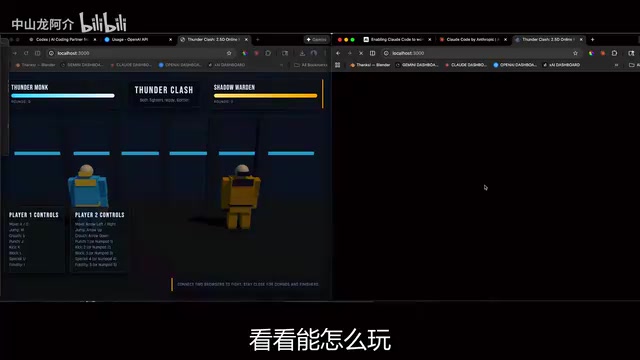
GPT Codex (version 5.2, High mode) was remarkably direct — it asked nothing and just got to work. It completed the entire game build in roughly 12 minutes. The final product was a two-player fighting game with skeletal animation, decent-looking character designs, support for jumping, crouching, punching, and other basic moves, with different key bindings assigned to each player.
Skeletal Animation is the most mainstream character animation technique in game development. It works by constructing a virtual bone system inside the character model, then moving and rotating bone nodes to drive mesh deformation on the outer layer, producing natural character movement. Compared to frame-by-frame sprite animation, skeletal animation can achieve smooth motion transitions with minimal data and supports animation blending — for example, a character can walk and punch simultaneously. The fact that GPT Codex generated characters with skeletal rigging in 12 minutes demonstrates that its code generation capabilities already cover fairly complex graphics programming logic.
However, GPT Codex's output had obvious rough edges: characters faced the camera instead of their opponent, and the finishing move had virtually no visual effects — the so-called "fatal embrace" looked more like two characters awkwardly hugging each other.
Claude Opus 4.6: The Thoughtful Questioner
Claude's approach was completely different. Before writing any code, it proactively asked a series of key questions: networking technology choice (peer-to-peer or server-based), character visual style (procedural 3D, 2D sprites, or shader textures), number of characters, and more. This "ask first, build later" approach cost a few extra minutes of communication, but ultimately delivered a more polished product in about 15 minutes.
Claude's game was noticeably superior in animation fluidity, with character stances that carried more fighting game presence and better overall visual quality.
Round 2: AI Plays the Game — Claude Crushes Gemini
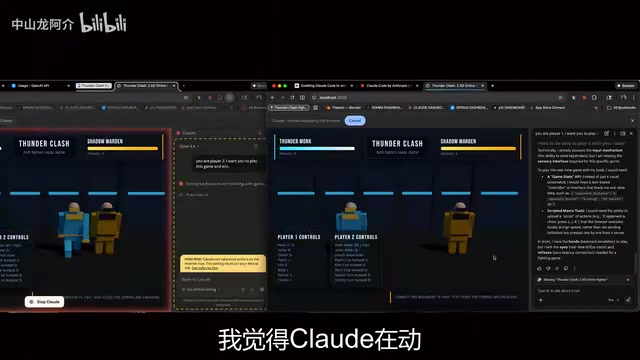
This was the most fascinating part of the entire experiment. The tester had Claude and Gemini each control game characters through browser extensions to fight each other, with Claude assigned as Player 2 and Gemini as Player 1.
AI controlling games through browser extensions essentially leverages a capability known as "Computer Use." This technology allows AI models to perceive screen content like humans (through screenshot recognition) and simulate keyboard and mouse actions to interact with applications. Both Anthropic's Claude and Google's Gemini have released their own browser control solutions, though their implementation paths differ. Claude's approach works through a loop of screenshot analysis + action commands, while Gemini's Ultra plan integrates similar browser automation capabilities. The core challenge is real-time responsiveness — games demand millisecond-level reaction times, but AI's "screenshot → analyze → decide → execute" loop typically takes hundreds of milliseconds or even seconds, which explains why AI-controlled gameplay is far less fluid than human play.
The results were surprising yet logical:
- Gemini was almost completely unable to operate the game, quickly "giving up" with no effective gameplay actions
- Claude, while mixing up player numbers (assigned as Player 2 but controlling Player 1), genuinely demonstrated real game control ability — moving, punching, kicking, executing combos, and even attempting finishing moves
After 177 steps, Claude's character won the match. This raised an interesting question: Claude was assigned as Player 2 but controlled Player 1 and won — so who actually won? In terms of results, Claude demonstrated environment interaction capabilities far beyond Gemini's, though there's still room for improvement in instruction comprehension accuracy.
A notable detail: using Gemini's browser control feature requires the Ultra plan, while Claude doesn't require the highest-tier subscription.
Round 3: Connecting to Godot Engine — From Web Games to Professional Game Development
The Leap from Browser to Game Engine
To address the latency issues of the web version, the tester had Claude connect to a Godot MCP server via Cloud Code to build a fighting game in a real game engine.
Godot is a completely free and open-source cross-platform game engine, first released in 2014 by Argentine developers Juan Linietsky and Ariel Manzur. Unlike the two major commercial engines Unity and Unreal Engine, Godot uses the MIT license, requiring developers to pay no licensing fees or revenue shares. Godot uses its own GDScript scripting language (with Python-like syntax) while also supporting C# and C++. In recent years, due to Unity's controversial runtime fee changes in 2023, a large number of indie developers migrated to Godot, rapidly growing its community and ecosystem. Choosing Godot as the test platform for AI game development reflects both its prominence in indie game development and the fact that its open-source nature facilitates MCP server development and integration.
MCP (Model Context Protocol) is an open standard protocol introduced by Anthropic in late 2024, designed to provide AI models with a unified way to connect to and invoke external tools, data sources, and services. Think of MCP as the "USB port" of the AI world — whether it's a database, file system, API, or a game engine like Godot, as long as an MCP server is implemented, AI can interact with it in a standardized way. In this experiment, Claude directly controlled Godot's editor functions through the MCP server, including creating scene nodes, writing GDScript scripts, and configuring resource references. This means AI is no longer limited to generating code text — it can operate directly within an IDE just like a human developer.
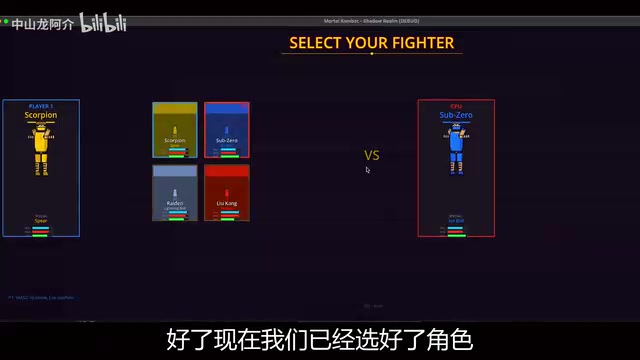
The MCP server installation process itself was interesting — the tester simply pasted the Godot MCP server link to Claude and let it figure out the installation on its own. About 15 minutes later, Claude successfully built a runnable fighting game prototype in the Godot engine.
Debugging and Iteration
The process wasn't entirely smooth. The game crashed on its first run, but after feeding the error messages back to Claude, it was able to use MCP tools to inspect and fix the errors on its own. After two rounds of debugging, the game ran successfully, complete with a character selection screen (classic characters like Liu Kang, Scorpion, Raiden, Sub-Zero, etc.) and a basic combat system.
Even more impressive, during the debugging process Claude actually played the game itself to verify whether features were working properly — it was literally "playing" its own game.
The Challenge of Importing 3D Assets
The tester further attempted to have Claude fetch 3D model assets through the SketchFab API, but this step hit a wall. SketchFab is the world's largest 3D model sharing and marketplace platform, hosting over 5 million 3D model resources spanning game characters, architecture, props, and more. Its REST API allows developers to programmatically search, preview, and download 3D models in multiple output formats including FBX, glTF, OBJ, and others. In the context of AI-assisted game development, if AI could autonomously fetch needed 3D assets through the SketchFab API, it would mean the entire workflow from "design → find assets → integrate → debug" could be AI-driven. However, this step failed in the experiment, reflecting AI's limitations when handling complex multi-step task chains involving third-party API authentication, file downloads, and format conversion.
A compromise was adopted: manually downloading FBX-format 3D character models and animation files (including breathing idle, flying kick, MMA kick, punch, four-hit combo, etc.), placing them in the project folder, and letting Claude handle the integration.
The trickiest problem during this process was the character being stuck in T-Pose. T-Pose is the standard reference pose in 3D character modeling, where the character stands upright with arms extended horizontally, forming a "T" shape. This pose serves as the starting point for skeletal rigging, with all animations calculated as bone offsets from the T-Pose. In game development, "character stuck in T-Pose" is an extremely common bug, typically indicating that the animation system failed to correctly load or play the specified animation clip, causing the character to fall back to the default bind pose. The issue in this experiment was more specific: each animation track in the FBX file contained a T-Pose as the default animation, and the animation player was erroneously referencing this default pose instead of the actual combat animations — a common pitfall when exporting 3D assets from DCC tools like Blender or Maya. After resolving this naming and reference issue, the game finally triggered combat animations correctly.
Comparing the Three AIs' Game Development Capabilities
| Dimension | Claude Opus 4.6 | GPT Codex | Gemini Pro |
|---|---|---|---|
| Code Generation Speed | ~15 minutes | ~12 minutes | Not tested separately |
| Visual Quality | ★★★★☆ | ★★★☆☆ | - |
| Game Interaction Ability | Can control gameplay | - | Almost unable to operate |
| Tool Invocation | Successfully connected to Godot | - | - |
| Development Style | Ask first, build later | Execute directly | - |
Overall, Claude Opus 4.6 demonstrated the strongest comprehensive capabilities in this all-around test: not only higher code quality, but also the ability to control games through browser extensions and connect to a professional game engine for development. GPT Codex had advantages in speed and execution, but slightly lower output quality. Gemini performed the weakest in the interactive control segment.
Insights from AI Game Development
This experiment revealed several noteworthy trends:
-
AI can now build playable game prototypes in minutes, which is hugely significant for indie developers and rapid prototype validation. In traditional game development, even a simple fighting game prototype requires programmers to spend days building foundational systems like character control, collision detection, and animation state machines. AI compresses this process to under 15 minutes, meaning game designers can validate dozens of gameplay ideas in a single day, dramatically accelerating the iteration cycle from concept to playable prototype.
-
MCP is becoming the bridge connecting AI to professional tools. Claude's integration with the Godot engine showcases AI's evolution from "writing code" to "using tools." The significance of this shift is that AI is no longer just a code generator — it's gradually becoming an intelligent agent capable of operating complete development toolchains. As more professional software implements MCP servers in the future, AI could potentially operate Photoshop for texture work, model in Blender, design sound effects in Wwise, forming an AI workflow covering the entire game development pipeline.
-
AI's environmental perception and control capabilities vary enormously. Claude could play the game while Gemini was virtually unable to operate it, highlighting significant differences in each AI's technical approach to real-time interaction.
-
Human-AI collaboration remains the optimal approach for now — the 3D asset integration phase required human intervention, and purely end-to-end AI completion of complex game development still has a way to go.
From "having AI write games" to "having AI play games" to "having AI build games with professional engines," this experiment paints a complete picture of AI-assisted game development. As these capabilities continue to mature and converge, "one person + one AI = a game studio" may truly not be far off.
Related articles

How Nextdoor's Engineering Team Uses Codex to Enable Single-Engineer Full-Stack Delivery
Nextdoor's engineering lead shares how OpenAI Codex is reshaping development for their 105M-user platform: single-engineer full-stack delivery, solving tough technical problems, and deep cultural integration.

OpenAI Codex Powers Black Hole Simulation: 1000x Algorithm Speedup Brings First-Ever Black Hole Video Within Reach
The EHT team used OpenAI Codex to speed up black hole plasma simulation algorithms by 1000x, from ten days to minutes. Learn how Codex is enabling the first-ever black hole video.

OpenAI's Stargate Lands in a Small Texas Town: How Ranches and Data Centers Coexist
OpenAI's Stargate data center lands in Buffalo Gap, Texas, boosting local restaurant traffic by 20% and revitalizing a small ranching community.