AI Coding Tools Deep Dive: How to Choose Between Qoder, Cursor, Windsurf, and Devin

Comparing four AI coding tools: context engine capability matters more than autonomy or the underlying model.
This article compares four AI coding tools: Qoder, Cursor, Windsurf, and Devin. Qoder achieves panoramic context awareness through 100K-file retrieval and knowledge graphs with the highest reliability; Cursor is the most commercially successful with $500M ARR; Windsurf innovates with its AI Flow paradigm but lacks stability; Devin claims to be an autonomous AI engineer but has an extremely low real-world success rate. The core conclusion: focus on context engine capability and actual success rates rather than chasing surface-level autonomy.
The Explosive Growth of the AI Coding Tools Market
The AI coding assistant space is experiencing unprecedented growth. From simple code completion to intelligent collaborators that can understand entire projects, this market is expanding rapidly — with a compound annual growth rate (CAGR) of 23.24%, projected to grow nearly 8x over the next decade.
Behind this growth is a generational leap in technology paradigms: from early rule-based code completion (like IntelliSense), to the first generation of LLM-powered AI coding assistants represented by GitHub Copilot, to today's second-generation tools with agentic capabilities — the industry has undergone a qualitative transformation. The core driver is the maturation of the Transformer architecture and large-scale pretraining on code corpora, enabling models to understand code semantics rather than just syntactic patterns. This has turned AI into a true collaborator in the development workflow, rather than a simple autocomplete engine.
In this rapidly evolving landscape, Qoder, Cursor, Windsurf, and Devin each bring unique strengths, representing different technical approaches to AI-assisted programming. The core difference between them boils down to one key question: Do you want autonomy, or do you want reliability?
Qoder: A Deep Player in Panoramic Context Awareness
Core Technology: Enhanced Context Engineering
Qoder's core competitive advantage lies in its "enhanced context engineering" capabilities. Context Engineering is the central battleground for today's AI coding tools — traditional LLMs have limited context windows that can't accommodate all the information in a large codebase, so techniques like Retrieval-Augmented Generation (RAG) and Code Graphs are needed to dynamically construct relevant context. Qoder's implementation in this area operates on three levels:
First, panoramic context understanding. Qoder can integrate tens of thousands of tokens of code text, covering directory structures, images, logs, and other multimodal information. Its built-in code retrieval engine can search through 100,000 code files at once, using a hybrid retrieval approach combining semantic vector search, code graphs, and real-time indexing to achieve project-level precise comprehension. Semantic vector search embeds code snippets into high-dimensional vector spaces and matches semantically related content via cosine similarity; code graphs structure relationships like function calls, class inheritance, and module dependencies, enabling the AI to understand the topology of the code rather than isolated fragments.
Second, knowledge-graph-based project memory. Qoder automatically generates architectural knowledge graphs, making implicit project knowledge explicit. Developers can trace inter-module dependencies, and the system can perform logical reasoning based on historical commit records, achieving a depth of understanding far beyond traditional tools.
Third, dynamic model routing. It automatically selects the appropriate model based on different task types, striking a balance between depth of understanding and cost.
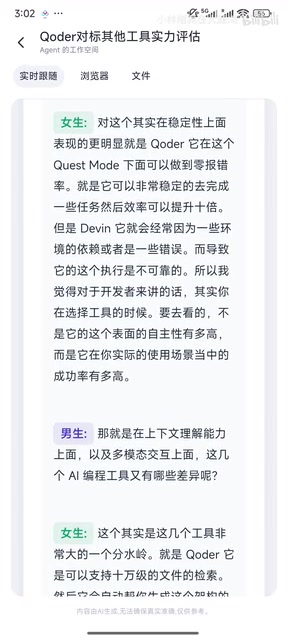
In terms of reliability, Qoder can achieve a zero error rate in Quest Mode, with task completion efficiency improvements of up to 10x. This means it's not only highly autonomous but also delivers excellent reliability.
Cursor: The Most Commercially Successful AI-Native IDE
Precise Product Positioning and Business Strategy
As an AI-native IDE, Cursor has achieved remarkable commercial success: over 70,000 monthly active users, $500 million in Annual Recurring Revenue (ARR), and a valuation of $2.5 billion — making it one of the highest-valued unicorns in the industry.
ARR (Annual Recurring Revenue) is a core metric in the SaaS industry for measuring business health, reflecting the predictability of subscription-based revenue. Cursor's achievement of $500 million ARR in just a few years rivals the early growth curves of top SaaS companies like Stripe and Figma. Its success validates the unique business logic of the "developer tools" space: developers are both users and decision-makers, product quality itself is the best marketing, word-of-mouth spreads extremely efficiently, and once integrated into a workflow, the tool becomes incredibly sticky.
Several key factors drive its success:
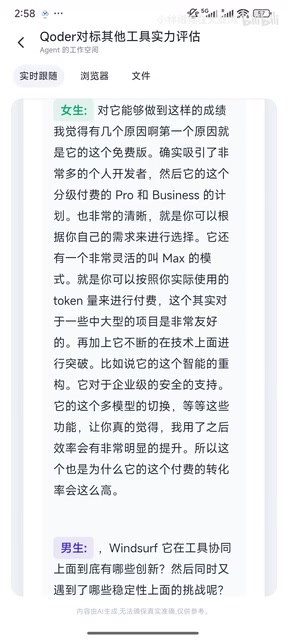
- Free tier + tiered pricing strategy: The free version attracts a large number of individual developers, while Pro and Business plans serve different tiers of needs
- Flexible Max model: Pay-per-token pricing that's very friendly for medium to large projects
- Continuous technical breakthroughs: Features like intelligent refactoring, enterprise-grade security support, and multi-model switching are constantly iterated
In terms of context understanding, Cursor excels at multi-root workspace management and nested mono repo support, and its image context feature is very intuitive — making it particularly well-suited for cross-project collaboration scenarios. However, it still requires developers to lead the development process, executing tasks through background agents.
Windsurf: Innovation and Growing Pains of the AI Flow Paradigm
The Innovative Flows Mode
Windsurf's core innovation lies in its "AI Flow" paradigm. This paradigm represents a transitional form from the Copilot model (AI as assistant) to the Agent model (AI as executor) — in the traditional Copilot model, AI passively responds to each developer input; in the Agent model, AI can proactively plan tasks, invoke tools, and execute multi-step operations. Through Flows mode, AI can not only complete code in real-time but also independently execute tasks as an Agent, covering the entire pipeline from requirements analysis to deployment.
Its Cascade panel is the core vehicle for tool orchestration — essentially a task orchestration layer that decomposes natural language instructions into executable tool call sequences, similar to a productized implementation of Agent frameworks like LangChain and AutoGen. It supports triggering a series of operations through natural language commands, automatically detecting toolchains and fixing errors. The inherent challenge of this approach is that errors propagate along the call chain, creating cascading failures — which is one of the root causes of Windsurf's stability issues.
For beginners, Windsurf is very friendly — it can generate 70% of the code in a very short time. It also has unique advantages in long file processing, multimodal interaction (directly pasting images), and real-time web preview, making it particularly suitable for frontend styling optimization scenarios.
Notable Shortcomings in Stability
However, Windsurf's stability issues are quite prominent:
- Recent updates have caused numerous interruptions, blank screens, and file retrieval failures
- Cascading errors appear in some projects
- Model provider Anthropic's supply disruption of the Claude model led to user attrition
- Frequent technical integrations introduce compatibility risks
On the automation spectrum, Windsurf actually leans toward the end requiring more manual intervention — each step requires user confirmation, and complex tasks need additional prompts to continue.
Devin: Grand Vision, Harsh Reality
The Gap Between the Autonomous AI Engineer Vision and Reality
Devin bills itself as an "autonomous AI engineer" with an independent sandbox environment. It can receive tasks through a Slack interface and independently complete code review, modification, testing, and even deployment. On the SWE-bench test, it solved 13.86% of real GitHub Issues — higher than Claude 2's performance.
SWE-bench (Software Engineering Benchmark) is a standardized evaluation set published by Princeton University, containing 2,294 GitHub Issues from 12 real open-source Python projects. It requires models to automatically generate code patches that pass test suites based on Issue descriptions, and is considered the "gold standard" for measuring AI coding capabilities. However, subsequent research has pointed out data leakage risks in the test, and significant distribution shift exists between the lab environment and real engineering scenarios — a model's excellent performance on controlled benchmarks doesn't directly translate to complex, dynamic real-world development scenarios. Devin's case is a textbook example of this phenomenon.
Real-world usage data is disappointing: only 3 successes out of 20 tasks. Common issues include getting stuck in technical dead ends, generating invalid scripts, consuming too much memory and crashing, and even causing terminal hangs on macOS due to incorrect directories.
More critically, Devin's context reuse capability is extremely weak — it cannot remember a project's historical context and frequently errors when handling cross-component integration. Its daily active users number only 10,000, severely mismatched with its $4 billion valuation. This once again confirms a key lesson: Higher autonomy doesn't necessarily mean greater practicality.
Selection Framework: The Spectrum of Autonomy vs. Reliability
Placing the four tools on a spectrum from "manual intervention" to "full autonomy" clearly reveals their positioning differences:
| Tool | Autonomy | Reliability | Context Capability | Best For |
|---|---|---|---|---|
| Qoder | High (end-to-end from requirements to deployment) | High (zero error rate) | 100K-file retrieval + knowledge graphs | Primary dev tool, large projects |
| Cursor | Medium (requires human leadership) | Relatively high | Multi-root workspaces + mono repo | Primary dev tool, cross-project collaboration |
| Windsurf | Medium-low (requires frequent confirmation) | Relatively low | Long files + multimodal interaction | Specialized tool, frontend development |
| Devin | Theoretically highest, practically lowest | Low | Single-file snippet level | Auxiliary experimental tool |
Choosing the Right Context Engine Matters More Than Choosing the Right Model
An important conclusion emerges from this comparison: when selecting AI coding tools, the capability of the context engine is more critical than the underlying model.
The underlying model (such as GPT-4, Claude 3.5, Gemini, etc.) determines the upper bound of AI reasoning, but the context engine determines how much of that upper bound can actually be utilized. A well-designed context engine can inject the right information, in the right format, at the right time into the model's context window, thereby converting the model's theoretical capabilities into actual engineering output. This is similar to how human engineers work: even a top-tier engineer can't work efficiently if they know nothing about the project background; whereas a mid-level engineer who understands the full project picture can often produce higher-quality code. This also explains why different tools using the same underlying model can produce vastly different real-world results — both Qoder and Devin can call top-tier models, but the former, with its context engine built on 100K-file retrieval and knowledge graphs, achieves an overwhelming advantage in actual task success rates.
Whether a tool can truly integrate into your development workflow, understand the full picture of your project, and maintain a high success rate in real-world scenarios — these are the core factors that determine productivity gains. For developers, rather than chasing surface-level "autonomy," it's better to focus on the tool's actual success rate and reliability in your specific use cases. After all, a "semi-automatic" tool that reliably completes tasks is far more valuable than a "fully automatic" tool that frequently fails.
Key Takeaways
- The AI coding tools market is projected to grow from $1.226 billion in 2024 to $9.91 billion in 2034, with a CAGR of 23.24%
- Qoder achieves panoramic context awareness through 100K-file retrieval, knowledge graphs, and dynamic model routing, reaching zero error rates in Quest Mode
- Cursor has achieved commercial success with its AI-native IDE positioning and precise free + tiered pricing strategy, reaching $500M ARR and a $2.5B valuation
- Devin claims to be an autonomous AI engineer but succeeded in only 3 out of 20 tasks in practice, highlighting significant distribution shift between SWE-bench benchmarks and real-world scenarios
- The core criterion for choosing an AI coding tool isn't the level of autonomy, but the success rate and reliability in real-world scenarios — context engine capability matters more than the underlying model
Related articles
 Product Reviews
Qoder vs Cursor Real-World Comparison: Which $20/Month AI IDE Is Better?
Hands-on comparison of Qoder vs Cursor AI IDEs: Agent autonomy, human interaction count, and architecture decisions. Qoder needed only 2 interactions vs Cursor's 8.
 Product Reviews
Cursor Cloud Agent Demo: Eliminating Bottlenecks Across the Entire Software Development Lifecycle
Deep analysis of Cursor's Cloud Agent demo showing how cloud VMs, automated test artifacts, and a full-chain control plane systematically eliminate human bottlenecks across the software development lifecycle.
 Product Reviews
Cursor 3.0 Deep Dive: Multi-Agent Parallelism, Design Mode, and Best-of-N Model Comparison
Cursor 3.0 evolves from an AI coding assistant into an Agent fleet command center. Explore multi-agent parallelism, Design Mode, and Best-of-N model comparison.