AI Coding Tools Keep Crashing When Building Websites? Root Cause Analysis & Practical Solutions
AI Coding Tools Keep Crashing When Bui…
AI coding tools face frequent crashes and disconnections, making stability a more urgent challenge than intelligence.
Starting from blogger Lu Songsong's real experience of frequent crashes while using AI coding tools across multiple windows, this article analyzes the technical root causes of AI coding instability: API rate limiting, cross-border network latency, local resource contention, tight LLM inference compute, and immature toolchain engineering. It offers practical solutions including reducing concurrent windows, switching to domestic models, off-peak usage, and proper version control, while calling on vendors to prioritize stability fundamentals.
When AI Coding Meets Stability Challenges
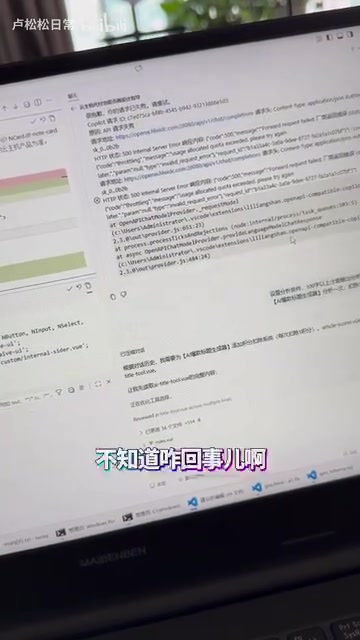
Recently, well-known Chinese blogger Lu Songsong shared his real experience using AI tools to revamp his website — frequent request failures, LLM connection drops, and multi-window concurrency causing outright crashes. He described the entire process as "mentally exhausting." This is far from an isolated case; it's a common pain point faced by AI coding tool users today.

Multi-Window Concurrency: The Primary Cause of AI Coding Crashes
Based on Lu Songsong's description, his workflow involved opening three VS Code windows simultaneously, using AI-assisted coding tools like Cursor and Copilot for website development and modification. However, when multiple windows sent requests to LLMs concurrently, the system frequently experienced connection failures.

The root causes of this problem span multiple layers:
-
API Rate Limiting: Most AI coding tools rely on LLM APIs that impose concurrent request limits. Rate Limiting is a core mechanism cloud service providers use to control resource usage, typically enforced across dimensions including requests per minute (RPM), tokens processed per minute (TPM), and maximum concurrent connections. Taking OpenAI as an example, free-tier users have an RPM cap of just 3 requests, and even paid users face strict concurrency controls by default. When Cursor or Copilot simultaneously initiates code completion and context analysis requests across multiple windows, it's extremely easy to exhaust quotas in a short time, triggering HTTP 429 (Too Many Requests) errors — this is the direct technical reason behind the "request failed" messages users see. Running three editor windows simultaneously means request volume multiplies, easily triggering rate limiting mechanisms.
-
Unstable Network Connections: When users in China access overseas LLM services like OpenAI or Anthropic, data packets must travel through transpacific submarine fiber optic cables. The base latency (RTT) from physical distance alone is typically 150-300 milliseconds. Factor in international bandwidth congestion and BGP routing jitter, and actual latency is often higher and more unstable. For AI coding tools, a complete code generation request often requires multiple TCP handshakes and data round-trips — packet loss at any point can cause the entire request to fail. Concurrent multi-path requests compound the problem, further amplifying the impact of network fluctuations.
-
Local Resource Contention: Running AI plugins across multiple VS Code instances simultaneously places significant strain on local memory and CPU resources.
AI Coding Instability Is an Industry-Wide Problem

Lu Songsong's experience resonated widely. Current mainstream AI coding tools all have significant room for improvement in stability. Whether it's Cursor, GitHub Copilot, or various domestic AI coding assistants, user communities are flooded with feedback about "request timeouts," "connection drops," and "lost responses."
The deeper reasons behind this situation fall into two main categories:
Tight LLM Inference Resources
LLM inference compute remains a scarce resource. Unlike traditional software, every AI code completion request requires billions of matrix operations on GPU clusters. For GPT-4-class models, a single inference occupies multiple high-end GPUs (such as A100 or H100) for hundreds of milliseconds to several seconds, with individual GPUs costing tens of thousands of dollars and facing chronic global supply shortages. Service providers typically use Request Queue mechanisms to balance load, and queue backlogs during peak hours cause response latency to spike dramatically. For users on free or low-cost plans, queue priority is often lower, making crashes and timeouts more likely. This also explains why off-peak usage can significantly improve the experience.
Immature AI Coding Toolchains
AI coding tools are still in the early stages of rapid iteration, most having emerged during the 2022-2023 generative AI wave with extremely fast product cycles. Engineering stability encompasses multiple capabilities including Retry with Exponential Backoff, Reconnection, Idempotency, and Graceful Degradation. However, many current products are racing ahead on features, with engineering teams focusing primarily on model capability integration and feature innovation, investing relatively less in these fundamental stability mechanisms. For example, mature web applications automatically retry failed requests with exponential backoff strategies, while some AI coding plugins simply throw error messages to users upon encountering 429 or 503 errors, lacking automatic recovery capabilities. This significantly amplifies the perceived instability for users.
Practical Solutions to Reduce AI Coding Crashes
To address frequent AI coding tool crashes, the following recommendations can effectively mitigate the problem:
-
Reduce Concurrent Windows: Avoid opening multiple VS Code windows for simultaneous AI requests. Instead, complete tasks step by step in a single window, reducing the probability of triggering rate limits at the source.
-
Switch to Domestic LLM Services: Domestic Chinese LLMs like DeepSeek and Tongyi Qianwen have servers deployed locally, with RTT typically under 30 milliseconds and connection stability orders of magnitude better than overseas services. If you frequently experience disconnections with overseas models, switching to domestic LLMs like DeepSeek or Tongyi Lingma is an effective solution that fundamentally addresses latency and disconnection issues.
-
Enable Auto-Retry Mechanisms: Some AI coding plugins support configuring request retry counts and timeout durations. Appropriately increasing these parameters can alleviate occasional connection failures. An ideal retry strategy should use Exponential Backoff to avoid compounding server load during high-traffic periods.
-
Use During Off-Peak Hours: Avoid peak usage hours in North American time zones (evening to early morning Beijing time), and operate during periods of lower server load.
-
Maintain Proper Version Control: AI-generated code often modifies numerous files at once, and generation results have inherent randomness. Develop a habit of "small commits": immediately execute
git commitafter completing each feature point or passing a test case. Usegit stashto temporarily save unfinished work, andgit bisectto quickly locate problematic commits when AI introduces bugs. These practices minimize losses from tool crashes and prevent work from being lost due to unexpected failures.
Stability Matters More Than Intelligence for AI Coding Tools
AI coding tools are indeed reshaping how developers work, but there's a stability gap between "impressive" and "usable." Lu Songsong's complaints represent the voice of countless real users — we need not just smarter AI, but AI that doesn't constantly disconnect and crash.
For tool vendors, rather than solely pursuing the ceiling of model capabilities, it's better to first solidify basic connection stability and user experience. After all, a god-tier tool that constantly crashes is less practical than an ordinary tool that's always online.
Key Takeaways
- AI coding tools frequently experience request failures and connection drops in multi-window concurrent scenarios
- Root causes span multiple layers including API rate limiting (RPM/TPM quota exhaustion), cross-border network latency, and local resource contention
- Tight GPU inference compute for LLMs and insufficient toolchain engineering maturity are industry-wide deep-rooted issues
- Reducing concurrent windows, switching to domestic models, and off-peak usage can effectively mitigate problems
- AI coding tool vendors need to invest more effort in fundamental stability capabilities like error retry and automatic reconnection
Related articles
 Product Reviews
Qoder vs Cursor Real-World Comparison: Which $20/Month AI IDE Is Better?
Hands-on comparison of Qoder vs Cursor AI IDEs: Agent autonomy, human interaction count, and architecture decisions. Qoder needed only 2 interactions vs Cursor's 8.
 Product Reviews
Cursor Cloud Agent Demo: Eliminating Bottlenecks Across the Entire Software Development Lifecycle
Deep analysis of Cursor's Cloud Agent demo showing how cloud VMs, automated test artifacts, and a full-chain control plane systematically eliminate human bottlenecks across the software development lifecycle.
 Product Reviews
Cursor 3.0 Deep Dive: Multi-Agent Parallelism, Design Mode, and Best-of-N Model Comparison
Cursor 3.0 evolves from an AI coding assistant into an Agent fleet command center. Explore multi-agent parallelism, Design Mode, and Best-of-N model comparison.