AIStarter and PanelAI Architecture Upgrade Explained: The Evolution of an All-in-One AI Toolbox

AIStarter and PanelAI plan architecture upgrades this year to build an all-in-one local AI project management ecosystem.
Developer "Brother Xiong" and his team have spent nearly two years refining AIStarter and PanelAI, with architecture upgrades planned for completion this year. AIStarter serves as an all-in-one AI project management tool offering a project market, multi-channel downloads, and model management to lower the barrier for local AI deployment. Post-upgrade, model management shifts to a decentralized approach, and a new AI Assistant feature creates a product loop with PanelAI. The perpetual license is currently ¥499 but will rise to ¥999 after the upgrade, giving early adopters a clear price advantage.
An Entrepreneur's Persistence: Two Years of Dedication
In an era where AI tools emerge endlessly, a developer affectionately called "Brother Xiong" by his fans has led his team for nearly two years, continuously refining two AI products — AIStarter and PanelAI. Working through late nights every month, with the projects unable to turn a profit or barely breaking even, yet still persisting with development — this kind of dedication is rare in the often impatient AI startup scene.
Recently, Brother Xiong shared a detailed video introducing the latest architecture upgrade plans and feature highlights for both products. Let's take a closer look at what makes this "all-in-one AI toolbox" worth paying attention to.
Upgrade Timeline for Both Products
PanelAI: Official Version Before September
Brother Xiong revealed that PanelAI is expected to release its official version before September. As a more feature-complex product, PanelAI currently consumes the majority of the team's development resources. After the official launch, the entire team will shift to AIStarter's architecture upgrade.
AIStarter: Rapid Iteration on Existing Foundation
AIStarter's upgrade is expected to take only one to two months to complete. The reason is that AIStarter already has a mature architecture and a solid codebase — the team only needs to complete the architecture upgrade and feature updates on the existing foundation rather than starting from scratch. This means both products will be upgraded to their latest versions within the year.

AIStarter Market: All-in-One AI Project Management
The Complexity of Local AI Project Ecosystems
The "AI projects" managed by AIStarter primarily refer to open-source AI inference and generation frameworks built on Python as their core tech stack. These projects typically depend on complex environment configurations: CUDA versions, Python virtual environments, dependency conflicts, and other issues that deter ordinary users. Notable examples include Stable Diffusion WebUI and ComfyUI for image generation, Wan2.1 and CogVideoX for video generation, and local large language model frameworks like Ollama and LM Studio. These projects update frequently, with model files and code repositories managed separately, creating an extremely high barrier to entry for non-technical users. AIStarter's value proposition is precisely to package this complex toolchain into a "one-click ready" experience.
How the Project Market Works
One of AIStarter's core features is its Project Market. Brother Xiong's daily workflow involves: discovering new projects → downloading and testing → verifying they run properly → uploading to servers and cloud storage → finally presenting them in the market for users to download and install with one click.
Behind this seemingly simple process lies a massive amount of manual effort. Every project in the market has been actually tested and verified to ensure users can use it properly after downloading — this is the key differentiator between AIStarter and ordinary aggregation platforms.
Flexible Multi-Channel Download Options
Domestic Chinese users face severe network challenges when using open-source AI projects, which is the important context behind AIStarter's multi-channel download design. Most mainstream AI projects are hosted on overseas platforms like GitHub and HuggingFace, with extremely unstable access speeds from within China. The varying adoption rates of IPv6 and public IP addresses further exacerbate download difficulties. Many AI models are several GB or even hundreds of GB in size, making resume-after-interruption and integrity verification major pain points on unstable networks. This is why numerous "one-click installer" products have emerged in China — their core value lies not in technical innovation, but in solving the "last mile" deployment obstacle.
To address this, AIStarter offers multiple download methods to meet different users' needs:
- Standard Download: Direct download from servers, suitable for users with good network conditions
- Offline Download: For users without IPv6 or public IPs, download a compressed package first, then complete installation through the "offline import" function
- High-Speed Download: Some popular projects support accelerated download channels
This multi-channel design effectively solves the pain point of many users being unable to smoothly download AI projects due to network environment limitations.

Evolution of Model and Plugin Management
Current Pain Points in Model Management
Currently, model management in AIStarter is still quite traditional — Brother Xiong needs to manually download models (some reaching hundreds of GB), upload them to servers, and then configure download addresses. This approach is not only inefficient but also extremely costly in terms of storage and bandwidth, severely limiting the expansion speed of the model library.
The New Management Logic After Upgrade: Embracing Decentralization
The distribution method for AI models is undergoing an evolution from centralized to decentralized. As model sizes grow dramatically (some multimodal models already exceed hundreds of GB), the storage and bandwidth costs of centralized distribution have become unsustainable. The rise of professional model hosting platforms like HuggingFace and ModelScope has made "downloading models directly from official sources" a viable path.
After the architecture upgrade, AIStarter's model management will follow this industry trend with a completely new logic: download directly from the model's official website and place it in the project directory for immediate use. Users can configure models into supported projects themselves, eliminating intermediate steps.
This decentralized design brings two significant advantages:
- Reduced operational costs: The team no longer needs to bear the storage and distribution expenses for massive model files
- Faster access: Users can obtain the latest released models from official channels immediately, avoiding version lag caused by re-hosting

New Desktop Interface Highlights
AI Assistant Feature: Completing the Product Loop
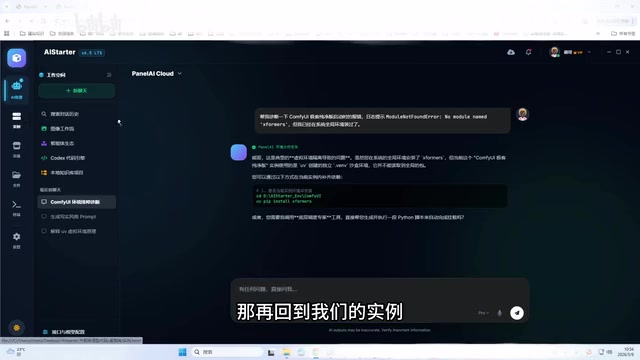
The most eye-catching feature of the new AIStarter desktop version is the built-in AI Assistant. Users can configure PanelAI's API within AIStarter to conduct AI conversations locally and save chat history.
From a product strategy perspective, the significance of this feature goes far beyond simple feature stacking. In the AI tools space, a single product is easily replaced by competitors, but when local tool management (AIStarter) and cloud AI services (PanelAI) form a complementary pair, users' switching costs increase significantly. This "local + cloud" dual-engine model is similar to the synergy between Mac and iCloud in Apple's ecosystem — each product has standalone value, but the synergistic effect when used together is the true moat. AIStarter (local AI tool management) and PanelAI (AI service platform) thus form a complete product loop. For a small team, this is also an effective path to building competitive barriers with limited resources.
Six Interface Interaction Improvements
The new interface has been polished and optimized across multiple details:
- More intuitive project information: After opening a project, URLs and logs are displayed directly without extra steps
- Clearer navigation categories: Favorites, Market, Applications, Models, Plugins, Workflows and other modules have been reorganized
- One-click deployment: Click on a project in favorites to deploy directly, greatly simplifying the process
- Visual update logs: Update content for each version can be viewed directly, with support for selective updates
- Independent terminals: Each project's terminal is listed separately, eliminating the chaos of mixed multi-project terminals
- Enhanced file management: Support for custom directory additions, such as output directories and input directories, for convenient file management
Pricing Strategy and Business Model
The Business Logic of Dual-Track Pricing
In the AI tools space, the choice of business model directly determines a product's sustainability. Currently, there are three mainstream approaches: API call billing (pay-per-use but with lower user stickiness), SaaS subscription (stable cash flow but requiring continuous value delivery), and perpetual licensing (high one-time revenue but lacking recurring cash flow). AIStarter's "annual subscription + perpetual license" dual-track system accommodates different users' payment preferences and represents a pragmatic business design.
AIStarter Current Pricing
| Plan | Price | Notes |
|---|---|---|
| Annual Subscription | ¥199 | Less than ¥1/day |
| Perpetual License | ¥499 | One-time purchase |
Most projects in the market are free for members, and even paid projects come with discounts. Compared to individual AI projects on the market that often cost hundreds or thousands of yuan, this pricing offers solid value for money.
Expected Post-Upgrade Pricing: Early Bird Strategy
Brother Xiong revealed that after the architecture upgrade, AIStarter's perpetual license will be adjusted to ¥999, with the annual subscription at ¥365 (equivalent to one yuan per day). This strategy of locking in users at low early prices and significantly raising prices for the official version is a common "Early Bird Pricing" model in the SaaS space, designed to trade price advantages for seed users and word-of-mouth growth. Current early supporters will enjoy locked-in preferential pricing.
PanelAI's Bundling Strategy
Currently, supporting PanelAI (¥1,999) includes a free AIStarter perpetual license, essentially getting permanent access to both products with a single investment. After the official version launches, PanelAI's pricing will start at ¥10,000, making the early support price advantage quite significant.
Summary and Reflections
In the AI tools space, AIStarter and PanelAI are taking a "heavy operations" approach — not simply building an aggregation platform, but manually testing and verifying every project to ensure user experience. The advantage of this model is high user trust; the disadvantage is that scaling speed is limited by team capacity.
Two major changes after the architecture upgrade deserve special attention:
- The new logic of downloading models directly from official sources aligns with the industry's decentralization trend, effectively reducing operational costs while accelerating model update speed
- The AI Assistant feature creates an ecosystem loop between AIStarter and PanelAI, building competitive barriers by increasing user switching costs and enhancing overall product value
For users who want low-barrier access to various AI tools, this kind of all-in-one solution is definitely worth watching. Getting in before the architecture upgrade and price increase offers particularly strong value.
Brother Xiong said something very down-to-earth at the end of his video: "My abilities may not be the strongest, but I have a persistent heart and very strong execution." In today's rapidly iterating AI industry, perhaps it's precisely this kind of pragmatic persistence that allows products to truly take root and continuously evolve.
Key Takeaways
- PanelAI is expected to release its official version before September; AIStarter will complete its architecture upgrade within 1-2 months afterward
- The new AIStarter features a built-in AI Assistant that can be configured with PanelAI's API for local conversations, forming a "local + cloud" product loop
- Model management will shift from a centralized upload model to a decentralized approach with direct downloads from HuggingFace, ModelScope, and other official sources
- Comprehensive interface optimizations: independent terminals, one-click deployment, visual update logs, and more
- Early users can secure perpetual licenses at preferential prices (early bird pricing strategy); prices will increase significantly after the official version launches
Related articles
 Product Reviews
Qoder vs Cursor Real-World Comparison: Which $20/Month AI IDE Is Better?
Hands-on comparison of Qoder vs Cursor AI IDEs: Agent autonomy, human interaction count, and architecture decisions. Qoder needed only 2 interactions vs Cursor's 8.
 Product Reviews
Cursor Cloud Agent Demo: Eliminating Bottlenecks Across the Entire Software Development Lifecycle
Deep analysis of Cursor's Cloud Agent demo showing how cloud VMs, automated test artifacts, and a full-chain control plane systematically eliminate human bottlenecks across the software development lifecycle.
 Product Reviews
Cursor 3.0 Deep Dive: Multi-Agent Parallelism, Design Mode, and Best-of-N Model Comparison
Cursor 3.0 evolves from an AI coding assistant into an Agent fleet command center. Explore multi-agent parallelism, Design Mode, and Best-of-N model comparison.