Amazon Kiro In-Depth Review: How Spec Mode Redefines AI Programming
Amazon Kiro In-Depth Review: How Spec …
Amazon launches AI IDE tool Kiro, featuring Spec Mode's structured development workflow as its core highlight.
Amazon officially enters the AI programming arena with Kiro, an AI IDE tool featuring built-in Claude Sonnet 4.0 and 3.7 models, free during the trial period. Its core differentiating feature, Spec Mode, splits development into three phases — requirements design, architecture design, and code implementation — simulating professional team workflows and addressing the pain point of low engineering rigor in AI programming. Real-world testing shows it can automatically build a complete expense tracking system from scratch, with official pricing expected at $19/month.
Amazon Officially Enters the AI Programming Arena
Amazon recently launched a brand-new AI IDE development tool — Kiro — officially marking its entry into the AI programming space. Unlike competitors such as Cursor and Windsurf, Kiro is backed by the AWS cloud ecosystem, comes with built-in Claude Sonnet 4.0 and Claude Sonnet 3.7 models, and is completely free to use during the trial period.
AI IDEs (Intelligent Integrated Development Environments) have become one of the hottest sectors in software development in recent years. From GitHub Copilot igniting the market in 2021, to the subsequent rise of Cursor and Windsurf, AI-assisted programming tools have evolved from simple code completion into "AI programmers" capable of understanding project context and autonomously planning tasks. The core competitive advantages in this space lie across three dimensions: underlying large model capabilities, IDE integration depth, and engineering workflow design. Amazon's decision to enter now is driven by AWS's massive enterprise customer base and its deep strategic partnership with Anthropic — the developer of the Claude model series. Amazon is a major strategic investor in Anthropic, and the two companies are deeply integrated at the cloud computing level.
This tool is far more than a code completion assistant. Its biggest highlight is the introduction of Spec Mode — a structured programming approach that simulates real team development workflows. This article provides a comprehensive review of Kiro across three dimensions: core features, hands-on experience, and usage recommendations.
Kiro Core Feature Breakdown
Dual-Mode Design: Vibe Mode and Spec Mode
Kiro offers two distinctly different working modes:
-
Vibe Mode: Similar to traditional AI programming assistants with a quick Q&A format, suitable for simple code generation, bug fixes, and rapid prototype validation. Each query gets an instant response, making it ideal for fragmented needs during daily development.
-
Spec Mode: This is Kiro's core differentiating feature. It first creates a complete requirements document based on your needs, then generates the project architecture design after confirmation, and only then enters the actual coding phase. The entire workflow is divided into three steps — Requirements Design → Architecture Design → Code Implementation — perfectly simulating a professional development team's workflow.
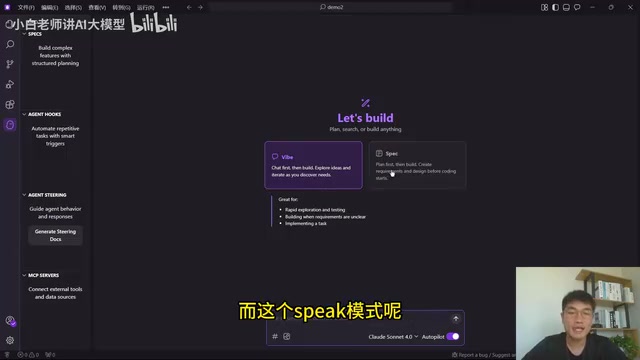
The design philosophy behind Spec Mode stems from a fusion of the classic "waterfall model" in software engineering and modern agile development thinking. Traditional software development emphasizes a linear flow of requirements analysis → system design → coding → testing → deployment, while AI programming tools commonly suffer from the problem of "skipping design and jumping straight to code generation," resulting in output that lacks holistic architectural consideration and is difficult to maintain. By enforcing requirements documentation and architecture design as prerequisite phases, Spec Mode essentially embeds software engineering best practices into the AI workflow, addressing the core pain point of "AI-generated code being high quality but low in engineering rigor."
The benefits of this design are obvious: it prevents AI from blindly generating code right away. Through upfront requirements confirmation and architecture design, it significantly improves the quality and maintainability of the final output.
Agent Hooks: Event-Triggered Automation
Kiro includes a built-in Hooks mechanism that automatically executes specific operations based on preset rules. For example:
- Automatically adding standard comment headers when creating new files
- Automatically running format checks before code commits
- Unified code style reviews during team collaboration
- Triggering automated deployment scripts
Kiro's Hooks mechanism is essentially an event-driven automation framework, sharing the same lineage as Git Hooks and triggers in CI/CD pipelines. In modern DevOps practices, automation is the core means of improving team efficiency — lint checks before code commits, automatic unit test execution, unified code style formatting, and other operations traditionally require configuration through pre-commit hooks or CI tools like Jenkins. Kiro integrates these capabilities directly at the IDE level and gives AI the ability to understand context, dramatically lowering the barrier to configuring automation rules. Even independent developers without DevOps experience can benefit from the standardization guarantees of an engineering team.
This feature is especially valuable for team development scenarios, automating many repetitive compliance checks and reducing the possibility of human oversight.
Model Support and Security Mechanisms
Kiro currently offers Claude Sonnet 4.0 and 3.7 for free, with the official version expected to be priced at $19 per month. Claude is a large language model series developed by Anthropic, a company founded by former core OpenAI members that focuses on AI safety research. The Claude Sonnet series is positioned at the balance point between performance and speed — compared to the flagship Claude Opus, Sonnet offers advantages in inference speed and cost, making it well-suited for high-frequency use cases like code generation. Claude 4.0 excels in complex logical reasoning and code architecture understanding, while 3.7 has the edge in response speed.
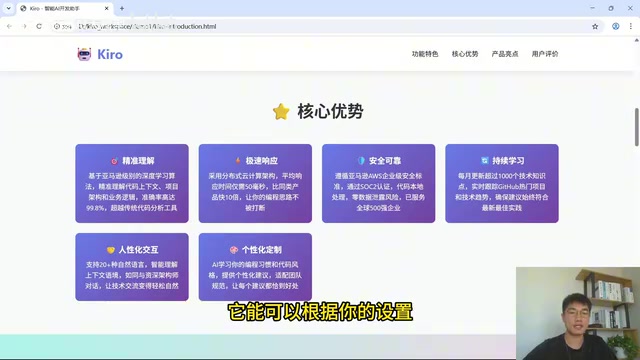
On the security front, Kiro adopts enterprise-grade security standards on par with AWS, supporting continuous learning functionality (controllable via toggle) that can personalize based on users' coding habits and historical code.
Hands-On Experience: Building an Expense Tracking System from Scratch with Spec Mode
Step 1: Requirements Phase
To test Kiro's actual capabilities, I used Spec Mode to build an expense tracking project from scratch. All I needed was to describe the requirements in natural language: "I want to build an expense tracking project that mainly records every daily expense, can aggregate data, and generate weekly and monthly reports."
Kiro immediately auto-generated a complete requirements document covering functional module breakdown, data structure design, and more. If you're not satisfied with the document content, you can edit it directly or fine-tune it through conversation. Once confirmed, click approve to proceed to the next phase.
Step 2: Design Phase
After requirements confirmation, Kiro automatically enters the architecture design phase, generating a detailed design document including:
- Overall system architecture
- Technology stack selection
- Component breakdown and functional design
- Data model design
- Detailed implementation plan and task decomposition
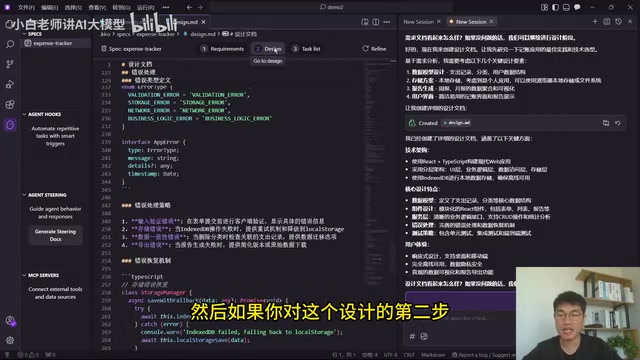
Each phase requires user confirmation before proceeding. This "Human-in-the-Loop" design ensures developers maintain control throughout, rather than being led by the AI. This concept is widely advocated in the AI safety field — ensuring human participation in reviewing critical decision points is an important principle of responsible AI system design.
Step 3: Code Implementation Phase
Kiro breaks the implementation plan into multiple Tasks and executes them step by step. Related commands run automatically in the terminal, and users only need to click "Run" to confirm when necessary. Note that since it's currently in the free trial phase, occasional interruptions requiring manual clicks to "Continue" may occur, but the overall flow is smooth.
The final expense tracking system includes the following features:
- Login Page: Complete user authentication flow
- Dashboard: Displays monthly spending totals and spending category breakdowns
- Record Management: Supports date filtering, covering categories like dining, utilities, entertainment, etc.
- Settings Center: Theme switching, currency settings, category management, data export
- Add Record: Supports fields for date, amount, category, notes, payment method, etc.
No code was written by hand throughout the entire process. The complete project from requirements to a runnable application was entirely generated by Kiro.
Kiro vs. Cursor and Other AI Programming Tools: Comparative Analysis
| Dimension | Kiro | Cursor |
|---|---|---|
| Development Mode | Dual Vibe + Spec modes | Primarily conversational |
| Process Structure | Three-phase: Requirements → Design → Implementation | Direct code generation |
| Free Models | Claude 4.0/3.7 (limited-time free) | Limited free quota |
| Automation | Hooks event-trigger mechanism | Rules system |
| Security Level | AWS enterprise-grade standards | Standard security |
| Expected Pricing | $19/month | $20/month |
The current AI programming tool market has formed clear pricing tiers: GitHub Copilot Individual is around $10/month, Cursor Pro and Windsurf Pro are both around $20/month, while enterprise versions typically exceed $40. Kiro's $19/month pricing puts it in direct competition with Cursor, but offering full Claude 4.0 access during the free trial period is a highly attractive market strategy. It's worth noting that the real cost of these tools primarily comes from large model API call fees, and Amazon's structural advantage on the cost side — thanks to its strategic relationship with Anthropic — provides a foundation for maintaining competitive pricing long-term.
Kiro's greatest advantage lies in Spec Mode's structured development workflow. For medium to large projects, the plan-first-code-later approach can significantly reduce rework and technical debt. Cursor, however, still has its advantages in rapid iteration and instant responsiveness.
Kiro Usage Recommendations and Notes
-
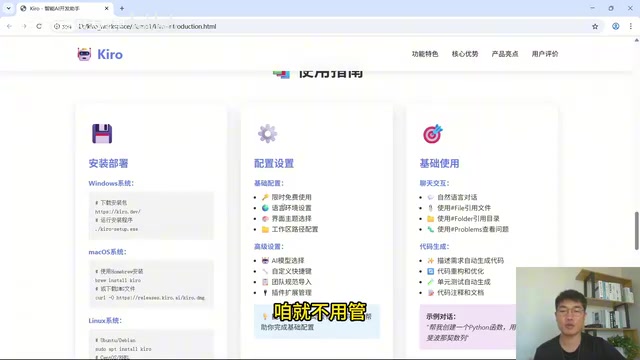
Installation: Kiro's official website currently has a waitlist mechanism, indicating high user demand. It supports Windows, Mac, and Linux platforms.
-
Mode Selection: Use Vibe Mode for simple code modifications and quick Q&A; for complete project development, Spec Mode is strongly recommended — it helps you clarify your thinking and standardize your workflow.
-
Model Selection: Claude 4.0 is stronger for complex logic processing, while 3.7 responds faster. Switch flexibly based on task complexity.
-
Getting Started Tutorial: Kiro officially provides a "Learn by doing" interactive tutorial. New users are encouraged to follow the guided steps to quickly master the software.
Conclusion: Is Kiro Worth Trying for Developers?
As Amazon's first product in the AI programming space, Kiro demonstrates impressive capabilities. Spec Mode's structured development workflow is its greatest differentiating advantage, elevating AI programming from "rapid code generation" to "standardized project development" — a philosophy that aligns closely with decades of accumulated software engineering best practices, rather than merely pursuing generation speed. While there's still room for improvement in stability, considering the free access to Claude 4.0 and AWS-level security guarantees, Kiro is absolutely worth trying for every developer.
Related articles
 Product Reviews
Qoder vs Cursor Real-World Comparison: Which $20/Month AI IDE Is Better?
Hands-on comparison of Qoder vs Cursor AI IDEs: Agent autonomy, human interaction count, and architecture decisions. Qoder needed only 2 interactions vs Cursor's 8.
 Product Reviews
Cursor Cloud Agent Demo: Eliminating Bottlenecks Across the Entire Software Development Lifecycle
Deep analysis of Cursor's Cloud Agent demo showing how cloud VMs, automated test artifacts, and a full-chain control plane systematically eliminate human bottlenecks across the software development lifecycle.
 Product Reviews
Cursor 3.0 Deep Dive: Multi-Agent Parallelism, Design Mode, and Best-of-N Model Comparison
Cursor 3.0 evolves from an AI coding assistant into an Agent fleet command center. Explore multi-agent parallelism, Design Mode, and Best-of-N model comparison.