API Aggregation Proxy Platforms Tested: One Interface to Call 100+ AI Models
API Aggregation Proxy Platforms Tested…
API proxy platforms unify multiple AI model interfaces, lowering the barrier to multi-model access.
API proxy platforms use reverse proxy and adapter pattern architectures to consolidate models from Claude, Gemini, GPT, and others under a single interface. This article tests GPT-Image2 image generation via APImart, with a single generation costing only about $0.006. These platforms suit individual developers and small teams for quick experimentation, but production use requires attention to stability, cumulative Token billing, and data security risks.
What Is an API Proxy Platform?
With the explosive growth in the number of AI models, developers and individual users face a practical problem: different models are scattered across different platforms, each with its own independent API interface, billing system, and integration method. API proxy platforms (also known as aggregated API platforms) emerged to solve this — they consolidate models from multiple providers under a single interface, allowing users to call hundreds of models after just one integration.
From a technical standpoint, an API proxy platform is essentially a Reverse Proxy architecture. It acts as a middleware layer between user requests and the original AI service providers, dynamically converting standardized user requests (typically compatible with OpenAI's API format) into each provider's proprietary protocol format, then packaging the returned results uniformly before sending them back. This design pattern is known as the "Adapter Pattern" in software engineering, with its core value being the abstraction of underlying differences behind a unified interface. Because of this, developers can use the same codebase and freely switch between completely different underlying services like Claude, Gemini, and GPT simply by changing the model name parameter.
This article uses a proxy platform called APImart as an example to hands-on test its model calling capabilities and see how these platforms actually perform in daily use.
Hands-On Test: GPT-Image2 Image Generation Quality & Cost
Generation Process Demo
For this test, I chose the recently popular GPT-Image2 model for image generation. This is OpenAI's next-generation image generation capability, known for its understanding of Chinese prompts and quality of human figure generation.
It's worth noting that GPT-Image2 represents a significant evolution compared to the earlier DALL-E series — it deeply integrates GPT's language understanding capabilities, with the underlying architecture employing a hybrid of Diffusion Models and autoregressive language models, making text rendering, composition logic, and style control much more refined. Particularly in Chinese semantic understanding, it can parse more complex scene descriptions rather than just keyword stacking.
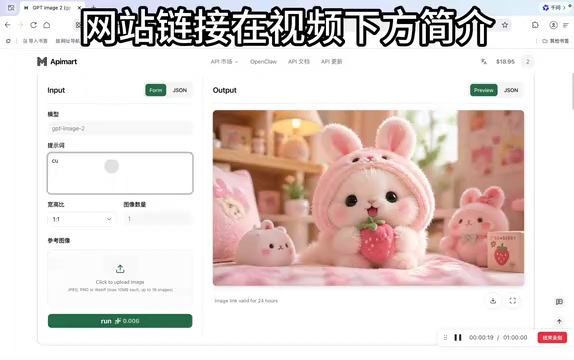
During testing, I used a relatively simple prompt. The entire calling process was completed through the proxy platform's unified interface, with no need to separately configure an OpenAI API key.
Generation Results & Cost Breakdown
From the actual test, the cost per image generation was approximately $0.006, roughly 4 Chinese cents (RMB). This price is quite friendly for individual developers or light users, and the pay-per-use model also avoids the waste that monthly subscriptions might incur.
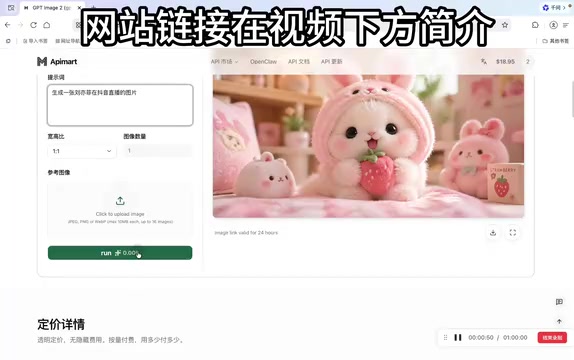
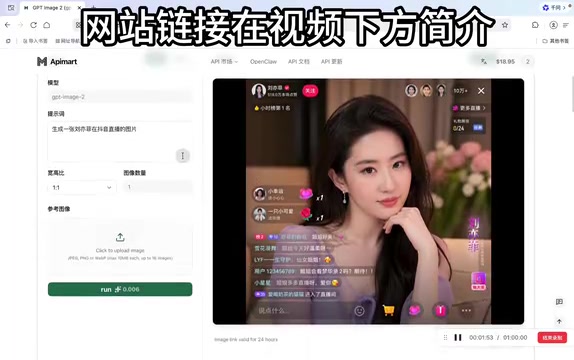
After generation, you can directly preview the image result. Although the prompt used in testing was relatively simple, the model still produced usable output.
Model Coverage: Which Mainstream AI Models Are Supported?
Language, Image, and Video Models All in One Place
The platform claims to cover over a hundred models. From the actual interface, supported model types include:
- Language Models: Claude Sonnet 4, Gemini 2.5 Pro, Llama 3.3, and other current mainstream large language models
- Image Generation: GPT-Image2 and other image models
- Video Generation: Some video generation models are also on the supported list
This "one-stop" model aggregation is genuinely convenient for users who need to switch between different models for different tasks — use Claude for coding, Gemini for analysis, GPT-Image2 for image generation, all on the same platform.

Use Case Analysis
These API proxy platforms are primarily suited for the following types of users:
- Individual Developers: Don't want to register on multiple platforms separately or manage multiple sets of API keys
- Small Teams: Need rapid prototype validation with minimal integration costs
- AI Application Builders: Need to flexibly switch between different models within applications to achieve optimal results
Usage Tips & Considerations
When choosing an API proxy platform, several key factors are worth paying attention to:
Stability: Proxy platforms essentially relay requests through an additional layer, which can affect latency and availability. It's recommended to have fallback plans in place for production projects.
Pricing Transparency: While pay-per-use is flexible, be aware of price differences between models. GPT-Image2 at $0.006 per call seems cheap, but for GPT-4o-level long conversations, accumulated token consumption shouldn't be ignored.
Here it's important to understand the details of the Token billing mechanism: Tokens are not simply equivalent to characters or words. In English, one Token corresponds to approximately 4 characters; in Chinese, due to different encoding methods, one Chinese character typically corresponds to 1-2 Tokens. GPT-4o-level models typically cost several dollars per million Tokens for input/output, and in long conversation scenarios, the context window carries all historical messages, causing Token consumption to grow linearly — this is the main reason costs can exceed expectations. It's recommended to estimate Token usage for typical conversations before use.
Data Security: Requests passing through a third party means your prompts and returned content are theoretically visible to the proxy operator. From an information security perspective, this presents a "Man-in-the-Middle" risk — even if the proxy platform claims not to log data, users have no way to independently verify this. For enterprise users, it's recommended to evaluate whether the proxy platform holds security compliance certifications such as SOC 2 or ISO 27001, or whether it supports private deployment. Individual users should avoid transmitting content containing personally identifiable information (PII), trade secrets, or medical data through proxy platforms. Scenarios involving sensitive data require careful evaluation.
Conclusion
API aggregation proxy platforms lower the barrier to multi-model calling and are a solid choice for personal experimentation and lightweight development. However, in production environments, you still need to weigh factors like stability, security, and cost. If you simply want to quickly experience the latest capabilities of various models, these platforms do provide a low-friction entry point.
Key Takeaways
- API proxy platforms are based on reverse proxy and adapter pattern architectures, consolidating multiple AI models into a single interface to lower the barrier to multi-model calling
- GPT-Image2 uses a hybrid architecture of diffusion models and autoregressive language models, with a single generation costing approximately $0.006, offering flexible pay-per-use billing
- The platform covers 100+ mainstream models including Claude Sonnet 4, Gemini 2.5 Pro, and Llama 3.3
- Suitable for individual developers and small teams for quick experimentation and prototype validation
- When using proxy platforms, be aware of risks related to stability, cumulative Token billing effects, and man-in-the-middle data security concerns
Related articles
 Product Reviews
Qoder vs Cursor Real-World Comparison: Which $20/Month AI IDE Is Better?
Hands-on comparison of Qoder vs Cursor AI IDEs: Agent autonomy, human interaction count, and architecture decisions. Qoder needed only 2 interactions vs Cursor's 8.
 Product Reviews
Cursor Cloud Agent Demo: Eliminating Bottlenecks Across the Entire Software Development Lifecycle
Deep analysis of Cursor's Cloud Agent demo showing how cloud VMs, automated test artifacts, and a full-chain control plane systematically eliminate human bottlenecks across the software development lifecycle.
 Product Reviews
Cursor 3.0 Deep Dive: Multi-Agent Parallelism, Design Mode, and Best-of-N Model Comparison
Cursor 3.0 evolves from an AI coding assistant into an Agent fleet command center. Explore multi-agent parallelism, Design Mode, and Best-of-N model comparison.