Atoms Cloud: Zero-Config Database, Auth, and Payment Integration for AI Full-Stack Development

Atoms Cloud uses AI to zero-config enable backend services, bridging the gap from demo to product.
Atoms Cloud is a tool for indie developers that uses AI to automatically identify project requirements and zero-config enable backend services including databases, user authentication, Stripe payments, and deployment. By deeply fusing BaaS with AI code generation, it supports seamless migration for existing projects while retaining manual control flexibility, dramatically lowering the full-stack development barrier and providing the shortest path from idea to launch for rapid MVP validation.
The Last Mile from Demo to Product
For indie developers and small teams, turning a prototype demo into a production-ready product often means a mountain of tedious infrastructure configuration work—database setup, user authentication systems, payment integration, deployment pipelines—each of which can consume days or even weeks. Atoms Cloud attempts to solve this problem in an ultra-minimalist way: letting AI automatically identify your needs and connect all backend services with a single click.
This pain point has persisted because, while modern web application backend infrastructure is highly mature, the selection, configuration, and integration between various services still requires numerous engineering decisions. A seemingly simple "user login + paid subscription" feature might involve coordinating over a dozen technical components including authentication services, payment gateways, database schema design, API routing, webhook handling, and more.
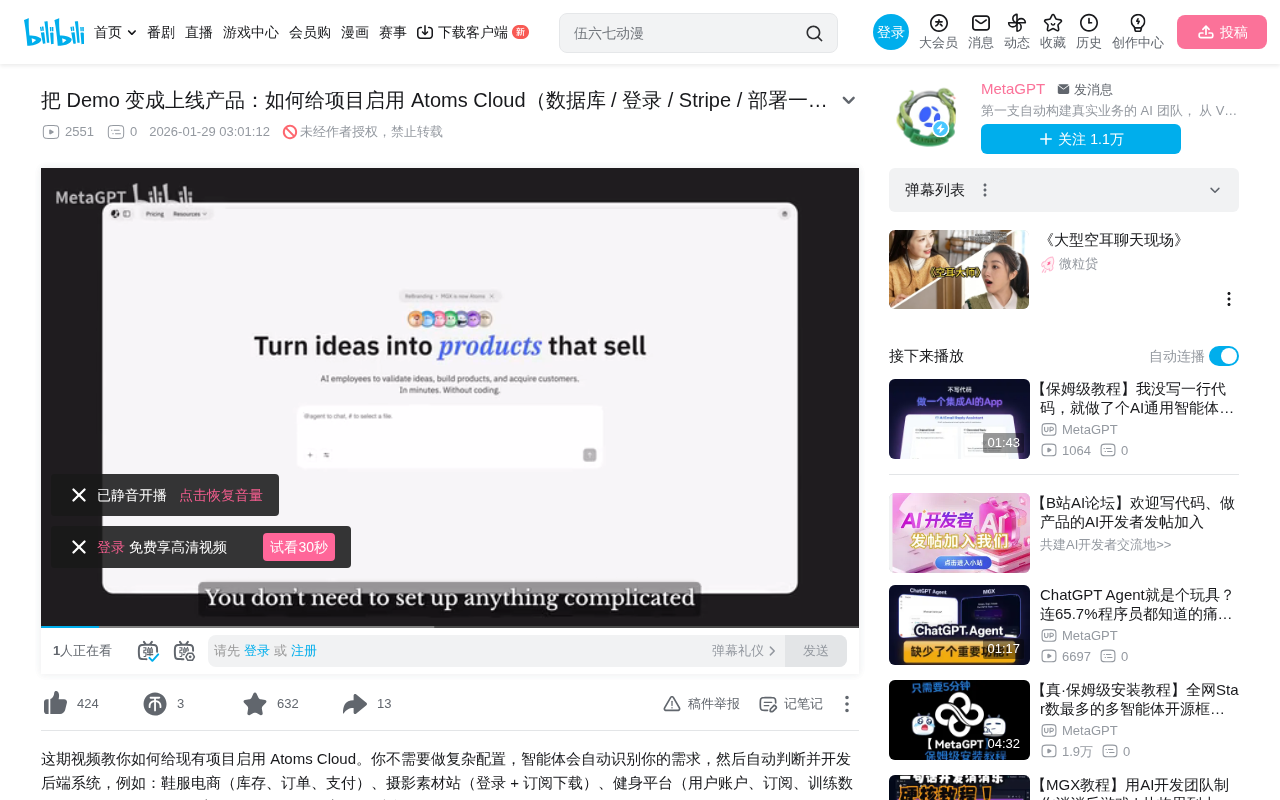
Atoms Cloud's Core Philosophy: Zero-Config Auto-Activation
AI Automatically Identifies Project Requirements
Atoms Cloud's biggest highlight is its "zero-config" design philosophy. You don't need to manually set up any complex backend services—Atoms analyzes your natural language description, automatically determines whether the project needs cloud capabilities, and activates Atoms Cloud when necessary.
This capability builds on the rapid evolution of AI code generation technology. From early GitHub Copilot providing line-level code completion, to Cursor, Windsurf, and other AI editors extending contextual understanding to entire codebases, to Bolt, Lovable, v0, and similar products generating complete frontend applications directly from natural language—AI-assisted development tools have leaped from "code snippets" to "complete applications." Atoms Cloud represents the latest stage of this evolution: not only generating frontend code but also automatically orchestrating and configuring backend services, forming true end-to-end application generation capability. The underlying driver of this trend is the continuous improvement of large language models (LLMs) in code comprehension, intent reasoning, and multi-step planning.
Here's a concrete example: when you input "Build a minimalist photography store where users must log in and subscribe to download high-resolution photos," Atoms automatically analyzes that this project needs:
- User authentication system (login functionality)
- Subscription payments (Stripe integration)
- Database (storing user and subscription information)
- File storage and access control (access control for high-resolution photos)
The system automatically activates Atoms Cloud and completes all configuration, with the entire process being completely transparent to the developer.
Seamless Migration for Existing Projects
For existing projects, even those that haven't previously enabled Atoms Cloud, the migration process is equally simple. You just describe your new requirements in natural language—for example, "Add user login and Stripe payments to this project"—and Atoms automatically handles all the remaining work. This means you can quickly validate your product idea first, then seamlessly connect full backend services when it's time to go live.
This progressive integration design aligns closely with the MVP (Minimum Viable Product) concept from lean startup methodology. The core idea of MVP is to build a product version that can validate core assumptions with minimal resources, iterating quickly through real user feedback to avoid over-investing in unvalidated directions. In practice, the key challenge of MVP is often not feature development itself, but building the infrastructure around core features—user systems, payment flows, data persistence, and other "necessary but non-differentiating" engineering work. Atoms Cloud's value lies precisely in compressing these infrastructure costs to near zero, enabling developers to devote nearly all their energy to validating core product value.
Retaining Manual Control Flexibility
While automation is Atoms Cloud's core selling point, the team has also considered developers' need for control, offering two manual activation methods:
Method 1: Chat Input Quick Button
Above Atoms' chat input box, there's a quick button to directly enable Atoms Cloud. This is suitable for scenarios where you clearly know the project needs cloud capabilities but haven't started describing specific requirements yet.
Method 2: Workspace View Toggle
In the workspace, you can switch to the Atoms Cloud view, which provides a more detailed cloud service management interface, including a manual activation button and configuration status for each service.
Technical Architecture: Four Core Modules of Full-Stack as a Service
Based on the product description, Atoms Cloud integrates the four most common backend needs of modern web applications:
| Service Type | Function | Typical Scenarios |
|---|---|---|
| Database | Persistent data storage | User information, order records |
| Authentication | User login/registration | Membership systems, access control |
| Stripe Payments | Subscriptions/one-time payments | SaaS subscriptions, e-commerce transactions |
| Deployment | One-click publishing | Production environment deployment |
This "Full-Stack as a Service" model essentially represents a deep fusion of BaaS (Backend as a Service) with AI code generation. BaaS is a cloud computing service model that provides backend infrastructure to developers in the form of APIs and SDKs, eliminating the need to build and maintain servers themselves. Representative products include Google's Firebase, the open-source alternative Supabase, and AWS Amplify. Traditional BaaS has already significantly lowered the barrier to backend development, but developers still need to make selection decisions across multiple platforms and manually complete the configuration and integration of each service. Atoms Cloud goes a step further by automating the BaaS configuration process through an AI understanding layer—developers don't even need to know which specific BaaS service is being used under the hood.
Among the four modules, authentication and Stripe payments deserve special attention for their automated configuration, as these two areas have the highest manual integration complexity.
Modern user authentication systems are typically built on the OAuth 2.0 authorization framework and OpenID Connect (OIDC) protocol. OAuth 2.0 allows users to authorize third-party applications to access their resources on other services without exposing their passwords (e.g., "Sign in with Google"). Building a secure authentication system involves numerous security considerations including token management (Access Token, Refresh Token), session control, CSRF protection, password hash storage (e.g., bcrypt), multi-factor authentication (MFA), and more. The emergence of specialized authentication services like Auth0, Clerk, and Supabase Auth has already greatly simplified this process, while Atoms Cloud delegates even the selection and configuration decisions to AI.
Stripe payment integration is likewise far from simply calling a few APIs. Developers need to handle webhook callbacks (for receiving payment status change notifications), manage subscription lifecycles (trials, upgrades/downgrades, cancellations, refunds), handle invoices and tax compliance, implement card information processing under PCI DSS security standards, and deal with various edge cases (such as payment failure retries, 3D Secure secondary verification, etc.). Traditionally, a complete Stripe subscription system might require one to two weeks of development time—precisely the pain point Atoms Cloud aims to eliminate through automation.
Practical Significance for Indie Developers
The emergence of tools like this is redefining the barrier to "full-stack development." In the past, a frontend developer wanting to independently launch a SaaS product with payment functionality might need to learn database design, OAuth protocols, webhook handling, and a whole series of backend knowledge. Now, this complexity is encapsulated beneath AI's understanding layer.
From a broader perspective, this reflects a decades-long trend in software development: abstraction levels continuously moving upward. From assembly language to high-level programming languages, from manually managing servers to cloud computing, from writing SQL to ORM frameworks—each elevation in abstraction level has enabled more people to participate in software creation. The "natural language to full-stack application" approach that Atoms Cloud represents may be another important milestone in this trend—it removes the complexity of backend engineering from developers' cognitive burden, making product thinking rather than technical ability the core barrier to creating software products.
Of course, this high level of abstraction also means that when encountering complex business logic or needing deep customization, developers may need to return to traditional development approaches. Highly automated tools are extremely efficient at handling standardized scenarios, but when business requirements exceed preset patterns—such as needing custom payment flows, complex multi-tenant data isolation, or specific compliance requirements—developers still need to understand underlying technical principles. This is also an important reason why Atoms Cloud retains manual control options.
But for MVP validation and rapid iteration, Atoms Cloud provides the shortest path from idea to live product.
Interested developers can experience this feature at atoms.dev.
Key Takeaways
- Atoms Cloud uses AI to automatically identify project requirements, enabling zero-config activation of database, authentication, payment, and deployment services
- Supports seamless integration for existing projects—just describe your needs in natural language to complete backend service migration
- Retains manual control options, offering both chat quick buttons and workspace view activation methods
- Deeply fuses BaaS with AI code generation, significantly lowering the full-stack development barrier
- Ideal for rapid MVP validation scenarios, dramatically shortening the path from demo to live product
Related articles
 Product Reviews
Qoder vs Cursor Real-World Comparison: Which $20/Month AI IDE Is Better?
Hands-on comparison of Qoder vs Cursor AI IDEs: Agent autonomy, human interaction count, and architecture decisions. Qoder needed only 2 interactions vs Cursor's 8.
 Product Reviews
Cursor Cloud Agent Demo: Eliminating Bottlenecks Across the Entire Software Development Lifecycle
Deep analysis of Cursor's Cloud Agent demo showing how cloud VMs, automated test artifacts, and a full-chain control plane systematically eliminate human bottlenecks across the software development lifecycle.
 Product Reviews
Cursor 3.0 Deep Dive: Multi-Agent Parallelism, Design Mode, and Best-of-N Model Comparison
Cursor 3.0 evolves from an AI coding assistant into an Agent fleet command center. Explore multi-agent parallelism, Design Mode, and Best-of-N model comparison.