Augment Remote Agent Hands-On: Running 10 Cloud AI Agents in Parallel for Programming
Augment Remote Agent Hands-On: Running…
Augment Remote Agent ushers in a new era of multi-Agent parallel collaboration for AI programming
Augment's Remote Agent feature supports up to 10 cloud Agents working in parallel on programming tasks, continuing even after you shut down your computer. Key advantages include a semantic indexing engine for millisecond-level context retrieval, independent containerized cloud execution, and MCP toolchain sharing. Real-world testing covers documentation generation, cross-project bug fixes, UI optimization, and model replacement, demonstrating a capability leap from instruction execution to autonomous decision-making.
AI Programming Officially Enters the Multi-Agent Era
While we're still debating whether Cursor or Copilot is better, the competition among AI programming tools has quietly escalated to a new dimension—multi-Agent parallel collaboration. Augment released its Remote Agent feature in early May this year, ahead of both Cursor Background Agent and OpenAI Codex, supporting up to 10 cloud Agents running simultaneously. From fixing bugs to submitting PRs, everything is fully automated—and it keeps working even after you shut down your computer.
Multi-Agent Systems (MAS) represent an important branch of artificial intelligence. The core idea is to decompose complex tasks into multiple subtasks, processed in parallel by multiple Agents with autonomous decision-making capabilities. In the AI programming tools space, introducing this architecture marks a paradigm shift from "single-threaded assistance" to "parallel autonomy." Traditional AI programming assistants (like early Copilot) were essentially synchronous code completion tools, while multi-Agent architecture allows multiple independent AI instances to simultaneously explore different solution paths, dramatically improving processing efficiency for complex engineering tasks.
This article provides an in-depth analysis of Augment Remote Agent's core capabilities, usage methods, and real-world results based on creator Kate's hands-on experience.
What Is Remote Agent? Why Should You Care?
Remote Agent is essentially an AI programming assistant running in independent cloud containers. Each Agent is built on an Ubuntu 22.04 image with a complete development environment, capable of independently executing code editing, testing, committing, and other operations.
The containerized environment is built on Docker/OCI container technology, with each Agent instance having fully isolated file systems, network stacks, and process spaces. This architecture ensures that multiple Agents running in parallel don't interfere with each other while providing a reproducible, standardized development environment. Container images come pre-installed with common programming language runtimes, package managers, and development toolchains, enabling Agents to directly execute compilation, testing, Git operations, and other complete development workflows without additional environment configuration steps.
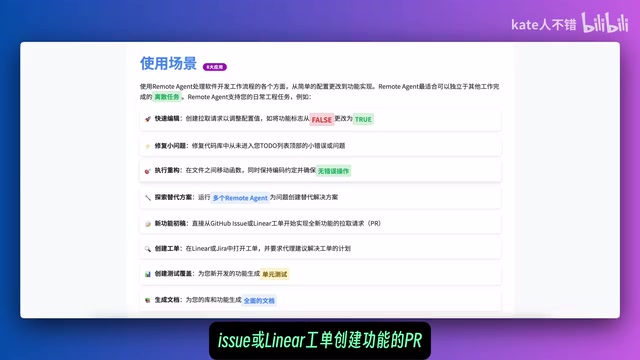
Its core use cases include:
- Quick code edits: Fixing those small bugs that never make it to the top of the priority list
- Code refactoring: Structural optimization of existing code
- Parallel solution exploration: Running multiple Agents simultaneously to provide different solutions for the same problem
- Automated PR creation: Generating feature PRs directly from GitHub Issues or Linear tickets
- Documentation generation: Creating complete technical documentation for libraries or modules
- Unit test generation: Automatically writing test cases for new features
Two Most Compelling Features
First, true "offline" working capability. Remote Agent runs in independent cloud containers, so even if you shut down your computer, it continues coding and submitting merge-ready PRs. Imagine assigning several tasks to your Agents before heading out in the morning, then coming back after coffee to review the results.
Second, powerful context management. Augment's semantic indexing can retrieve relevant code snippets in milliseconds, ensuring Agents maintain context consistency across complex multi-repository projects. This is crucial in practice—an Agent without context understanding only creates more problems.
Semantic Indexing is one of the core technologies behind modern code intelligence. It goes beyond traditional keyword matching by converting code snippets into high-dimensional vector embeddings and computing semantic similarity in vector space. Augment's semantic indexing engine preprocesses the entire code repository, building a semantic graph of the code that includes function call relationships, data flow, module dependencies, and other structural information. When an Agent needs to understand the context of a code segment, the system can retrieve semantically related code snippets in milliseconds through Approximate Nearest Neighbor (ANN) search algorithms—critical for handling large multi-repository projects.
Case Study 1: Technical Documentation Generation and Project Analysis
Kate's first practical scenario was highly useful: quickly understanding a new project. The traditional approach involves cloning the repository locally and reading through files one by one. With Remote Agent, you simply fork the original repository, prompt the Agent in natural language to generate technical documentation, then create a PR with one click—all done in the cloud.
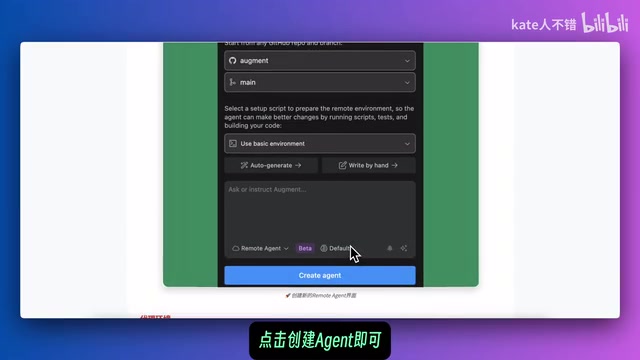
Detailed Workflow
Here are the specific steps:
- Open the Augment plugin panel and click the top-right icon to view the Remote Agent list
- Connect your GitHub account, select the target repository and branch
- Choose the runtime environment (use preset environments or custom scripts)
- Enter your requirements in natural language in the prompt box
- Click "Create Agent" and you're done
You'll receive notifications when the Agent completes a task or needs confirmation. If you need to edit files directly, you can SSH into the Agent environment.
While analyzing a project that simulates parallel multi-terminal work, Kate asked Augment to determine whether the project could actually run thousands of terminals. Augment accurately answered: This is a real multi-terminal system that can indeed create tens of thousands of terminal windows, but the content within the terminals consists of preset simulated data and typing animations rather than real command execution. When exceeding 1,000 terminals, only the most recent 40 to 80 are displayed. This depth of code comprehension is impressive.
Case Study 2: Cross-Project Bug Fixing and Automated PR Submission
While building a Gemma 3N application, Kate discovered a decoding error in the MXVLM project—Chinese text input was being corrupted. After solving the problem locally, she used Remote Agent to complete the fix for the upstream project.
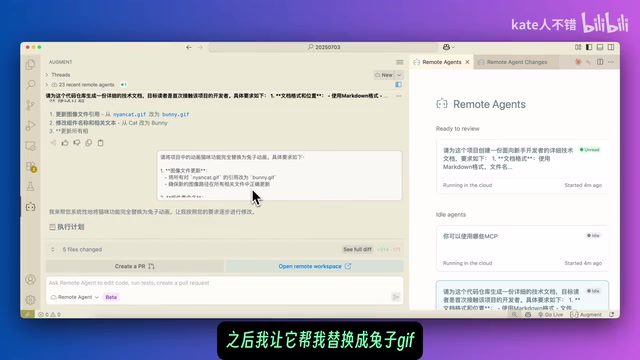
Fix Process Breakdown
The entire workflow demonstrates several key capabilities of Remote Agent:
- Problem identification: The Agent not only fixed the issue Kate pointed out but also searched multiple times through the context engine, identifying and fixing several related issues simultaneously
- Compatibility assurance: After completing the fix, the Agent proactively summarized that the changes were backward-compatible and wouldn't affect English or other languages
- Zero local resource consumption: The entire fork, fix, and PR creation process was completed entirely in the cloud
Additionally, Kate tested using Remote Agent to find critical bugs in the OpenCode project. Augment invoked the context engine multiple times to locate issues and provided detailed modification plans. When she shared the original repository's Issue link with Augment, it quickly analyzed the bug and provided solutions.
Case Study 3: Comprehensive Upgrade of an AI Creative Project
The best demonstration of Remote Agent's comprehensive capabilities was Kate's complete overhaul of her own AI creative project. The project originally had rich functionality but a crude interface. Through multiple rounds of Agent collaboration, the following upgrades were completed:
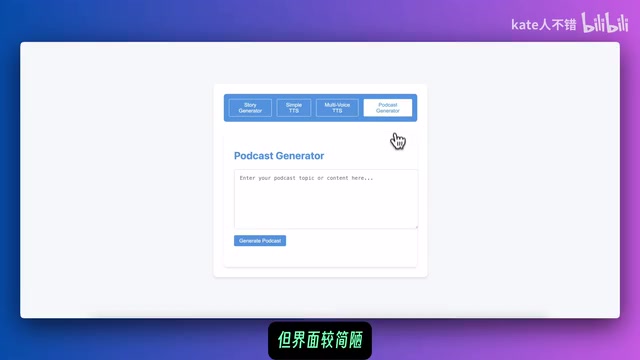
UI Interface Optimization
The Agent first analyzed the project structure and tech stack, developed a modification plan, and completed a satisfying interface makeover with just a single prompt.
Voice Model Replacement
Replaced the English-only Cocoro model with the multilingual Minimax Speech 2. Minimax Speech 2 is a multilingual text-to-speech (TTS) model developed by Chinese AI company MiniMax, supporting multiple languages including Chinese, English, and Japanese, with advanced features like emotion control and voice cloning. Compared to the English-only Kokoro model, its multilingual capability comes from pre-training on large-scale multilingual speech data and specialized optimization for different language phoneme systems. In AI creative applications, the language coverage of a TTS model directly determines the product's audience reach—this was Kate's core motivation for replacing the underlying model. After multiple searches and edits, the Agent restarted the server and performed automated testing verification using Playwright MCP.
Intelligent Image Model Upgrade
This segment best demonstrates the Agent's "intelligence." Kate requested replacing the AI image generation model with Black Forest Labs' Context series. Black Forest Labs is an image generation AI company founded by core members of the Stable Diffusion team, known for their FLUX series models' high-quality image generation and flexible conditional control. The FLUX Context series is a variant designed specifically for image editing and context-aware generation. Through web search, Augment discovered:
- Flex Context Dev doesn't support text-to-image and requires image input (positioned as a development/testing version that mandates image input as a reference condition)
- Flex Context Pro and Max don't require image input (supporting pure text-to-image generation workflows with broader applicability)
Based on this assessment, the Agent proactively excluded the unsuitable model and expanded support to 5 selectable models. This kind of autonomous judgment and decision-making—proactively gathering information through tool calls, identifying technical constraints, and adjusting plans accordingly—goes beyond simple "instruction execution," demonstrating a key characteristic of evolution from "instruction executor" to "autonomous decision-maker."
Multilingual Support and Documentation
Finally, the Agent also completed Chinese localization of the interface and added operational instructions, with all modifications going through comprehensive automated testing.
MCP Tool Sharing: A Noteworthy Detail
During her usage, Kate discovered an interesting phenomenon: Remote Agent could use the MCP tools she had configured in her local Augment setup. She had configured multiple MCPs (including Playwright), and once noticed that Remote Agent proactively invoked Playwright MCP for automated testing. After inquiry, she confirmed that Remote Agent's MCP configuration was identical to her local setup.
MCP (Model Context Protocol) is an open standard protocol introduced by Anthropic in late 2024, designed to solve the integration fragmentation between AI models and external tools/data sources. MCP uses a client-server architecture that allows AI assistants to call various external tools through a unified protocol interface, including browser automation (Playwright), database queries, file system operations, and more. The Playwright MCP server enables AI Agents to control browsers like real users, executing end-to-end UI tests—particularly important when verifying frontend changes. Remote Agent's ability to share local MCP configurations means Augment reproduces the complete local tool ecosystem in the cloud, greatly reducing context-switching costs between cloud and local development environments.
This means the toolchain you've carefully configured locally can seamlessly extend to cloud Agents, dramatically reducing the redundant cost of environment configuration.
Summary: Augment Remote Agent's Core Competitive Advantages
From hands-on experience, Augment Remote Agent's core advantages come down to three points:
- True parallel capability: 10 Agents working simultaneously, ideal for scenarios with clear task boundaries and well-defined goals
- Excellent context management: The semantic indexing engine prevents Agents from getting "lost" in complex projects
- Independent cloud execution: No local resource consumption, continues working even when your machine is off
Currently, multiple companies are competing for the Remote Agent market. It's foreseeable that multi-Agent systems and multi-level AI parallel exploration approaches will become the next battleground for AI programming tools. Augment, paired with Claude 4 models and powerful context management, has already demonstrated clear competitiveness in this space.
For developers, it's time to rethink your workflow—those long-backlogged small bugs, documentation you've been putting off, and legacy code that needs refactoring can perhaps all be handed off to cloud Agents.
Related articles
 Product Reviews
Qoder vs Cursor Real-World Comparison: Which $20/Month AI IDE Is Better?
Hands-on comparison of Qoder vs Cursor AI IDEs: Agent autonomy, human interaction count, and architecture decisions. Qoder needed only 2 interactions vs Cursor's 8.
 Product Reviews
Cursor Cloud Agent Demo: Eliminating Bottlenecks Across the Entire Software Development Lifecycle
Deep analysis of Cursor's Cloud Agent demo showing how cloud VMs, automated test artifacts, and a full-chain control plane systematically eliminate human bottlenecks across the software development lifecycle.
 Product Reviews
Cursor 3.0 Deep Dive: Multi-Agent Parallelism, Design Mode, and Best-of-N Model Comparison
Cursor 3.0 evolves from an AI coding assistant into an Agent fleet command center. Explore multi-agent parallelism, Design Mode, and Best-of-N model comparison.