Can News About Declining Birth Rates Actually Boost Fertility? The Deep Logic of Information Feedback Loops

Can declining birth rate news serve as a negative feedback loop to boost fertility? Intriguing in theory, limited in practice.
A viral tweet proposes that news about declining birth rates constitutes a biological self-balancing negative feedback mechanism that may stimulate people to consider having children. This article analyzes the logic from a cybernetics perspective but argues that structural barriers like economic pressure, algorithm-driven information cocoons, and global historical data all demonstrate that information feedback alone is far from sufficient to reverse declining fertility trends—real solutions require systemic institutional reform.
An Intriguing Idea: Information Dissemination as a Biological Feedback Loop
Recently, a tweet about fertility rates sparked widespread discussion on social media. The poster proposed a thought-provoking idea: news and discussions about declining birth rates are themselves part of humanity's self-balancing biological mechanism.
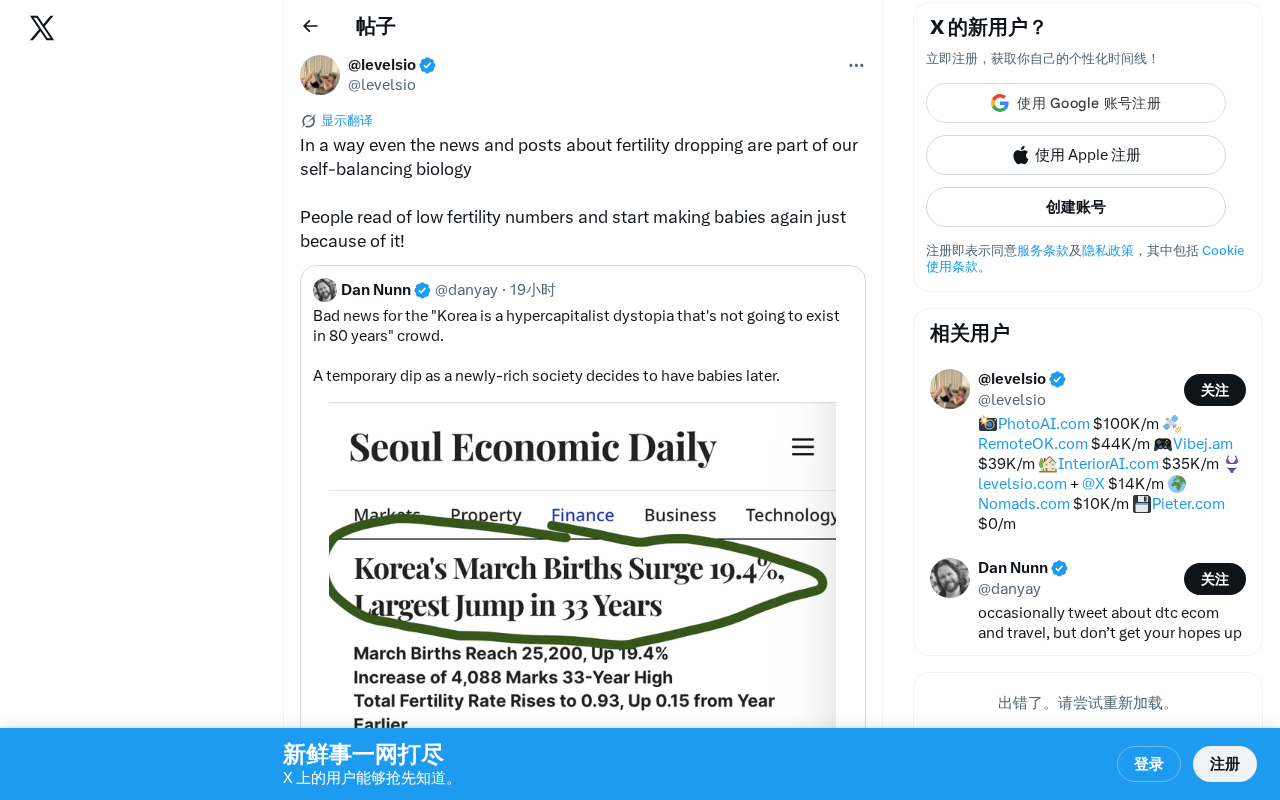
The logic is simple—when people are constantly exposed to reports about falling birth rates, they develop a sense of urgency that leads them to consider having children, ultimately pushing birth rates back up. It sounds like a joke, but it actually touches on deep intersections between information dissemination, social psychology, and evolutionary biology.
From a Cybernetics Perspective: How Negative Feedback Loops Could Regulate Birth Rates
Cybernetics was systematically introduced by mathematician Norbert Wiener in his 1948 book of the same name, focusing on the laws of control and communication in animals and machines. Within this framework, negative feedback loops are the core mechanism for maintaining system stability—part of the system's output is "fed back" to the input to counteract deviations and maintain homeostasis. A thermostat is a classic example: it activates heating when the temperature drops too low and stops when it rises too high, keeping the system within a relatively stable range. In biology, negative feedback is equally ubiquitous: blood sugar regulation, body temperature maintenance, and hormone secretion all rely on this mechanism. It's worth noting that critics point out that social systems are far more complex than mechanical or biological ones, and delays, noise, and nonlinear effects in feedback signals often make prediction extremely difficult.
Applying this framework to the birth rate issue:
- Signal Detection: Society observes that birth rates continue to decline
- Signal Amplification: Media reports extensively, social platforms spread the word widely
- Behavioral Adjustment: Some segments of the population, stimulated by this information, reconsider their reproductive plans
- System Correction: Birth rates experience a degree of recovery
This approach treats human society's information dissemination system as a kind of "distributed biological regulator," with news media and social networks playing a role similar to the nervous system—sensing deviations, transmitting signals, and triggering responses.
Reality Is Far More Complex Than Theory
However, while this idea is clever, it faces numerous challenges in practice.
Information Doesn't Equal Action: Structural Barriers Are Hard to Overcome
There is an enormous gap between knowing that birth rates are declining and deciding to have a child. Reproductive decisions are constrained by multiple factors including economic pressure, housing costs, career development, and childcare support systems. A single news story can hardly budge these deeply entrenched structural barriers. According to survey data from multiple countries, the proportion of young people who "want children but don't dare to" far exceeds those who "don't want children at all"—the core issue isn't about willingness but about conditions.
Information Cocoons May Weaken the Feedback Effect
In algorithm-driven information environments, news about declining birth rates may not reach the most relevant audiences. The concept of the Information Cocoon was proposed by legal scholar Cass Sunstein in 2001, describing people's tendency to consume content that aligns with their existing views. In the age of algorithmic recommendations, this effect has been significantly amplified—modern social media platforms use users' historical behavior as their core training signal, essentially optimizing for "time spent" rather than equitable social coverage of information. This means birth rate-related content is highly likely to circulate predominantly among married and already-parenting groups, while algorithms may actually screen it out for young, single individuals who haven't yet formed reproductive intentions. People who already have children may pay more attention to such topics, while younger groups not yet considering parenthood may never see this content at all. The effectiveness of a feedback loop depends on whether the signal can reach the correct "receptors," and algorithmic mechanisms structurally undermine this possibility.
Historical Data Doesn't Fully Support the Theory
Looking at global trends, despite decades of discussion about declining birth rates, total fertility rates in most developed countries continue to fall. Countries like Japan, South Korea, and Italy have been in a state of ultra-low fertility for extended periods (South Korea's total fertility rate even dropped below 0.72 in 2023), and sustained media attention has not produced a significant fertility rebound. Behind this lies the accumulation of multiple structural pressures: economically, high housing prices, unstable employment, and expensive childcare directly compress the material foundation for having children; institutionally, the lack of childcare systems and workplace cultures unfriendly to parenting subject women to the "Motherhood Penalty"; culturally, the rise of individualistic values and the decoupling of marriage from childbearing have jointly reshaped younger generations' reproductive intentions. The deep-rootedness of these structural factors is precisely why information-level feedback signals struggle to produce substantive regulatory effects. If this "self-balancing mechanism" truly exists, its regulatory power is clearly far from sufficient.
A Deeper Reflection: Have Cultural Memes Become Tools of Evolution?
Nevertheless, this idea does touch on a question worth pondering: In the information age, have cultural memes become part of human evolutionary adaptation?
Richard Dawkins first introduced the concept of memes in Chapter 11 of his 1976 book The Selfish Gene, defining them as the basic replicating units of cultural information that spread between human brains through imitation and undergo processes of selection, variation, and inheritance similar to biological evolution. However, meme theory has always been controversial in academia: critics argue that it oversimplifies the complexity of cultural transmission and lacks operationally testable empirical standards. In the internet age, the word "meme" has evolved to specifically refer to viral internet images and jokes, both connected to and divergent from Dawkins' original definition.
If we accept this analogy, then the widespread propagation of the "declining birth rates" meme may indeed influence group behavior in some sense—even if that influence is weak and indirect, and its explanatory power still awaits systematic empirical verification.
From this perspective, every discussion about population crisis on social media, every article analyzing birth rates (including this one), could be a tiny signal within this vast feedback system. We are both observers and part of the system itself.
Conclusion: Beyond Information Feedback, Institutional Reform Is Still Needed
The value of this tweet lies not in providing a rigorous scientific theory, but in using an intuitive approach to reveal the potential connection between information dissemination and collective behavior. In an era where everything is interconnected, every piece of information can become a feedback signal within a complex system. However, when facing structural challenges like declining birth rates, information feedback alone is far from enough—real solutions still require systemic reform at the institutional level.
Key Takeaways
- The tweet proposes that news about declining birth rates constitutes a biological self-balancing negative feedback mechanism, where people exposed to low fertility reports may paradoxically begin considering having children
- From a cybernetics perspective, this view analogizes media and social networks to society's nervous system, performing signal sensing and transmission functions
- In reality, the conversion from information to action is severely constrained by structural factors such as economics, housing, and career concerns, limiting the feedback effect
- The information cocoon effect created by recommendation algorithms structurally undermines the possibility of feedback signals reaching target populations
- Historical data from major developed countries shows that decades of sustained media attention have not effectively reversed declining birth rate trends
- The idea touches on the deeper question of whether cultural memes have become tools of human evolutionary adaptation, though its explanatory power still awaits empirical verification
Related articles
 Expert Opinions
Windsurf CEO Deep Dive Interview: Speed Is the Only Moat
Windsurf CEO Varun Mohan shares insights on AI coding IDE pivots, product methodology, async Agent challenges, and differentiation strategy vs Cursor. Speed is the only moat.
 Expert Opinions
Being Underestimated Is Freedom: A Contrarian Competition Philosophy for the AI Era
Exploring the contrarian strategy of 'being underestimated is freedom' in AI. From OpenAI to DeepSeek to Cursor, why staying under the radar beats standing in the spotlight.
How the Protestant Work Ethic Was Hija…
How the Protestant Work Ethic Was Hijacked: From Protecting Workers to Oppressing Them
Philosopher Elizabeth Anderson reveals how the Protestant work ethic was twisted from a worker-protecting ideal into a tool of oppression—and what it means for the AI era.