Claude Code with MiniMax M2: Testing a Low-Cost AI Coding Solution Across Three Real Projects
Claude Code with MiniMax M2: Testing a…
Replace Claude Code's backend with MiniMax M2 for efficient AI coding at 8% of the cost
This article addresses Claude Code quota anxiety by proposing a low-cost alternative: replacing the backend model with MiniMax M2. Ranked in the global top five on Artificial Analysis with 100+ TPS inference speed, M2 costs only 8% of Claude while offering more quota. Testing across framework migration, iOS feature extension, and full-stack MVP development confirms M2 handles all tasks well, consuming under 16% of quota — delivering exceptional value for individual developers.
The Developer's Quota Anxiety
Using Claude Code for daily development, quota anxiety is something nearly every developer faces. With a Pro subscription, you can barely write much code before hitting the limit, forcing you to carefully ration usage each day. With a Max subscription, the nearly $140/month cost puts significant pressure on individual developers and small teams.
Is there a way to maintain efficient development within the Claude Code workflow while dramatically reducing costs? The answer is: replace Claude Code's backend model with the Chinese-made LLM MiniMax M2. This article puts this low-cost AI coding solution through its paces across three real development scenarios to see if it actually holds up.
MiniMax M2: Model Capabilities and Cost-Effectiveness Analysis
MiniMax's recently released M2 model has entered the global top five on the Artificial Analysis leaderboard, with coding ability and Agent task performance that even surpasses some models in the Claude 3 series. Real-world testing shows inference speeds of 100+ TPS — nearly twice as fast as Claude models.
About the Artificial Analysis Leaderboard: Artificial Analysis is one of the most closely watched third-party comprehensive LLM evaluation platforms in the industry. Its evaluation dimensions cover reasoning ability (academic benchmarks like MMLU and GPQA), coding ability (HumanEval, SWE-bench, etc.), response speed (TPS — Tokens Per Second), latency (TTFT — Time To First Token), and price-performance ratio. Unlike internal leaderboards published by individual organizations, Artificial Analysis uses a unified testing environment for horizontal comparison across all models, giving its rankings high reference value. TPS (Tokens Per Second) is the core metric for measuring model inference speed and directly impacts the developer's actual experience when waiting for code generation — 100+ TPS means generating a 500-token code snippet takes only about 5 seconds, while 50 TPS would take about 10 seconds. The difference is especially noticeable in high-frequency interactive coding scenarios.
More critically, here's the pricing strategy:
| Plan | Monthly Fee | vs. Claude Price | Quota Comparison |
|---|---|---|---|
| First Month Trial | ¥9.9 | — | Full feature access |
| Plus | ¥49/month | 8% of Claude | 2x Claude's quota |
| Max | ¥119/month | 8% of Claude Max | 1.5x Claude's quota |
All plans support image understanding, web search, and MCP — no significant feature gaps.
MCP (Model Context Protocol) Background: MCP is a standardized protocol proposed and open-sourced by Anthropic in late 2024, designed to solve the fragmentation problem of integrating AI models with external tools and data sources. Before MCP, every AI application needed custom integration code for different tools (databases, file systems, API services, etc.), making maintenance costs extremely high. MCP defines a unified server-client communication specification that allows any MCP-compatible model to directly invoke tools provided by any MCP server, enabling interoperability across the tool ecosystem. MiniMax M2's MCP support means it can plug into Claude Code's existing tool ecosystem (file read/write, terminal execution, browser control, etc.) — this is a critical technical prerequisite for seamlessly replacing the native model within the Claude Code workflow.
Tutorial: Connecting Claude Code to MiniMax M2
Claude Code is Anthropic's AI coding assistant that communicates with models through standardized REST APIs under the hood. Since OpenAI established the de facto standard for LLM APIs (including the /v1/chat/completions endpoint format, streaming output protocol, etc.), many subsequent model providers have implemented compatible interfaces. This compatibility allows developers to seamlessly switch the same client tool to different model backends simply by modifying the baseURL and API Key, without changing any business code. MiniMax M2 achieves direct invocation by Claude Code precisely through providing this API compatibility layer.
The configuration process is straightforward. Here are the core steps:
- Install the official Claude Code plugin from Anthropic in VS Code
- Click the gear icon to enter settings and modify the model configuration
- Replace the Model ID with MiniMax M2's model ID
- Open the Claude Code configuration file and set the
baseURLto MiniMax's API address - Enter the API Key obtained from the MiniMax dashboard, and save
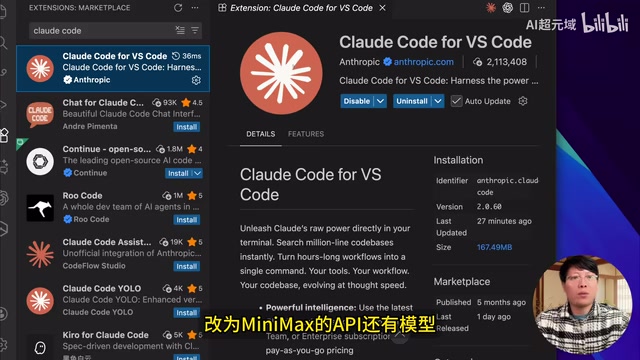
Once configured, enter any command in the Claude Code UI — if you get a normal response, the connection is successfully established.
Test 1: Agent Framework Migration (LangGraph → AtoZ)
The first test scenario evaluates the model's framework migration ability and abstract mapping capability — refactoring a self-correcting agent written in the LangGraph framework into AtoZ agent framework code.
LangGraph Framework Background: LangGraph is a stateful multi-agent orchestration framework from the LangChain team. Its core design philosophy abstracts AI workflows as directed graphs, where nodes represent computation steps (like LLM calls, tool execution) and edges represent state transition logic. This graph structure naturally supports loops, conditional branching, and parallel execution, making it particularly suited for building complex Agents that require self-correction, reflection, and multi-step planning. Migrating LangGraph code to another framework is a task that heavily tests a model's abstract understanding — the model must not only understand the source framework's API semantics but also find corresponding abstract mappings in the target framework. This is far more complex than simple code completion or bug fixing, which is why it was chosen as a typical scenario for testing framework comprehension.
Test Process
First, the /init command was used to let the model analyze the project code and create a memory file, establishing an initial understanding of the LangGraph project. Then the AtoZ official documentation link was provided, and the model was asked to perform the refactoring after deep reading.
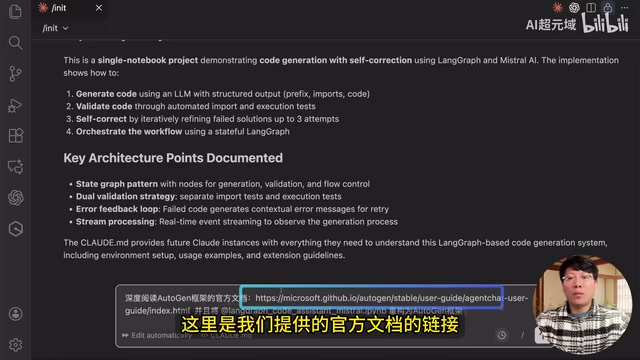
The entire refactoring process took about 5 minutes. When the generated code was uploaded to Colab for testing, the first run produced some errors. After feeding the error messages back to Claude Code, the model successfully fixed the issues. The second run produced successful output for both test cases with no errors.
Quota Consumption
After completing the entire framework migration task, the Coding Plan usage consumed only 10%. For an agent project refactoring with substantial code volume, this consumption is remarkably modest.
Test 2: iOS Native App Feature Extension
The second test scenario involved adding new features to an existing Pomodoro focus timer iOS native app. The project itself is fairly complex, containing multiple modules including focus timing, task management, statistical analysis, and settings, with a large codebase.
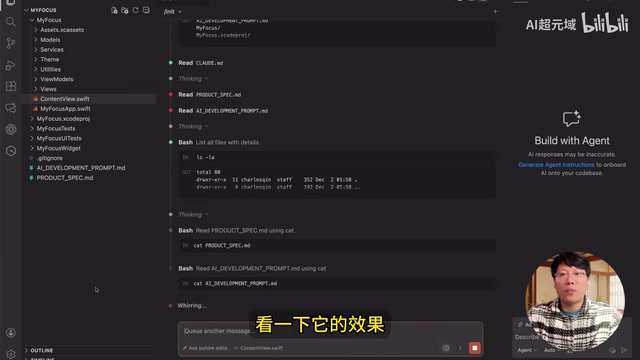
Test Process and Results
The requirement was clear: add 1-minute and 30-minute focus duration options to the app.
On the first attempt, the model didn't fully understand the requirement — it modified the code but didn't reflect preset duration buttons in the UI. After providing feedback, the model understood the actual requirement and delivered the correct implementation on the second try: adding complete preset duration options from 1 minute to 60 minutes in the settings page, with no errors during execution.
This test highlights a noteworthy point: M2 occasionally needs a second round of clarification on requirements, but once it understands correctly, code quality and first-pass success rate are both high.
Quota Consumption
An additional 4% was consumed on top of the previous 10%, bringing cumulative consumption to only 14%.
Test 3: Building a Pet Adoption Platform MVP from Scratch
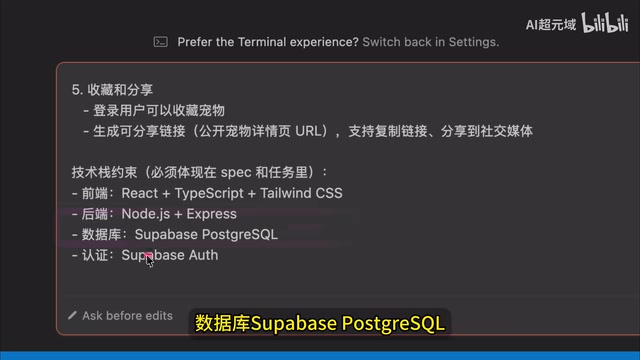
The third test was the most challenging — building a complete pet adoption platform MVP from scratch with the following tech stack:
- Frontend: React + TypeScript + Tailwind CSS
- Backend: Node.js + Express
- Database: Supabase PostgreSQL
- Feature Modules: Pet information management, user registration (email signup + social login placeholder), adoption application workflow, search and filtering, favorites and sharing
Tech Stack Notes: Supabase is an open-source Firebase alternative built on PostgreSQL, offering an integrated backend service including database, authentication, real-time subscriptions, storage, and edge functions. Its core advantages include: full SQL capabilities of PostgreSQL, auto-generated RESTful and GraphQL APIs, built-in Row Level Security (RLS) policies, and AI-friendly vector database extensions (pgvector). In AI-assisted development scenarios, Supabase has become the preferred database solution for LLM-generated full-stack projects due to its clear configuration file structure and comprehensive documentation — models can directly generate SQL migration scripts and RLS policies, significantly reducing database initialization complexity. The React + TypeScript + Tailwind CSS + Node.js + Supabase tech stack combination has also become the mainstream paradigm for AI-generated MVP projects.
Development Process Details
After about 5 minutes, the model completed code generation for the entire project, including the complete front-end and back-end project structure, configuration files, and Supabase auto-installation scripts.
The frontend started successfully on the first try. The backend encountered an error on first startup, which was fixed after feeding back the error message. The registration feature also hit an issue on first test, similarly fixed in one round of feedback. Ultimately, both user registration and login functions worked correctly.
Quota Consumption
Since this project took longer to develop, the usage had already reset within the cycle. After reset, only 2% was consumed. More importantly, no usage limits were encountered during the entire development process.
Comprehensive Assessment: Can MiniMax M2 Replace Claude's Native Model?
Coding Ability Evaluation
Across three tests covering framework migration, native iOS development, and full-stack web development, MiniMax M2 handled all tasks competently. While occasional one-to-two rounds of debugging were needed (common with any AI coding tool), overall code quality and completion were satisfactory.
Response Speed Performance
Throughout all tests, M2's response speed remained consistently fast with no interruptions or long waits. The real-world 100+ TPS speed provides a noticeably better experience than Claude's native model during actual development.
In-Depth Cost-Effectiveness Analysis
Taking the Max plan at ¥119/month as an example, developing three complete projects consumed only about 16% of the quota (considering cumulative usage before reset). Extrapolating from this, you could complete 15-20 projects of similar scale within a month — more than enough for most individual developers.
Recommended Use Cases
- Individual developers: Daily project development, code refactoring, rapid prototype validation
- Small teams: Reducing team costs for AI coding tools
- Learners: Experiencing top-tier coding model capabilities at minimal cost
Usage Considerations
- Complex requirements may need a second round of clarification — make prompts as specific as possible
- First-generated code should be validated in a test environment before deployment
- While image understanding is supported, UI replication precision still has room for improvement
Conclusion
For developers plagued by Claude Code quota anxiety, MiniMax M2 offers an extremely cost-effective alternative. 8% of the price, 1.5-2x the quota, global top-five coding ability — this combination is genuinely competitive in today's market. The ¥9.9 first-month trial price carries virtually zero risk, making it well worth trying.
Key Takeaways
- MiniMax M2 ranks in the global top five on the Artificial Analysis leaderboard, with coding ability comparable to the Claude 3 series and inference speeds of 100+ TPS
- Coding Plan pricing is only 8% of Claude's, yet offers 1.5-2x the quota, with a first-month trial at just ¥9.9
- All three test scenarios (framework migration, iOS feature extension, full-stack MVP development) were completed successfully, with cumulative quota consumption under 16%
- Configuration is simple — just replace the Model ID, baseURL, and API Key in the Claude Code plugin, enabled by the de facto standard API compatibility layer
- Occasional second-round requirement clarification is needed, but once understood, code quality and first-pass success rate are high
Related articles
 Product Reviews
Qoder vs Cursor Real-World Comparison: Which $20/Month AI IDE Is Better?
Hands-on comparison of Qoder vs Cursor AI IDEs: Agent autonomy, human interaction count, and architecture decisions. Qoder needed only 2 interactions vs Cursor's 8.
 Product Reviews
Cursor Cloud Agent Demo: Eliminating Bottlenecks Across the Entire Software Development Lifecycle
Deep analysis of Cursor's Cloud Agent demo showing how cloud VMs, automated test artifacts, and a full-chain control plane systematically eliminate human bottlenecks across the software development lifecycle.
 Product Reviews
Cursor 3.0 Deep Dive: Multi-Agent Parallelism, Design Mode, and Best-of-N Model Comparison
Cursor 3.0 evolves from an AI coding assistant into an Agent fleet command center. Explore multi-agent parallelism, Design Mode, and Best-of-N model comparison.