Codex vs Claude Code Hands-On Comparison: How to Choose Between the $20 and $200 Plans?

Claude Code leads Codex in overall experience and ecosystem for AI-assisted coding.
This article compares OpenAI's Codex (GPT-5.4, starting at $20/month) with Anthropic's Claude Code (Opus 4.6, $200/month). While both have comparable core coding capabilities, Claude Code comprehensively leads in product experience, feature innovation (Agent Skills, MCP), ecosystem completeness, and community activity. The recommended strategy is to use Claude Code as the primary tool, supplemented by the $20 Codex plan for specific tasks.
The AI Coding Tool Dilemma: Codex or Claude Code?
With the successive releases of GPT-5.4 and Opus 4.6, the developer community has ignited a heated debate about the "best AI coding tool." OpenAI's Codex, powered by GPT-5.4, starts at $20/month; Anthropic's Claude Code, powered by Opus 4.6, costs $200/month. With a combined monthly expense of $400, most developers are forced to make a choice.
A Bilibili content creator who has been using both tools long-term shared his in-depth comparison, and the conclusion might surprise many — this isn't just a battle of model capabilities, but a contest of overall user experience.

Codex (GPT-5.4): The Budget-Friendly Choice at $20
Subscription Content and Feature Coverage
Even with just the $20 ChatGPT Plus subscription, users can access Codex powered by GPT-5.4. Upgrading to the $200 Pro plan unlocks additional features, including:
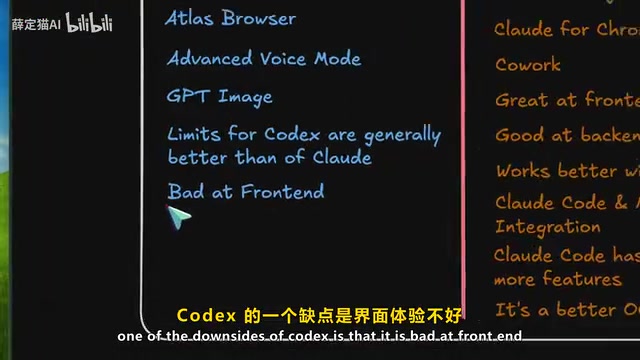
- Codex Web: Supports directly importing GitHub repositories and operating on them through the web interface
- Atlas Browser: Native browsing functionality for efficient searching
- Advanced Voice Mode and GPT image models
- Relatively generous usage limits (at least for now)
GPT-5.4 performs well on most coding tasks and can handle everyday development needs. From a pure model capability perspective, the creator stated that he "hasn't found anywhere Codex falls short compared to Opus" — the gap in core coding ability between the two isn't significant.
Codex's Obvious Shortcomings
However, Codex's problems lie in its interface experience. It handles everything in its own characteristic style, and the overall interaction feels "a bit awkward to get used to." Additionally, OpenAI's frequent model updates cause documentation to change constantly, forcing developers to modify prompts across various places — a significant disruption to workflow stability.
Claude Code (Opus 4.6): Comprehensive Lead in Product Experience
A More Mature Product Ecosystem
Claude Code's advantage lies not just in the model itself, but in the complete ecosystem built around it:
- Opus 4.6 and Sonnet 4.6 dual-model options, flexibly matching different scenarios
- Smoother web integration, with an out-of-the-box experience far superior to other platforms
- Mobile version for tracking code progress on the go
- Chrome extension enabling native browsing and collaboration features
- Agent SDK that is more complete, supporting custom workflow creation
More critically, Anthropic's prompt system has remained stable, unlike OpenAI's frequent changes, allowing developers to build more reliable workflows.
Industry-Leading Innovative Features
The creator particularly emphasized Claude Code's leadership in UX innovation. Agent Skills and MCP (Model Context Protocol) were both features pioneered by Anthropic, only later adopted and integrated by other platforms.
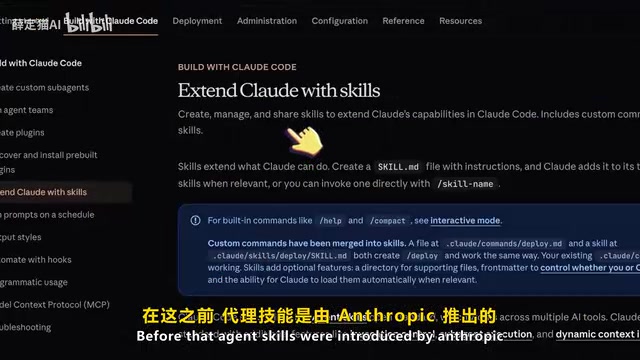
Opus 4.6 excels particularly in front-end development — "it's very easy to achieve great front-end results." Once equipped with Agent Skills, its performance "far surpasses Codex" — it's adept at understanding knowledge and then using flexible approaches to get code running.
Furthermore, Claude Code's community is more active. When new features launch, developers can keep up faster because many tools natively support Claude Code. New features ship every week, and the platform's capabilities continue to grow.
The Model Capability Debate: Which AI Coding Model Is Stronger?
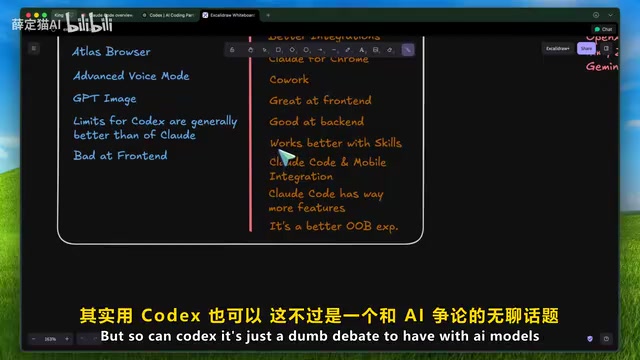
During the discussion, the creator raised a thought-provoking point: debating which model generates more impressive output is actually a pointless topic. Any model can produce garbage with poor prompting — what matters is how the user collaborates with the model.
He also observed an industry pattern: once Anthropic releases a new model, OpenAI typically follows closely behind, and most companies catch up to that level until the next innovation cycle begins. This means users who choose Claude Code essentially never miss any important developments and can continuously enjoy the most cutting-edge features.
Final Recommendation: The Codex + Claude Code Combo Is Optimal
Considering experience, features, and value for money, the creator offered a clear recommendation:
Best Combination Strategy
- Primary plan: The $200 Claude Code subscription (with Opus or Sonnet) as the core daily coding tool
- Supplementary plan: The $20 Codex subscription for handling specific tasks where Opus might not excel
- Additional recommendation: Pair with GLM5, which "is quite similar to Codex in many ways, and much more affordable"
Actual Usage Habits
The creator's own workflow is: primarily using Claude Code and GLM, occasionally accessing GPT-5.4 through the API. He specifically mentioned that using GPT-5.4 through the command-line interface yields "better results than Codex," suggesting that Codex's product packaging may actually be limiting the model's potential.
Conclusion: How Should You Choose an AI Coding Tool?
If your budget only allows for one, Claude Code is the more worthwhile investment. It not only matches Codex in model capability but comprehensively leads in product experience, feature innovation, ecosystem completeness, and community activity. Codex's $20 plan serves as a useful supplement for specific use cases.
Ultimately, competition among AI coding tools has evolved from a pure model capability showdown into a comprehensive battle over the entire development experience. In this battle, Claude Code currently holds a clear advantage.
Related articles
 Product Reviews
Qoder vs Cursor Real-World Comparison: Which $20/Month AI IDE Is Better?
Hands-on comparison of Qoder vs Cursor AI IDEs: Agent autonomy, human interaction count, and architecture decisions. Qoder needed only 2 interactions vs Cursor's 8.
 Product Reviews
Cursor Cloud Agent Demo: Eliminating Bottlenecks Across the Entire Software Development Lifecycle
Deep analysis of Cursor's Cloud Agent demo showing how cloud VMs, automated test artifacts, and a full-chain control plane systematically eliminate human bottlenecks across the software development lifecycle.
 Product Reviews
Cursor 3.0 Deep Dive: Multi-Agent Parallelism, Design Mode, and Best-of-N Model Comparison
Cursor 3.0 evolves from an AI coding assistant into an Agent fleet command center. Explore multi-agent parallelism, Design Mode, and Best-of-N model comparison.