CREAO Agent Competitive Monitoring Automation in Practice: From 5 Hours a Week to 10 Minutes a Day

Use CREAO Agent to compress competitive monitoring from 5 hours/week to 10 minutes/day
This article shows how indie developers and SaaS teams going global can automate competitive monitoring with CREAO Agent. Through conversational creation, Agent saving, and scheduled execution, the Agent automatically searches X, Reddit, Xiaohongshu, and other platforms, derives competitor intent keywords, and produces structured intelligence reports including high-value Leads, user complaint analysis, and actionable Ideas — with cross-competitor comparison insights automating the full pipeline from data collection to decision support.
For indie developers and SaaS teams going global, competitive monitoring is one of those tasks that's "impossible to skip, yet exhausting to do." Spending 5 hours a week manually scrolling through platforms, terrified of missing a competitor's pricing change or feature update — that's practically every founder's reality. Recently, a developer shared a complete workflow using CREAO Agent that compresses this entire process down to 10 minutes a day. It's worth a deep dive.
Competitive Monitoring: From Enterprise-Only Capability to Indie Developer Tool
Competitive Intelligence is a core component of product management and market strategy. Traditional enterprises typically have dedicated market analysis teams, but for indie developers and small SaaS teams, this work usually falls on the founder's already-overloaded plate. As AI Agent technology matures, "automated intelligence gathering" is shifting from a big-company exclusive to something accessible at the individual developer level — and that's the technological premise that makes this entire approach viable.
Two Critical Pain Points of Manual Competitive Monitoring
Before building an automated solution, let's first clarify exactly where manual monitoring hurts.
First, information is extremely fragmented. A competitor might announce a product update on X (Twitter), while users discuss alternatives on Reddit, and a recommendation post suddenly pops up on Xiaohongshu (Little Red Book). This information is scattered across four or five platforms, and just scrolling through all of them eats up enormous amounts of time.
For SaaS teams targeting global markets, this problem is especially acute. English-language discussions are concentrated on Reddit, X (Twitter), and Hacker News, while Chinese-language discussions center on Xiaohongshu, Zhihu, and Weibo. User profiles and discussion contexts differ significantly across platforms — Reddit users tend toward technical comparisons and price-sensitive discussions, KOL posts on X often shape product perception, and Xiaohongshu reflects everyday consumer experiences. Multi-platform parallel monitoring is therefore a prerequisite for global teams to capture complete market signals, and this is precisely the part that's hardest to sustain manually.
Second, processing information is grunt work. When you see someone on Reddit asking "Is there a cheaper alternative?", you need to determine whether they're a potential customer, analyze their needs, and assess the follow-up value. This type of work is high-volume and repetitive, yet you can't simply ignore it — because any single post could represent a real business opportunity.
These two problems compound each other, turning competitive monitoring into a low-ROI grind. CREAO Agent's approach: automate the entire pipeline from collection to analysis to report generation, so humans only need to consume results and make decisions.
Five-Minute Setup: From Conversation to Automated Agent
CREAO's core capabilities can be summarized in three keywords: conversational creation, Agent saving, and scheduled execution.
It's worth explaining the technical meaning of "Agent" here. An AI Agent is an intelligent system capable of autonomously planning and executing multi-step tasks, distinct from single-turn Q&A with a large language model. Its core architecture includes: a perception layer (fetching external information), a reasoning layer (analysis and judgment), and an action layer (executing operations and outputting results). In a competitive monitoring scenario, the Agent needs to simultaneously call multiple data source APIs, perform sentiment analysis on unstructured text, and generate reports according to preset templates — this is precisely the core advantage of Agents over simple scripts, and the underlying reason why "five-minute setup" is achievable.
Setup Process
Open CREAO's chat interface, enter the competitor names you want to monitor (one per line), with only three configuration options:
- Competitor name list
- Report language
- Optional Obsidian Vault path (for automatic archiving)
The Agent automatically searches four channels: X, Reddit, Xiaohongshu, and competitor official websites. Beyond direct competitor name searches, it also derives common keyword combinations like "competitor name + Alternative," "competitor name + Cheaper," and "competitor name + Better Than" — specifically designed to capture users with replacement intent. CREAO also integrates the X API, which is particularly crucial for global market scenarios.
These "Competitor Intent Keywords" are among the highest-converting traffic sources in SaaS marketing. Users actively searching for alternatives are already in the mid-to-late stages of their purchase decision, with willingness to pay far exceeding that of average users. This strategy has long been established in SEO (it's the core traffic driver for review platforms like G2 and Capterra), but applying it to real-time social media monitoring has only become feasible in the past two years as AI tools have proliferated.
The entire setup process takes just five minutes in practice, with an extremely low barrier to entry.
Actual Output: A Structured Competitive Intelligence Report
The first run monitored two competitors (Happy Horse and Siddance 2.0) and returned a complete structured report with core data including:
- 7 high-value Leads
- 10 user complaints
- 8 actionable Ideas
Transforming unstructured social media data into structured intelligence reports is a core challenge in Business Intelligence. Traditional approaches rely on manual annotation or complex NLP pipelines — expensive and high-latency. The emergence of large language models has driven the marginal cost of the "read raw text → extract key information → output by template" workflow toward zero, which is the fundamental reason these tools only became truly practical around 2024.
High-Value Lead Capture
The Agent captured multiple posts from Reddit's AI communities where users were seeking alternatives: some looking for watermark-free, region-unrestricted access points; others comparing actual API prices and noting a 13x price difference; and users directly stating "The Unlimited subscription at $119/month is too expensive — looking for a cheaper alternative."
Each Lead is tagged with urgency — red (high), yellow (medium), green (low) — enabling quick filtering of priority follow-up targets. This urgency tagging is essentially a priority queue mechanism that helps information consumers maximize decision efficiency within limited time. It aligns with the underlying logic of GTD (Getting Things Done) and similar time management methodologies — in information-overloaded environments, tiered processing is several times more efficient than reading everything sequentially.
User Complaint Analysis
Complaints are sorted by severity. High-frequency issues for Siddance 2.0 clustered around three areas:
- Severe regional blocking — non-Chinese users need VPNs or third-party platforms, resulting in terrible user experience
- Chaotic third-party API pricing — up to 13x price differences for the same model across different platforms
- Rampant counterfeit API platforms — users struggle to identify officially authorized ones
Complaints about Happy Horse mainly centered on capacity bottlenecks after API launch and local deployment needs.
Auto-Generated Actionable Ideas
Based on complaint data, the Agent automatically generated 8 actionable Ideas. Top-ranked ones include: building a watermark-free, region-unrestricted API proxy service, creating an aggregated price comparison platform, and developing a prompt engineering SaaS tool. Each Idea comes with background analysis, action recommendations, and value assessment.
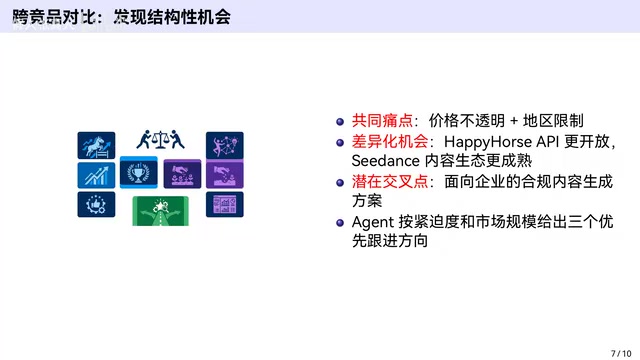
Cross-Competitor Comparison: Discovering Differentiation Opportunities
When monitoring multiple competitors simultaneously, the Agent automatically generates cross-competitor comparison insights — a perspective that's difficult to obtain from analyzing each one individually.
On shared pain points, users of both products complained about pricing opacity and regional restrictions. This suggests that "price transparency + global accessibility" could be an effective differentiation direction.
On differentiation opportunities, Happy Horse has moved further ahead on API openness, while Siddance 2.0 has a more mature content ecosystem. Finding an intersection between the two — such as a compliance-focused content generation solution for enterprises — might be worth deeper exploration.
The Agent also provided three recommended priority directions, ranked by urgency and market size, helping developers focus quickly.
Scheduled Execution and Continuous Iteration
After the run completes, the Agent asks whether to set it as a scheduled task. After selecting "daily," the system automatically creates a scheduled task that runs every morning at 9 AM, with reports saved automatically.
The Agent management page shows the complete run history. Each run generates a new competitive report, allowing direct comparison of trends across different time periods. To add new competitors to monitor, simply add a line in the configuration — no need to rebuild anything. The entire system supports parallel monitoring of multiple competitor groups, each generating independent sections that are then consolidated for comparison.
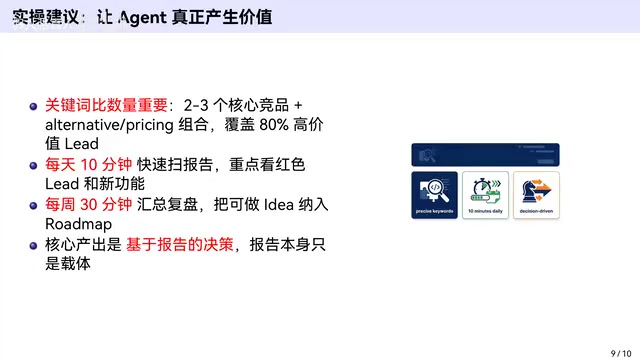
Three Practical Tips for Making Automation Truly Valuable
A low setup barrier doesn't mean casual use will produce results. To make this system generate real business value, several key points deserve attention:
1. Keyword Design Matters More Than Competitor Count
Rather than monitoring 10 competitors, it's better to design more precise keywords for two or three core competitors. The keyword combinations "competitor name + Alternative" and "competitor name + Pricing" alone can cover roughly 80% of high-value Leads. The logic behind this mirrors the "long-tail keyword" strategy in SEO: precise intent keywords deliver signal quality far superior to generic brand name monitoring.
2. Establish a Fixed Report Consumption Rhythm
Spend 10 minutes each morning for a quick scan, focusing on red-flagged high-value Leads and new feature updates. Spend 30 minutes weekly for a summary review, incorporating actionable Ideas into your product roadmap.
3. Reports Are the Vehicle; Decisions Are the Output
The core output of competitive monitoring isn't the report itself — it's the decisions made based on the report. The time the Agent saves you should be invested in following up on Leads, optimizing your product, and testing new directions — the actions that actually drive growth. The value of automation tools lies in freeing up cognitive resources, not replacing human judgment. The ultimate value of intelligence always depends on the person using it.
Summary
From 5 hours of manual monitoring per week to 10 minutes of automated reporting per day, the core value of this approach isn't technical complexity — it's the complete automation of the "information collection → analysis → structured output" pipeline. The maturation of AI Agent technology has made competitive intelligence capabilities — once affordable only by large enterprises — accessible to indie developers and small teams at an extremely low barrier. This shift itself is an industry change worth paying attention to. For indie developers and small teams with extremely scarce time, the time savings genuinely add up. CREAO is currently free to use with no credit card required for registration — interested developers can jump right in and try it out.
Related articles
 Product Reviews
Qoder vs Cursor Real-World Comparison: Which $20/Month AI IDE Is Better?
Hands-on comparison of Qoder vs Cursor AI IDEs: Agent autonomy, human interaction count, and architecture decisions. Qoder needed only 2 interactions vs Cursor's 8.
 Product Reviews
Cursor Cloud Agent Demo: Eliminating Bottlenecks Across the Entire Software Development Lifecycle
Deep analysis of Cursor's Cloud Agent demo showing how cloud VMs, automated test artifacts, and a full-chain control plane systematically eliminate human bottlenecks across the software development lifecycle.
 Product Reviews
Cursor 3.0 Deep Dive: Multi-Agent Parallelism, Design Mode, and Best-of-N Model Comparison
Cursor 3.0 evolves from an AI coding assistant into an Agent fleet command center. Explore multi-agent parallelism, Design Mode, and Best-of-N model comparison.