Cursor vs Tongyi Lingma vs Qoder: A Comprehensive Comparison of Price, Performance, and Experience
Cursor vs Tongyi Lingma vs Qoder: A Co…
Cursor leads in experience, Qoder wins on value, Tongyi Lingma trails behind in this AI coding tool showdown.
This article compares Cursor, Qoder, and Tongyi Lingma across price, performance, and experience. Cursor at $20/month leads in speed, code quality, and Agent capabilities. Qoder at $10/month (50% off) offers the best value with near-Cursor performance. Tongyi Lingma is free but limited to 50 rounds/month, suffers from severe language bias, and has Agent features still in Beta — making it the lowest actual value of the three.
The competition among AI coding tools has reached a fever pitch. With so many options on the market, where should developers invest their time and money? This article puts three mainstream AI coding tools — Cursor, Tongyi Lingma, and Qoder — side by side for a comprehensive comparison across price, performance, and experience, helping you make the most informed choice.
Price Comparison: Free Doesn't Mean Cost-Effective
Let's start with the most straightforward dimension: pricing. Cursor Pro costs $20/month (roughly ¥145 RMB), making it the most expensive of the three. Qoder Pro is currently offering a 50% discount at $10/month (roughly ¥73 RMB) — a very wallet-friendly option.
Then there's Tongyi Lingma: the individual edition is free, and the professional edition is also in a free promotional period (originally ¥59/month). Sounds incredibly attractive. But here's the critical catch — the free individual edition is limited to just 50 conversation rounds per month. What does 50 rounds look like in practice? Working on a moderately complex feature could burn through that in a single day. So behind the word "free," the actual usability deserves a big question mark.
From a pure pricing perspective, Qoder's half-price promotion is currently the best value for money, while Tongyi Lingma's free strategy looks more like a customer acquisition tactic with severely limited real-world utility.
Code Generation Speed: Latency Defines the Experience Ceiling
Speed is one of the core experiences of any AI coding tool, and the gap between these three is very noticeable.
Cursor is the undisputed industry benchmark. Its Tab-key predictions are blazingly fast — you barely feel any latency — and cross-file coordination is silky smooth. The entire coding flow feels effortless.
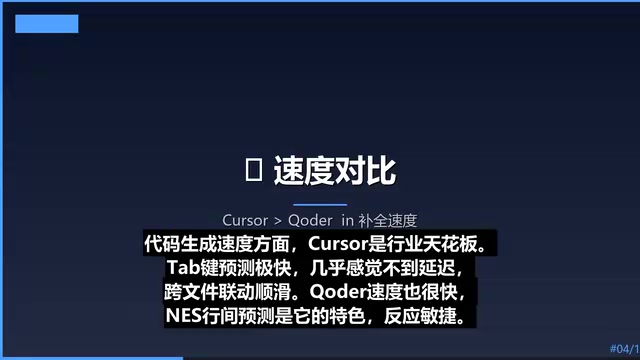
Qoder's speed is equally satisfying. Its NES inline prediction is a standout feature — responsive and snappy, delivering an overall fluid experience.
Tongyi Lingma, however, is noticeably a tier slower. Completion latency is palpable, especially in complex scenarios where wait times significantly disrupt your development rhythm. Given that Alibaba Cloud commands massive server resources, this performance is genuinely puzzling — where exactly are those resources going?
Where does latency come from? The response latency of AI coding tools isn't determined by a single factor but rather by multiple compounding layers: network transmission delay (RTT from client to inference server), model inference time (directly tied to model parameter count and hardware configuration), and client-side rendering and post-processing time. Top-tier tools typically employ several techniques to compress perceived latency: predictive prefetching (running inference on likely completions before the user even triggers a request), streaming output (returning tokens one by one rather than waiting for the complete result), and local small model assistance (using lightweight models for simple completions while reserving cloud-based large models for complex scenarios). Tongyi Lingma's latency issues likely stem from insufficient inference resource scheduling priority or a lack of these optimization mechanisms, rather than a simple shortage of server resources.
Code Quality and Accuracy: Language Bias Is a Serious Weakness
Cursor, backed by the full Claude and GPT model families, delivers first-rate performance in multi-file refactoring and context understanding, with consistently reliable generation quality. Qoder also supports top-tier models, and its Chopsticks Mode can handle long-cycle complex tasks — overall code quality is on par with Cursor.
Tongyi Lingma, however, reveals a serious problem in code quality: language bias.
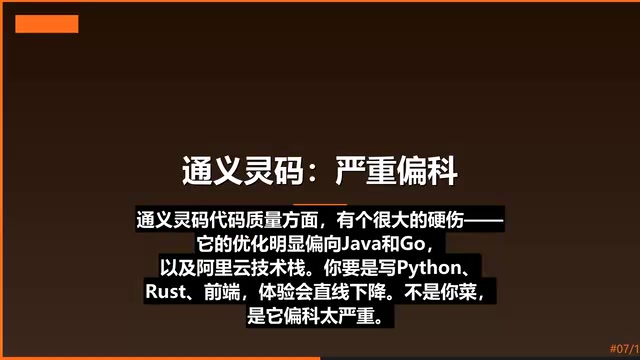
Its optimization clearly favors Java and Go, along with the Alibaba Cloud tech stack. If your primary languages are Python, Rust, or frontend technologies, the experience drops off a cliff. This isn't a matter of developer skill — it's the tool's uneven coverage. For teams or individual developers with diverse tech stacks, this bias is a major drawback.
IDE Support and Flexibility: Plugin Model vs. Standalone IDE
Cursor takes the standalone IDE route. It's essentially a deep fork of VS Code, which means the highest level of integration — all AI features feel like a native part of the editor.
Why does a standalone IDE deliver a better experience? Cursor's decision to deeply fork VS Code rather than build a plugin reflects a deliberate architectural choice with profound technical reasoning. The plugin model is constrained by the host editor's extension API and cannot modify core editor behaviors — such as custom rendering pipelines, deep keyboard event interception, or modifying Language Server Protocol (LSP) processing logic. A standalone IDE, on the other hand, can inject AI capabilities across the rendering layer, input layer, and language service layer, achieving a truly seamless feel. The trade-off is that users must migrate their work environment and the team must continuously merge upstream VS Code updates. Qoder's plugin approach represents a different business logic: lowering user migration costs, rapidly expanding the user base, and trading flexibility for penetration. The two approaches are fundamentally differences in product philosophy, not technical capability.
Qoder uses a plugin model that works with both VS Code and JetBrains, offering excellent flexibility — developers don't need to change their editor habits.
Tongyi Lingma is also a plugin, supporting VS Code and JetBrains. But there's an easily overlooked gotcha: the enterprise edition requires a minimum purchase of 10 seats.
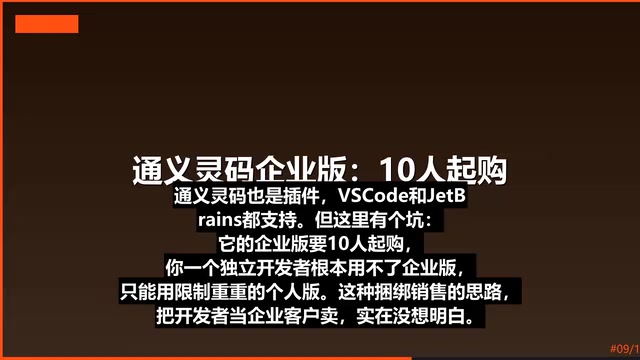
This means independent developers or small teams simply cannot access the full enterprise feature set and are stuck with the heavily restricted individual edition. This bundling strategy essentially treats a developer tool like enterprise SaaS — completely at odds with how the developer community actually works.
Agent Capabilities: The Key Dimension for Future Competitiveness
The next battleground for AI coding tools is Agent capability — whether AI can autonomously complete multi-step, cross-file complex tasks.
What is Agent mode? Agent mode in AI coding tools represents a fundamental leap from "single-turn Q&A" to "autonomous task execution" for large language models. Traditional code completion is passive and reactive, while Agent mode allows AI to proactively plan task steps, invoke tools, read and write files, execute commands, and dynamically adjust strategies based on intermediate results. The core technologies underpinning this capability include: Function Calling, Chain-of-Thought reasoning, and Reflection mechanisms. The maturity of Agent mode directly determines whether developers can use AI for complex engineering tasks like refactoring, debugging, and test generation — not just line-level code completion. The industry consensus is that Agent capability will be the core battleground where AI coding tools differentiate themselves in the next phase.
Cursor's Agent mode is currently the most mature solution — multi-step task execution is stable, it supports the MCP (Model Context Protocol) extension protocol, and its ecosystem is the most comprehensive. Qoder's Quest mode is positioned against Cursor's Agent and is well-suited for long-cycle project management, also delivering strong performance.
What is the MCP protocol? MCP (Model Context Protocol) is an open standard protocol proposed by Anthropic in late 2024, designed to solve the fragmentation problem of integrating AI models with external tools and data sources. Before MCP, every AI coding tool had to develop separate adapters for different external services (databases, APIs, file systems, etc.), resulting in extremely high maintenance costs. MCP provides a unified protocol specification that enables AI models to invoke external tools and retrieve contextual information in a standardized way — similar to how the USB interface unified the hardware ecosystem. For developers, the maturity of the MCP ecosystem directly determines the extensibility ceiling of an AI coding tool — MCP support means access to hundreds of community-developed tool plugins, seamlessly connecting everything from code review to database queries.
Tongyi Lingma's "AI Programmer" feature is still in Beta, with limited multi-file editing capabilities and no support for MCP protocol extensions.
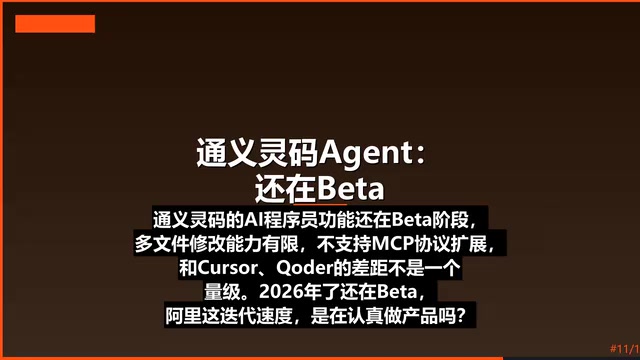
The gap compared to Cursor and Qoder is not even in the same league. In an era of rapid iteration for AI coding tools, having core features still stuck in Beta inevitably raises questions about the team's product investment priorities.
Overall Ratings and Recommendations
Based on performance across all three dimensions, here are the rankings:
| Dimension | 1st Place | 2nd Place | 3rd Place |
|---|---|---|---|
| Performance & Experience | Cursor | Qoder | Tongyi Lingma |
| Value for Money | Qoder | Cursor | Tongyi Lingma |
| Agent Capability | Cursor | Qoder | Tongyi Lingma |
Recommendations:
- Want the best experience with budget to spare → Go with Cursor Pro — it's the current ceiling for AI coding tools
- Want to save money without sacrificing quality → Go with Qoder Pro — unbeatable value during the 50% off promotion
- Alibaba Cloud tech stack, primarily Java/Go → Tongyi Lingma can serve as a supplementary tool, but it's not recommended as your primary one
One more thing: Tongyi Lingma's "free but crippled" status actually makes it the lowest value-for-money option of the three. The cost of free is limited quotas, biased language support, and immature Agent capabilities. For efficiency-minded developers, the time cost far exceeds a tool subscription fee.
Final Thoughts
The competitive landscape of AI coding tools is evolving rapidly. Cursor holds the top spot with its deep integration and mature Agent capabilities. Qoder is a strong challenger with its high value-for-money and flexible plugin model. And while Tongyi Lingma has Alibaba's resources behind it, there's still a clear gap in product strength.
For developers, the core criterion for choosing a tool always comes down to this: Can it genuinely improve your development efficiency? Price is just the entry barrier — experience is what drives retention. Rather than wasting time on free tools with severe limitations, invest in one that truly empowers your workflow.
Key Takeaways
- Cursor leads across the board in speed, code quality, and Agent capabilities — it's the current ceiling for AI coding tools
- Qoder Pro offers the best value during its 50% off promotion, with performance approaching Cursor — ideal for budget-conscious developers
- Tongyi Lingma is free but limited to 50 conversation rounds per month, suffers from severe language bias, and its core Agent feature is still in Beta
- Tongyi Lingma's enterprise edition requiring a minimum of 10 seats is extremely unfriendly to independent developers
- The next competitive focus for AI coding tools will be Agent capabilities and the maturity of the MCP protocol ecosystem
Related articles
 Product Reviews
Qoder vs Cursor Real-World Comparison: Which $20/Month AI IDE Is Better?
Hands-on comparison of Qoder vs Cursor AI IDEs: Agent autonomy, human interaction count, and architecture decisions. Qoder needed only 2 interactions vs Cursor's 8.
 Product Reviews
Cursor Cloud Agent Demo: Eliminating Bottlenecks Across the Entire Software Development Lifecycle
Deep analysis of Cursor's Cloud Agent demo showing how cloud VMs, automated test artifacts, and a full-chain control plane systematically eliminate human bottlenecks across the software development lifecycle.
 Product Reviews
Cursor 3.0 Deep Dive: Multi-Agent Parallelism, Design Mode, and Best-of-N Model Comparison
Cursor 3.0 evolves from an AI coding assistant into an Agent fleet command center. Explore multi-agent parallelism, Design Mode, and Best-of-N model comparison.