G-Rec: An Open-Source Agent Framework Built for Gemini CLI

G-Rec: A free agent framework for Gemini CLI as an alternative to Claude Code
G-Rec is an agent framework built on Gemini 2.5 Pro that brings Claude Code-style engineering configurations to Gemini CLI, offering persona settings and skills extension capabilities. The project deeply adapts to Windows systems and Chinese paths, and supports dynamically extending model capabilities through conversational interaction. Leveraging Google's free quotas, its usage cost is far lower than Claude Code, making it a cost-effective choice for individual developers.
Project Background: From Claude Code to Gemini CLI
Recently, a developer named "Bobo" shared an engineering configuration system he built for Claude Code. By optimizing the efficiency of each conversation to reduce Token consumption, he achieved better results when writing code and implementing features. Inspired by this, another developer migrated a similar approach to Google's Gemini CLI, creating an agent framework project called G-Rec.
Background: Gemini CLI and Claude Code Gemini CLI is a command-line interface tool released by Google that allows developers to invoke the capabilities of Gemini series large models directly from the terminal. Similar to Claude Code, these CLI tools represent a new paradigm in AI-assisted programming—deeply integrating large models into developers' local workflows rather than relying on web interfaces. Claude Code, developed by Anthropic, is renowned for its powerful code comprehension and generation capabilities, but its per-token pricing model can become costly in high-frequency usage scenarios. Gemini 2.5 Pro is Google's most powerful multimodal reasoning model, excelling in code generation and long-context understanding (supporting up to 1 million tokens of context window). Google provides daily API call quotas for free accounts, making it an important alternative for individual developers.
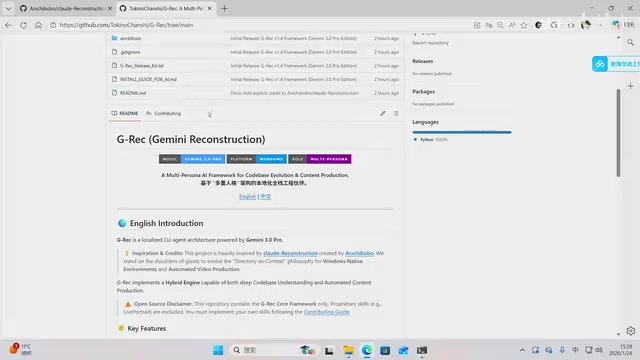
The entire project is built on Gemini 2.5 Pro. The author admits that he uses Gemini CLI far more frequently than Claude Code in his daily work, which is why he chose to deeply customize within the Gemini ecosystem. What's even more interesting is that the project itself was built with Gemini's assistance—a textbook case of "AI helping you build AI tools."
It's worth noting that the core logic of such engineering configuration systems lies in Token optimization. Tokens are the basic units that large language models use to process text, roughly corresponding to 0.75 English words or fewer Chinese characters. Since most commercial models charge based on input and output token counts, the token consumption of each conversation directly impacts usage costs. Through carefully designed System Prompts, context compression strategies, and conversation state management, engineering configurations can convey the most effective information with the fewest tokens per interaction—practice shows that proper prompt engineering can reduce token consumption for equivalent tasks by 30%-60%.
Core Features of G-Rec
Windows Adaptation and Chinese Path Support
One important feature of G-Rec is its deep adaptation for Windows systems. Many open-source AI tools have subpar compatibility on Windows, especially when it comes to path handling. The technical root cause lies in the historical legacy of character encoding systems: Windows defaults to GBK/GB2312 encoding for Chinese characters, while most open-source tools and modern programming languages default to UTF-8 encoding. Additionally, Windows uses backslashes (\\) as path separators, while Unix/Linux systems use forward slashes (/), and many tools fail to handle cross-platform compatibility during path concatenation. Since the author habitually uses Chinese-named paths, he specifically resolved various encoding issues caused by Chinese paths. Through a unified encoding processing layer and path normalization logic, he eliminated a long-standing pain point for Chinese developers.
Persona System: Making Gemini Understand You Better
G-Rec introduces a flexible Persona system. On a technical level, this corresponds to structured management of System Prompts—instruction sets injected to the model before each conversation begins, defining the model's role, behavioral norms, and output format preferences. Users can configure different role definitions and behavioral preferences for Gemini, with support for hierarchical management between global settings and project-level settings. This layered design borrows from mature software configuration management patterns, similar to the relationship between Git's global configuration and repository-level configuration: global settings define general behavioral preferences (such as language style and response format), while project-level settings customize for specific codebases' tech stacks and naming conventions, eliminating the need for developers to repeatedly explain background information in every conversation.
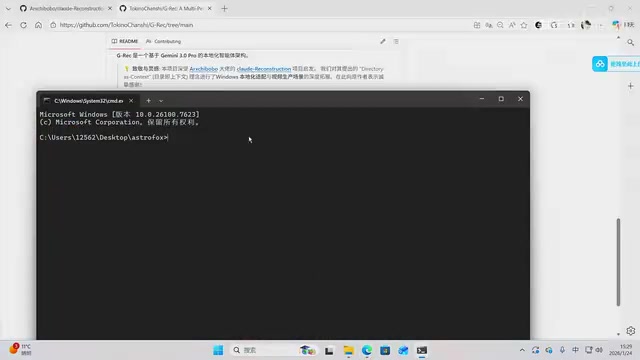
From the demo, when G-Rec is launched in a new directory with global settings already configured, the system automatically reads the working directory information and persona configuration. Users simply type "start," and the framework completes the initialization process, including:
- Reading and loading the working directory structure
- Applying preset persona settings
- Initializing installed skills and plugins
Skills Extension Mechanism: Giving Gemini Hands and Feet
One of G-Rec's most attractive designs is its Skills extension mechanism. To understand the value of this mechanism, you first need to understand the concept of AI Agents: agents are AI systems capable of perceiving their environment, autonomously planning, and executing a series of actions to accomplish goals, distinguishing them from simple Q&A interactions. Agent frameworks typically include Tool Use mechanisms that allow models to execute code, read/write files, and call APIs, upgrading them from "thinkers" to "doers." G-Rec's skills extension mechanism is essentially a tool registration system—users can have Gemini add new skill modules directly through the conversation interface, without manually writing configuration files or modifying code.
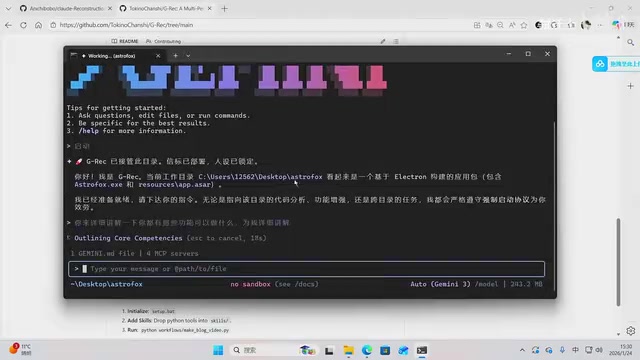
From the author's demo, the project includes a remarkably rich set of built-in features—more than what's described in the README documentation. These skills cover multiple areas including automatic image editing, tagging, and code writing, embodying the core philosophy of "giving Gemini hands and feet"—enabling the large model not only to think but also to execute concrete operations.
Cost Advantage: Zero-Cost Experience with Free Quotas
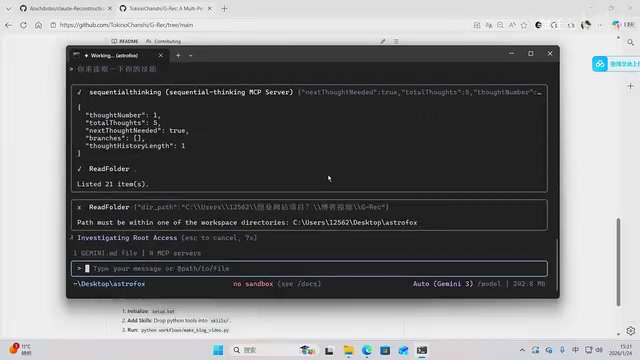
A noteworthy practical advantage is cost control. Google provides daily usage quotas for Gemini 2.5 Pro with free accounts, meaning users can experience G-Rec's full functionality without spending anything. In comparison, Claude Code's usage costs are significantly higher. For individual developers and learners, G-Rec paired with free quotas is an extremely cost-effective choice.
G-Rec's Design Philosophy and Future Outlook
The author positions G-Rec as a "relatively small project," but its design philosophy is quite forward-looking. By making AI capabilities framework-oriented and modular, G-Rec achieves several key goals:
- Lowering the barrier to entry: Configuration and extension through conversational interaction, without needing to understand underlying implementations
- Improving conversation efficiency: Borrowing from Claude Code's engineering configuration approach to optimize token usage per interaction
- Enhancing extensibility: The skills plugin mechanism allows functional boundaries to continuously expand
- Localization-friendly: Windows adaptation and Chinese path support reduce friction for Chinese users
From a broader perspective, G-Rec represents a trend: developers are shifting from simply using AI tools to building personalized AI workflow frameworks. As the foundational capabilities of large models become increasingly homogeneous, true differentiation will come from upper-layer engineering encapsulation and personalized configuration. This trend aligns closely with the evolution of the entire AI application layer—competition in foundational model capabilities is giving way to competition in agent frameworks, workflow orchestration, and vertical scenario adaptation.
Summary: A Gemini CLI Agent Solution Worth Trying
Although G-Rec is a personal open-source project, it demonstrates how to transform Gemini CLI into a feature-rich agent through engineering approaches. For developers seeking alternatives to Claude Code or looking to deeply customize their AI programming assistants, this project is worth following and trying. Especially now that Google offers free Gemini 2.5 Pro quotas, G-Rec provides an excellent opportunity for zero-cost entry.
Key Takeaways
- G-Rec is an agent framework built on Gemini 2.5 Pro, borrowing from Claude Code's engineering configuration approach to provide skills extension and persona settings for Gemini CLI
- The project deeply adapts to Windows systems and Chinese paths, resolving common pain points for Chinese developers at the encoding level, including GBK/UTF-8 incompatibility and path separator differences
- The skills extension mechanism is essentially a tool registration system that dynamically extends the model's executable capabilities through conversational interaction, without modifying underlying code
- Leveraging Google free accounts' daily Gemini 2.5 Pro quotas, usage costs are far lower than Claude Code
- The project reflects the trend of developers shifting from using AI tools to building personalized AI workflow frameworks, representing the industry's evolution from model capability competition to engineering encapsulation competition at the AI application layer
Related articles
 Product Reviews
Qoder vs Cursor Real-World Comparison: Which $20/Month AI IDE Is Better?
Hands-on comparison of Qoder vs Cursor AI IDEs: Agent autonomy, human interaction count, and architecture decisions. Qoder needed only 2 interactions vs Cursor's 8.
 Product Reviews
Cursor Cloud Agent Demo: Eliminating Bottlenecks Across the Entire Software Development Lifecycle
Deep analysis of Cursor's Cloud Agent demo showing how cloud VMs, automated test artifacts, and a full-chain control plane systematically eliminate human bottlenecks across the software development lifecycle.
 Product Reviews
Cursor 3.0 Deep Dive: Multi-Agent Parallelism, Design Mode, and Best-of-N Model Comparison
Cursor 3.0 evolves from an AI coding assistant into an Agent fleet command center. Explore multi-agent parallelism, Design Mode, and Best-of-N model comparison.