Google AI Studio 2.0 Deep Dive: The Antigravity Agent Ushers in the Era of Full-Stack Vibe Coding
Google AI Studio 2.0 Deep Dive: The An…
Google AI Studio integrates the Antigravity agent, pushing Vibe Coding to production-grade apps.
Google introduces the Antigravity coding agent to AI Studio with deep Firebase integration, enabling zero-configuration automation of databases, user authentication, secrets management, and real-time multiplayer sync. The agent understands full project context and multi-turn conversation history, with new Next.js support and session persistence. Compared to competitors like Cursor, Bolt, and Replit, AI Studio differentiates with free Gemini-powered models and automated backend capabilities, marking a pivotal shift for Vibe Coding from prototype toy to production tool.
Google just delivered a landmark update to AI Studio — integrating the Antigravity coding agent to push Vibe Coding from "toy-grade prototypes" to "production-grade applications." Databases, user authentication, real-time multiplayer sync, secrets management… infrastructure that used to take backend engineers weeks to set up can now be handled automatically with a single prompt.
Vibe Coding is a programming paradigm coined by OpenAI co-founder Andrej Karpathy in early 2025 that quickly gained traction. The core idea: developers no longer write code line by line — instead, they describe their intent in natural language and let AI handle all the code generation. This approach dramatically lowers the barrier to software development, enabling designers, product managers, and even founders with zero coding background to rapidly build working app prototypes. However, Vibe Coding has long faced a structural bottleneck: AI can easily generate frontend interfaces but struggles to automatically handle database design, user authentication, API key security, and other backend infrastructure — precisely the things required to take a prototype into production. Google's latest update is a targeted breakthrough aimed squarely at this pain point.
The Antigravity Agent: Not Just Writing Code, but Understanding Entire Projects
At the heart of this update is Google's Antigravity Agent. Unlike previous AI coding tools, it doesn't just generate code line by line — it understands your entire project architecture and full chat history, including things you built several conversation turns ago.
For example: when you say "add a leaderboard to the game I just made," it actually knows which game you're referring to, without requiring you to re-describe the context. If you've ever suffered from AI tools losing context mid-conversation, the significance of this improvement speaks for itself.
More importantly, the Antigravity agent can independently determine the optimal technical approach and handle automatic installation. Need smooth animations? It pulls in Framer Motion. Need icons? It calls Shadcn directly. It's no longer limited to a fixed set of built-in tools — instead, it thinks and solves problems like a real developer.
Deep Firebase Integration: One-Click Database and Authentication Setup
The most eye-catching feature is the deep Firebase integration. When the agent detects that an app needs a database or user login functionality, it proactively asks whether you'd like to configure it. Once you confirm, it automatically deploys Cloud Firestore and Firebase Authentication — you don't need to write a single line of backend code, or even touch a configuration file.
To appreciate the significance of this feature, it helps to understand Firebase's technical foundation. Firebase is Google's all-in-one Backend-as-a-Service (BaaS) platform, acquired by Google in 2014 and continuously expanded since. Its core product, Cloud Firestore, is a NoSQL document database designed around real-time data synchronization — clients can subscribe to data changes, and the server pushes updates proactively without polling, making it naturally suited for collaborative scenarios. Firebase Authentication provides a turnkey login system supporting email/password, Google accounts, GitHub, and other sign-in methods. Firestore Security Rules are a declarative access control language that lets developers precisely define "who can read and write which data" — manually configuring this entire system used to take hours or even days, and the Antigravity agent compresses it down to a single conversation confirmation.
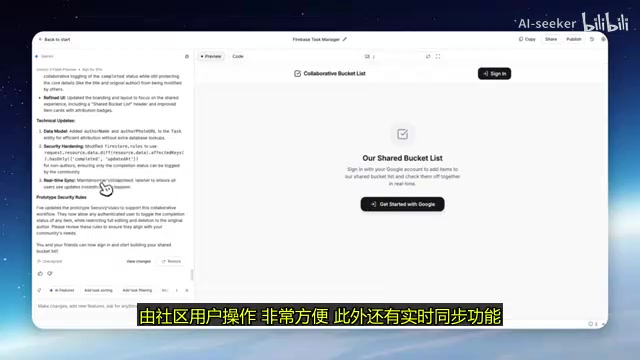
This is absolutely a game-changing update. Once you have a database and authentication in place, your project transforms from a demo prototype into a real application. This is exactly the barrier that stops most people from finishing their projects, and Google has now essentially eliminated it.
In hands-on testing, the author used a single prompt to create a "collaborative wish list app with user login support." The agent not only automatically configured the database and login functionality but also intelligently set up Firestore security rules — allowing collaborators to toggle task completion status while ensuring that core information like titles couldn't be arbitrarily modified and original author information couldn't be tampered with. After logging out and logging back in, all data was fully preserved.
Secrets Management and Security: The Final Piece of the Vibe Coding Puzzle
The new Secrets Manager in the settings panel addresses a long-standing pain point in the Vibe Coding space. Previously, many AI coding tools would write API keys directly into code as plaintext, creating serious security vulnerabilities.
Now you can securely connect your own API keys — whether for map services or payment functionality. The agent automatically detects when a key is needed and prompts you to import it through the Secrets Manager rather than exposing it in the code. For developers looking to build truly publishable applications, this feature is essential.
Real-Time Multiplayer Sync: Complex Features with a Single Click
Real-time multiplayer sync sounds simple, but it's notoriously painful to implement in practice. To understand the complexity: the traditional HTTP protocol uses a "request-response" model that inherently doesn't support server-initiated data pushes. The WebSocket protocol solved this by establishing a persistent, bidirectional communication channel between client and server with extremely low latency. Socket.io is a JavaScript library built on top of WebSocket that adds higher-level features like room management, event broadcasting, and automatic reconnection — but even so, developers still need to manually handle connection state management, message serialization, concurrency conflicts, and other thorny issues that typically require an experienced full-stack engineer.
To showcase this capability, Google created several impressive demos: a first-person laser battle, a 3D chair-sharing experience, and a claw machine game with real physics effects and a leaderboard.
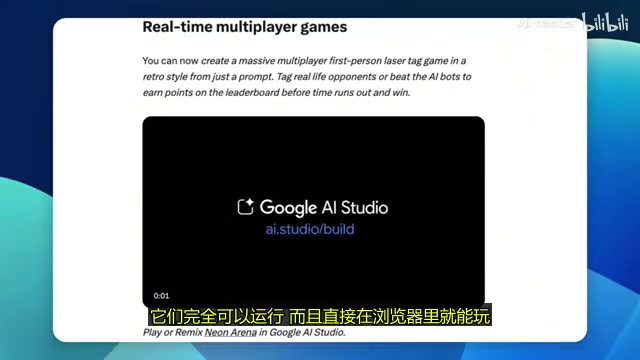
These aren't just trivial demos — they're fully functional, playable right in the browser, and all generated entirely from prompts. The agent automatically configures the synchronization logic (implemented via Socket.io), imports the required libraries, and delivers a working product.
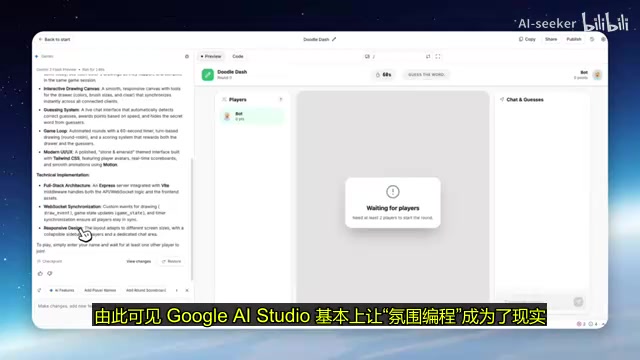
In a drawing-and-guessing game test, the agent built the complete architecture: an Express server with integrated Vite middleware handling API and WebSocket logic, with frontend asset synchronization included. Anything drawn on the canvas syncs in real time to all players.
Framework Support and Session Persistence
Beyond the existing React and Angular support, AI Studio now adds Next.js support, selectable from the settings panel.
Next.js is a React framework developed by Vercel and one of the most popular full-stack React solutions available. Unlike pure client-side rendered React apps, Next.js supports Server-Side Rendering (SSR) and Static Site Generation (SSG), where page HTML is pre-generated on the server, making it more friendly to search engine crawlers (SEO optimization) and delivering faster initial page loads. Its App Router architecture also allows developers to execute database operations directly on the server via Server Actions, eliminating the need to build a separate API layer. AI Studio's addition of Next.js support means developers can build production-ready products that require SEO and server-side logic, rather than being limited to internal tools or demo prototypes.
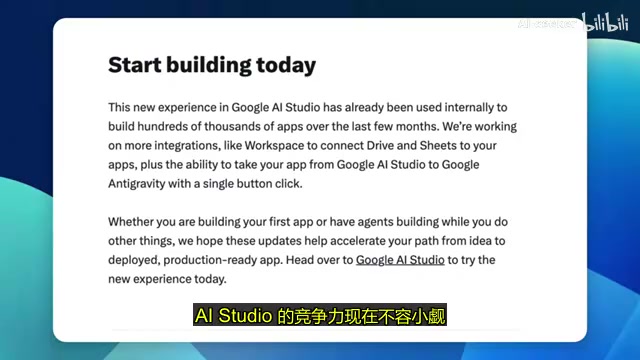
Another seemingly minor but extremely practical update is session persistence. You can close your tab at any time, come back later, and the app remembers your previous development progress, with data synced across devices and sessions. Google says this feature has been battle-tested internally — they've used it to build hundreds of thousands of applications over the past few months.
Future Roadmap: Building a Complete Build-to-Deploy Pipeline
According to Google AI Studio lead Logan Kilpatrick, more features will roll out over the coming weeks:
- Design Mode and Figma Integration: Generate code directly from design files
- Google Workspace Integration: Let apps directly access spreadsheets and other data
- Better GitHub Support: Repository syncing, critical for real-world deployment
- Planning Mode and Immersive UI: Smarter project planning
- Simplified Deployment: One-click deployment from AI Studio to Antigravity
- Gemini 2.5 Pro Support: Continuous upgrades to the underlying model
What This Means for Developers
Vibe Coding has always been impressive for rapid prototyping, but there was a clear ceiling — once databases, authentication, and API integrations were involved, you typically had to roll up your sleeves and deal with complex technical details yourself. Google has now significantly raised that ceiling.
Looking at the current competitive landscape of AI coding tools: Cursor positions itself as an IDE enhancement for professional developers, with deep codebase context integration, ideal for boosting productivity in existing projects; Bolt (by StackBlitz) and Replit Agent focus on in-browser full-stack development with no local environment setup required; Lovable and v0 (by Vercel) specialize in generating frontend UI components from natural language or design files. The common limitation across these tools: they either require paid subscriptions or still need manual user intervention when dealing with backend infrastructure.
Google AI Studio's differentiation strategy operates on three dimensions: first, providing powerful capabilities powered by top-tier Gemini models for free; second, leveraging the Firebase ecosystem to achieve zero-configuration automation of backend infrastructure; and third, naturally connecting to Workspace, Maps, payments, and other enterprise-grade services through the Google account ecosystem, building an ecosystem moat that competitors can't easily replicate.
Of course, this is still early days. But Google's strategic intent is crystal clear: build a complete pipeline from ideation to deployment within a single product, enabling non-technical users to build and ship real applications. This isn't just a product update — it's a pivotal turning point for Vibe Coding's evolution from "toy" to "tool."
Key Takeaways
- Google AI Studio integrates the Antigravity agent with full project context understanding, remembering development progress across multiple conversation turns
- Deep Firebase integration enables one-click database (Cloud Firestore) and user authentication setup without writing any backend code
- New production-grade features include Secrets Manager, real-time multiplayer sync (via Socket.io), and Next.js framework support
- Upcoming features include Figma integration, Google Workspace integration, and simplified deployment, building a complete build-to-deploy pipeline
- Compared to competitors like Cursor, Bolt, and Replit, AI Studio offers free access powered by Gemini models, with automated backend handling as a key differentiator
Related articles
 Product Reviews
Qoder vs Cursor Real-World Comparison: Which $20/Month AI IDE Is Better?
Hands-on comparison of Qoder vs Cursor AI IDEs: Agent autonomy, human interaction count, and architecture decisions. Qoder needed only 2 interactions vs Cursor's 8.
 Product Reviews
Cursor Cloud Agent Demo: Eliminating Bottlenecks Across the Entire Software Development Lifecycle
Deep analysis of Cursor's Cloud Agent demo showing how cloud VMs, automated test artifacts, and a full-chain control plane systematically eliminate human bottlenecks across the software development lifecycle.
 Product Reviews
Cursor 3.0 Deep Dive: Multi-Agent Parallelism, Design Mode, and Best-of-N Model Comparison
Cursor 3.0 evolves from an AI coding assistant into an Agent fleet command center. Explore multi-agent parallelism, Design Mode, and Best-of-N model comparison.