Google Jules 2.0 Major Upgrade: Deep Dive into Seven New Features

Google's AI coding assistant Jules exits Beta with seven major feature upgrades becoming a systematic intelligent coding agent.
During "Jules Week," Google comprehensively upgraded its AI coding assistant Jules, officially ending its Beta phase. New features include environment snapshots for faster startup, a Critic Agent based on Actor-Critic reinforcement learning for real-time code review, interactive planning, web preview screenshots, web search, and direct PR creation—systematically optimizing the complete developer workflow and evolving Jules from a code generation tool into an intelligent coding agent that more closely mirrors human developer collaboration patterns.
Google's AI coding assistant Jules received a wave of intensive updates over the past week, officially dubbed "Jules Week." After this round of upgrades, Jules has officially exited Beta, introducing several practical features including environment snapshots, Critic Agent, interactive planning, and web preview. These improvements transform Jules from a simple code generation tool into an intelligent coding agent that more closely mirrors human developer workflows.
Officially Out of Beta, Available to Free Users
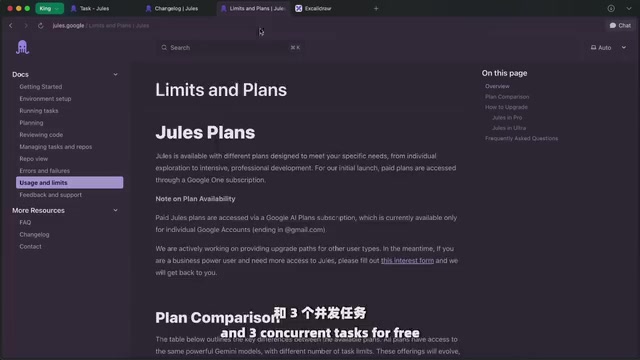
Jules has officially ended its Beta testing phase. All users who tried Jules during the Beta period will receive a three-month free subscription to Google AI Pro—Google's way of thanking early adopters.
Regarding pricing, free users can execute 15 tasks per day with 3 concurrent tasks; AI Pro plan users get 115 tasks per day; and the Ultra plan offers even higher limits. One notable detail: Jules isn't a standalone paid product but is integrated into the Google AI subscription plan, meaning subscribers can simultaneously enjoy Google's other AI services.
Direct Pull Request Creation: Streamlined Workflow
Previously, Jules could only create a separate branch for your feature requests, requiring developers to manually open a Pull Request. Now you can initiate a PR directly from the Jules interface, review the code, and merge it to the main branch with one click. This improvement may seem simple, but it dramatically reduces the friction of switching between IDE, terminal, and GitHub.
Pull Requests (PRs) are a core mechanism of modern collaborative software development, originating from Git's distributed version control workflow. After completing feature development on an independent branch, developers submit a merge request to the main branch via PR, during which team members can conduct code reviews, discussions, and automated testing. Integrating PR creation directly into the Jules interface means AI-generated code can seamlessly enter the team's standard review process rather than bypassing it—this is particularly important for enterprise-level code quality control.
Environment Snapshots: No More Repeated Initialization
This is a foundational optimization targeting development efficiency. Previously, every time Jules started a new task, it needed to re-run environment configuration scripts to set up the project environment—a process that was both time-consuming and resource-wasteful.
After the upgrade, Jules captures a snapshot of the virtual machine after the initial configuration is complete. Subsequent tasks launch directly from the snapshot with the environment already ready, allowing work to begin immediately.
VM Snapshots are a mature technology in cloud computing and virtualization, first commercially popularized by VMware in the early 2000s. A snapshot is essentially a persistent record of a virtual machine's complete state at a given moment (including memory, disk, CPU registers, etc.), enabling the system to be precisely restored to that state at any time. In CI/CD pipelines, snapshot technology is widely used to accelerate build environment initialization. Jules brings this technology to the AI coding agent scenario, solving the "cold start" problem—for complex projects relying on Node.js, Python virtual environments, or Docker containers, traditional initialization might take several minutes, while snapshot-based startup can typically be compressed to seconds. This optimization is especially impactful for projects with complex dependencies and long initialization times.
Web Preview: Verify Without Local Cloning
This is an extremely practical feature. Previously, after Jules completed a frontend task, developers had to clone the branch locally and manually start the project to see the results. Now you can directly ask Jules to verify its work—it renders the webpage using Playwright and returns a screenshot.
Playwright is a modern web automation testing framework open-sourced by Microsoft in 2020, supporting Chromium, Firefox, and WebKit browser engines for cross-browser, cross-platform consistent testing. Compared to its predecessor Selenium, Playwright natively supports asynchronous operations, auto-wait mechanisms, and network request interception, performing more reliably with modern single-page applications (SPAs). Jules chose Playwright as its underlying engine for web preview and frontend testing partly because of its mature and reliable screenshot API, and partly because Playwright has become one of the de facto standards for frontend automation testing in the developer community, lowering the barrier for developers to understand and extend test scripts.
While you can't yet interact with the rendered page, screenshot previews alone already help developers quickly determine whether the UI meets expectations, avoiding significant unnecessary local operations. Additionally, Jules supports Playwright-based frontend automation testing.
Critic Agent: Built-in Code Reviewer
Critic Agent is the most technically sophisticated feature in this upgrade. It's essentially a code quality review agent that intervenes in real-time during Jules's code generation process, performing "adversarial review" on every modification.
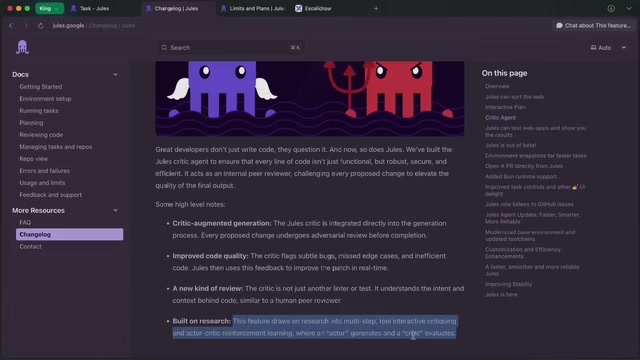
Critic Agent works by:
- Discovering Hidden Bugs: Flagging easily overlooked edge cases and potential errors
- Optimizing Performance: Identifying inefficient code and suggesting improvements
- Security Review: Checking for potential security vulnerabilities in the code
- Real-time Feedback: Jules immediately modifies code based on Critic's feedback
Notably, Critic Agent is not a simple linter or testing tool, nor is it an ordinary agent driven by system prompts. Google explicitly states that it has been specifically fine-tuned based on the Actor-Critic reinforcement learning framework—the Actor generates code while the Critic evaluates quality.
Actor-Critic is a classic architecture in reinforcement learning that combines the advantages of Policy Gradient and Value Function estimation methods. The Actor selects actions based on the current state (i.e., generates code), while the Critic evaluates the quality of those actions and provides feedback signals to guide the Actor in continuously optimizing its strategy. This architecture traces back to reinforcement learning research in the 1990s and has been widely applied in DeepMind's AlphaGo and OpenAI's PPO algorithm. Introducing it to code generation means the model no longer merely imitates human code through supervised learning but improves code quality through continuous self-play and feedback loops, theoretically capable of discovering optimization paths not present in training data. This architecture draws on research in multi-step, tool-interactive criticism, enabling it to understand the intent and context behind code, similar to human peer review.
Interactive Planning: Negotiating Development Plans with AI
Previously, Jules would automatically generate an execution plan after receiving a task, and developers could only accept or reject it. The new Interactive Plan feature now allows you to have a conversation with Jules before the task begins, collaboratively building an execution plan that precisely matches your requirements.
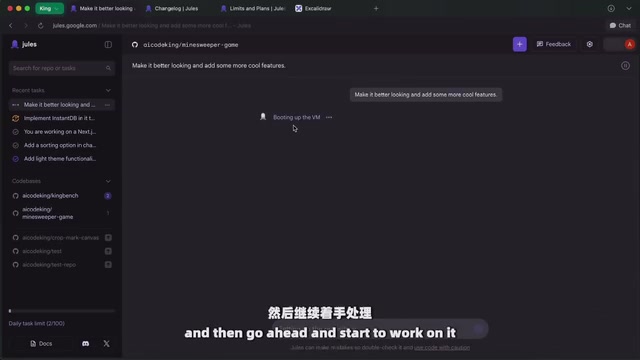
This means you no longer need to painstakingly define every detail in the task description box—instead, you can gradually clarify requirements through natural conversation. Jules will also proactively ask you to confirm unclear points during execution. This interactive mode makes the AI coding assistant experience much closer to collaborating with a real developer. This design philosophy aligns closely with the "requirements clarification" phase in software engineering—thoroughly communicating to align expectations before formal coding is a key practice for reducing rework costs.
Web Search: Knowledge Base Is No Longer a Bottleneck
Jules now has web search capabilities. When your project uses newer dependency libraries or frameworks, Jules can proactively search for the latest official documentation, finding relevant code examples and implementation references. This addresses a long-standing pain point of AI coding tools—knowledge lag caused by training data cutoff dates.
Large language models have fixed training data cutoff dates (Knowledge Cutoff), meaning the model knows nothing about new framework versions, API changes, or security patches released after the cutoff date. For rapidly iterating ecosystems like JavaScript (Next.js, React) or Python ML libraries (PyTorch, Transformers), API differences between versions can cause AI-generated code to simply not run. Web search capability extends the model's effective knowledge boundary from the training cutoff date to the present by retrieving official documentation and community resources in real-time—an important step toward making AI coding tools truly practical.
Summary and Reflections
Looking at this "Jules Week" update, Google is accelerating its positioning in the AI coding agent space. The Jules 2.0 upgrade isn't a single-point breakthrough but rather a systematic optimization around the developer's complete workflow:
- Efficiency: Environment snapshots and direct PR creation reduce repetitive operations
- Quality: Critic Agent improves code quality through reinforcement learning
- Experience: Interactive planning and web preview make human-AI collaboration smoother
- Capability: Web search breaks through knowledge boundaries
The combination of these features evolves Jules from a "code generator" into something closer to an "AI developer colleague." In the current fierce competition among Cursor, GitHub Copilot, Claude Code, and other competitors, the AI coding assistant market has entered an intensely competitive phase: Cursor offers a deeply customized VSCode experience focused on immersive in-IDE programming; GitHub Copilot leverages the Microsoft ecosystem and vast GitHub code repository for the broadest user base; Anthropic's Claude Code excels in powerful context understanding and long document processing; and Devin, as the first product embodying the "fully autonomous AI software engineer" concept, has defined the industry's imagination for Agentic Coding. Jules's differentiation path lies in deep integration with Google Cloud infrastructure and Gemini models, with an asynchronous, background task execution mode that distinguishes it from real-time interactive competitors, making it better suited for complex engineering tasks that take longer to complete. For developers, now is a great time to try Jules.
Related articles
 Product Reviews
Qoder vs Cursor Real-World Comparison: Which $20/Month AI IDE Is Better?
Hands-on comparison of Qoder vs Cursor AI IDEs: Agent autonomy, human interaction count, and architecture decisions. Qoder needed only 2 interactions vs Cursor's 8.
 Product Reviews
Cursor Cloud Agent Demo: Eliminating Bottlenecks Across the Entire Software Development Lifecycle
Deep analysis of Cursor's Cloud Agent demo showing how cloud VMs, automated test artifacts, and a full-chain control plane systematically eliminate human bottlenecks across the software development lifecycle.
 Product Reviews
Cursor 3.0 Deep Dive: Multi-Agent Parallelism, Design Mode, and Best-of-N Model Comparison
Cursor 3.0 evolves from an AI coding assistant into an Agent fleet command center. Explore multi-agent parallelism, Design Mode, and Best-of-N model comparison.