GPT-5.1 Deep Dive: 10 Core Features That Transform AI from Chat Tool to Work Partner

A deep analysis of GPT-5.1's 10 core features transforming AI from chat tool to work partner
GPT-5.1 delivers systematic upgrades: dual-mode switching balances speed and depth, structured prompts improve output controllability, project agent capabilities enable multi-step autonomous planning and execution, coding and tool orchestration are significantly enhanced, 24-hour prompt caching reduces costs, and built-in self-verification mechanisms reduce hallucination rates. Overall, it advances AI toward becoming a true productivity system through improved reliability and controllability.
Overview
OpenAI's latest release, GPT-5.1, brings a series of substantial upgrades—from dual-mode switching to project agent capabilities, from coding assistance to tool orchestration. Each improvement pushes AI further along the path from "chat tool" to "work partner." This article systematically breaks down the ten core features of GPT-5.1, helping you understand how to integrate these capabilities into your actual workflow.
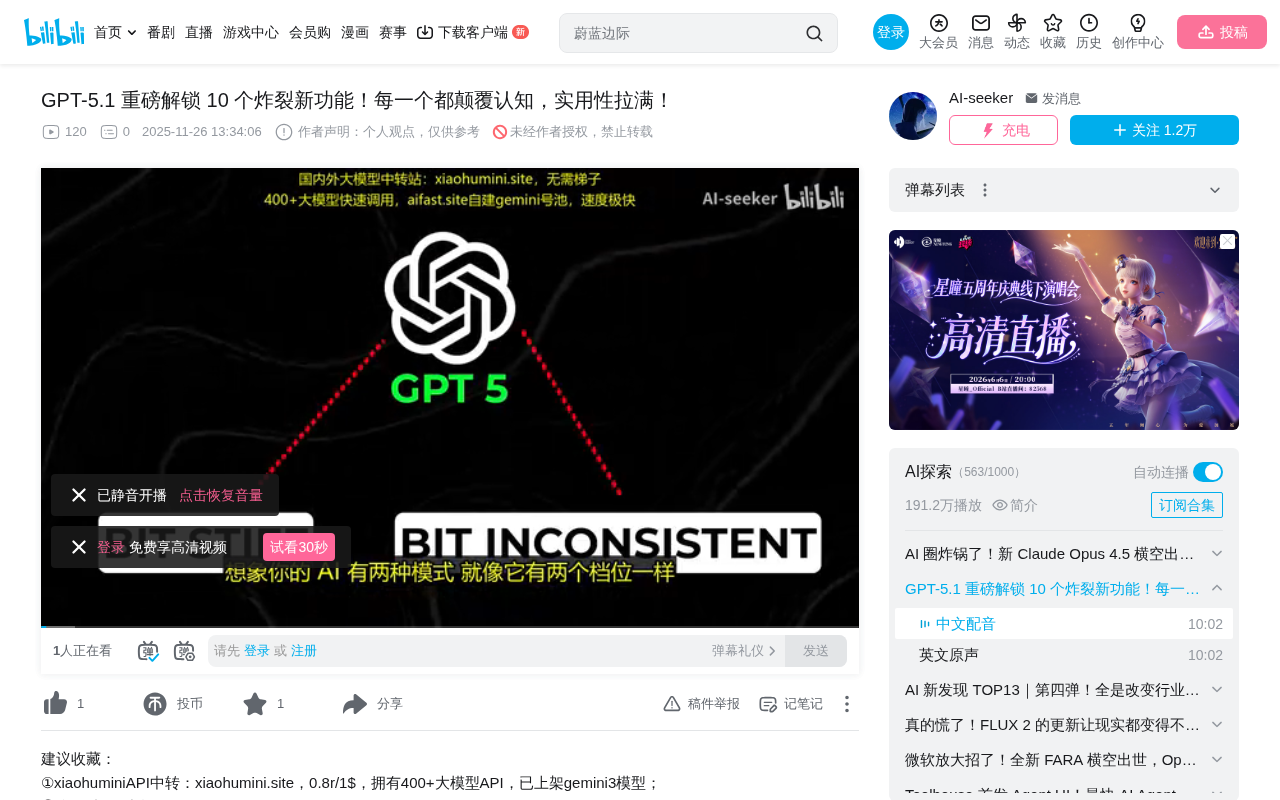
Dual-Mode Switching: Balancing Speed and Depth
GPT-5.1 introduces a "dual-gear" working mode—Instant Mode and Thinking Mode. Instant Mode is designed for lightweight tasks like quick email replies and simple summaries, delivering fast and efficient responses. Thinking Mode is purpose-built for complex tasks such as contract analysis and multi-factor decision-making.
The intelligence of Thinking Mode lies in its adaptive approach—rather than mechanically extending processing time, it dynamically adjusts reasoning depth based on task complexity. The technical foundation for this design stems from the "compute budget" concept in large language model inference. In traditional Transformer architectures, the computational effort per token is fixed, while Chain-of-Thought techniques increase effective computation by having the model generate intermediate reasoning steps. GPT-5.1's Thinking Mode essentially dynamically allocates inference compute resources—the model internally evaluates problem complexity and determines how many layers of reasoning chains are needed. This aligns with the "test-time compute scaling" strategy that OpenAI previously validated in its o1 and o3 series models, where investing more computational resources during inference significantly improves accuracy on complex tasks.
Testing the same question in both modes reveals clear differences: Instant Mode provides a high-level answer, while Thinking Mode breaks the problem into steps, risks, and details, even offering insights you hadn't considered. This design lets users flexibly choose based on context, finding the optimal balance between efficiency and quality.
Structured Prompts: Treating Prompts as Specifications
GPT-5.1's responsiveness to structured input has improved dramatically. Rather than asking questions casually, you should treat prompts as "mini specifications"—clearly defining roles, objectives, input formats, and output formats.
For example, instead of saying "help me analyze this project," write something like:
You are my project manager. Here is the project context. Please output: three risk points, three next steps, and a summary paragraph.
The effectiveness of structured prompts is closely tied to the attention mechanism in large language models. Transformer models process input sequences through Self-Attention mechanisms, and when prompts have clear hierarchical structure, the model can more accurately establish association weights between different information fragments. This is analogous to interface definitions in programming—explicit input/output specifications reduce ambiguity. OpenAI specifically optimized GPT-5.1 during the Instruction Tuning phase for structured inputs, dramatically improving the model's adherence to role definitions, constraints, and output formats.
The biggest benefit of this structured approach is reusability. You can apply the same template to different content and consistently get precise, structured output. Older models frequently went off-track or misunderstood intent, but GPT-5.1 has been specifically tuned to strictly follow these structured patterns.
Brand Persona and Tone Consistency
GPT-5.1 comes with multiple built-in personality presets (professional, friendly, quirky, high-efficiency, etc.), and maintains consistent tone throughout the entire conversation. For users who frequently write, communicate with clients, or create content, this means establishing a stable brand voice.
You can layer custom rules on top of presets, such as "use only concise sentences, no emojis." However, note that custom rules cannot conflict with the preset. If you select the "friendly" preset but demand overly direct expression, the output becomes unstable. The key is maintaining consistency between settings and instructions.
Mode Keywords: One Word to Switch Behavior
GPT-5.1 responds extremely well to simple mode keywords. Adding "explain," "plan," "critique," or "review" at the beginning of your message causes the model to immediately enter the corresponding mode, adjusting structure, tone, and depth.
These aren't hard switches but rather "soft modes" mentioned in OpenAI's prompting guidelines. For example:
- Say "explain"—the model enters teaching mode, providing examples and exercises
- Say "critique"—the model stays in review mode, only pointing out improvements without rewriting content
This is essentially building a "mode toolkit"—without switching models or writing lengthy prompts, a single keyword invokes the desired behavior.
Project Agent: From Chatbot to Autonomous Assistant
This is one of GPT-5.1's most transformative upgrades. It's no longer just a Q&A tool—it can plan, execute, verify, and summarize work as a project agent.
You can give it a series of coherent instructions: read three documents → list unresolved issues → draft a one-page plan → resolve as many issues as possible. The model will create an outline, invoke tools to read files, gather background information, and update the plan based on its findings.
The project agent capability relies on deep integration of the ReAct (Reasoning + Acting) framework. ReAct is a paradigm that enables language models to alternate between reasoning and action—the model first thinks about what to do next, then calls tools to execute, and adjusts subsequent plans based on execution results. GPT-5.1 builds on this with more sophisticated Task Decomposition and state-tracking mechanisms, enabling it to maintain a dynamic task graph that records which steps are completed and which dependencies remain unsatisfied. This shares conceptual similarities with early AI Agent projects like AutoGPT and BabyAGI, but GPT-5.1 internalizes it as a native model capability without requiring external orchestration frameworks.
Developer feedback indicates that GPT-5.1 is the most suitable version for agentic work to date, as it can properly plan steps and verify before delivering final answers. For researchers, content creators, or operations professionals, this makes the model a genuine small-scale autonomous assistant.
Substantial Coding Improvements
GPT-5.1's progress in the code domain is particularly notable:
- Multi-file edits are more reliable, maintaining structural consistency across files
- Built-in tools support direct file editing, patch application, and running commands in sandboxed environments
- Context understanding is deeper, no longer breaking formatting or missing dependencies
You can issue compound instructions like "scan the entire repo → find bugs → propose patches → explain the changes." Testing shows it generates fewer erroneous patches and has more accurate awareness of the surrounding codebase. While it can't replace engineers, it's capable enough for genuine development assistance without requiring constant micromanagement.
Tool Orchestration and API Collaboration
GPT-5.1's approach to handling tools has fundamentally changed. It can work across web searches, files, and databases, and even collaborate with user-defined APIs.
A typical scenario:
Pull the latest sales data from the internal API → summarize trends → write a brief for the team
GPT-5.1's tool orchestration capability builds on multiple generations of evolution in the Function Calling mechanism. Function Calling was first introduced in the GPT-3.5 era, allowing models to output function call requests in structured JSON format. GPT-5.1's breakthrough lies in supporting parallel tool calls and autonomous planning of multi-step tool chains—the model can determine dependency relationships between multiple API calls, deciding which can execute in parallel and which need to wait for results sequentially. This capability is known in the industry as "Tool-Use Planning" and represents critical infrastructure for building complex AI workflows.
Earlier versions often struggled with when to use tools or how to chain steps together, but GPT-5.1 has achieved a qualitative improvement in tool-calling fluency. As long as tool descriptions are clear and instructions are explicit, it operates like a coordinator overseeing the entire workflow.
24-Hour Prompt Caching: Longer-Lasting and More Economical
This is an infrastructure improvement with tremendous practical value. GPT-5.1 extends context activation persistence to 24 hours, with significantly reduced cached token pricing.
The underlying technology is KV Cache (Key-Value Cache) persistence. During Transformer inference, each token generates corresponding Key and Value vectors that are repeatedly used during subsequent token generation. The traditional approach releases these caches after a session ends, requiring recalculation in the next conversation. GPT-5.1 persists the KV Cache to high-speed storage media, enabling direct reload and reuse within 24 hours, avoiding the enormous overhead of recomputing prefix tokens. This is particularly critical for long-context scenarios (such as large codebases or lengthy documents), where recomputing KV Cache for tens of thousands of tokens is both time-consuming and expensive.
This means:
- During extended code debugging sessions, the model retains context without repeated charges
- A full day of research follow-ups can maintain context without incurring additional costs
- Ongoing chat agents and research tasks see dramatically improved efficiency
For work involving large documents or codebases, this improvement directly eliminates the primary bottleneck that previously slowed productivity.
Reliability Mode: Built-in Self-Verification
GPT-5.1 introduces improved reliability mechanisms. You can ask the model to:
- List which parts require external verification
- Provide a summary of its reasoning process
- Generate a checklist at the end of its response
For example: "Give me your answer, then list two things I should verify before trusting you." This prompts the model to distinguish between what it's confident about and what requires external validation.
GPT-5.1's reduced hallucination rate benefits from the combined application of multiple techniques. First, RLHF (Reinforcement Learning from Human Feedback) training specifically rewards "uncertainty expression"—the model learns to say "I'm not sure" rather than fabricating answers when uncertain. Second, deep integration of Retrieval-Augmented Generation (RAG) capabilities means the model prioritizes searching external knowledge sources when answering factual questions. Additionally, GPT-5.1 introduces an internal consistency checking mechanism that audits reasoning chains before generating final answers, identifying logical contradictions or unsupported assertions. This "generate-then-verify" dual-stage architecture significantly improves factual accuracy of outputs.
While GPT-5.1 can still make mistakes, its hallucination rate is lower than GPT-5, and paired with verification prompts, it produces more reliable and easier-to-check results.
Reusable Workflows: From Tricks to Systems
GPT-5.1's deepest change lies in a paradigm shift in how it's used. The model itself is powerful enough—the real bottleneck is workflow design.
Any successful approach can be saved and reused—weekly planning templates, client proposal formats, complete content pipelines from ideation to final draft. Thanks to GPT-5.1's improved consistency, these workflows are more reliable than ever: predictable structure, stable formatting, and output that strictly follows instructions.
Rather than inventing new prompts every day, distill your proven methods into standardized workflows, making AI a truly reliable productivity system.
Summary
The core of GPT-5.1's upgrade isn't about breakthrough in any single feature, but rather a systematic improvement in overall reliability and controllability. From dual-mode switching to project agents, from tool orchestration to 24-hour caching, every improvement reduces the friction cost of AI collaboration. For users serious about using AI to boost productivity, now is the ideal time to redesign your workflows.
Key Takeaways
- GPT-5.1 introduces dual-mode switching between Instant and Thinking modes, flexibly balancing speed and reasoning depth
- Structured prompts and mode keywords make outputs more predictable and reusable, lowering the barrier to prompt engineering
- Project agent capabilities enable the model to plan, execute, and verify multi-step tasks, evolving from chatbot to autonomous assistant
- 24-hour prompt caching and reduced token pricing make extended complex tasks more cost-effective
- Built-in reliability modes and self-verification mechanisms reduce hallucination rates and improve output trustworthiness
Related articles
 Product Reviews
Qoder vs Cursor Real-World Comparison: Which $20/Month AI IDE Is Better?
Hands-on comparison of Qoder vs Cursor AI IDEs: Agent autonomy, human interaction count, and architecture decisions. Qoder needed only 2 interactions vs Cursor's 8.
 Product Reviews
Cursor Cloud Agent Demo: Eliminating Bottlenecks Across the Entire Software Development Lifecycle
Deep analysis of Cursor's Cloud Agent demo showing how cloud VMs, automated test artifacts, and a full-chain control plane systematically eliminate human bottlenecks across the software development lifecycle.
 Product Reviews
Cursor 3.0 Deep Dive: Multi-Agent Parallelism, Design Mode, and Best-of-N Model Comparison
Cursor 3.0 evolves from an AI coding assistant into an Agent fleet command center. Explore multi-agent parallelism, Design Mode, and Best-of-N model comparison.