GPT-5 Codex Deep Dive: 93% Token Savings But Tool Ecosystem Still Needs Work
GPT-5 Codex Deep Dive: 93% Token Savin…
GPT-5 Codex dramatically improves coding efficiency but suffers from tool ecosystem fragmentation.
OpenAI's GPT-5 Codex model features elastic Token allocation — reducing consumption by 93.7% on simple tasks while investing 2x+ Tokens for deep reasoning on complex ones. However, testing reveals declining UI generation quality, terrible search functionality, and severe fragmentation across CLI, web interface, and VS Code extension experiences. OpenAI open-sourced related tools under Apache 2.0, signaling an open ecosystem strategy.
OpenAI quietly launched a new model built specifically for developers on September 15 — GPT-5 Codex. This isn't just a routine model update; it's another strong signal from OpenAI that they're taking developer experience seriously. A well-known YouTube developer creator, after receiving early access, conducted extensive testing and concluded: the model itself is impressive, but the surrounding tool ecosystem still has significant issues to address.
Dramatic Token Optimization: Nearly 95% Savings on Simple Tasks
The most exciting improvement in GPT-5 Codex isn't about benchmark scores — it's about intelligent Token consumption management.
Understanding Token Economics: Tokens are the basic units LLMs use to process text, roughly corresponding to 3/4 of an English word or 1-2 Chinese characters. A model's inference cost and speed are directly tied to Token consumption — more Tokens mean slower responses and higher costs. This is why Token efficiency has long been a core metric for developers evaluating model practicality. GPT-5 Codex's elastic Token allocation strategy is essentially an engineering implementation of "Adaptive Computation" — letting the model dynamically decide how much compute to invest based on task difficulty, rather than uniformly consuming fixed resources for all tasks. This closely mirrors how human experts work: giving immediate answers to simple questions while deliberating carefully on complex ones.
The creator noted that when using standard GPT-5 for development tasks, the most frustrating aspect was slow model execution and massive Token consumption. Even if the model itself wasn't slow, the need to generate excessive Tokens for basic work made the overall experience feel sluggish.
According to OpenAI internal employee usage data, GPT-5 Codex reduces Token consumption on simple tasks by 93.7% compared to standard GPT-5 — roughly one-twentieth of the original amount. For complex tasks (top 10%), it actually uses more than twice the Tokens for deeper reasoning, editing, and testing.
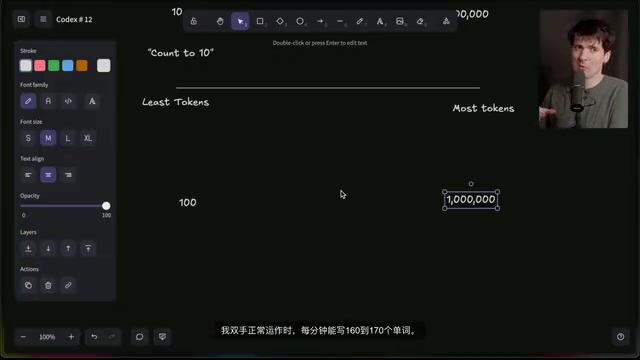
This elastic "save where you can, spend where you must" strategy means the model automatically adjusts reasoning depth based on task complexity. Simple code changes no longer waste massive compute resources, while truly complex tasks get full reasoning support.
Real-World Coding Tests: Better Code Efficiency But Lower UI Quality
The creator ran a classic comparison test — building the same image studio application with both standard GPT-5 and GPT-5 Codex.
Results:
- Standard GPT-5 used approximately 23.6K Tokens
- GPT-5 Codex used approximately 27.8K Tokens
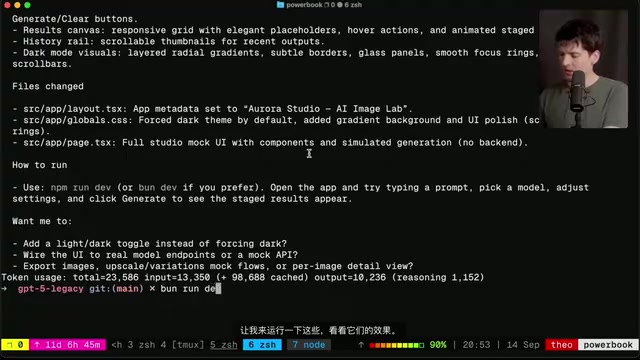
Token consumption was similar, but UI quality showed clear differences. GPT-5 Codex's generated interfaces, while decent overall, had more visual errors — elements clipping into each other, abnormal UI layering, etc. Standard GPT-5 remained more stable for UI generation.
The technical logic behind this makes sense: Codex was specifically optimized for code logic and engineering tasks, with training data and reinforcement learning signals prioritizing code correctness over visual presentation quality. UI generation is inherently a cross-domain task requiring both code structure and visual aesthetics, and specialized optimization often means trade-offs in other dimensions.
Search Functionality Is Terrible: The Model's Most Obvious Weakness
In deeper testing, the creator attempted to build a complete backend service using Convex and Supabase with GPT-5 Codex.
About Convex and Supabase: Both are Backend-as-a-Service (BaaS) platforms for modern web apps but with different positioning. Supabase is PostgreSQL-based, offering relational databases, real-time subscriptions, and authentication — an open-source Firebase alternative. Convex is a reactive backend platform centered on functional programming, where data changes automatically trigger frontend updates, ideal for real-time collaboration apps. Both have rapidly iterating APIs, which is precisely why models tend to use outdated documentation — LLMs have training data cutoff dates, and for fast-evolving frameworks, the API knowledge they possess is often already obsolete.
The model got quite far but exposed serious problems at critical points. First, the model misunderstood Convex — insisting on outdated schema configuration methods and producing multiple errors in client-server operations and internal configuration.
More disappointing was the search functionality. When the creator enabled web search via the -s parameter, the model generated extremely poor search queries. For example:
FileClientImportFileFromFileClientSubscribe example— completely wrong import approachFAI FluxProV1.1 Ultra API example file Subscribe prompt aspect ratio guidance scale— meaningless query
The creator stated bluntly: "The search results are garbage." The issue isn't Codex's search infrastructure but rather the model's inability to construct effective search queries. This reveals a deeper problem: translating natural language understanding into precise information retrieval queries is an independent capability requiring specialized training that doesn't automatically improve alongside coding ability.
The Business Strategy Behind Open Source
OpenAI showed a surprisingly open stance with this release. Codex CLI and related tools are fully open-sourced on GitHub under the Apache 2.0 license, free for anyone to use.
Strategic Significance of Apache 2.0: Apache 2.0 is one of the most permissive open-source licenses, allowing commercial use, modification, and distribution with the only requirement being preservation of the original copyright notice. Unlike GPL licenses, Apache 2.0 doesn't require derivative works to also be open-sourced, making it the preferred choice for enterprise open-source projects. OpenAI choosing Apache 2.0 over stricter licenses means any company can integrate Codex CLI into their commercial products without contributing back to the community. This strategy favors rapid ecosystem expansion, making Codex's toolchain an industry standard rather than just OpenAI's moat.
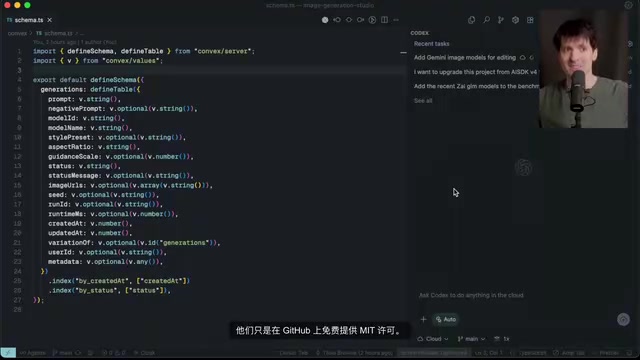
The creator speculates this open-source strategy may relate to IP agreements between OpenAI and Microsoft — Microsoft has rights to all OpenAI intellectual property created before AGI is achieved. By open-sourcing, OpenAI ensures other developers can also access these tools, somewhat balancing Microsoft's exclusive advantage.
Additionally, OpenAI plans to release an SDK allowing anyone to spin up their own Codex-like system in the cloud. They apparently don't want to win through closed tools but rather want their models and protocols to become infrastructure for agentic coding.
Tool Ecosystem Fragmentation: The Most Pressing Problem
The creator's sharpest criticism of GPT-5 Codex focused on tool ecosystem fragmentation.
Agentic Coding Context: Agentic Coding refers to AI models no longer passively responding to single prompts but autonomously planning multi-step tasks, calling external tools, executing code, and iteratively correcting based on results. The core of this paradigm is "Tool Use" and "Reflection Loop" — the model continuously observes environmental feedback during execution and dynamically adjusts its next action. This paradigm's rise makes "where you run the model" equally important as "the model's capabilities themselves," which is the deeper reason why Codex's tool ecosystem fragmentation is particularly problematic.
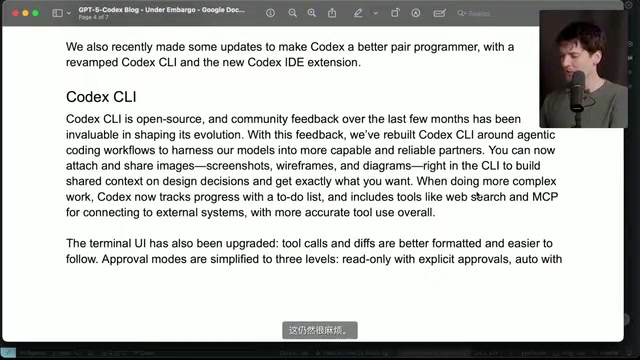
Currently, the "Codex" name is used across too many different products: CLI tool, web interface, VS Code extension, the model itself... each with vastly different experiences. The creator found:
- CLI version: Significantly improved, more agentic, best experience. Command-line environments naturally suit agentic workflows — the model can directly read/write the file system, execute Shell commands, and integrate seamlessly with local development environments.
- Web interface: Background agent experience is "very bad," real-time notification system completely broken
- VS Code extension: Cumbersome environment setup, missing auto-updates, using local changes breaks the main UI
The creator warned that when different users use different versions of Codex, they'll have entirely different experiences, leading to severe community division on product evaluation. He suggested OpenAI should at minimum use different names for the model and the tools to reduce confusion.
Pricing and Value: The $20 Plan Is Surprisingly Sufficient
On pricing, the creator revealed an interesting finding: he conducted extensive testing on the $20/month ChatGPT plan without hitting any usage limits. This directly relates to the elastic Token optimization — because simple tasks consume dramatically fewer Tokens, actual daily development usage is far below user expectations. For most developers, even the most basic paid plan provides quite generous Codex usage allowance.
Compared to the $200/month premium plan, the $20 plan may offer unexpectedly high value for Codex usage.
Conclusion: Clear Model Progress, Ecosystem Still Needs Polish
GPT-5 Codex as a model is a substantial improvement — it's more efficient at coding tasks, intelligently adjusts reasoning depth, and shows significantly better code review capabilities (erroneous comments reduced by roughly two-thirds). But the surrounding tool ecosystem remains in a "puzzle pieces are in place but not yet assembled" state.
Practical advice for developers:
- Prioritize Codex CLI for the best experience
- Continue using standard GPT-5 for UI generation tasks
- Don't over-rely on the model's search functionality; use templates and explicit instructions
- The $20 plan suffices for most development needs — no rush to upgrade
Key Takeaways
- GPT-5 Codex reduces Token consumption by 93.7% on simple tasks while using 2x+ Tokens for deep reasoning on complex tasks
- UI generation quality has declined, with element clipping and layering anomalies
- Search functionality performs poorly — the model can't construct effective web search queries
- Codex tool ecosystem is severely fragmented, with vastly different experiences across CLI, web interface, and VS Code extension
- OpenAI open-sourced Codex tools under Apache 2.0 and plans an SDK for anyone to build Codex-like systems
Related articles
 Product Reviews
Qoder vs Cursor Real-World Comparison: Which $20/Month AI IDE Is Better?
Hands-on comparison of Qoder vs Cursor AI IDEs: Agent autonomy, human interaction count, and architecture decisions. Qoder needed only 2 interactions vs Cursor's 8.
 Product Reviews
Cursor Cloud Agent Demo: Eliminating Bottlenecks Across the Entire Software Development Lifecycle
Deep analysis of Cursor's Cloud Agent demo showing how cloud VMs, automated test artifacts, and a full-chain control plane systematically eliminate human bottlenecks across the software development lifecycle.
 Product Reviews
Cursor 3.0 Deep Dive: Multi-Agent Parallelism, Design Mode, and Best-of-N Model Comparison
Cursor 3.0 evolves from an AI coding assistant into an Agent fleet command center. Explore multi-agent parallelism, Design Mode, and Best-of-N model comparison.