Hands-On with Replit Agent 4: Multi-Agent Parallel Execution + Canvas Design + One-Click Deployment Full Workflow

Replit Agent 4 tested: multi-Agent parallel collaboration lets one person ship products like managing a team.
A Bilibili creator tested Replit Agent 4's core capabilities by building a Mexican restaurant landing page: Plan Mode auto-generates task plans, Canvas enables multi-Agent parallel generation of different design options, task-level independent review and merge, Draw visual annotations to direct AI, and one-click publishing. The entire process cost $8.55, completed within a single browser tab, marking AI-assisted development's shift from "human-AI dialogue" to "humans managing AI teams."
One Person, One Entire Team? Hands-On with Replit Agent 4
Replit Agent 4 integrates design, development, and deployment into a single workflow, claiming to let you ship a real product slice in a single session. Bilibili creator "AI Builders" put this new version through its paces with a complete Mexican restaurant landing page case study, testing its core capabilities — multi-Agent parallel execution, in-canvas design, task-level review and merge, and one-click publishing.

This is no longer simply "chatting with AI to write code" — you become a project lead directing a small execution team.
From Linear Conversation to Workflow: Agent 4's Four Core Capabilities
Replit officially summarizes Agent 4's upgrades around four pillars: Design Freely, Move Faster, Ship Anything, Build Together.
Unlike the previous linear chat mode, Agent 4's core changes include:
- Design and code in the same environment: No need to jump to external tools like Figma. In traditional product development, design and development are two separate phases — designers complete visual designs in tools like Figma or Sketch, then pass dimensions, colors, spacing, and other parameters to developers through design specs, who then recreate the designs in code. This "design-handoff-implementation" process typically involves significant communication overhead and implementation drift. Agent 4's Canvas feature aims to eliminate this gap: design operations directly generate or modify underlying code, and code changes are instantly reflected on the visual canvas, achieving true "design is development."
- Multi-Agent parallel execution: Multiple tasks run simultaneously, no more waiting in queue
- Task-level review and merge: Each Agent's completed work is presented independently, allowing you to review each one before merging
- One-click publishing: From design to going live, all without leaving the platform
This means the work mode shifts from "one person chatting with one AI" to "one lead managing a small team."
In Practice: Building the La Luz Cantina Restaurant Page from Scratch
Plan Mode: Starting Like Writing a PRD
The creator first enabled Plan Mode and entered a concise requirements description: a mobile-first single-page landing page with a Hero section, reservation CTA, menu highlights (about 6 dishes), gallery, location, and business hours.
The Hero Section mentioned here is a core web design term referring to the prominent large display area at the top of a page, typically containing the main headline, subheadline, key visual imagery, and primary Call To Action (CTA) button. In landing page design, the Hero section carries the critical "3-second rule" task — users decide within the first 3 seconds of opening a page whether to continue browsing, so the Hero section must convey brand tone, core value proposition, and next-step guidance in an extremely short time.
The key insight is: When the plan is good enough, building becomes easy. The Agent automatically generated a task plan based on the requirements, including What and Why, with clear structure. A PRD (Product Requirements Document) is a core document written by product managers before formal development begins, typically containing product goals, user stories, functional requirements, non-functional requirements, and acceptance criteria. In traditional workflows, PRDs go through multiple rounds of review before entering the development phase. Agent 4's Plan Mode essentially automates PRD writing and parsing — users only need to provide concise natural language descriptions, and the Agent structures them into executable task plans. This "plan first" design philosophy stems from a classic software engineering principle: the quality of upfront planning directly determines downstream execution efficiency.
Canvas Design: Three Styles Generated in Parallel
This is one of Agent 4's most impressive features. In the Canvas interface, the creator clicked "Try different vibes," and the Agent immediately launched three parallel Agents simultaneously, each generating a different visual style variant:
- First: Black background, nightclub style — rejected
- Second: Café/brunch style — didn't match positioning
- Third: Latin-inspired color palette — selected
Three Agents working simultaneously is far faster than generating one at a time. It's like being in a small meeting room with three designers pitching to you simultaneously.
This multi-Agent parallel execution is an important trend in current AI system architecture. Traditional LLM interaction is serial — the user sends one instruction, waits for a complete response, then sends the next. Multi-Agent architecture allows the system to simultaneously launch multiple independent AI instances, each with its own context and execution environment. This design borrows from distributed computing and microservices architecture thinking: breaking large tasks into multiple independently executable subtasks and dramatically reducing total time through parallel processing. In Replit's implementation, each Agent not only executes independently but also produces independent code changesets (similar to branches in Git), making subsequent review and merging possible.
Multi-Task Parallel Execution: A Real Team Collaboration Feel
After selecting the design direction, the creator needed two modifications: changing the navbar's "La Luz" to the full name "La Luz Cantina," and removing the image hover interaction effects.
He created two independent tasks, assigned to two Agents executing simultaneously. One handled the navbar text, the other handled image interactions — this is the shift from "chatting with AI" to "assigning work to a team."
After each Agent finished, results were presented independently. You don't need to accept a large batch of mixed changes — instead, you can review each one individually, confirm satisfaction, then merge into the main version. This "task-level review and merge" mechanism essentially brings mature version control practices from software engineering into AI-assisted development scenarios. In traditional team collaboration, each developer works on an independent branch, submits a Pull Request (PR) upon completion, and a reviewer checks code changes individually before merging to the main branch. Agent 4 applies this workflow to AI-generated code: each Agent's output is equivalent to an independent PR, and the user as reviewer can view diffs, test effects, and only merge when satisfied. This design avoids a common problem with early AI coding tools — AI generating large amounts of code at once, making it difficult for users to determine which changes are correct and which introduce problems. This is the design philosophy of "parallel execution with controlled merging."
Draw Feature: Directing Agents with a Brush
Another practical feature is Draw. When it's difficult to describe an element's position in words, you can draw lines, arrows, and circles directly on the canvas to annotate. The creator used an arrow pointing to background text and requested its removal — the Agent precisely understood the instruction.
This solves a common pain point in Vibe Coding: the communication cost of describing UI element positions. Vibe Coding is a concept proposed by Andrej Karpathy in early 2025, referring to developers no longer writing code line by line but describing requirements in natural language, letting AI generate code, with developers only needing to "feel the vibe" — checking if results look right, and continuing to adjust with natural language if not. The concept quickly sparked industry discussion because it implies a fundamental lowering of the programming barrier. But Vibe Coding also exposed clear limitations: when precise UI layout and element positioning descriptions are needed, pure text descriptions are extremely inefficient and prone to ambiguity. The Draw feature is a direct response to this pain point — replacing text descriptions with visual annotations for more intuitive communication.
Inspect Mode: WYSIWYG Editing Like PowerPoint
Canvas also provides an Inspect mode, allowing you to click elements directly to modify font size, color schemes, and layout — just like editing PowerPoint. The creator demonstrated changing button colors to dark green, adjusting font sizes, and other operations with what-you-see-is-what-you-get results.
One-Click Publishing and Actual Costs
After completing all edits, the creator clicked Publish directly within the platform, set up a custom domain (laluscantina.replit.app), and the entire website went live immediately.
Cost: Building this complete landing page cost $8.55. The creator estimated that pursuing a perfect result would cost around $10.
Time: The entire process was completed within a single browser tab, without switching to any other platform or tool.
Replit Agent 4: Use Cases and Limitations
The creator offered a precise positioning: Agent 4 is like a fast-moving junior team, and you are the senior reviewer.
Best-Fit Scenarios
- Rapid prototyping and MVP development
- Fast iteration between UI and code
- Internal tool development (speed over perfect architecture)
- Product slice validation
MVP (Minimum Viable Product) is a core concept of lean startup methodology, systematically articulated by Eric Ries in The Lean Startup. Its core idea is: use minimal resources to build a product version that can validate core hypotheses, quickly put it in market to get real user feedback, then decide whether to continue investing. "Product Slice" is a further refinement of the MVP concept, referring to a vertical slice of a complete functional chain — though features are limited, users can experience the full flow from entry to result. Replit Agent 4 reduces the cost of building a product slice to under $10 and compresses the time to a single session, meaning entrepreneurs can validate multiple product directions in a single day, dramatically lowering the cost of experimentation.
Limitations to Note
- For complex, long-lifecycle systems, migration to traditional workflows may still be necessary
- Your core competitive advantage is no longer "typing prompts" but rather taste, scope definition, and review capability
Conclusion: From Human-AI Dialogue to Humans Managing AI Teams
Replit Agent 4 represents an important directional shift in AI-assisted development: from "human-AI dialogue" to "humans managing AI teams." Parallel execution, controlled merging, design and code in the same environment, one-click publishing — these capabilities combined do make "one person building a product" more realistic.
But the shift in core competencies is also worth noting: when execution becomes cheap, judgment, product taste, and project management ability are the real leverage.
Related articles
 Product Reviews
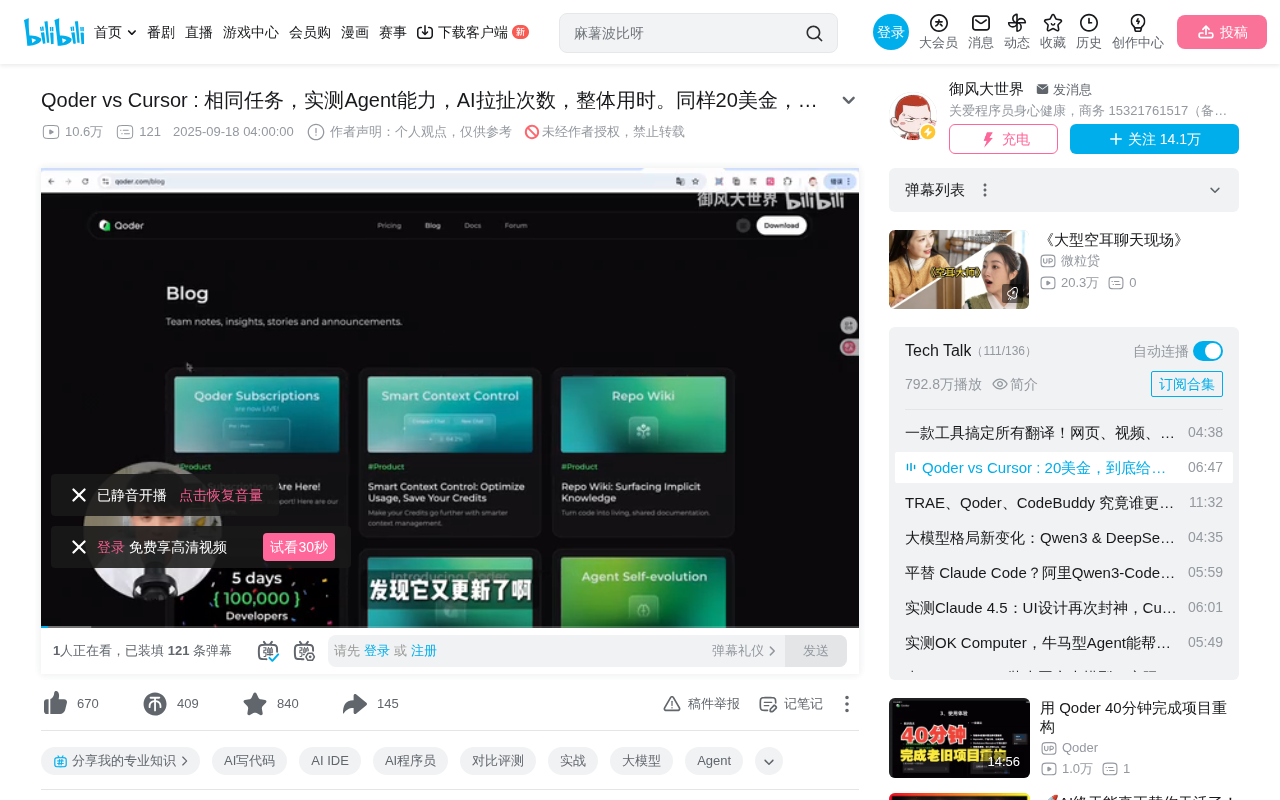
Qoder vs Cursor Real-World Comparison: Which $20/Month AI IDE Is Better?
Hands-on comparison of Qoder vs Cursor AI IDEs: Agent autonomy, human interaction count, and architecture decisions. Qoder needed only 2 interactions vs Cursor's 8.
 Product Reviews
Cursor Cloud Agent Demo: Eliminating Bottlenecks Across the Entire Software Development Lifecycle
Deep analysis of Cursor's Cloud Agent demo showing how cloud VMs, automated test artifacts, and a full-chain control plane systematically eliminate human bottlenecks across the software development lifecycle.
 Product Reviews
Cursor 3.0 Deep Dive: Multi-Agent Parallelism, Design Mode, and Best-of-N Model Comparison
Cursor 3.0 evolves from an AI coding assistant into an Agent fleet command center. Explore multi-agent parallelism, Design Mode, and Best-of-N model comparison.