Hermes Agent Deep Dive: Installation & Practical Guide to the Self-Learning AI Framework

Hermes Agent is the first AI Agent framework with a built-in learning loop that gets smarter over time.
Hermes Agent is an open-source AI Agent framework that gained 41.7K stars in two months, distinguished by its autonomous learning capability. Unlike Claude Code (interactive programming) and OpenCode (configuration-driven), Hermes Agent achieves continuously improving automated workflows without manual maintenance through its five-step closed-loop learning mechanism, three-layer memory system, and self-evolving Skill system — embodying the evolution of Harness Engineering from manual upkeep to autonomous operation.
Introduction: From Harness Engineering to Hermes Agent
Recently, an open-source project on GitHub has garnered 41.7K stars in just two months — Hermes Agent. Before this, you might have used Claude Code or experienced OpenCode's "lobster" ecosystem, but Hermes Agent takes a completely different path — it's the first AI Agent framework that ships with built-in "reins."
By "reins," I mean you don't need to write configurations yourself or manually maintain rules. Hermes Agent can autonomously learn how to work better for you. This concept originates from the Harness Engineering methodology.
The AI coding community has reached a consensus: the bottleneck isn't the model itself, but the environment configuration surrounding the model. The Long-Term team ran an experiment where, using the same model and only adjusting the surrounding rule constraints and memory system, performance jumped from 52.8% to 66.5%, and ranking leaped from Top 30 to Top 5 — without changing the model one bit. Terraform creator Mitchell Hashimoto named this approach Harness Engineering, which essentially means "building reins for AI."
Hermes Agent vs OpenCode vs Claude Code: Positioning Differences
Many people ask: Is Hermes Agent trying to replace Claude Code or OpenCode? The answer is no. These three tools solve problems at different levels:
- Claude Code: Interactive programming — you sit at the terminal and chat with it; it's your on-demand engineer
- OpenCode: Configuration-as-behavior — you write rule documents to make AI work the way you want; mature ecosystem (44,000+ community Skills)
- Hermes Agent: Autonomous operation + self-improvement — it doesn't need you sitting beside it; it runs on its own, learns on its own, evolves on its own, operating 24/7

The two dimensions with the biggest gap are learning ability and user modeling. OpenCode's Skills mainly rely on manual writing and community maintenance, while the longer you use Hermes Agent, the more precise its Skills become, the deeper its memory grows, and the smoother its work gets.
One sentence to distinguish them: OpenCode is a lobster you raise yourself; Hermes Agent is a lobster that grows on its own. One relies on your careful feeding; the other learns from its own experience.
Here's a detail worth noting: all three tools adopt the Agent Skills standard, and Skills are interoperable — they're not three parallel lines, but more like three roles with different responsibilities within the same ecosystem.
Hermes Agent Core Mechanism 1: Learning Loop — The Secret to Getting Smarter Over Time
The learning loop is Hermes Agent's most core mechanism and the most surprising aspect — it's not about what it can do, but that it "evolves."
The Transformation from the 1st to the 10th Use
Suppose the first time you ask Hermes Agent to write a Python web scraper, it produces working code, but the style might not suit your taste. By the tenth time, things are completely different: it knows you prefer httpx over requests, knows you like writing error logs to files rather than printing to the terminal, knows you hate overly long function names — nobody taught it; it learned on its own.
The Five-Step Closed-Loop Learning Mechanism Explained
The learning loop performs five things that form a closed loop:
- Curate Memory: After a conversation ends, it proactively decides which information is worth remembering (not passively storing all history)
- Create Skills: After completing complex tasks, it asks itself "Will this solution be useful again?" — if yes, it distills it into a Skill document
- Skill Self-Improvement: Automatically modifies the Skill itself based on user feedback, rather than only adjusting within the current execution
- FTS Full-Text Search: Uses the database's FTS5 extension for full-text indexing, searching relevant history on demand before a conversation begins
- User Modeling: Infers what kind of person you are, and can even catch inconsistencies between what you say and what you do
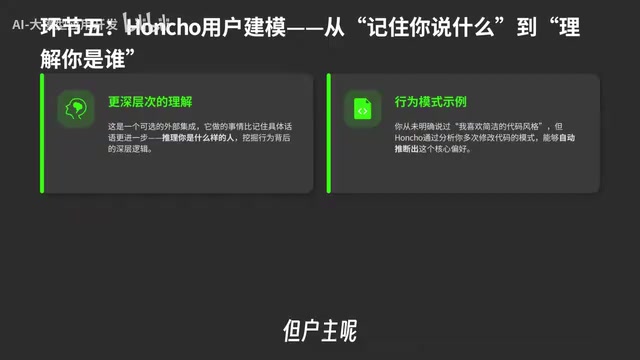
The key to these five steps lies in their causal relationships: memory feeds Skills, Skill usage generates new memories, new memories trigger Skill improvements, improved Skills produce better results, and better results make user modeling more accurate. This is a positive feedback loop, similar to Amazon's flywheel effect, except Hermes's flywheel spins for a single user — you can feel noticeable changes after just three to five days of use.
Hermes Agent Core Mechanism 2: Three-Layer Memory System Architecture
Most AI chat tools have memory like a goldfish — what was said last turn is forgotten the next. Hermes Agent's goal is to be an "old friend" — one that knows your temperament, habits, and working style.
A good memory system isn't about storing more; the key is retrieving accurately. Hermes solves this with a three-layer architecture:
| Layer | Question It Answers | Stored Content | Characteristics |
|---|---|---|---|
| Session Memory | What happened | Conversation content + FTS5 index | On-demand retrieval, not full loading |
| Persistent Memory | Who you are | Coding preferences, project structure, commonly used tools | Persists across sessions, stored locally |
| Skill Memory | How to do things | Methodologies and operational standards (Markdown documents) | Corresponds to procedural memory, self-evolving |
The three layers correspond to prospective memory, semantic memory, and procedural memory in cognitive science. It's like humans learning to ride a bicycle: you remember falling last time (session memory), know that your center of gravity should be low (persistent memory), and your body automatically maintains balance (Skill memory).
Local storage is an underrated feature: All data resides in the local Hermes directory. Backup only requires copying a folder — unlike many cloud-based AI tools where switching tools means starting from scratch.
Hermes Agent Core Mechanism 3: Self-Evolving Skill System
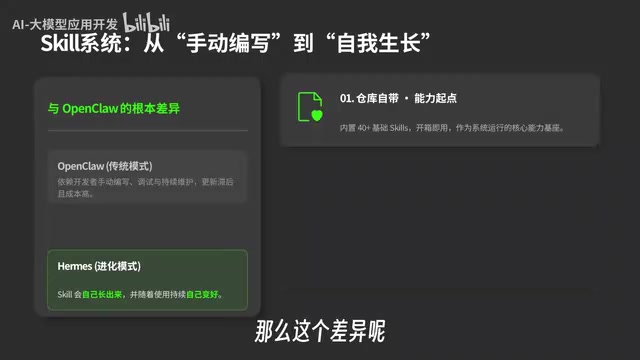
Hermes Agent's Skill system is fundamentally different from traditional approaches:
Three Sources of Skills
- Built-in with the repo: 40 built-in Skills
- Agent-created autonomously: Automatically distilled from repetitive tasks
- Community Hub installation: Acts as an accelerator
Four-Step Skill Self-Evolution Mechanism
- Execute Skill
- Collect feedback
- Analyze feedback
- Automatically modify the Skill document
Here's a practical example: You ask Hermes to organize your GitHub notifications every morning. The first few times, you have to explain your requirements each time. After the third or fourth time, Hermes will extract the recurring task pattern into a Skill document in the background. From then on, you only need to say "check GitHub," and it knows what to do. One day you say "add Discussions too" — it doesn't just add it this time; it also updates the Skill rules so next time it includes Discussions without being asked.
Built-in Tools & Safety Mechanisms: 40+ Tools + Triple Constraints
Hermes comes with over 40 built-in tools, divided into five categories: Execution (running commands and file operations), Information (search and browser automation), Media (images and voice), Memory (managing memories and Skills), and Coordination (delegating Agents and multi-model reasoning).
A few noteworthy tools:
- Session Search: FTS full-text search of conversation history — most Agents don't have this capability
- Cron Job: Define scheduled tasks in natural language without writing Cron expressions
- Delegation: Launch up to 3 sub-Agents working in parallel simultaneously
On the safety side, there are triple constraints: Tool Sets control the available tool scope, code runs in a sandbox, and Sessions can specify restricted tool sets.
Hermes Agent Installation & Deployment: Step-by-Step Practical Tutorial
Environment Requirements
- macOS/Linux: Direct installation
- Windows: Must install through WSL (Windows Subsystem for Linux); direct installation via CMD or PowerShell is not supported
Detailed Installation Steps
1. Prepare WSL Environment (Windows Users)
Open PowerShell and execute:
wsl -d Ubuntu
2. Install Git
apt install git
3. Run the Official Installation Script
Go to the Hermes Agent official website to get the installation script and execute it directly in the terminal. The installation process takes about ten minutes and will automatically install dependencies like Node.js, FFmpeg, etc.
4. Configure AI Model
After installation, select a model provider (supports OpenAI, DeepSeek, Qwen, and many other domestic and international providers), then configure the API Key, Base URL, and Model ID.
5. Launch Hermes Agent
hermes
Once launched, you can interact conversationally in the terminal. The operation is similar to Claude Code, but with additional support for instant messaging integration (WeChat, etc.).
Conclusion: The Value and Limitations of Hermes Agent
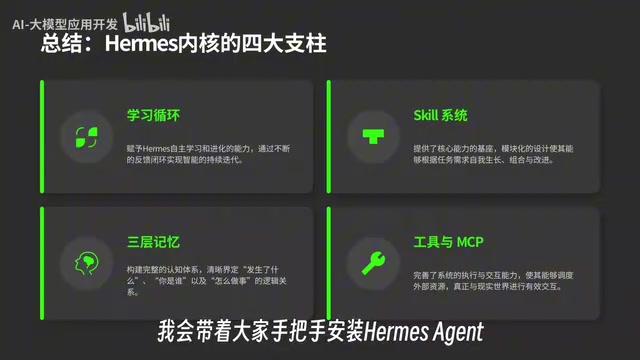
Hermes Agent's core value lies in advancing Harness Engineering from "manual maintenance" to "automatic operation." The learning loop gives it autonomous learning ability, the three-layer memory lets it understand context and users, the Skill system provides an evolvable capability foundation, and 40+ tools plus MCP complete its capability extension.
Current limitations: No automatic expiration mechanism (the memory database keeps growing), memory pollution issues (early incorrect information may persistently affect behavior), and Skill evolution effectiveness depends on the LLM's capabilities and feedback quality.
Usage recommendations: Regularly check the Hermes directory, clean up outdated Skill documents, review memory data, and ensure the system runs healthily.
Related articles
 Product Reviews
Qoder vs Cursor Real-World Comparison: Which $20/Month AI IDE Is Better?
Hands-on comparison of Qoder vs Cursor AI IDEs: Agent autonomy, human interaction count, and architecture decisions. Qoder needed only 2 interactions vs Cursor's 8.
 Product Reviews
Cursor Cloud Agent Demo: Eliminating Bottlenecks Across the Entire Software Development Lifecycle
Deep analysis of Cursor's Cloud Agent demo showing how cloud VMs, automated test artifacts, and a full-chain control plane systematically eliminate human bottlenecks across the software development lifecycle.
 Product Reviews
Cursor 3.0 Deep Dive: Multi-Agent Parallelism, Design Mode, and Best-of-N Model Comparison
Cursor 3.0 evolves from an AI coding assistant into an Agent fleet command center. Explore multi-agent parallelism, Design Mode, and Best-of-N model comparison.