Hermes Agent Desktop App: The Self-Evolving Open-Source AI Agent

Hermes Agent: an open-source autonomous AI agent with closed-loop learning and persistent memory launches desktop app
Hermes Agent is an MIT-licensed open-source autonomous AI system whose core advantages are its closed-loop learning mechanism and cross-session persistent memory, enabling continuous self-evolution over time. Its new desktop app supports all three major platforms, transforming CLI operations into a visual interface with multi-agent management, skill systems, cron jobs, and multi-platform gateways, covering use cases from content creation to financial analysis and application development.
What is Hermes Agent?
Hermes Agent is one of the most noteworthy open-source AI projects right now, surpassing tools like OpenClaw and Claude Code to become the go-to choice for many users' daily workflows. Unlike ordinary AI chatbots, Hermes is designed as a persistent autonomous system that continuously evolves over time.
Built on the latest research, it's released under the MIT open-source license—which, compared to GPL and similar licenses, allows commercial integration, helping attract both enterprise users and developer community contributions to accelerate ecosystem maturity. It can run 24/7 on your own computer and infrastructure while building long-term memory, reusable skills, and even developing a deeper understanding of you as a user.

Core Feature: Self-Evolution Through Closed-Loop Learning
Closed-Loop Learning Mechanism
Hermes' most critical differentiator is its built-in Closed Learning Loop. When it successfully completes a task, it automatically creates and optimizes reusable skill modules. In other words, the more you use it, the smarter it gets—this isn't marketing speak, but a fundamental architectural design.
From a technical perspective, closed-loop learning originates from cybernetics and reinforcement learning. Traditional AI tools use an open-loop model—each interaction is independent, and the system cannot accumulate improvements from historical experience. A closed-loop system introduces a feedback loop: the system executes a task → evaluates the result → encodes successful experiences as reusable modules → prioritizes verified strategies when encountering similar tasks in the future. This closely mirrors the neural mechanisms of human skill acquisition. In the AI agent domain, this mechanism is typically implemented through "skill distillation": compressing successful multi-step reasoning chains into single callable functions, which both reduces token consumption for future tasks and improves execution reliability. Hermes' implementation draws on architectural ideas from research projects like Stanford's Voyager, which validated the feasibility of continuous skill accumulation in a Minecraft environment.
Persistent Cross-Session Memory
Unlike most AI tools that start from scratch with every conversation, Hermes maintains persistent memory across sessions. Through a user modeling system called Poncho, it gradually builds a deep understanding model of you. Combined with periodic self-nudges and a persistent knowledge base, Hermes' capabilities continuously improve as runtime increases.
Persistent cross-session memory is one of the core challenges in current AI agent research. Mainstream implementation approaches fall into three categories: vector database retrieval (embedding historical conversations as vectors and recalling them by semantic similarity), structured knowledge graphs (explicitly storing entity relationships), and summary compression (periodically distilling long-term memory into concise user profiles). The Poncho user modeling system combines the latter two approaches—it doesn't just record "what you've said" but attempts to infer "what kind of person you are": work habits, preferred communication style, professional domain depth, and other meta-information. In academia, such systems are called "User Adaptive Models," and their challenge lies in balancing personalization with privacy protection—a concern that the local deployment architecture naturally resolves by eliminating data leakage risks.
Comparison with OpenClaw
Hermes is frequently compared with another popular open-source agent, OpenClaw. Users primarily switch to Hermes for three reasons: higher reliability, built-in long-term memory, and the self-improvement loop that makes the agent smarter over time. Hermes focuses more on depth and experiential learning rather than simply pursuing feature breadth.
This positioning also reflects the architectural evolution trend in autonomous AI agents. The concept of autonomous AI agents entered public awareness in 2023 with AutoGPT's viral popularity, but early implementations universally suffered from "hallucination cascading"—errors accumulating across multi-step tasks until the agent completely deviated from its goal. Since 2024, the research community has shifted toward more conservative "human-in-the-loop" architectures: agents proactively request human confirmation at critical decision points rather than executing fully autonomously. The new generation of systems that Hermes represents attempts to find a balance between the two: reducing single-step failure probability through skill modularization, minimizing repeated errors through persistent memory, while retaining user intervention interfaces.
Desktop App: The Leap from Command Line to Visual Interface
For a long time, Hermes' biggest pain point was the setup experience—it relied heavily on the command-line interface (CLI). While the terminal UI was acceptable, it lacked an intuitive visual environment for managing multiple agents, workflows, memory systems, and orchestration. For many users, the command line was a barrier to entry.
The Hermes Desktop App was launched precisely to solve this problem. It's an open-source native desktop application supporting Windows, macOS, and Linux, providing:
- Complete desktop UI interface
- More convenient multi-agent management
- Better workflow orchestration
- Native application performance
This may be the first time an open-source autonomous AI system has truly bridged the gap between research project and everyday usable tool.
Installation and Configuration Guide
Quick Installation
The installation process is straightforward: go to the GitHub repository's Release page and download the appropriate installer for your operating system—.dmg for macOS, .exe installer for Windows. Local installation requires approximately 2GB of disk space.
After installation, you can choose between two startup modes:
- Local mode: Click "Get Started" to install Hermes Agent locally
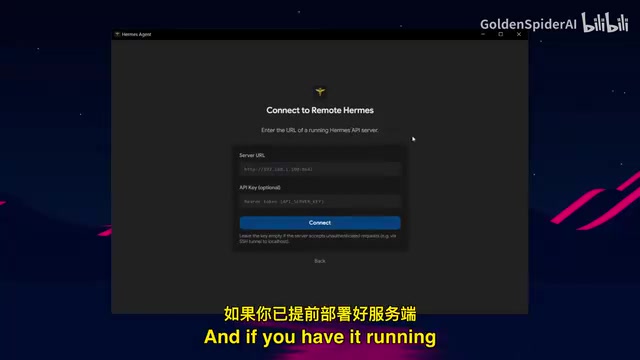
- Remote mode: Connect to an existing remote Hermes API server by entering the server URL and optional API Key
Model Configuration
During setup, you'll need to select an AI model provider. Supported options include: OpenRouter, Anthropic, OpenAI, and even local models. Notably, Hermes also offers a free model endpoint—while not optimal in performance, it's sufficient for experiencing the full feature set at zero cost.
Complete Feature Overview
Multi-Agent and Workspace Management
The desktop app's left panel integrates rich management modules:
- Session logs: Track all interaction records
- Multiple profiles: Create different agents for different use cases
- 3D Office: An interesting visualization feature that displays the collaboration status of various AI sub-agents in a 3D workspace format
- Skill management: Extend the agent's reusable skills and workflows
- Persona definition: Customize the agent's response style and tone
- Memory management: Manage the agent's knowledge base
Tools and Integration Ecosystem
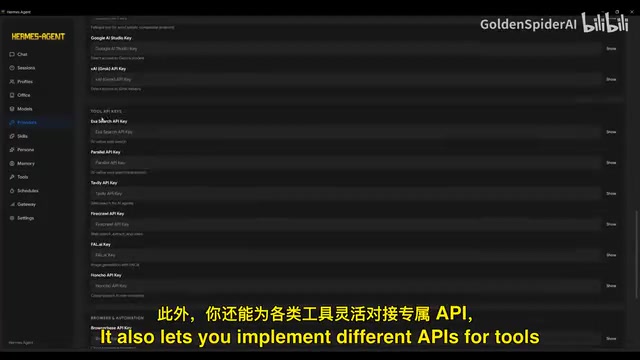
The tools module is a crucial component of Hermes, with built-in core tools including web search, browser operations, terminal commands, file operations, and memory management. More powerfully, you can extend capabilities through API integrations, such as:
- Image generation tools
- FireCrawl for web scraping and search
- XAI and various other tool APIs
Additionally, the Cron Jobs feature allows you to set up regularly scheduled automated tasks, similar to the scheduling capabilities of Claude Code or Codex. The Gateway module supports connecting Hermes to platforms like Telegram, Discord, and iMessage, enabling remote control from your phone.
Migrating from OpenClaw
If you're already using OpenClaw with extensive tools and skills configured, the Hermes desktop app provides a one-click migration feature—all configurations, API Keys, sessions, and skills can be imported directly, significantly reducing migration costs.
Practical Use Cases
Hermes Agent's application scenarios are extremely broad:
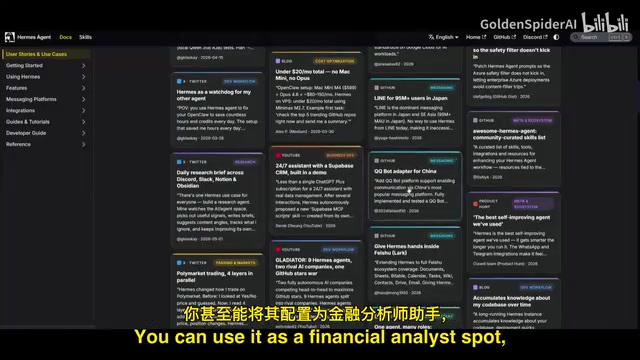
- Self-improving knowledge Wiki: Serves as a second brain, supporting multiple workflows
- Content creation: Automatically generates blog posts and video content (supports HyperFrame video skills)
- 24/7 assistant: Includes a built-in Supabase CRM demo
- Financial analysis: Assists decision-making as a financial analysis tool
- Application development: Generates complete CRM dashboards and other applications using the latest components
The HyperFrame video generation capability deserves special mention. Unlike diffusion model-based video generation tools like Sora and Runway, HyperFrame uses HTML/CSS/JavaScript as the "source code" for videos—each frame is essentially a programmatically controlled web rendering result. The core advantage of this approach is that AI agents can precisely control the position, animation curves, and timing logic of every visual element without relying on probabilistic pixel generation, making outputs highly predictable and editable. Its limitation is that the visual style tends toward "dynamic infographics" rather than photorealistic footage. For scenarios like data visualization, product demos, and educational content, this "code-as-video" paradigm is actually more practical than diffusion models, with significantly lower computational costs.
Conclusion and Outlook
The launch of the Hermes Agent desktop app marks a critical transition for open-source autonomous AI agents from "geek toys" to "productivity tools." Its core value lies not in the intelligence of any single conversation, but in its continuous evolution capability that accumulates over time—a fundamental paradigm shift.
For users who want to run autonomous AI systems on local infrastructure while maintaining data privacy and full control, Hermes offers one of the most mature open-source solutions available today. With ongoing community contributions and feature iterations, this project's potential is worth continued attention.
Key Takeaways
- Hermes Agent is a persistent autonomous AI system that achieves self-evolution through a closed-loop learning mechanism, getting smarter the more you use it
- The new desktop app supports Windows/macOS/Linux, transforming complex CLI operations into an intuitive visual interface, significantly lowering the barrier to entry
- Built-in cross-session persistent memory, user modeling (Poncho), and reusable skill systems distinguish it from traditional AI chat tools
- Supports multiple model providers, cron jobs, multi-platform gateways (Telegram/Discord, etc.), and offers one-click migration from OpenClaw
- Use cases span content creation, financial analysis, application development, knowledge management, and more, with 24/7 autonomous operation capability
Related articles
 Product Reviews
Qoder vs Cursor Real-World Comparison: Which $20/Month AI IDE Is Better?
Hands-on comparison of Qoder vs Cursor AI IDEs: Agent autonomy, human interaction count, and architecture decisions. Qoder needed only 2 interactions vs Cursor's 8.
 Product Reviews
Cursor Cloud Agent Demo: Eliminating Bottlenecks Across the Entire Software Development Lifecycle
Deep analysis of Cursor's Cloud Agent demo showing how cloud VMs, automated test artifacts, and a full-chain control plane systematically eliminate human bottlenecks across the software development lifecycle.
 Product Reviews
Cursor 3.0 Deep Dive: Multi-Agent Parallelism, Design Mode, and Best-of-N Model Comparison
Cursor 3.0 evolves from an AI coding assistant into an Agent fleet command center. Explore multi-agent parallelism, Design Mode, and Best-of-N model comparison.