Red Alert "Hair Trigger" Map Guide: Oil Derrick Mind Games and Prism Tank Breakthrough Strategies
Red Alert "Hair Trigger" Map Guide: Oi…
Strategic breakdown of Red Alert's "Hair Trigger" map: oil derrick gambles and Prism Tank tactics.
This article provides a detailed analysis of a multiplayer match on the Red Alert 2 custom map "Hair Trigger." The map's core mechanic features critically damaged oil derricks in the center — capturing them grants economic advantage, but they can be detonated to trigger chain destruction at any time. The player wins through adaptive opening strategies, garrisoned chimney defenses, long-range Prism Tank breakthroughs, and Aircraft Carrier naval supremacy, showcasing RTS competitive thinking across environmental exploitation, economic warfare, and multi-dimensional combat.
Among the many custom maps in Red Alert, "Hair Trigger" is a uniquely designed battle map. All players' bases are clustered in the center of the map, surrounded by critically damaged oil derricks — these structures have only a sliver of health remaining, and the slightest mistake can trigger a chain explosion that takes out your base along with them. This distinctive design fills every match with tension and strategic depth.
The Red Alert series (particularly Red Alert 2 and its expansion Yuri's Revenge) boasts an extremely active custom map community. The game's built-in map editor allows players to freely design terrain, place buildings, and set resource points, giving rise to tens of thousands of creative maps. These maps can be broadly categorized into battle maps, survival maps, RPG maps, and entertainment maps. "Hair Trigger" is a classic example of a mechanic-driven battle map — by altering standard game rules, it creates an entirely new strategic experience where players must make decisions in a familiar unit system but on a completely different battlefield.
Map Mechanics: The Double-Edged Sword of Low-HP Oil Derricks
The core mechanic of the "Hair Trigger" map lies in the densely packed, critically damaged oil derricks in the central area. These derricks have extremely low health — a single pillbox's firepower is enough to detonate one, and the resulting chain reaction can destroy every building nearby.
In standard Red Alert 2 gameplay, oil derricks (tech oil derricks) are neutral buildings that, once captured by an engineer, automatically generate funds at regular intervals, serving as an important supplementary income source. When destroyed, oil derricks produce a large-area explosion with enough damage to wipe out surrounding buildings and units. Under normal conditions, oil derricks have high enough health that they're not easily destroyed, but the map editor allows designers to modify a building's initial HP. "Hair Trigger" exploits this feature by setting oil derrick health to an extremely low value, meaning any minor attack can trigger an explosion. When multiple derricks are packed closely together, the result is a terrifying chain reaction — one derrick's explosion damages adjacent ones, setting off a domino effect of destruction.
This means the oil derricks are both a vital economic resource and a ticking time bomb that could detonate at any moment. Players face a classic strategic dilemma: capturing derricks provides an economic advantage, but once an enemy detonates them, you lose not only your income source but potentially your entire base. As a result, nearly every player relocates their base away from the central area immediately after the match begins — this has become an unwritten rule of this map.
Opening Strategy: Territory Control vs. Oil Derrick Capture
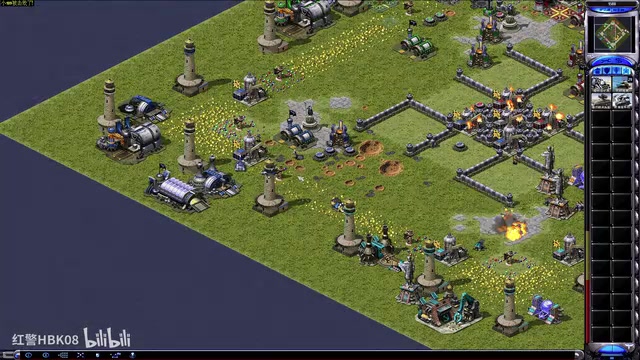
In this match, the content creator (UP主) opted for a steady opening strategy. First, they aggressively deployed pillboxes to seize territory, prioritizing the suppression of the purple player's development space and preventing purple from producing units normally.
The critical decision came in how to handle the oil derricks. The creator originally planned to use pillboxes to detonate the central derricks, but after observing that all other players had already relocated their bases, they decisively changed course — since the explosions could no longer damage enemy bases, it made more sense to send engineers to capture these derricks and convert them into an income source. This on-the-fly judgment reflects the battlefield awareness of a high-level player: strategy must adapt to the evolving situation rather than mechanically following a preset plan.
Subsequently, the creator and the red player (小红) fell into a delicate "balance of terror" — both sides had captured oil derricks, and neither was willing to trigger detonation because the explosion would destroy both sides' economic infrastructure simultaneously. This is a vivid demonstration of Nash equilibrium from game theory in a Red Alert match. Nash equilibrium, a core concept in game theory proposed by mathematician John Nash, describes a situation in a game where all participants have chosen their optimal strategies and no single party can improve their outcome by unilaterally changing their strategy. On this map, both sides occupied adjacent oil derricks; detonating them would destroy the opponent's economy but also annihilate one's own derricks in the chain explosion, so both chose not to detonate — similar to the Cold War doctrine of Mutually Assured Destruction (MAD), where the existence of nuclear weapons paradoxically maintained peace.
Mid-Game Development: Chimney Defense and Economic Management
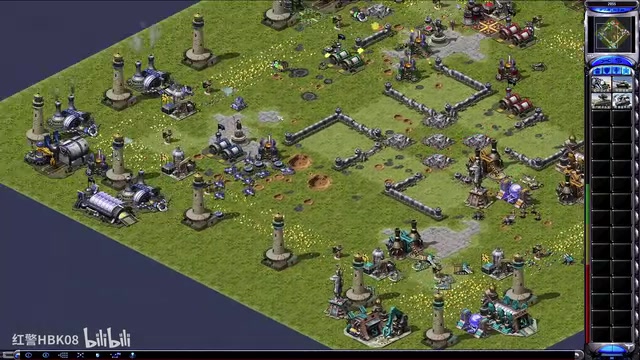
Another distinctive feature of this map is the chimneys (some players call them lighthouses) scattered across the entire map. Garrisoning infantry inside these chimneys creates an extremely powerful defensive network that makes it very difficult for attackers to break through. In Red Alert 2, infantry garrisoned in buildings receive additional protection bonuses, and the buildings themselves have far more health than infantry units, making garrisoned buildings an exceptionally cost-effective defensive measure. Clearing garrisoned buildings typically requires engineers, Crazy Ivan, or concentrated fire from large numbers of tanks — the cost of offense far exceeds the cost of defense. The creator fully exploited this terrain advantage by filling all chimneys in their controlled area with soldiers, establishing a solid defensive line.
On the economic front, the creator adopted a "hold one corner" development approach — controlling one corner of the map and ensuring mining area security. This strategy is especially important on maps with relatively scarce resources. In Red Alert 2's economic system, ore miners are the most fundamental income source, shuttling between the refinery and ore fields, with shorter distances yielding higher efficiency. Therefore, controlling a safe, ore-rich area is more economically efficient than scattered mining. When the green player's (小绿) refinery attempted to encroach on the creator's mining zone, it was immediately and firmly repelled. Resource competition in Red Alert matches often determines the trajectory of the mid-to-late game.
The Turning Point: Prism Tank Breakthrough and Naval Supremacy
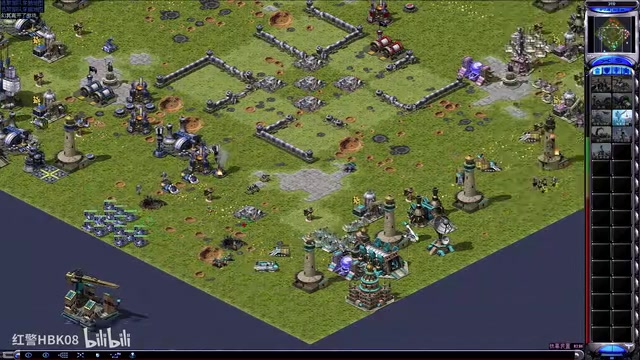
Entering the mid-to-late game, the creator's primary opponent was the light blue player, who controlled two oil derricks. Both sides had comparable economic development with three ore miners each, and the situation reached a stalemate.
The creator's breakthrough came through the classic combination of Prism Tanks with Prism Tower range extension. The Prism Tank is an advanced Allied tank unit that attacks by firing a prism beam. The game features an important mechanic: when a Prism Tank's beam passes through a friendly Prism Tower, the tower refracts and amplifies the beam, effectively extending the attack range. Through relay refraction across multiple Prism Towers (colloquially called "utility poles" by players), the attack range can be extended far beyond normal distance. This tactic requires precise building placement and an understanding of beam refraction angles — it's a signature technique of high-level Allied players. By chaining two Prism Towers together, the creator maximized the Prism Tank's range advantage, destroying enemy oil derricks from long distance and dismantling the opponent's economy.
Light blue attempted to counter with V3 Rockets and Dreadnoughts, but the creator struck first, using Prism Tanks to demolish the opponent's high-tech buildings, directly cutting off the Dreadnought production line. The V3 Rocket Launcher is a Soviet long-range fire support unit — while it has extreme range, its missiles travel slowly and are easily intercepted, and the vehicle itself is fragile. Dreadnoughts share similar weaknesses despite their extreme range. By prioritizing the destruction of high-tech buildings (such as the Battle Lab and other advanced tech prerequisites), the creator cut off the opponent's ability to produce advanced units at the source — embodying a "decapitation strike" approach.
On the naval front, the creator built a shipyard in time, using dolphins to counter enemy Dreadnoughts before developing Aircraft Carriers to achieve total naval supremacy. The concept of naval supremacy originates from military theorist Alfred Thayer Mahan's The Influence of Sea Power upon History, and it applies equally to real-time strategy games. In Red Alert 2, Aircraft Carriers can continuously launch Hornet drones for bombing from a safe distance, outranging most land-based anti-air units. Dolphins, as anti-submarine units, effectively protect the fleet from submarine threats. Controlling the seas means possessing a long-range fire platform that land armies can barely counter — on maps with waterways, this is often a decisive strategic advantage. This series of maneuvers demonstrated a core principle: In Red Alert matches, unit counters and timing matter far more than simply amassing numbers.
Endgame: Three-Way Standoff and Final Victory
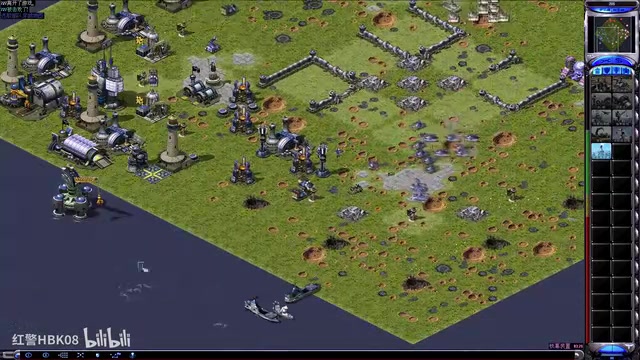
As the creator gradually absorbed light blue's territory, the pink player in the upper portion of the map had already developed the Iron Curtain and begun attacking the red player. The Iron Curtain Device is one of the Soviet superweapons — when activated, it renders selected vehicles within a designated area completely invincible for a period of time, serving as the Soviets' ultimate tool for breaking through defensive lines. A pink player with the Iron Curtain could periodically launch an unstoppable armored charge, posing a massive threat to any defensive system. The situation evolved into a three-way standoff.
The creator's strategy was crystal clear: while pink was busy attacking red, accelerate the elimination of light blue, then concentrate forces against pink. This "befriend the distant, attack the nearby" strategy is extremely common in multiplayer matches — prioritize eliminating the nearest threat while letting other players wear each other down.
In the final showdown, although pink had a numerical advantage in tanks, the creator held complete naval supremacy — multiple Aircraft Carriers and a dolphin fleet. Carrier long-range bombardment destroyed pink's nuclear power plants and base, while red's destroyers also helped demolish pink's remaining structures. In Red Alert 2, nuclear power plants are the primary power supply buildings in the advanced stage; once destroyed, they cause widespread power outages that disable all defensive structures and radar while drastically reducing production speed. Stripped of production capability, pink could only mount a last stand.
The creator ultimately won this spectacular match through a layered defense system composed of pillboxes, garrisoned chimneys, Prism Towers, and Rocketeers. This multi-layered defensive approach — ground fire points (pillboxes), garrisoned buildings (chimneys), long-range support (Prism Towers), and air units (Rocketeers) working in concert — forms a defensive network with no obvious weaknesses, and is a key hallmark that distinguishes high-level players from average ones.
Tactical Summary: Five Lessons from the Battlefield
This match offers several important takeaways for Red Alert players:
- Leverage the environment: Low-HP oil derricks are both resources and weapons — how you use them depends on the battlefield situation
- Stay adaptable: Opening strategies must be adjusted in real-time based on opponent behavior — never be rigid
- Wage economic warfare: Destroying enemy economic infrastructure is often more effective than head-on confrontation
- Fight on multiple dimensions: Coordinating army, navy, and defensive structures is the key to victory
- Master your timing: In multiplayer matches, choosing the right moment and target to attack is paramount
These lessons apply not only to the "Hair Trigger" map specifically but represent universal competitive thinking across all real-time strategy games. Whether it's multi-front harassment in StarCraft, economic pressure in Age of Empires, or unit counter-play in Red Alert, the core always comes down to information assessment, timing, and the ability to make optimal decisions amid uncertainty.
Related articles
 Product Reviews
Qoder vs Cursor Real-World Comparison: Which $20/Month AI IDE Is Better?
Hands-on comparison of Qoder vs Cursor AI IDEs: Agent autonomy, human interaction count, and architecture decisions. Qoder needed only 2 interactions vs Cursor's 8.
 Product Reviews
Cursor Cloud Agent Demo: Eliminating Bottlenecks Across the Entire Software Development Lifecycle
Deep analysis of Cursor's Cloud Agent demo showing how cloud VMs, automated test artifacts, and a full-chain control plane systematically eliminate human bottlenecks across the software development lifecycle.
 Product Reviews
Cursor 3.0 Deep Dive: Multi-Agent Parallelism, Design Mode, and Best-of-N Model Comparison
Cursor 3.0 evolves from an AI coding assistant into an Agent fleet command center. Explore multi-agent parallelism, Design Mode, and Best-of-N model comparison.