Indie Developer Uses AI for Game Development: Cutscenes Done in Just 5 Minutes
Indie Developer Uses AI for Game Devel…
Indie developer builds complete AI tool chain for cutscenes, voice acting, and music, dramatically lowering game dev barriers.
An indie game developer demonstrates AI-assisted game development in practice: generating cutscenes in 5 minutes using AI tools like Jimeng, building a complete tool chain of AI music + voice acting + animation, and implementing AAA-level features like character sitting animations and camera anti-clipping systems. The main AI bottleneck currently lies in the inability to directly adapt to character rigging and animation systems, but once this is overcome, the indie developer dream of being a one-person army will become reality.
When AI Meets Indie Game Development
An indie game developer shared his latest progress using AI tools to assist game development on Bilibili. He demonstrated three exciting new features: AI-generated cutscenes, a character sitting animation (commonly known as "AAA sit"), and a camera anti-clipping system. The implementation of these features shows us the enormous potential of AI tools in indie game development — one person can create an immersive gaming experience.
AI-Generated Cutscenes: 5 Minutes to Dramatically Boost Immersion
The developer used an AI video generation tool called "Jimeng" (即梦) to create opening animations and mission transition cutscenes for the game. The entire process took only about 5 minutes, yet dramatically enhanced the game's sense of immersion.
AI video generation tools like Jimeng rely on a combination of Diffusion Models and video temporal consistency techniques. Unlike image generation, video generation requires maintaining coherence in content, lighting, and motion between frames, which places extremely high demands on the model's temporal modeling capabilities. In recent years, the emergence of products like Sora, Runway Gen-2, and Kling marks AI video generation's evolution from "frame-by-frame stitching" to "semantically-driven continuous motion synthesis." For indie developers, the greatest value of these tools lies in bypassing the most time-consuming aspects of traditional cutscene production — storyboard design, 3D scene construction, and rendering — compressing what would normally take days into minutes.
He demonstrated two cutscene effects: one was an atmospheric opening sequence, and the other was a narrative scene where the player follows an NPC captain to turn in a quest. Although the first attempt only used 720P resolution, making the visuals slightly rough, the overall effect was already quite impressive.

The developer pointed out that many large-scale games rely on cutscenes to enhance immersion — it's just that big companies have the manpower to build scenes and create realistic models. The term AAA Game originated from the game industry's informal grading of high-budget, large-scale production projects, analogous to the highest credit rating. A typical AAA game development cycle usually spans 3 to 7 years, with team sizes ranging from hundreds to over a thousand people, and budgets easily exceeding $100 million. Take GTA5 as an example — its development cost was approximately $265 million, with dedicated motion capture teams, environment art teams, and cutscene directors. In contrast, indie developers typically operate with extremely small teams of 1 to 5 people, relying on limited personal funds or crowdfunding. This resource gap used to essentially determine the ceiling of game quality, but now with AI video generation tools, indie developers can achieve similar effects. As AI video tools continue to improve, the quality of generated cutscenes will only get better.
AAA-Level Detail Polish: Sitting Animation and Camera Anti-Clipping
Character Sitting Animation
The developer excitedly demonstrated the character's "sit down" animation — a feature commonplace in AAA titles, but a significant technical breakthrough for an indie developer. The character can smoothly execute a stand-up and sit-down loop animation. While it may seem simple, this kind of interactive detail is key to elevating the perceived quality of a game.
Camera Anti-Clipping System
Another feature the developer was very satisfied with is the camera anti-clipping system. In third-person games, the camera clipping through walls is a common annoying problem that seriously breaks player immersion.
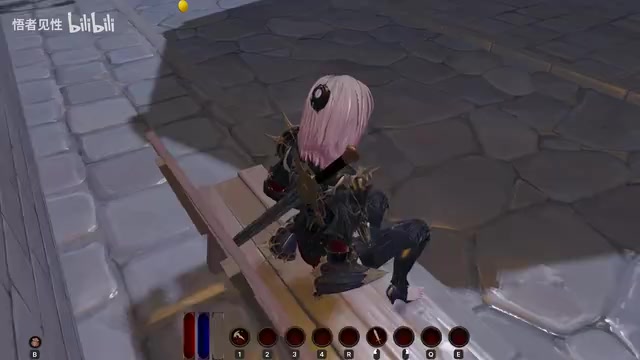
Camera Collision in third-person games is a classic game engineering problem. The standard implementation is typically based on Raycast or SphereCast: a detection ray is cast from the character's position toward the ideal camera position, and if the ray collides with scene geometry, the camera is pulled closer to a safe distance between the collision point and the character. More refined implementations also introduce a Spring Arm mechanism, using damped interpolation to make camera displacement smoother and avoid camera jitter caused by collisions. Unreal Engine's built-in Spring Arm component has encapsulated this logic as an out-of-the-box feature, while Unity developers typically need to use the Cinemachine plugin or implement it themselves.
This developer's solution follows exactly this approach: when the system detects that the camera is about to embed into a wall, it automatically pushes the camera closer to the character to avoid clipping. From the demo, the camera naturally moves closer to the character when approaching walls rather than penetrating through them, creating a smooth and natural overall experience. This feature achieved satisfying results on the first implementation, demonstrating solid game engineering fundamentals.
AI Tool Chain: Music, Voice Acting, and Animation as a Trinity
The developer has built a complete AI-assisted development workflow: AI-generated music, AI voice acting, and AI-produced cutscenes. The integration of these three capabilities has achieved a qualitative leap in the game's completeness and coherence.
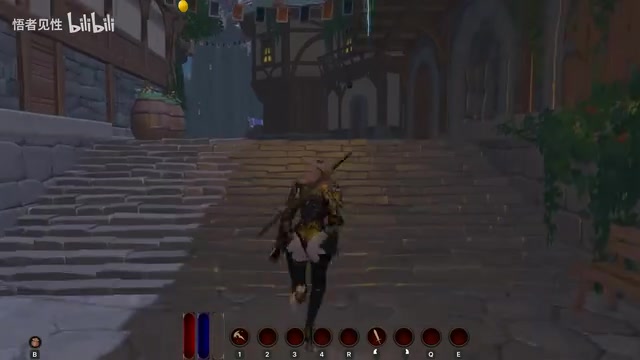
This "AI music + AI voice acting + AI cutscenes" trinity workflow is essentially a modern reconstruction of a modular Content Pipeline. Traditional game content pipelines require collaboration among multiple specialized roles such as audio engineers, voice directors, and animators, while AI tools democratize the core output capabilities of these roles through APIs or interactive interfaces. From an engineering architecture perspective, the developer's emphasis on "flexible embedding" capability is crucial — this means his game framework adopts a Data-Driven design philosophy, decoupling content assets from game logic so that externally AI-generated assets can be injected through unified interfaces without modifying underlying code. Cutscenes support up to 10 seconds per segment, and content exceeding this duration can be processed in segments — for example, a 30-second animation is split into three segments played sequentially. This architectural design not only improves current development efficiency but also reserves space for seamless replacement as AI capabilities upgrade in the future.
The Indie Developer's AI Vision and Real-World Challenges
Current Limitations
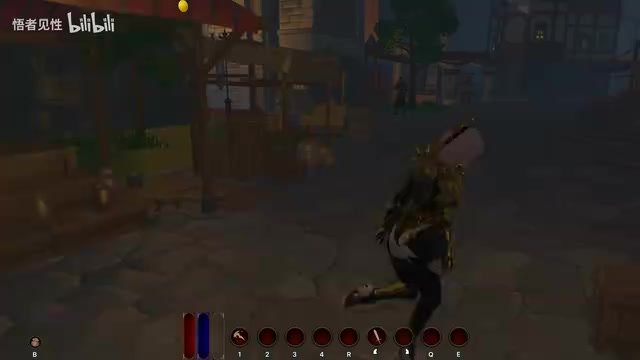
The developer candidly admits that current AI tools still have obvious shortcomings. The biggest pain point is: existing AI tools cannot directly adapt to the character models, rigging, and animation systems used in games.
Rigging is the core infrastructure of 3D game character animation. Its principle involves constructing a hierarchical bone structure inside the character Mesh, mapping bone movement to surface vertex deformation through Skinning Weights. A complete humanoid character skeleton typically contains 50 to over 100 bone nodes, covering fine control hierarchies for the spine, limbs, facial expressions, and more. Motion Capture Data or procedural animation must strictly match the target character's skeletal topology — this is precisely the core bottleneck of current AI tools. Generated motion data is often based on standard skeletons (such as Mixamo's Human IK standard) and cannot directly drive a developer's custom character skeleton, requiring tedious manual adaptation processes like Retargeting. This means much of the work still requires manual conversion and adjustment, making the process quite cumbersome.
Expectations for the Future
But he's full of expectations for the future. If one day AI could directly generate animation and rigging data adapted to specific character models based on developer instructions, that would be a true game changer. At that point, one person might be able to produce game content equivalent to one-tenth the scale of GTA5 within a single month — NPC reactions, animations, and voice lines would all become rich and diverse.
He also compared his AI-powered game development approach with traditional indie games. Games like Slay the Spire and Hades have excellent gameplay, but they can hardly achieve the kind of narrative immersion enhancement that AI cutscenes provide. This is precisely the unique advantage of his technical approach.
Final Thoughts
This developer's practice shows us an interesting trend: AI is lowering the barrier to game development, not by replacing developers, but by becoming a "super assistant" for indie developers. From music to voice acting to cutscenes, AI tools are filling the gaps in resources and manpower that indie developers face, redefining the decades-long resource divide between AAA studios and indie teams.
Of course, core game design, system architecture, and technical implementation still require the developer's own abilities. AI currently functions more as a content production accelerator rather than a universal solution. Once the real bottlenecks — rigging adaptation and motion data generation — are broken through, the indie developer dream of being a "one-person army" will accelerate from vision to reality. But as AI tools continue to evolve, that day may arrive sooner than we expect.
Related articles
 Product Reviews
Qoder vs Cursor Real-World Comparison: Which $20/Month AI IDE Is Better?
Hands-on comparison of Qoder vs Cursor AI IDEs: Agent autonomy, human interaction count, and architecture decisions. Qoder needed only 2 interactions vs Cursor's 8.
 Product Reviews
Cursor Cloud Agent Demo: Eliminating Bottlenecks Across the Entire Software Development Lifecycle
Deep analysis of Cursor's Cloud Agent demo showing how cloud VMs, automated test artifacts, and a full-chain control plane systematically eliminate human bottlenecks across the software development lifecycle.
 Product Reviews
Cursor 3.0 Deep Dive: Multi-Agent Parallelism, Design Mode, and Best-of-N Model Comparison
Cursor 3.0 evolves from an AI coding assistant into an Agent fleet command center. Explore multi-agent parallelism, Design Mode, and Best-of-N model comparison.