InsForge: The Open-Source Tool That Gives AI Coding Assistants Backend Capabilities

InsForge gives AI coding assistants backend operation capabilities for true end-to-end development.
InsForge is an open-source backend platform designed specifically for Agentic Coding. Through interfaces like MCP Server, it exposes backend capabilities—databases, authentication, storage, Edge Functions, deployment—to AI coding assistants. It solves the "last mile" problem where AI coding tools cannot execute backend infrastructure operations after code generation, enabling AI Agents to go from reading context to executing database migrations, deploying functions, and achieving true end-to-end delivery.
The "Backend Breakpoint" Problem with AI Coding Assistants
Developers who've used Claude Code, Codex, or Cursor Agent are probably familiar with this rhythm—the first half goes blazingly fast, with AI smoothly handling pages, APIs, refactoring, and bug fixes. But when the project actually needs to run, problems emerge: setting up databases, configuring authentication, managing storage, deploying functions, checking logs, handling deployment… these actions typically fall outside the scope of code completion capabilities.
So the workflow shifts from "let AI keep going" to "you switch to the console and command line to fill in the gaps." Every time this handoff happens, AI coding assistants fall short of true end-to-end delivery.
The root cause lies in the capability boundaries of current AI coding tools: they excel at file-level operations (generating, modifying, refactoring code), but backend infrastructure operations involve external system interactions—database servers, cloud platform consoles, deployment pipelines—things that can't be accomplished by editing code files alone. Traditional code completion tools (like early GitHub Copilot) only provided line-by-line suggestions, and even the more advanced Agentic Coding paradigm—where AI acts as an autonomous agent that understands tasks, plans steps, invokes tools, and iterates on corrections—lacks standardized tool interfaces for backend operations.
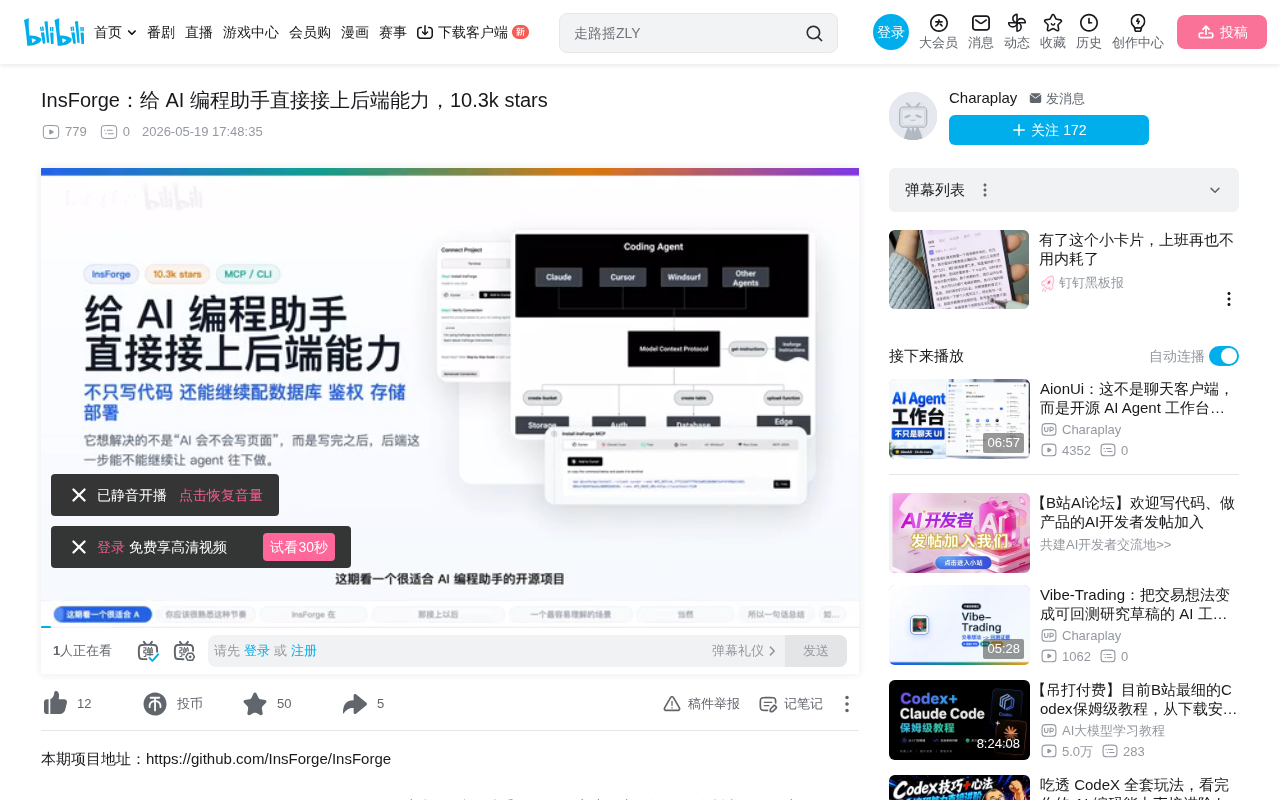
What InsForge Is: Giving Agentic Coding Its Backend Hands and Feet
InsForge (GitHub 10.3k stars) has a very straightforward positioning: an open-source backend platform for Agentic Coding. More precisely, it organizes backend capabilities—databases, authentication, storage, model gateways, Edge Functions, deployment—into operational interfaces that AI coding assistants can call directly.
To understand this, you need to grasp the fundamental difference between Agentic Coding and traditional code completion: Agentic Coding is a programming paradigm that emerged in 2024-2025 where AI no longer just offers line-by-line suggestions but participates in development as an autonomous agent—understanding task objectives, planning execution steps, invoking tools, reading feedback, and iterating on corrections. Typical examples include Claude Code's autonomous coding mode, OpenAI Codex's multi-step task execution, and Cursor's Agent Mode. In this paradigm, developers act more like project managers while AI handles the complete chain from understanding requirements to delivering code. But the "last mile" of this chain—backend infrastructure operations—has always been a weak link, and InsForge is designed specifically to fill this gap.
Two Integration Paths
The repository provides two integration approaches:
- MCP Server: Supports both self-hosted and cloud access, currently the most flexible option
- CLI + Skills: The README explicitly marks this as Cloud-only, not supporting all local scenarios
MCP (Model Context Protocol) is an open protocol released by Anthropic in late 2024, aimed at standardizing communication between AI models and external tools/data sources. Think of it as the USB-C port of the AI world—regardless of the underlying tool or service, as long as it implements the MCP protocol, an AI Agent can discover, invoke, and interact with it in a unified way. The MCP Server, as the service side, exposes available tool lists and invocation methods to AI Agents, which send requests through MCP Clients. This architecture allows InsForge's backend capabilities to be seamlessly called by any MCP-supporting AI coding assistant (such as Claude Code, Cursor, etc.) without developing separate integration plugins for each Agent.
For developers who want full local control, the MCP Server is currently the preferred path.
What AI Coding Assistants Can Do After Connecting to InsForge
After connecting to InsForge, an AI Agent's capability boundaries expand significantly:
Context Reading Phase: The Agent can first read documentation, schemas, metadata, deployed function information, storage bucket contents, and runtime logs. The Agent no longer writes code blindly but makes decisions after obtaining complete backend context.
Backend Action Execution Phase: After understanding the context, the Agent can proceed to execute specific operations—running database migrations, deploying Edge Functions, configuring storage buckets, etc.
The concept of "database migrations" deserves elaboration: database migration is the standard practice of managing database schema changes through versioned script files. Each time you need to add a table, modify a field, or adjust an index, a developer writes a migration file (typically containing SQL for both up and down directions), then executes them in sequence. This ensures database schema changes are trackable, reversible, and synchronizable across teams. In traditional AI coding scenarios, if an Agent can only generate ORM model definitions in code but cannot execute actual migration commands, the database schema remains permanently in the "planning" stage. InsForge lets Agents directly trigger migration execution, completing the full path from schema design to actual database changes.
Overview of InsForge Core Capability Modules
The README lists the following core capabilities:
- Authentication: Auth configuration
- Database: Database management and migrations
- Storage: Object storage operations
- Model Gateway: Model gateway
- Edge Functions: Edge function deployment
- Compute: Computing resources (currently Private Preview)
- Site Deployment: Site deployment
Edge Functions are a serverless computing model that runs on CDN edge nodes. Unlike traditional centralized cloud functions (like AWS Lambda), Edge Functions are geographically closer to users, typically running on V8 engines or WebAssembly runtimes with extremely short cold start times (usually under 5ms). Cloudflare Workers, Vercel Edge Functions, and Supabase Edge Functions are all typical implementations. In InsForge's context, an AI Agent being able to directly deploy Edge Functions means it can complete the entire workflow from writing business logic to publishing it to a global edge network, without developers manually configuring deployment pipelines.
The key insight here isn't how many modules it covers, but that these capabilities can be incrementally connected to AI coding assistants to form a complete end-to-end workflow.
Typical Use Cases
The easiest scenario to understand: you ask an AI coding assistant to build a tool from scratch.
First, it writes out the pages and APIs. Then, through InsForge's MCP Server, it continues to read documentation, check the current project state, configure the database, set up authentication, open storage, and deploy functions. The workflow is no longer "AI writes halfway, human takes over to finish" but more like "human sets the direction, AI pushes forward with backend capabilities."
Local Quick Start Guide
The local Quick Start in the README is very straightforward:
- Spin up a local instance using Docker Compose
- Connect InsForge MCP to your Agent
- Use a verification prompt to have the Agent call the
FetchDocstool to confirm the connection is working
The entire process has a low barrier for developers with Docker experience.
Boundaries to Keep in Mind When Using InsForge
Amid the excitement, several boundaries need to be clarified:
- CLI + Skills is Cloud-only: Don't assume all local scenarios are supported
- Compute is still in Private Preview: Think of it more as a preview of extended capabilities, not the most mature feature currently
- It's not a general-purpose backend platform: If you're just looking for a regular BaaS solution, InsForge's core value isn't there
The third point deserves further explanation: BaaS (Backend as a Service) refers to platforms like Firebase, Supabase, and Appwrite that provide out-of-the-box backend capabilities, where developers call database, authentication, storage, and other services directly through SDKs or REST APIs, eliminating the complexity of building backends from scratch. While InsForge overlaps with BaaS in functional modules (both involve databases, auth, storage), the core difference lies in the interaction target—BaaS users are human developers, while InsForge's primary "users" are AI Agents. Its API design, documentation structure, and context exposure methods are all optimized for Agent cognition patterns, with the goal of enabling machines to autonomously complete backend operations rather than simplifying manual configuration for humans.
Summary: Keeping AI Coding Assistants from Dropping the Ball at the Backend Step
The most noteworthy aspect of InsForge isn't that it built yet another backend platform, but that it solves a very specific problem—preventing AI coding assistants from immediately falling off a cliff at the backend step after writing code.
It lets Agents not just generate code but continue handling databases, authentication, storage, functions, and deployment. If what you care most about is how to keep AI coding assistants pushing full-stack projects forward, InsForge is worth ongoing attention and exploration.
Related articles
 Product Reviews
Qoder vs Cursor Real-World Comparison: Which $20/Month AI IDE Is Better?
Hands-on comparison of Qoder vs Cursor AI IDEs: Agent autonomy, human interaction count, and architecture decisions. Qoder needed only 2 interactions vs Cursor's 8.
 Product Reviews
Cursor Cloud Agent Demo: Eliminating Bottlenecks Across the Entire Software Development Lifecycle
Deep analysis of Cursor's Cloud Agent demo showing how cloud VMs, automated test artifacts, and a full-chain control plane systematically eliminate human bottlenecks across the software development lifecycle.
 Product Reviews
Cursor 3.0 Deep Dive: Multi-Agent Parallelism, Design Mode, and Best-of-N Model Comparison
Cursor 3.0 evolves from an AI coding assistant into an Agent fleet command center. Explore multi-agent parallelism, Design Mode, and Best-of-N model comparison.