Kimi K2.6 Hands-On Review: A Zero-Barrier Experience for Building Dynamic Websites
Kimi K2.6 Hands-On Review: A Zero-Barr…
Kimi K2.6 Web Coding review: strong design, built-in database, one-click deploy lowers website building barriers.
Kimi K2.6 delivers outstanding Web Coding performance across multiple scenarios, with commendable design aesthetics, 3D animation fidelity, and business logic implementation. Key highlights include built-in database capability for dynamic websites, auto-generated assets, and one-click deployment — dramatically lowering the barrier for non-technical users. Its coding ability reaches at least Gemini 2.5 Pro level, leading among domestic models, though a gap remains versus Claude 4. Prompt design remains critical for optimal results.
Article
Kimi K2.6 has officially launched, and its Web Coding capabilities have attracted widespread attention. Through multiple real-world test cases, this model demonstrates impressive performance in frontend development — not only delivering strong design aesthetics but also integrating database capabilities, enabling ordinary users to generate and deploy dynamic websites with a single click. This article provides an in-depth analysis of Kimi K2.6's Web Coding capabilities based on actual testing.
Background: What is Web Coding Capability? Kimi K2.6 is the next-generation large language model from Moonshot AI. Web Coding capability refers to a model's ability to directly generate runnable frontend/full-stack web code. This space has rapidly heated up in recent years with the proliferation of products like Claude Artifacts and GPT-4o Canvas. Unlike traditional code completion tools, Web Coding emphasizes end-to-end completeness — from UI design to business logic to deployment. The model needs cross-layer engineering comprehension, making it an important dimension for measuring the practical engineering value of large models.
Multi-Scenario Testing: Excellent Design Sense and Fidelity
The tester used Kimi K2.6 to complete multiple website demos of different types, covering typical scenarios including animation showcases, personal homepages, and corporate websites. The overall performance was commendable.
Earth Journey Animation Page
The first case was a children-oriented "Earth Journey" animation page. Kimi K2.6 not only generated a 3D globe effect but also implemented various rotation animations, with impressive overall fidelity.
Technical Deep Dive: WebGL and Three.js Behind 3D Animations Generating 3D globe rotation animations typically requires calling Three.js (a WebGL-based JavaScript 3D library) or pure CSS 3D Transform techniques. WebGL is a browser-native graphics rendering interface that enables GPU-accelerated 3D rendering in web pages. For large models, correctly generating Three.js scene code requires understanding the relationships between multiple abstract concepts — cameras, lights, geometries, and materials. For example, how to set up a perspective camera's frustum, how to apply an Earth texture map to a sphere, and how to drive frame animations with requestAnimationFrame. This poses a significant challenge to the model's code reasoning depth, which is why pages requiring spatial awareness and motion effects serve as classic test scenarios for evaluating Web Coding capabilities.
Harry Potter-Style "Daily Prophet"
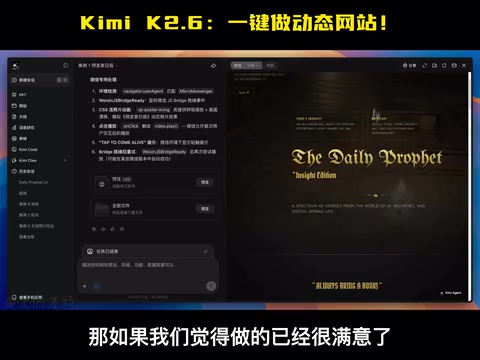
As a Harry Potter fan, the tester attempted to recreate the visual style of the "Daily Prophet." Kimi K2.6 independently designed vintage-style fonts and typography, and even reproduced the "moving portraits" dynamic effect from the Daily Prophet. The page also featured a fun interaction at the end — an owl delivering the first letter — creating a fully immersive experience.
Corporate Website and Motorcycle Booking Page
In enterprise application scenarios, Kimi K2.6 performed equally well. The tester generated a motorcycle brand homepage with complete functional modules including product showcases, configuration details, and test ride booking forms. Users can select different configuration options and submit booking information — this is no longer a simple static page but a dynamic website with real business logic.
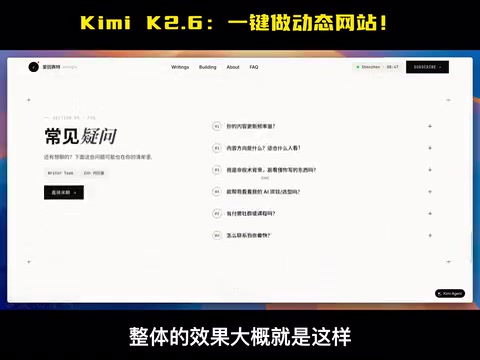
An Extremely Low-Barrier Development Workflow
What truly gives Kimi K2.6's Web Coding capabilities universal value is its extremely low barrier to entry. The entire workflow can be summarized as: Write a prompt → Wait for generation → One-click deployment.
Core Structure of Prompts
Using the "Daily Prophet" case as an example, a high-quality prompt typically consists of three parts:
- Tech stack description: Explicitly specify the frontend technology framework to use
- Design style definition: Including colors, fonts, layout, and other visual elements
- Page content planning: Describe the specific content for each section one by one
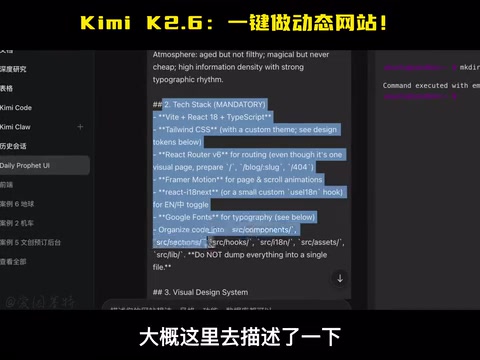
Deep Dive: Why is Prompt Engineering So Critical? Prompt engineering refers to the methodology of carefully designing input text to guide large models toward higher-quality outputs. In Web Coding scenarios, the degree of prompt structure directly determines generation quality: tech stack descriptions (e.g., "use React + Tailwind CSS") help the model lock in code style and component ecosystem; design style definitions (e.g., "vintage parchment texture, serif fonts, deep brown tones") activate the model's visual semantic understanding, enabling consistent decisions on CSS variables and font choices; page content planning provides an information architecture blueprint, preventing the model from "freestyling" and deviating from expected structure. Research shows that structured prompts can improve code usability by 30%-50% compared to vague natural language descriptions, which is why prompt design remains the core variable for achieving optimal results even when the model itself is powerful.
The core principle is "describe your requirements clearly" — users can fully unleash their creativity, and the model handles converting that creativity into runnable code.
Integrated Generation and Deployment
During generation, Kimi K2.6 automatically executes Web Coding tasks through its built-in Computer Use capability. One notable detail: it automatically generates required image and video assets during the process, without requiring users to prepare them separately. This significantly lowers the development barrier.
What is Computer Use Capability? Computer Use refers to a large model's ability to directly control computer interfaces (clicking, typing, screenshot feedback) to complete tasks. This was first publicly demonstrated by Anthropic with Claude 3.5 Sonnet, sparking widespread industry attention. Unlike simply generating code text, models with Computer Use capability can actually run code in a sandbox environment, observe browser rendering results, and autonomously iterate based on visual feedback, forming a "generate—execute—observe—correct" closed loop. Kimi K2.6's built-in Computer Use capability means it doesn't just output text code — it truly "runs through" the entire development workflow in a controlled virtual environment. This is also the technical foundation enabling it to automatically generate accompanying image assets.
After generation is complete, you can continue iterating if you're not satisfied with the results. Once confirmed, clicking the "Share" button in the upper right corner completes deployment with one click, generating an online link accessible to everyone.
Database Integration: From Static Pages to Real Applications
Compared to other Web Coding tools that can only generate static pages, a major highlight of Kimi K2.6 is its built-in database capability, enabling the construction of truly dynamic websites with data interaction functionality.
Technical Background: How Does BaaS Architecture Give Frontend "Backend Capabilities"? Traditional AI code generation tools output purely static HTML/CSS/JS files that cannot persist user data. Kimi K2.6's built-in database capability essentially integrates BaaS (Backend as a Service) capabilities similar to Firebase or Supabase — developers don't need to set up servers, configure database connections, or write backend APIs themselves; the platform directly provides data read/write interfaces. This architecture allows frontend pages to interact with cloud databases through REST APIs or real-time WebSocket interfaces, enabling form submissions, data queries, real-time updates, and other dynamic features. For non-technical users, this means "writing a prompt" can deliver a complete application that previously required collaboration between frontend engineers, backend engineers, and DevOps engineers — a critical technological leap from "static display" to "real application."
Practical Application of Data Collection
The tester demonstrated this with a creative product pre-order page. After users select products, fill in personal information, and submit on the page, the data is actually written to the backend database. In the database management interface, each submission record is clearly visible, and data can be pulled from the database for display.
This means websites generated by Kimi K2.6 are no longer just "pretty vases" but tools usable in real business scenarios — whether for event registration, product pre-orders, or surveys, all can be implemented through simple prompts.
Gap with International Top-Tier Models and Positioning
Objectively speaking, the tester believes Kimi K2.6 still has a certain gap compared to international SOTA models (such as Claude 4) in Web Coding capability, but its coding ability has at least reached the level of Gemini 2.5 Pro, placing it in a leading position among domestic models.
Horizontal Comparison: Where Do Claude 4 and Gemini 2.5 Pro Stand? SOTA (State of the Art) in AI refers to the best-performing model on a given task at the current time. Claude 4 is Anthropic's latest flagship model, consistently ranking at the top on code generation benchmarks (such as SWE-bench Verified, HumanEval), particularly excelling in complex engineering tasks requiring multi-file collaboration — understanding dependency relationships in large codebases and making precise modifications. Gemini 2.5 Pro is Google DeepMind's flagship multimodal model, with strong performance in frontend code generation and design reproduction thanks to its ultra-long context window (up to 1 million tokens) and powerful visual understanding. Positioning Kimi K2.6 as "at least reaching Gemini 2.5 Pro level" means it's already in the top tier among domestic models, but a quantifiable gap remains compared to Anthropic's top-tier performance, primarily manifesting in stability when handling highly complex multi-component interaction logic and large-scale engineering projects.
Summary of Core Advantages
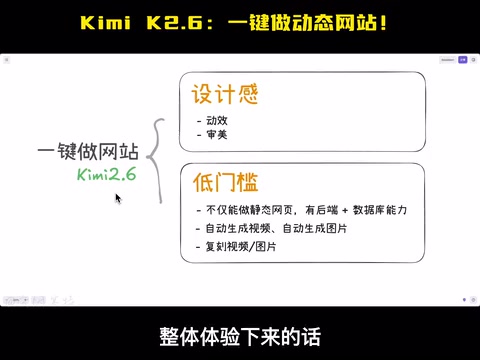
After testing multiple cases, Kimi K2.6's core advantages in Web Coding scenarios can be summarized in two points:
- Excellent design sense: As long as the design style description in the prompt is sufficiently detailed, Kimi K2.6 can generate highly aesthetic web pages — its frontend design quality is among the best of domestic models
- Extremely high encapsulation: Auto-generating image/video assets, integrated backend and database capabilities, one-click deployment and sharing — the low-barrier encapsulation of the entire pipeline makes it easy for non-technical users to get started
Final Thoughts
Kimi K2.6's Web Coding capability represents an important breakthrough for domestic large models at the application layer. It's not pursuing "whether it can write code" but solving the more universally valuable question of "whether ordinary people can turn their ideas into websites." From auto-generating assets to database integration, from code generation to one-click deployment, Kimi K2.6 is lowering the barrier to web development to unprecedented levels.
For users with creativity but lacking technical backgrounds, now is a worthwhile time to give it a try. Of course, if you have higher expectations for the generated results, carefully designing your prompts remains the key to achieving the best outcomes.
Key Takeaways
- Kimi K2.6's Web Coding capability reaches SOTA level among domestic models, with coding ability at least on par with Gemini 2.5 Pro
- Supports an integrated development workflow: auto-generates image/video assets, built-in database, one-click deployment and sharing — dramatically lowering the barrier to website development
- Built-in database capability (BaaS architecture) is a core differentiator, enabling construction of dynamic websites with real data interaction rather than being limited to static pages
- Prompt design is the key factor affecting final results, requiring clear descriptions across three dimensions: tech stack, design style, and page content
- A gap remains compared to top international models (Claude 4), but it excels in design aesthetics and engineering encapsulation, with Computer Use capability enabling a true end-to-end development closed loop
Related articles
 Product Reviews
Qoder vs Cursor Real-World Comparison: Which $20/Month AI IDE Is Better?
Hands-on comparison of Qoder vs Cursor AI IDEs: Agent autonomy, human interaction count, and architecture decisions. Qoder needed only 2 interactions vs Cursor's 8.
 Product Reviews
Cursor Cloud Agent Demo: Eliminating Bottlenecks Across the Entire Software Development Lifecycle
Deep analysis of Cursor's Cloud Agent demo showing how cloud VMs, automated test artifacts, and a full-chain control plane systematically eliminate human bottlenecks across the software development lifecycle.
 Product Reviews
Cursor 3.0 Deep Dive: Multi-Agent Parallelism, Design Mode, and Best-of-N Model Comparison
Cursor 3.0 evolves from an AI coding assistant into an Agent fleet command center. Explore multi-agent parallelism, Design Mode, and Best-of-N model comparison.