LangBot: A Deep Dive into the 16K-Star Multi-Platform AI Bot Development Framework
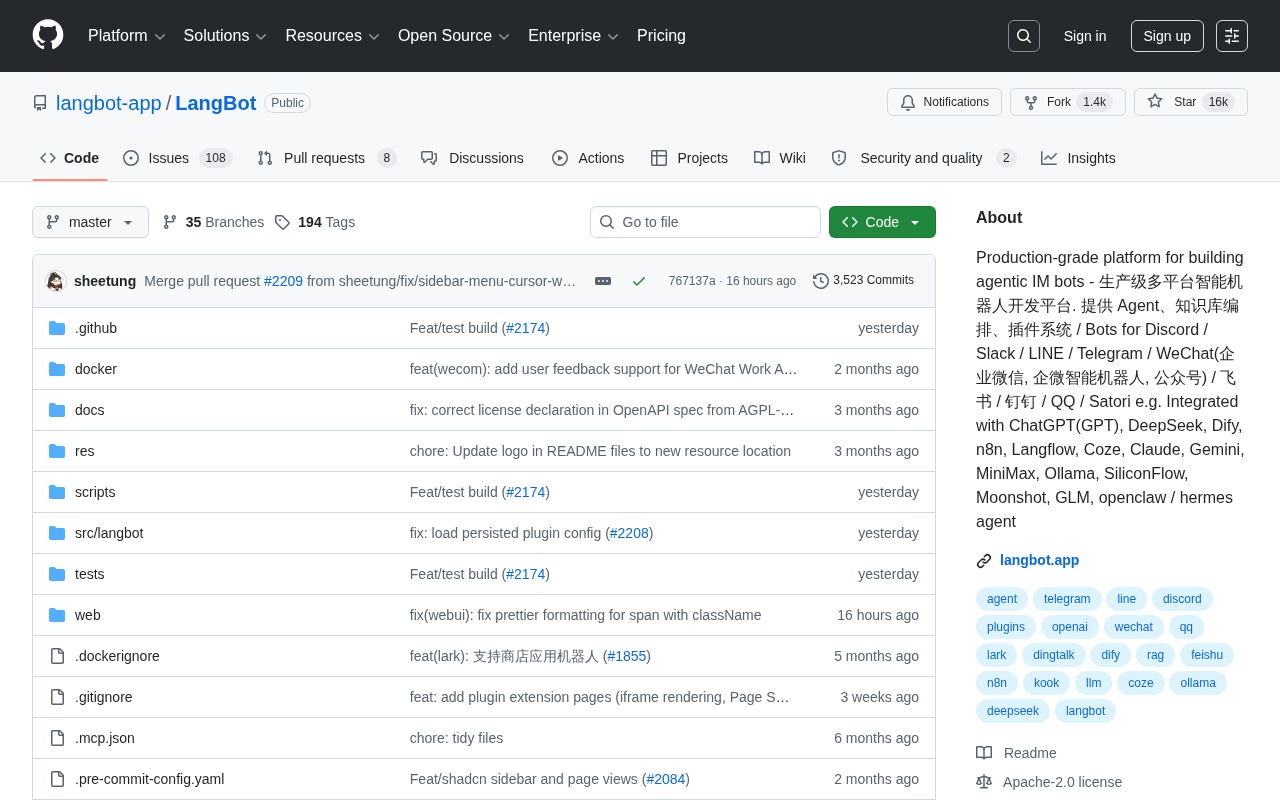
LangBot is a production-grade open-source multi-platform IM intelligent bot development platform.
LangBot is a production-grade multi-platform intelligent bot development platform built with Python, boasting over 16,000 GitHub stars. It supports Agent orchestration, RAG knowledge base retrieval-augmented generation, and a plugin extension system, covering major IM platforms including Discord, Telegram, WeChat, Feishu, DingTalk, and QQ. It integrates mainstream LLMs like ChatGPT, Claude, and DeepSeek, as well as orchestration platforms like Dify and n8n, enabling a build-once, deploy-everywhere workflow.
Project Overview
Quickly connecting large language models to instant messaging platforms is a core challenge every developer inevitably faces when bringing AI applications to production. LangBot was built to solve exactly this problem — it's a production-grade, multi-platform intelligent bot development platform that has earned over 16,000 stars on GitHub, making it one of the most popular open-source projects in the IM bot development space.
Built with Python, LangBot positions itself as a "production-grade" platform — it's not a simple demo or proof of concept, but a mature solution refined through extensive real-world use cases, ready for direct deployment in production environments. In software engineering, "production-grade" means the system offers high availability, fault tolerance, observability, and horizontal scalability. In the context of IM bots, this requires message queue mechanisms to prevent message loss under high concurrency, session state management to ensure coherent multi-turn conversations, rate limiting to avoid triggering platform API bans, retry mechanisms to maintain service stability, and comprehensive logging and monitoring systems for troubleshooting. These engineering capabilities are the critical dividing line between a "demo project" and a "commercially viable solution."
Core Capabilities of LangBot
Agent Orchestration
LangBot comes with built-in Agent capabilities, enabling developers to build AI bots with autonomous decision-making and tool-calling abilities. Unlike simple "question-and-answer" chatbots, bots in Agent mode can automatically select the right tools based on user intent, perform multi-step reasoning, and complete more complex task chains.
Agents represent one of the most important paradigms in the current LLM application landscape. Traditional chatbots follow a "Prompt-In, Response-Out" single-turn interaction model, while Agents introduce the ReAct (Reasoning + Acting) framework, allowing models to dynamically invoke external tools (such as search engines, database queries, code executors, etc.) during the reasoning process and make subsequent decisions based on the results returned by those tools. This capability transforms AI bots from passive responders into proactive task executors, capable of handling complex requests like "Check today's weather and recommend an outfit based on it" — tasks that require multi-step coordination. LangBot's native support for Agent capabilities means developers can quickly build intelligent bots with autonomous action abilities without having to build tool-calling pipelines from scratch.
Knowledge Base RAG System
The platform provides a complete knowledge base orchestration feature. Developers can import enterprise documents, FAQs, product manuals, and other structured or unstructured data into the knowledge base, enabling the bot to perform Retrieval-Augmented Generation (RAG) based on domain-specific knowledge when answering questions. This capability is especially critical for scenarios like enterprise customer service and internal knowledge assistants.
RAG (Retrieval-Augmented Generation) is a core technical approach for addressing LLM "hallucination" issues and knowledge timeliness problems. Here's how it works: when a user asks a question, the system first uses vector search to find the most relevant document fragments from a pre-built knowledge base, then injects these fragments as context into the LLM's prompt, guiding the model to generate answers based on real data. This process involves multiple technical steps including document chunking, vector embedding, and similarity search. Compared to fine-tuning an LLM, the RAG approach offers lower cost, faster updates, and better explainability — enterprises only need to update documents in the knowledge base, and the bot's answers will immediately reflect the latest information without retraining the model.
Plugin Extension System
LangBot features a flexible plugin system that allows developers to extend the bot's functional boundaries by writing plugins. Whether it's integrating external APIs, implementing custom business logic, or adding specialized message processing workflows, everything can be achieved through the plugin mechanism, significantly enhancing the platform's extensibility.
Multi-Platform Coverage: Build Once, Deploy Everywhere
One of LangBot's most prominent advantages is its extensive IM platform support, covering major platforms both domestically and internationally:
- International Platforms: Discord, Slack, LINE, Telegram
- Chinese Platforms: WeChat (WeCom, WeCom Smart Bot, Official Accounts), Feishu (Lark), DingTalk, QQ
- Universal Protocols: Satori, etc.
Satori is a cross-platform chat protocol standard designed to provide a unified messaging interaction interface for different instant messaging platforms. It defines a standardized set of event models, message formats, and API specifications, allowing developers to interface with multiple IM platforms using the same codebase. Satori's design philosophy is similar to HTTP in the web domain — it uses an abstraction layer to shield underlying platform differences, letting the application layer focus on business logic. LangBot's support for the Satori protocol means that even if an IM platform isn't officially supported out of the box, it can seamlessly integrate into the LangBot ecosystem as long as a corresponding Satori adapter exists, providing a solid protocol foundation for long-term extensibility.
This "build once, deploy everywhere" architectural design eliminates the need for developers to write separate adapter code for each platform, significantly reducing the development cost of multi-platform operations. For enterprises that need to provide AI services across multiple channels simultaneously, this is an extremely attractive feature.
LLM Ecosystem Integration
LangBot demonstrates exceptional openness in LLM integration, covering virtually all mainstream large language models and AI platforms on the market:
| Category | Supported Models/Platforms |
|---|---|
| Commercial Models | ChatGPT (GPT), Claude, Gemini, DeepSeek, MiniMax, Moonshot, GLM |
| Local Deployment | Ollama |
| Inference Platforms | SiliconFlow |
| Orchestration Platforms | Dify, n8n, Langflow, Coze |
On the local deployment front, Ollama is an open-source local LLM runtime framework that simplifies the process of downloading, configuring, and running inference on large models into Docker-like command-line operations. Developers can run open-source models like Llama, Mistral, and Qwen on their local machines with a single command, without dealing with complex dependency environments or model quantization configurations. LangBot's integration with Ollama means enterprises can run AI bots in fully private environments where data never leaves the internal network, meeting the strict data security requirements of industries like finance, healthcare, and government.
Notably, LangBot doesn't just support direct LLM API calls — it also integrates with mainstream AI orchestration platforms including Dify, n8n, Langflow, and Coze. These platforms represent the current "low-code/no-code" trend in AI application development: Dify is an LLMOps platform offering visual prompt orchestration, RAG pipeline configuration, and application publishing capabilities; n8n is a workflow automation tool supporting integration with hundreds of third-party services; Langflow provides drag-and-drop AI chain design based on LangChain; and Coze is ByteDance's AI bot development platform.
Developers can first design complex AI workflows in these visual orchestration tools, then deploy them to various IM platforms through LangBot, achieving a decoupling of the "orchestration layer" and the "distribution layer." This architecture allows business teams to design AI logic on orchestration platforms while technical teams handle multi-channel distribution through LangBot — each focusing on their strengths, dramatically improving team collaboration efficiency.
Technical Architecture and Community Ecosystem
Looking at the project metrics, LangBot has over 1,420 forks, indicating that a large number of developers are building upon and customizing the project. Python as the primary development language also lowers the barrier to entry for AI developers — Python is already the most mainstream programming language in the AI/ML field, making it easy for developers to quickly understand and modify the source code.
As an active open-source project, the LangBot community provides ample momentum for its continued evolution. Developers can contribute code through pull requests or share their extensions through the plugin system, creating a healthy ecosystem cycle.
Use Cases for LangBot
LangBot excels particularly in the following scenarios:
- Enterprise Intelligent Customer Service: With a connected knowledge base, it can provide 24/7 intelligent Q&A services across WeChat, DingTalk, Feishu, and other platforms
- Community Operations Assistant: Deploy AI bots in Discord, Telegram, and QQ groups for automated community management and content distribution
- Internal Productivity Tools: Combined with workflow platforms like n8n, build internal AI automation assistants for enterprises
- Unified Multi-Channel AI Service Management: Teams that need to provide AI services across multiple IM platforms simultaneously can manage everything through a single codebase
Conclusion
LangBot solves the "last mile" problem of AI application deployment — seamlessly bringing powerful LLM capabilities into the instant messaging tools users rely on every day through a unified platform architecture. Its production-grade stability, extensive platform coverage, rich LLM integrations, and flexible plugin system make it one of the top open-source framework choices for building IM-based intelligent bots today.
If your team is looking for a mature and reliable AI bot development framework, LangBot is well worth a thorough evaluation and trial.
Related articles
 Product Reviews
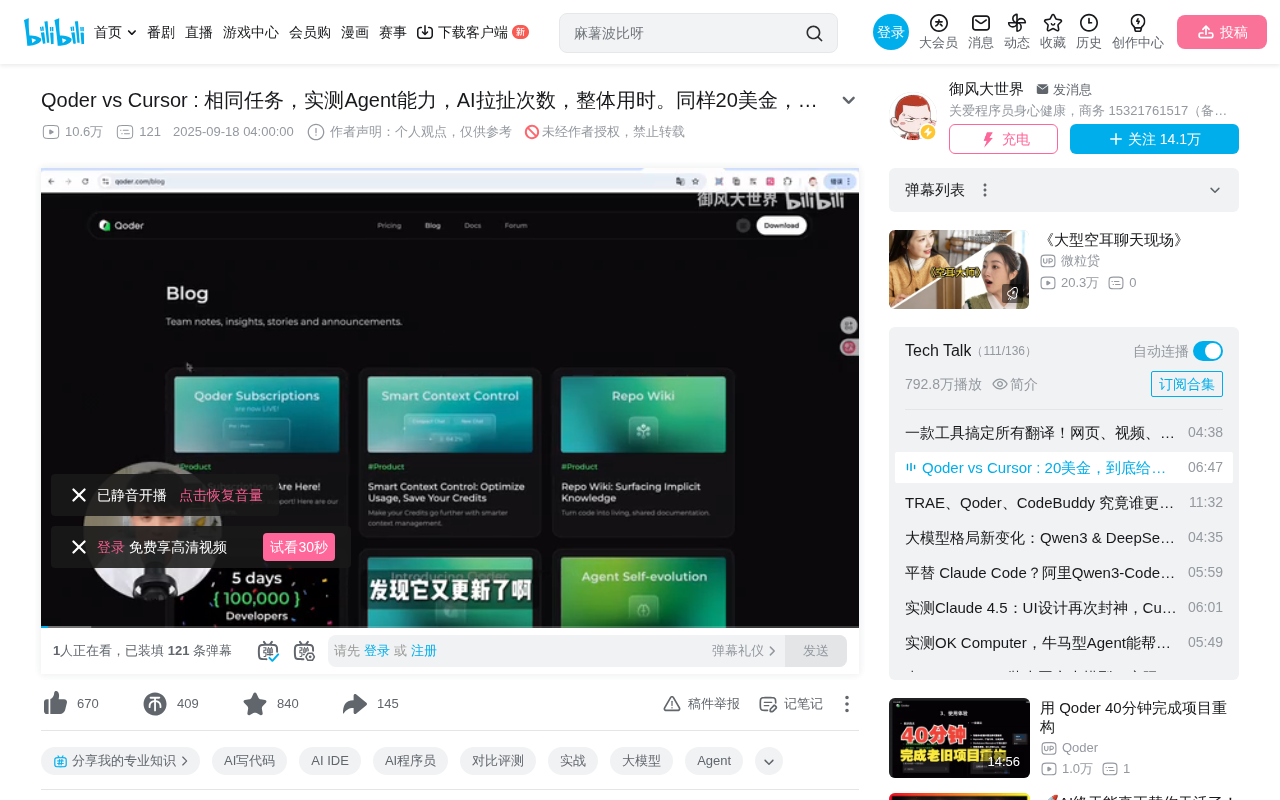
Qoder vs Cursor Real-World Comparison: Which $20/Month AI IDE Is Better?
Hands-on comparison of Qoder vs Cursor AI IDEs: Agent autonomy, human interaction count, and architecture decisions. Qoder needed only 2 interactions vs Cursor's 8.
 Product Reviews
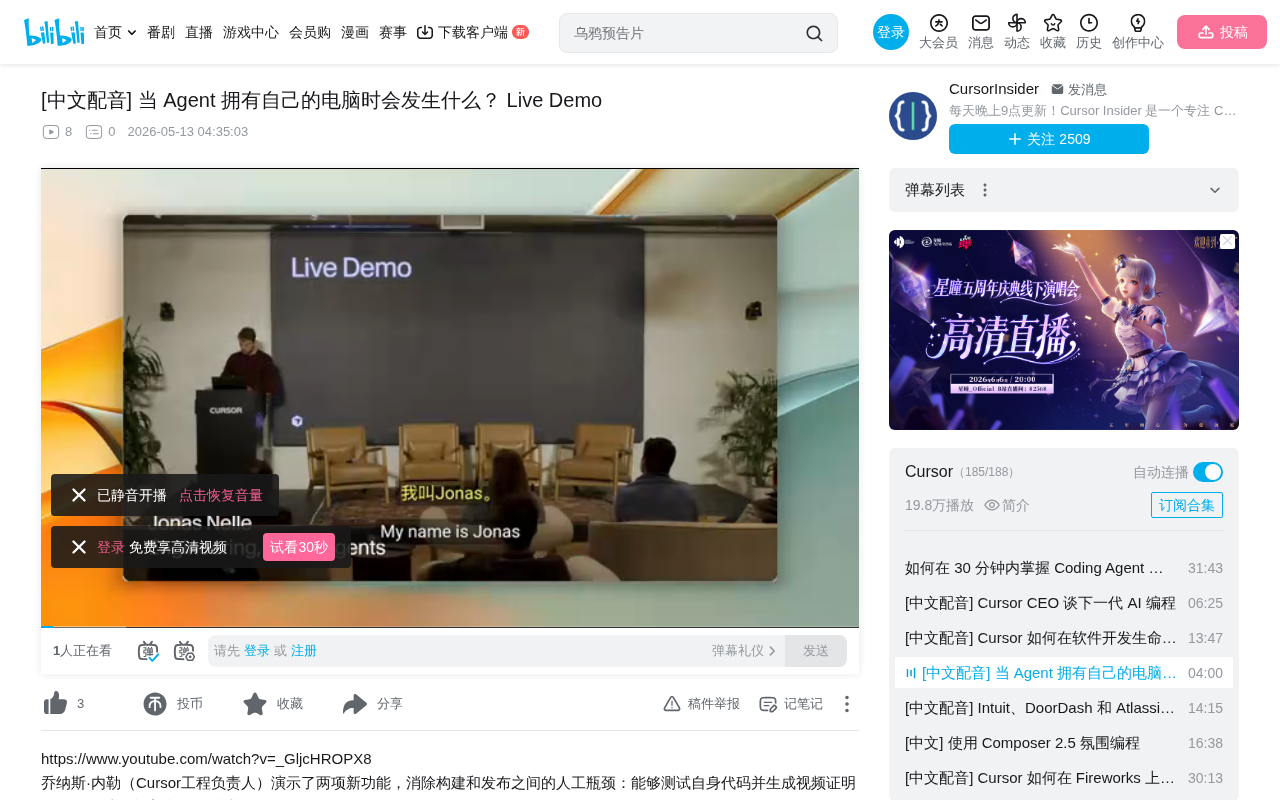
Cursor Cloud Agent Demo: Eliminating Bottlenecks Across the Entire Software Development Lifecycle
Deep analysis of Cursor's Cloud Agent demo showing how cloud VMs, automated test artifacts, and a full-chain control plane systematically eliminate human bottlenecks across the software development lifecycle.
 Product Reviews
Cursor 3.0 Deep Dive: Multi-Agent Parallelism, Design Mode, and Best-of-N Model Comparison
Cursor 3.0 evolves from an AI coding assistant into an Agent fleet command center. Explore multi-agent parallelism, Design Mode, and Best-of-N model comparison.