Lark CLI: A Deep Dive into Feishu's Open-Source AI Agent Command-Line Tool

Feishu open-sources Lark CLI, an Agent Native command-line tool bridging AI Agents and enterprise collaboration.
Lark CLI is Feishu's official open-source command-line tool, written in Go and released under the MIT license. It provides 200+ commands covering 17 business domains, with its core highlight being the Agent Native design philosophy—featuring 24 built-in structured Skills, Schema introspection support, and optimization specifically for AI Agent invocation. Its three-layer command architecture (shortcuts, API wrappers, native APIs) balances ease of use with flexibility, providing critical infrastructure for enterprise-grade AI Agent deployment.
Overview
Lark CLI is an official command-line tool from Feishu (Lark), maintained by the Lark Suite team, written in Go, and open-sourced under the MIT license. The project has garnered over 10,800 stars and more than 700 forks on GitHub, with a crystal-clear positioning—built for both humans and AI Agents.
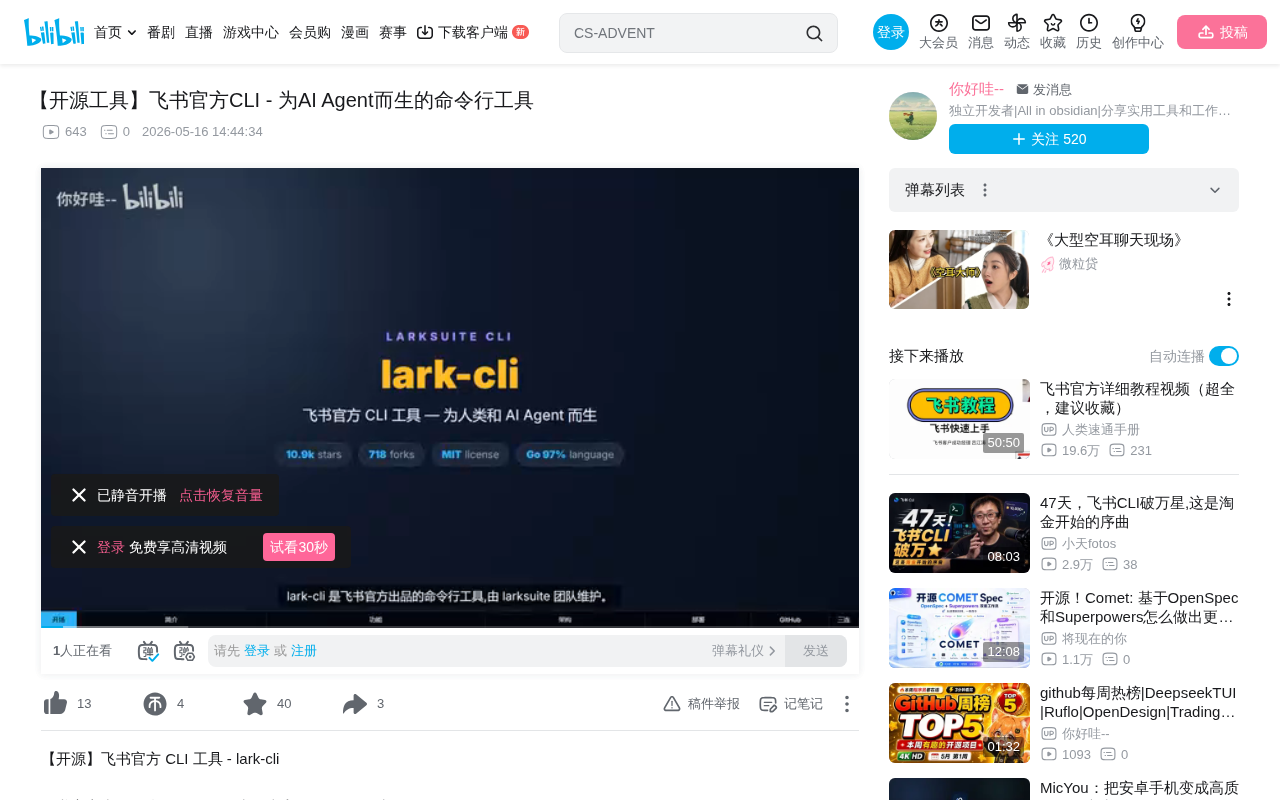
This tool provides over 200 commands covering all of Feishu's core business domains, including messaging, documents, spreadsheets, calendars, email, tasks, and meetings. Every command has been tested with real Agents, featuring concise parameters and structured output, specifically optimized for AI Agent invocation scenarios.
It's worth noting that the MIT license is one of the most permissive open-source licenses available, allowing anyone to freely use, modify, and distribute the code—even for commercial projects—without requiring source code disclosure. Feishu's choice of MIT over more restrictive licenses like GPL or Apache signals their intent to minimize integration barriers for enterprises and developers, promoting widespread adoption of the tool within the AI Agent ecosystem.
Core Features Analysis
Agent Native Design Philosophy
Lark CLI's biggest highlight is its Agent Native design philosophy. The tool comes with 24 built-in structured Skills that AI can use out of the box. When you integrate Lark CLI into an AI Agent workflow, the Agent can directly understand and invoke these predefined skills without any additional adaptation work.
This design approach reflects the current development trend in AI toolchains: tools are no longer designed solely for human users but simultaneously consider the usage experience of AI Agents as callers. Structured input/output and concise parameter design are all aimed at lowering the barrier for Agent comprehension and invocation.
The term "Agent Native" represents a fundamental paradigm shift from traditional "Human Native" tool design. Traditional CLI tools typically output free-form text meant for human reading, while Agent Native tools require output in structured formats like JSON, enabling AI to precisely parse the semantics of each field. This philosophy is highly aligned with MCP (Model Context Protocol), which emerged in 2024—proposed by Anthropic, MCP aims to establish a standardized communication protocol between AI models and external tools, allowing Agents to discover, understand, and invoke various tools in a unified manner. The 24 Skills built into Lark CLI are essentially predefined Tool Descriptions, containing functional descriptions, parameter Schemas, and return value structures. AI Agent frameworks can directly register these Skills as callable tools without developers manually writing adaptation layers. This "tool self-description" capability is critical infrastructure for building reliable Agent systems.
Three-Layer Command Architecture
Lark CLI employs a carefully designed three-layer command architecture:
- Shortcut Layer: Targets high-frequency scenarios, completing common tasks with a single command
- API Command Layer: Structured encapsulation of Feishu APIs, balancing flexibility and ease of use
- Native API Layer: Direct access to over 2,500 Feishu native OpenAPIs, providing maximum flexibility
This layered design allows users to flexibly choose the operational granularity based on their needs. Simple tasks can be accomplished in one step with shortcut commands, while complex requirements can drill down to the native API layer for fine-grained control.
This three-layer abstraction architecture is a classic pattern in developer tool design, similar to the layered relationship in the database domain between ORM (high-level abstraction), Query Builder (mid-level encapsulation), and Raw SQL (low-level direct operations). The shortcut layer orchestrates multiple API calls into a single atomic command—for example, "send a message to a group" might involve group lookup, message construction, and send confirmation across multiple steps, but users only need one command. The API command layer corresponds one-to-one with Feishu's OpenAPI interfaces but simplifies parameter formats and authentication flows, so developers don't need to manually handle HTTP request headers, token refresh, and other low-level details. The native API layer directly exposes all 2,500+ Feishu platform OpenAPI endpoints—as ByteDance's enterprise collaboration platform, Feishu's API system has grown extremely large through years of iteration, covering everything from basic communication to HR management, approval workflows, and data dashboards. For AI Agents, this layered design is particularly important: Agents can call high-level commands for simple tasks to reduce error probability, while degrading to low-level APIs for complete control when facing complex or non-standard requirements.
Full Business Domain Coverage
Lark CLI covers 17 business domains in Feishu, encompassing virtually all core enterprise collaboration scenarios:
- Instant message sending and management
- Document creation, editing, and collaboration
- Bitable (multi-dimensional spreadsheet) data operations
- Calendar event management
- Email sending and receiving
- Task creation and tracking
- Meeting scheduling and management
The comprehensive coverage of these 17 business domains means Lark CLI is not merely a message-sending tool but a complete command-line entry point to an enterprise collaboration operating system. Among these, Bitable is a distinctive product in the Feishu ecosystem, similar to Airtable or Notion Database, fusing traditional spreadsheet capabilities with relational database features, supporting multiple field types, view switching, and automation workflows. Through Lark CLI's Bitable operations, AI Agents can perform batch data read/write, record filtering, and field updates, providing powerful foundational capabilities for building data-driven automated workflows.
Technical Architecture Design
From a technical architecture perspective, Lark CLI is divided into four core modules:
- CLI Core: Written in Go, providing 200+ commands and the three-layer command architecture, ensuring execution efficiency and cross-platform compatibility
- Skill System: Provides 24 AI Agent Skills with structured data output for easy Agent parsing and processing
- Authentication Layer: Supports OAuth login, identity switching, and Scope management, ensuring security and control
- API Gateway: Connects to 2,500+ Feishu native OpenAPIs with Schema introspection support
Choosing Go for CLI tools is a mainstream industry practice. Go compiles to a single statically-linked binary that requires no runtime environment (unlike Python which needs an interpreter or Java which needs a JVM), making tool distribution and deployment extremely convenient. Additionally, Go natively supports cross-compilation, allowing a single codebase to easily build executables for Linux, macOS, Windows, and other platforms. In the CLI tool space, well-known projects like Docker CLI, Kubernetes' kubectl, GitHub CLI (gh), and Terraform are all written in Go, forming a mature ecosystem with established best practices.
The Schema introspection capability deserves special attention—it allows AI Agents to dynamically learn about API structures and parameter requirements at runtime, which is extremely valuable for building adaptive Agent systems. Schema Introspection originates from technology systems like GraphQL, with the core idea being that an API can describe its own capabilities and data structures. In Lark CLI's context, this means AI Agents don't need to hard-code all API parameter formats in advance but can query at runtime which parameters an API endpoint accepts, the type and constraints of each parameter, return value structures, and other metadata. This capability is crucial for Agent systems—when the Feishu platform adds or updates APIs, Agents can automatically adapt to changes without manual updates to tool descriptions. This is one of the key technical advantages that distinguishes Lark CLI from traditional SDK wrappers.
On the authentication front, Lark CLI's OAuth 2.0 protocol is the most widely used authorization framework in enterprise applications. The OAuth login flow allows users to complete identity authentication without exposing passwords to third-party tools, while Scope management enables fine-grained permission control—for example, an Agent can be authorized to only read calendar information but not send messages. This principle of least privilege is critical for enterprise security compliance. The identity switching feature supports flexible switching between different Feishu tenants, meeting multi-organization management needs.
Installation and Quick Start
Deploying and using Lark CLI is very straightforward—the official team claims you can get started in three minutes:
- Installation: Recommended via NPM with a single command. Building from source (requires Go environment) is also supported
- Configuration: Complete app creation and configuration through interactive commands
- Login: Interactive OAuth login to complete identity authentication
Three steps to complete your first API call, with an extremely low barrier to entry.
Distributing Go-compiled binaries via NPM (Node Package Manager) is a clever practice that has emerged in the developer tools space in recent years. Although Lark CLI itself is written in Go, NPM is one of the world's largest package managers with over 2 million packages and an enormous developer user base. By distributing through NPM, Lark CLI can leverage the npx command for installation-free direct execution, or be globally installed with a single npm install -g command. NPM packages typically auto-download the appropriate pre-compiled binary based on the user's operating system and CPU architecture, so users never need to worry about underlying compilation or platform adaptation. This distribution strategy has been widely adopted by modern development tools like esbuild, Turbo, and Biome, effectively combining Go's performance advantages with NPM ecosystem's distribution convenience.
Use Cases and Practical Value
Value for Developers
For developers who need to integrate with Feishu, Lark CLI dramatically lowers the development barrier. Without writing complex SDK invocation code, most operations can be completed via the command line, making it ideal for rapid prototyping and automation scripting.
In the traditional Feishu API integration workflow, developers need to select the corresponding language SDK (Feishu officially provides SDKs for Go, Java, Python, Node.js, and more), then handle token acquisition and refresh, request signing, error retries, pagination traversal, and a series of other low-level logic—a simple "send message" function might require dozens of lines of code. Lark CLI encapsulates all this complexity behind the command line, allowing developers to focus solely on business logic. This is particularly valuable for DevOps scenarios—operations engineers can embed Lark CLI commands in CI/CD pipelines to implement build notifications, deployment reports, alert pushes, and other automated workflows without writing and maintaining dedicated integration code.
Significance for the AI Agent Ecosystem
The release of Lark CLI marks Feishu's official embrace of the AI Agent ecosystem. By providing a standardized command-line interface, any AI Agent framework (such as LangChain, AutoGPT, etc.) can easily integrate all of Feishu's capabilities. This provides critical infrastructure support for enterprise-grade AI Agent deployment.
In the current AI Agent technology stack, Tool Use / Function Calling is the core mechanism for Agent interaction with the external world. Taking OpenAI's Function Calling as an example, developers need to define a list of callable functions and their parameter Schemas for the Agent, and the large language model determines during inference when to call which function and generates structured invocation parameters. LangChain, currently the most popular Agent development framework, provides a Tool abstraction layer that can wrap CLI commands as LangChain Tools, enabling Agents to autonomously decide invocation timing within their Chain of Thought. Autonomous Agent frameworks like AutoGPT and CrewAI similarly support tool registration mechanisms. However, enterprise-grade AI Agent deployment faces serious challenges including permission control, data security, and operation auditing—operations autonomously executed by Agents must remain within controllable bounds, preventing unauthorized access or data leaks. Lark CLI's built-in OAuth authentication and Scope permission management provide solutions precisely for these enterprise-grade requirements.
A New Paradigm for Office Automation
Combined with AI Agent capabilities, Lark CLI makes "natural language-driven office automation" possible. Users can describe their needs in natural language, and the Agent automatically translates them into CLI commands for execution, achieving a truly intelligent office assistant.
The practical operation of this paradigm works as follows: a user tells the Agent "Help me summarize last week's sales data and send it to the operations group," and the Agent decomposes this natural language into multiple steps—first querying last week's sales records through Bitable commands, then performing data aggregation calculations, formatting the results into a message card, and finally sending it to the specified group via messaging commands. Throughout this process, the Agent might need to chain 5-10 Lark CLI commands together, with each command's output serving as input for the next, forming a complete automation pipeline. This is fundamentally different from traditional RPA (Robotic Process Automation)—RPA relies on predefined fixed process scripts, while AI Agent-driven automation possesses the ability to understand semantics, dynamically plan, and handle exceptions, capable of addressing more flexible and variable business scenarios.
Conclusion
Lark CLI represents an important strategic move by Feishu in the AI Agent era. The MIT open-source license, Go language implementation, 200+ command coverage, and Agent Native design make it a vital bridge connecting AI Agents with enterprise collaboration platforms. For teams building enterprise-grade AI Agents, this is a tool worth watching and trying.
From a broader perspective, the emergence of Lark CLI reflects an important trend in enterprise software platforms: evolving from providing two access methods (GUI and API) to a four-layer parallel access system of GUI, API, CLI, and Agent Interface. Under this trend, CLI is no longer just a developer efficiency tool but has become a standardized communication bridge between AI Agents and enterprise systems. It's foreseeable that more enterprise collaboration platforms (such as Slack, Microsoft Teams, DingTalk, etc.) will release similar Agent Native CLI tools, forming an AI Agent tool ecosystem connected by the command line.
Related articles
 Product Reviews
Qoder vs Cursor Real-World Comparison: Which $20/Month AI IDE Is Better?
Hands-on comparison of Qoder vs Cursor AI IDEs: Agent autonomy, human interaction count, and architecture decisions. Qoder needed only 2 interactions vs Cursor's 8.
 Product Reviews
Cursor Cloud Agent Demo: Eliminating Bottlenecks Across the Entire Software Development Lifecycle
Deep analysis of Cursor's Cloud Agent demo showing how cloud VMs, automated test artifacts, and a full-chain control plane systematically eliminate human bottlenecks across the software development lifecycle.
 Product Reviews
Cursor 3.0 Deep Dive: Multi-Agent Parallelism, Design Mode, and Best-of-N Model Comparison
Cursor 3.0 evolves from an AI coding assistant into an Agent fleet command center. Explore multi-agent parallelism, Design Mode, and Best-of-N model comparison.