Lenovo ThinkBook 16+ R7-H255 Review: Is This $660 AI Programming Laptop Worth It?

Lenovo ThinkBook 16+ R7-H255: a $660 large-screen laptop for AI programming and office work
The Lenovo ThinkBook 16+ features the AMD R7-H255 processor (Zen 5 architecture with integrated NPU) at 4,799 CNY (~$660), positioned as a high-performance business laptop. Its 16-inch display suits multitasking and AI programming, offering strong competitiveness in its price range. Check GPU and memory specs before buying to ensure local AI model requirements are met.
Lenovo ThinkBook 16+ R7-H255 Product Overview
The Lenovo ThinkBook 16+ features the AMD R7-H255 processor at a price of 4,799 CNY (~$660), positioned as a high-performance business laptop. This product aims to strike a balance between business productivity, AI programming, and light gaming, making it a noteworthy large-screen productivity tool in its price range.
In-Depth Analysis of Key Selling Points
AMD R7-H255 Processor Performance
The AMD R7-H255 is a recent mobile processor based on the Zen 5 architecture, part of the AMD Ryzen AI 200 series (codenamed Strix Point), manufactured on TSMC's 4nm process. Compared to the previous Zen 4 architecture, Zen 5 delivers roughly 16% higher IPC (Instructions Per Clock) with significantly improved power efficiency. A major highlight is the integrated NPU (Neural Processing Unit) capable of up to 50 TOPS of AI compute, meeting Microsoft's Copilot+ PC requirements. The H-series targets high-performance mobile platforms with a configurable TDP of 28-54W, balancing performance and battery life.
Multi-core performance is excellent, particularly suited for local model inference and code compilation in AI programming workflows. For developers using local AI tools like GitHub Copilot or intelligent code completion, this processor provides reliable compute power with satisfying efficiency for daily compilation and multithreaded tasks.
Is the 4,799 CNY Price Point Reasonable?
At 4,799 CNY, the pricing is quite competitive among 16-inch high-performance laptops. Compared to similarly priced alternatives, the ThinkBook 16+ holds advantages in both screen size and processor specs, making it ideal for budget-conscious users who need large-screen productivity.
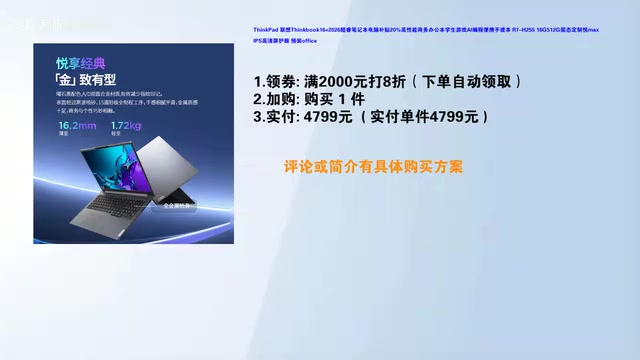
ThinkBook 16+ Use Case Overview
- AI Programming & Development: Running lightweight local AI models, daily coding and debugging
- Business Productivity: Multitasking, large-screen document editing and spreadsheet work
- Light Entertainment: Integrated or entry-level discrete graphics for casual gaming
Hardware Requirements for Local AI Development
Hardware demands for local AI development vary significantly by task type. Code completion tools like GitHub Copilot rely primarily on cloud inference with minimal local hardware pressure. However, running local LLMs (such as Llama 3, Qwen, etc.) requires large memory capacity (32GB recommended minimum) and sufficient VRAM. For example, a 7B parameter model with INT4 quantization needs roughly 4-6GB of memory/VRAM for inference, but requirements increase steeply for 13B+ models. NPU currently accelerates specific AI tasks like image processing and speech recognition, while LLM inference support is still developing within the ecosystem.
Buying Advice: Who Should Consider This Laptop?
For users with a budget under 5,000 CNY who need a machine for both AI development and daily office work, the Lenovo ThinkBook 16+ R7-H255 deserves serious consideration. Before purchasing, pay close attention to the specific GPU configuration and memory specs (capacity and expandability), as these significantly impact the AI programming experience. If your primary use case involves local model training, evaluate whether VRAM is sufficient — current mainstream 7B quantized models require at least 8GB of available VRAM or memory for smooth operation.
Key Takeaways
- Lenovo ThinkBook 16+ features the R7-H255 processor at 4,799 CNY
- Positioned as a high-performance laptop for AI programming and business productivity
- 16-inch large screen suits multitasking productivity scenarios
- R7-H255 is built on Zen 5 architecture with integrated NPU for hardware-level AI acceleration
Related articles
 Product Reviews
Qoder vs Cursor Real-World Comparison: Which $20/Month AI IDE Is Better?
Hands-on comparison of Qoder vs Cursor AI IDEs: Agent autonomy, human interaction count, and architecture decisions. Qoder needed only 2 interactions vs Cursor's 8.
 Product Reviews
Cursor Cloud Agent Demo: Eliminating Bottlenecks Across the Entire Software Development Lifecycle
Deep analysis of Cursor's Cloud Agent demo showing how cloud VMs, automated test artifacts, and a full-chain control plane systematically eliminate human bottlenecks across the software development lifecycle.
 Product Reviews
Cursor 3.0 Deep Dive: Multi-Agent Parallelism, Design Mode, and Best-of-N Model Comparison
Cursor 3.0 evolves from an AI coding assistant into an Agent fleet command center. Explore multi-agent parallelism, Design Mode, and Best-of-N model comparison.