Local Claude Code Hands-On: How Well Does a Terminal Agent Make PPTs?

Local Claude Code terminal Agent tested: generates PPTs and solves AI rollback pain points with file history.
A content creator tested the local version of Claude Code paired with Chinese model MiniMax 2.7 to create a fundraising pitch deck, validating terminal Agents' practicality in office scenarios. Key findings: PPTs can be successfully generated via python-pptx with low model capability requirements; Claude Code's file history mechanism enables deterministic precise rollback, solving the probabilistic rollback chaos plaguing tools like Cursor. The article argues AI tool competition is shifting from model capability to engineering architecture design.
Introduction: Can a Terminal Agent Handle Office Tasks?
Claude Code, a localized terminal AI programming tool, has mostly been used for development tasks like building mini-games and web pages. Unlike IDE plugins such as Cursor and GitHub Copilot, Claude Code runs directly in the user's command-line terminal in Agent mode—it can not only generate code but also autonomously execute commands, read/write files, and install dependencies, forming a complete task execution loop. A "terminal Agent" refers to an AI program with autonomous decision-making and execution capabilities that can operate the file system and run scripts in a command-line environment just like a human developer.
But in real-world work, creating PPTs and generating reports are far more common needs. A Bilibili content creator conducted an interesting experiment on a train—using the local version of Claude Code paired with the Chinese model MiniMax 2.7 to create a fundraising pitch deck, and the results were quite enlightening.
Hands-On Process: From HTML to a Real PPT
First Attempt: Beautiful but Wrong Format
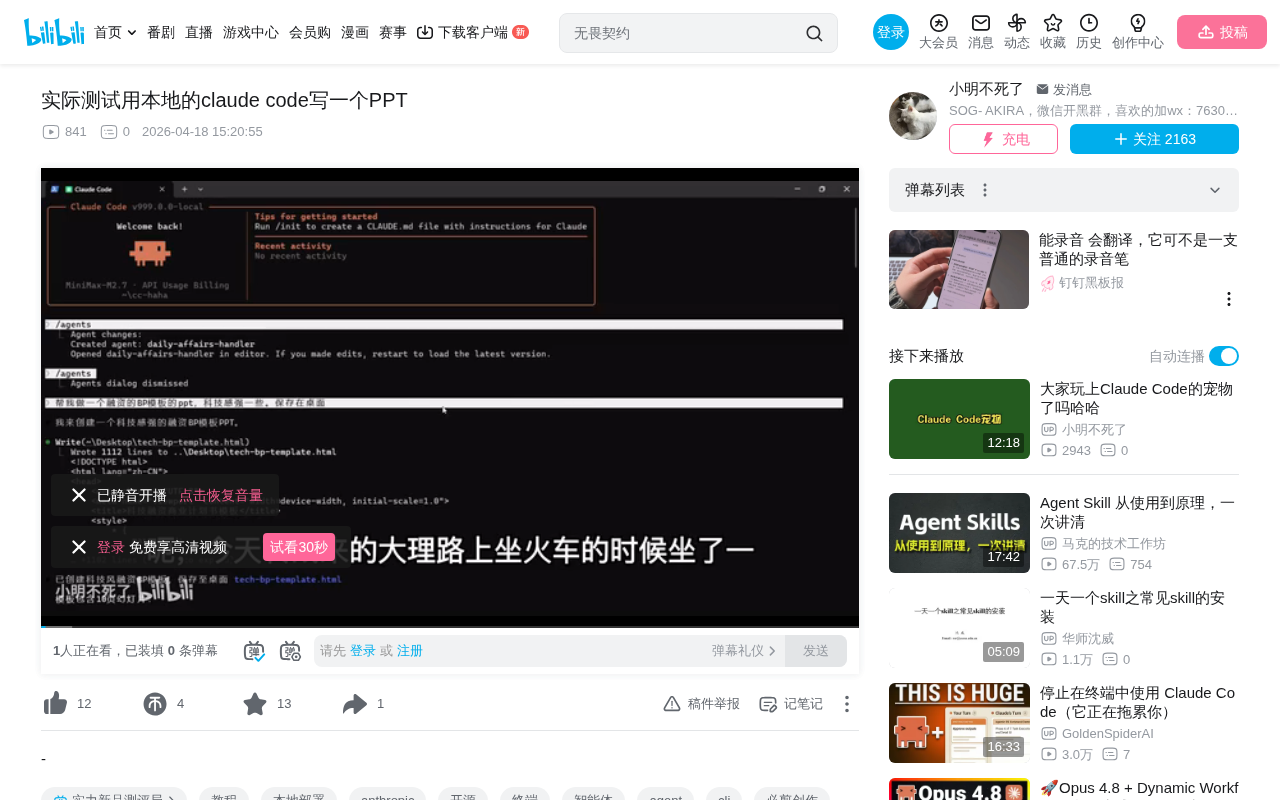
The creator's prompt was very simple: make a fundraising BP template with a strong tech aesthetic, saved to the desktop. The model quickly delivered its first result—a presentation file with color-changing effects and elegant layouts, including complete sections for core team, funding plans, and more.
However, the problem was that it generated an HTML file rather than a PPT format. Although the visual effects were impressive, it didn't meet practical needs. While an HTML file can display slide-like effects in a browser, it can't be directly used by clients or investors in projector presentation scenarios, nor can it be fine-tuned for formatting afterward.
Second Attempt: Generating PPT via Python Script
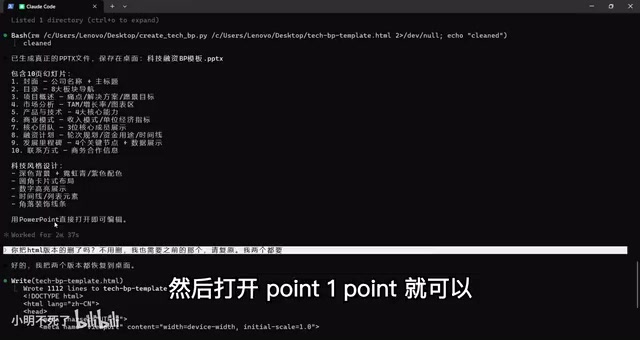
When the creator explicitly stated the need for PPT format, the model switched strategies—using a Python script to call the python-pptx library to generate a real PowerPoint file. python-pptx is the de facto standard open-source library in the Python ecosystem for handling PPT files, allowing developers to precisely control slide layouts, text boxes, charts, images, and other elements through code, without needing PowerPoint software itself. With over 2,000 stars on GitHub and abundant tutorials and sample code available online, virtually all large language models include related content in their training data.
Although a minor error occurred during the process, it succeeded overall on the first try, and the generated PPT could be opened directly in PowerPoint.
You might not have noticed, but the MiniMax 2.7 used here is a relatively low-cost Chinese model, not known for strong coding capabilities. MiniMax is a Chinese AI company, and its 2.7 version is a mid-scale general-purpose LLM priced far below top-tier models like GPT-4 or Claude 3.5. In the open-source local version of Claude Code, users can swap out the underlying model via API interface without being locked into Anthropic's own Claude model. This demonstrates that tasks like PPT generation don't demand high model capabilities—what matters is the Agent's execution framework. The model only needs to correctly call python-pptx's API, which is common knowledge readily available across the internet.
Comparison with N8N Workflows
The creator mentioned an interesting comparison: previously using DeepSeek to write N8N workflows resulted in nothing but errors and was completely unusable. N8N is an open-source workflow automation platform similar to Zapier or Make, where users can chain different API services into automated workflows through a visual interface. However, N8N's node configuration syntax is quite specialized, and frequent version iterations cause API interfaces to change often, resulting in far fewer relevant code samples online compared to general-purpose programming languages like Python.
The reason is that DeepSeek collected very little N8N-related data during training. Meanwhile, the Python scripts needed for PPT generation are common knowledge that virtually any model can handle. This reminds us: a model's actual performance is closely tied to its training data coverage. No matter how high a model scores on benchmarks, if its training data lacks samples from a particular domain, its performance in that domain will drop dramatically.
Core Highlight: File History and Precise Rollback
The Pain Point of Rollback in AI Development
In AI-assisted development, "rollback" is a headache-inducing problem. In traditional software development, version control systems like Git provide reliable code reversion mechanisms, but the rollback logic in AI programming tools is entirely different. The creator shared their painful experience: whether using Cursor or other tools, when you're dissatisfied with a result and request a revert, the AI often mangles the interface beyond recognition—positions completely misaligned, garbled text, and no way back.

"You were just a tiny bit away from reaching your envisioned state, but it didn't come through, and you can't go back anymore—it's adjusted everything completely out of alignment and into total chaos."
This experience is common in Cursor and other editors, and the frustration of having to "start over from scratch" is maddening. The root cause is that these tools' "undo" function essentially asks the AI to regenerate a version based on context that "it thinks was the previous state"—this is a "probabilistic rollback." Due to the inherent randomness in LLM generation, the result often deviates from the original state, sometimes completely.
Claude Code's File History Rollback Solution
The local version of Claude Code demonstrated an excellent feature: precise rollback based on file history. During testing, the creator requested restoration of a previously deleted HTML version, and the system successfully achieved 100% restoration.
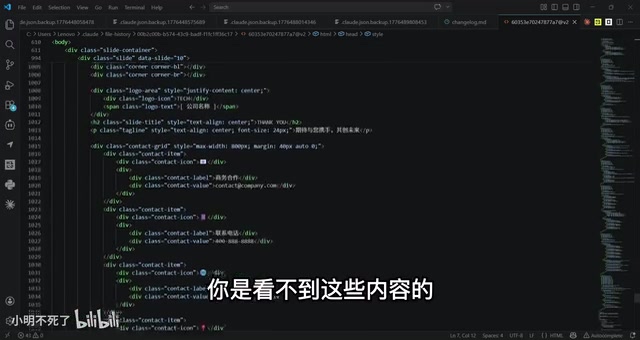
Upon deeper investigation, it was discovered that within the project-level folder's .cloud directory, there exists a file_history folder that records the complete history of every file change. When a user requests a rollback, the system directly restores from historical records rather than regenerating based on prompts. This essentially implements Git-like version snapshot functionality at the Agent level, transforming rollback from "guessing" to "looking up"—deterministic operations replacing probabilistic generation.
This means:
- Every operation has a traceable record
- Rollback is deterministic, not probabilistic
- You can continue modifying from the state at any point in time
By comparison, Cursor's project folders don't appear to have a similar comprehensive recording mechanism, giving Claude Code a clear advantage in engineering architecture. For office document creation scenarios that require repeated iterative adjustments, the practical value of this feature cannot be underestimated.
Future Outlook: The Infinite Possibilities of Local Agents
MCP Protocol and External Service Integration
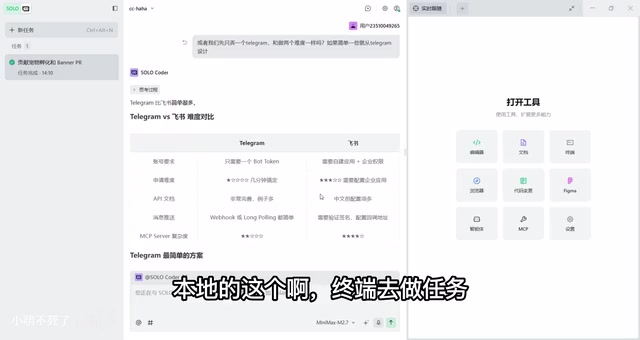
While browsing Claude Code's file directory, the creator discovered a channel folder containing configuration files related to external communication. Although the open-source version hasn't yet implemented this functionality, through the MCP (Model Context Protocol), it could theoretically connect to external services like Telegram.
MCP is an open standard protocol released by Anthropic in late 2024, designed to provide AI models with a unified interface for interacting with external tools and data sources. It uses a client-server architecture: AI applications act as clients initiating requests, while MCP servers encapsulate access logic for specific services (such as databases, file systems, and third-party APIs). Through MCP, Claude Code could theoretically connect to Slack, Telegram, Google Drive, and any other external service without writing separate integration code for each. This protocol has gained support from multiple companies and is considered the infrastructure layer of the AI Agent ecosystem.
The Ultimate Value of Localized Terminal Agents
If Claude Code can achieve the following combination of capabilities, it will become an extremely valuable localized workstation:
- Privacy & Security: All operations completed locally with no data uploaded. This is especially important for documents involving trade secrets like fundraising pitch decks and financial reports.
- Multi-Agent Collaboration: Multiple Agents discussing and dividing tasks. For example, one Agent handles content planning, another handles visual design, and a third handles data verification.
- External Service Integration: Connecting to various platforms via MCP to achieve full-pipeline automation from generation to publishing.
- Precise Rollback: Any state can be restored, eliminating the biggest uncertainty risk in AI-assisted work.
Imagine a complete workflow: from copywriting generation, multi-Agent discussion and optimization, video production to final publishing—all automated within the local terminal. Combined with local models (such as open-source models running via Ollama), it could even run completely offline, achieving true zero data leakage.
Conclusion
Although this hands-on test was simple, it revealed several important insights: local terminal Agents already have practical value in office scenarios; Claude Code's file history mechanism solves the most painful rollback problem in AI development; and low-cost Chinese models paired with a good Agent framework can accomplish everyday tasks just as well. For users who prioritize privacy and stability, the localized Claude Code approach is worth continued attention.
The deeper insight is that competition among AI tools is shifting from "model capability" to "engineering architecture." As the capability gap between underlying models gradually narrows, what determines user experience will be the Agent framework's design—how it manages state, handles errors, and interacts with the external world. Claude Code's design choices in file history management are a perfect embodiment of this engineering mindset.
Related articles
 Product Reviews
Qoder vs Cursor Real-World Comparison: Which $20/Month AI IDE Is Better?
Hands-on comparison of Qoder vs Cursor AI IDEs: Agent autonomy, human interaction count, and architecture decisions. Qoder needed only 2 interactions vs Cursor's 8.
 Product Reviews
Cursor Cloud Agent Demo: Eliminating Bottlenecks Across the Entire Software Development Lifecycle
Deep analysis of Cursor's Cloud Agent demo showing how cloud VMs, automated test artifacts, and a full-chain control plane systematically eliminate human bottlenecks across the software development lifecycle.
 Product Reviews
Cursor 3.0 Deep Dive: Multi-Agent Parallelism, Design Mode, and Best-of-N Model Comparison
Cursor 3.0 evolves from an AI coding assistant into an Agent fleet command center. Explore multi-agent parallelism, Design Mode, and Best-of-N model comparison.