Make AI Tools in 3 Minutes and Sell Them Online — Is This Side Hustle Model Actually Viable?
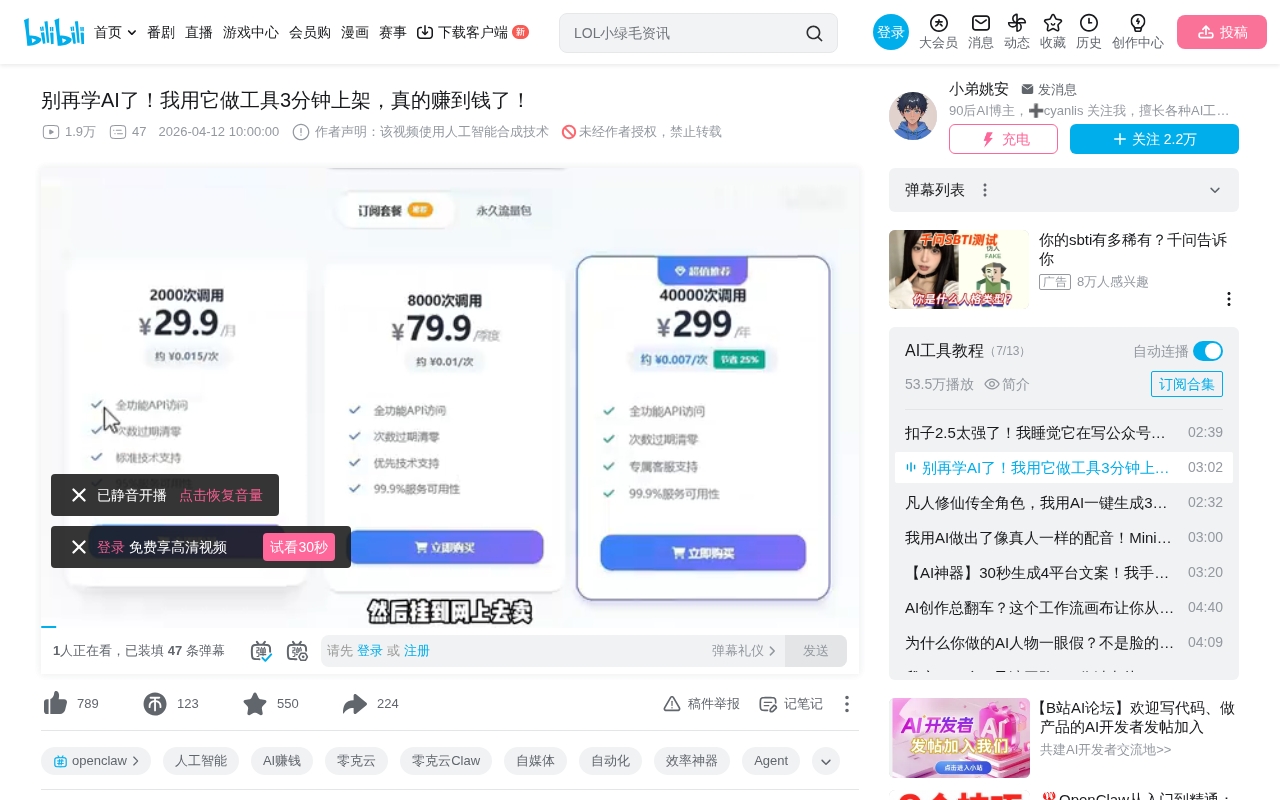
Analysis of the AI tool generation and sales model: building it doesn't mean you can sell it.
This article analyzes an emerging AI monetization model: using the LinkCloud Crow platform to quickly generate tools via natural language and list them for sale. Using a social media data monitoring tool as an example, it demonstrates the zero-code creation process. However, while technical barriers have dropped significantly, real challenges remain — customer acquisition, quality stability, homogeneous competition, ongoing maintenance, and data compliance. True competitive advantage lies in business operations, not tool creation itself.
AI Tool Monetization: A New Approach — Skip the Tech, Just Sell Tools
Recently, a new AI monetization model has been gaining attention in the content creator community — instead of learning AI technology itself, you use AI platforms to quickly generate tools and then list them for sale to earn passive income. A Bilibili creator shared their experience using the "LinkCloud Crow" platform to build Xiaohongshu/Douyin data monitoring tools and successfully monetize them, claiming the entire process takes just a few minutes.
How does this model actually work? Can you really make money from it? Let's dive deep into the analysis.
Core Concept: From "Learning AI" to "Making Money with AI"
Identifying Content Creators' Data Pain Points
The creator's entry point is clear: people doing social media need to check their Xiaohongshu and Douyin performance data daily — which videos went viral, which topics are trending, follower growth, likes and comments, etc. Most of this work currently requires manual effort, which is both time-consuming and prone to oversight.
The mainstream data analytics tools currently available include Xinbang, Chanmama, Huitun Data, Feigua Data, and others. These platforms typically charge monthly or annually, ranging from a few hundred to several thousand yuan, offering competitor monitoring, trending topic tracking, audience profile analysis, and more. However, for small and medium-sized creators, these tools are often feature-bloated and overpriced — what they really need might just be a simple data change notification. This leaves market space for lightweight, low-cost vertical tools.
Based on this pain point, the creator decided to build an automated data monitoring tool: real-time platform data tracking that automatically sends Feishu (Lark) notifications when content goes viral and logs the data into Feishu Bitable. This need genuinely exists — while similar products are available, most are either expensive or overly complex.
The AI Tool Generation Process
According to the creator, the entire production process is remarkably simple:
- Open the LinkCloud platform and click "Open Crow" to deploy
- The deployment process is foolproof — no environment configuration or API calls needed
- Describe your requirements in natural language (e.g., "Build a Xiaohongshu and Douyin data monitoring tool that sends Feishu notifications when content goes viral and logs data to Feishu Bitable")
- Wait a few minutes while AI automatically generates the complete tool
The entire workflow is extremely friendly to non-technical users — virtually zero coding knowledge required.
The underlying technology of these AI tool generation platforms is based on the code generation capabilities of Large Language Models (LLMs). The core principle involves converting users' natural language requirements into structured program logic, then automatically assembling runnable applications through preset code templates and API integration frameworks. These platforms typically employ an Agent architecture, meaning the AI not only generates code but can also autonomously invoke tools, debug errors, and deploy services. Similar products include Bolt.new, Lovable, Replit Agent, and others. Their common feature is compressing traditional software development stages — requirements analysis, architecture design, coding, testing, and deployment — into a single natural language interaction, dramatically lowering the barrier to software development.
LinkCloud Crow Platform's Core Selling Points
Built-in App Marketplace Creates a Complete Monetization Loop
The biggest difference from other AI coding platforms is that LinkCloud Crow not only generates tools but also includes a built-in app marketplace. Users can directly list, price, and sell their AI tools, with the platform handling payment collection. The creator positions it as an "AI clone factory" — not just for personal use, but for mass-producing tools to sell to others.
Multi-Scenario Adaptability
The platform claims to support the following scenarios:
- Entrepreneurs: Quickly validate product ideas and reduce trial-and-error costs
- Business professionals: Automate repetitive workflows
- Content creators: Build practical tools for followers (e.g., automatically generating video scripts from research paper links)
- Enterprise teams: Integrate with Feishu, DingTalk, WeCom, and other workplace tools for automated replies and consultations
The use of Feishu Bitable as a data backend deserves special mention. Feishu Bitable is a structured data management tool provided by ByteDance's Feishu (Lark) platform, similar to Airtable or Notion Database, supporting data read/write operations via API. For non-technical users, using Feishu Bitable as a substitute for traditional databases is an extremely low-cost solution — data visualization, filtering, and collaboration features work out of the box. Combined with Feishu bot message push capabilities, you can quickly build a complete data monitoring + notification system without setting up independent servers and databases.
Additionally, the platform can search resources from global professional sites like GitHub and Cloudflare, switching to technical expert mode when coding is needed.
Monetization Model Analysis: The Gap Between Theory and Reality
Theoretical Revenue Calculation
The creator provides a simple revenue model: price the tool at 29 yuan/month, and if 200 users subscribe in the first month, monthly income would be 5,800 yuan. While this number isn't huge, it's certainly attractive as "passive income."
From a business model perspective, this is essentially a Micro-SaaS model. Micro-SaaS refers to software-as-a-service products developed and operated by individuals or very small teams, targeting specific niche scenarios. Unlike traditional SaaS products that serve millions of users, Micro-SaaS typically serves only a few hundred to a few thousand paying users. However, since operating costs are extremely low (often just server fees), profit margins can be very high. Typical Micro-SaaS products include industry-specific automation tools, Chrome extensions, and Slack/Feishu bots. This model is already quite mature overseas, with communities like IndieHackers and MicroConf gathering large numbers of Micro-SaaS entrepreneurs.
Five Questions That Demand Sober Thinking
However, this model has several issues worth deep consideration:
- Customer acquisition cost: Even if the tool is ready, how do you get 200 people to discover it and be willing to pay? Where does the traffic come from?
- Tool quality: Can a tool generated by AI in minutes meet paying users' expectations for stability and feature completeness?
- Competitive moat: If anyone can build a similar tool in 3 minutes, homogeneous competition will be extremely fierce
- Ongoing maintenance: Xiaohongshu and Douyin APIs change frequently — data monitoring tools require continuous updates and maintenance
- Compliance risks: Scraping platform data may involve compliance issues — legal boundaries must be observed
Regarding the fifth point on compliance risks, further elaboration is needed. Scraping social media platform data involves multiple layers of legal and compliance issues. The user agreements and robots.txt of platforms like Xiaohongshu and Douyin typically explicitly prohibit unauthorized data collection. China's Data Security Law and Personal Information Protection Law, implemented in 2021, impose strict requirements on data collection, storage, and usage. There have been multiple cases of legal liability for unauthorized platform data scraping, such as the 2019 "Qiaoda Technology" case. For tool developers, if a tool's core functionality relies on scraping third-party platform data, special attention must be paid to whether official platform APIs are being used, whether user authorization has been obtained, and whether data storage and usage are compliant. Once platforms strengthen anti-scraping measures or initiate legal action, tools may face sudden failure or even legal risks.
Objective Assessment: Who Is This AI Side Hustle Model Suitable For?
People with Existing Traffic Have a Better Chance of Success
For creators or community operators who already have a clear user base, this model does have some viability — they already possess traffic and trust, and creating a small tool that solves their followers' pain points offers a relatively clear monetization path.
But for the average person, the claim that "you can make money by building a tool in 3 minutes" oversimplifies the entire business chain. The tool is just the first step — marketing, operations, and after-sales support are the real challenges.
The Micro-SaaS Trend Worth Watching
Setting aside specific platforms, the trend of "AI tools as products" is genuinely worth paying attention to. As AI capabilities improve, the barrier for individual developers or non-technical people to create and sell small tools is dropping dramatically. We may see a proliferation of "Micro-SaaS" products targeting niche scenarios in the future, which will impact the entire software industry landscape.
As AI lowers the development barrier, the Micro-SaaS space is accelerating with new entrants. But this also means competition is intensifying — when the cost of building tools approaches zero, true competitive advantage shifts to deep understanding of user needs, continuous product iteration capability, and precise market positioning. In other words, the disappearance of technical barriers doesn't mean the disappearance of business barriers — it may actually make "soft skills" even more important.
Conclusion: Being Able to Build It Doesn't Mean Being Able to Sell It
The LinkCloud Crow platform provides a complete loop from tool generation to marketplace listing, lowering the technical barrier to AI tool monetization. But there's still a long road between "being able to build it" and "being able to sell it."
For interested readers, I recommend first using the free tier to experience the platform's capabilities. But before investing significant effort, make sure you've thought through three questions: Who are your target users? How will you reach them? And what unique value does your tool offer compared to competitors? Only by answering these three questions well can AI tool monetization truly work.
Key Takeaways
- LinkCloud Crow platform supports automatic AI tool generation from natural language descriptions and includes a built-in app marketplace for listing and selling
- Using a social media data monitoring tool as an example, the creator demonstrated the full process from requirement description to tool generation, claiming it takes just minutes
- The platform supports integration with Feishu, DingTalk, and other workplace tools, applicable to startup validation, workflow automation, fan tools, and more
- The monetization model is theoretically viable but faces multiple real-world challenges including customer acquisition, quality, competition, maintenance, and compliance
- The trend of AI tools as products is worth watching, but the business operations between creation and profitability cannot be overlooked
Related articles
 Product Reviews
Qoder vs Cursor Real-World Comparison: Which $20/Month AI IDE Is Better?
Hands-on comparison of Qoder vs Cursor AI IDEs: Agent autonomy, human interaction count, and architecture decisions. Qoder needed only 2 interactions vs Cursor's 8.
 Product Reviews
Cursor Cloud Agent Demo: Eliminating Bottlenecks Across the Entire Software Development Lifecycle
Deep analysis of Cursor's Cloud Agent demo showing how cloud VMs, automated test artifacts, and a full-chain control plane systematically eliminate human bottlenecks across the software development lifecycle.
 Product Reviews
Cursor 3.0 Deep Dive: Multi-Agent Parallelism, Design Mode, and Best-of-N Model Comparison
Cursor 3.0 evolves from an AI coding assistant into an Agent fleet command center. Explore multi-agent parallelism, Design Mode, and Best-of-N model comparison.