Mistral Vibe: Free Open-Source Terminal AI Coding Assistant — A Claude Code Alternative
Mistral Vibe: Free Open-Source Termina…
Mistral Vibe is a free, open-source terminal AI coding agent rivaling Claude Code.
Mistral has released Mistral Vibe, a free, open-source terminal-native AI coding agent as an alternative to Claude Code. It features custom sub-agents with parallel multi-agent architecture, multi-choice clarification, Slash commands with a Skills system, and async agent mode with ACP protocol support. Powered by three models — DevStral, CodeStral, and CodeStral Embed — it integrates with GitHub, Jira, and other mainstream tools, and is free to use with your own API key.
Mistral Vibe: A Comprehensive Look at the Free, Open-Source Alternative to Claude Code
Claude Code's $200/month subscription has priced out many developers. Now, the Mistral team has released Mistral Vibe, a terminal-native AI coding agent that's not only open-source and free but also rivals Claude Code and OpenAI's comparable products in functionality. So what makes this tool stand out? This article provides a comprehensive breakdown — from features and technical architecture to real-world experience.
What Is Mistral Vibe? A Terminal-Native AI Coding Agent
Mistral Vibe is a terminal-native AI coding agent, similar to Claude Code and Open Code, capable of handling the entire development workflow — writing code, testing, refactoring, and even deploying — directly from the command line.
Terminal-native AI coding agents represent a new paradigm in AI-assisted programming. Unlike traditional IDE plugins (such as GitHub Copilot), these tools run directly in the command-line environment, with access to the file system, Shell command execution, external API calls, and the ability to reason and operate across an entire codebase. The advantages of this architecture are clear: it's not tied to any specific IDE and can run in any development environment; it can execute complex multi-step tasks — complete loops like "read code → analyze dependencies → generate tests → run tests → fix errors"; and it naturally supports CI/CD pipeline integration. Claude Code was the pioneer in this space, built on Anthropic's research into "Computer Use" capabilities — enabling AI models to operate computer interfaces and toolchains just like humans.
Its core positioning is crystal clear: give developers a powerful AI coding assistant right in the terminal, without the hefty price tag.
The tool supports asynchronous task processing, integrates with mainstream development tools like GitHub, Jira, Slack, and Jenkins, and offers customizable agent workflows to automate long-running tasks. Most importantly, it's fully open-source — developers can use it for free with their own API key.
Four Key Feature Highlights of Mistral Vibe
1. Sub-Agents & Task Delegation: A Composable Automation System
One of Mistral Vibe's most exciting features is custom sub-agents. You can create sub-agents dedicated to deployment scripts, PR reviews, test generation, or any repeatable workflow, and invoke them on demand with a single command.
Sub-agents inherit the project context while staying focused on their specific domain. This means you can build a composable automation system that scales flexibly with your team size and development workflow. For example, simply tell Mistral Vibe to "create a sub-agent that handles PR reviews and run it," and it will automatically handle the setup and execution.
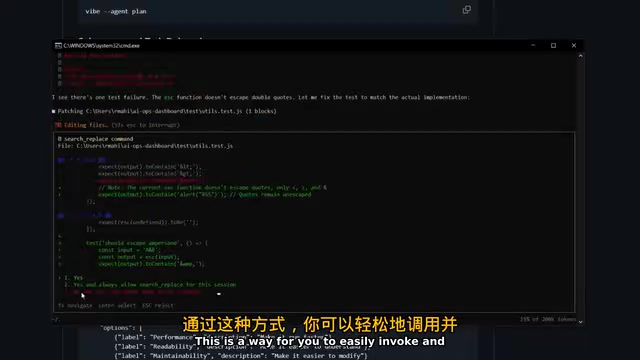
This design reflects the cutting-edge Multi-Agent Architecture thinking in today's AI engineering. In this architecture, an "Orchestrator Agent" understands high-level goals, breaks them into subtasks, and delegates them to specialized "Worker Agents" — fully aligned with the agent collaboration patterns championed by frameworks like AutoGen and LangGraph. More critically, these sub-agents support parallel execution — tasks can be delegated to multiple sub-agents running simultaneously, compressing what would take minutes of sequential processing down to seconds, with validation loops ensuring output correctness. Validation loops are the key mechanism for quality assurance — after completing a task, the agent automatically runs tests, checks code standards, and forms a closed loop of "generate → validate → fix." This is also the core technical boundary that distinguishes "AI code completion tools" from "AI coding agents."
In real-world testing with a large codebase, Mistral Vibe was able to analyze the entire codebase and generate tests for all utility functions while providing a detailed summary report.
2. Multi-Choice Clarification: Safer Automated Output
When Mistral Vibe is uncertain about your intent, it doesn't blindly guess — instead, it proactively presents multiple options for you to choose from. This design delivers safer automation and more precise code generation output.
In practice, when you request a frontend page, it will ask whether you want to upload a reference image, choose a design style, and so on, using interactive Q&A to ensure the final result matches your expectations.
3. Slash Commands & Skills System
Mistral Vibe CLI supports pre-configured workflows that can be triggered instantly via Slash commands. You can use commands like /deploy, /lint, /generate docs to execute common development tasks.
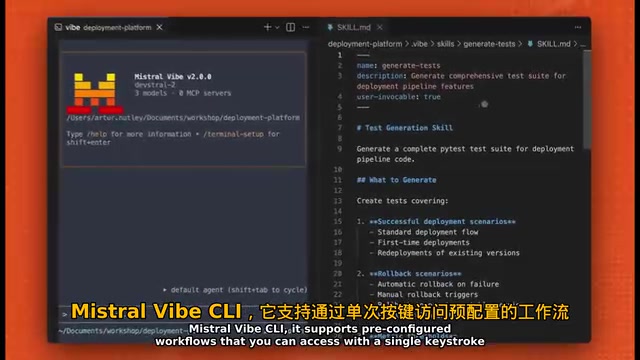
Going further, you can also create custom Skills — similar to the skills directory in Claude Code — by creating a skills.md file to define command logic. For example, you can create a skill that deploys directly to a GitHub repository; after setting the description, you simply specify the skill in the CLI and it executes automatically. These skills encapsulate best practices into repeatable commands, eliminate boilerplate code, and significantly boost operational efficiency across the entire codebase.
4. Async Agent Mode: Non-Blocking Development Workflows
Mistral Vibe supports an async agent mode that handles long-running tasks without blocking the developer's workflow. At startup, you can choose between two modes:
- Vibe Mode: Standard CLI usage — manually run commands and interact step by step
- ACP Mode: A more agent-driven automation mode that orchestrates tasks and manages workflows with higher execution efficiency
ACP (Agent Communication Protocol) points to a major technical trend in AI agent interoperability. ACP is an open protocol led by IBM Research and hosted by the Linux Foundation, designed to establish standardized interfaces for communication between different AI agents — similar to what HTTP is for web services. Under the ACP framework, agents can discover each other's capabilities, negotiate task distribution, and pass structured context without relying on any vendor's proprietary API. This complements Anthropic's MCP (Model Context Protocol) — MCP addresses "how models access external tools and data sources," while ACP addresses "how agents collaborate with each other." Mistral Vibe's support for ACP mode means it's architecturally designed to interoperate with other ACP-compliant agent systems, which has significant implications for building enterprise-grade multi-agent workflows.
Technical Architecture: Three Models Working in Concert
Under the hood, Mistral Vibe is powered by a layered model stack that calls the most appropriate model for each scenario:
- DevStral: Handles code generation and deployment — the core code creation engine
- CodeStral: Manages code comprehension and analysis for large-scale projects
- CodeStral Embed: Provides semantic search capabilities for smarter code navigation and retrieval
DevStral, CodeStral, and CodeStral Embed form Mistral's model matrix purpose-built for software engineering scenarios. This layered design reflects the principle that "specialized models outperform general-purpose models."
Related articles
 Product Reviews
Qoder vs Cursor Real-World Comparison: Which $20/Month AI IDE Is Better?
Hands-on comparison of Qoder vs Cursor AI IDEs: Agent autonomy, human interaction count, and architecture decisions. Qoder needed only 2 interactions vs Cursor's 8.
 Product Reviews
Cursor Cloud Agent Demo: Eliminating Bottlenecks Across the Entire Software Development Lifecycle
Deep analysis of Cursor's Cloud Agent demo showing how cloud VMs, automated test artifacts, and a full-chain control plane systematically eliminate human bottlenecks across the software development lifecycle.
 Product Reviews
Cursor 3.0 Deep Dive: Multi-Agent Parallelism, Design Mode, and Best-of-N Model Comparison
Cursor 3.0 evolves from an AI coding assistant into an Agent fleet command center. Explore multi-agent parallelism, Design Mode, and Best-of-N model comparison.