Moore Threads AI Coding Plan: A Fully Domestic AI Programming Service with 30-Day Free Trial

Moore Threads launches a full-stack domestic AI coding tool powered by its own GPU and GLM-4 model.
Moore Threads has officially launched its AI Coding Plan intelligent programming service, achieving full-stack domestication from underlying compute (self-developed MTT S5000 GPU) through inference engine to upper-layer model (Zhipu AI's GLM-4). The service is compatible with mainstream IDEs including VS Code and Cursor, offering a 30-day free trial and tiered pricing plans. Amid U.S. chip export controls and restricted access to foreign model APIs, this solution charts a self-controlled alternative path for domestic AI coding tools.
Domestic Chips + Domestic LLM: Moore Threads Enters the AI Coding Arena
At a time when the AI coding tool market is dominated by overseas products like GitHub Copilot and Cursor, Chinese chipmaker Moore Threads has officially launched its AI Coding Plan intelligent programming service, aiming to achieve a breakthrough in this critical space. AI coding tools (AI Code Assistants) have been the fastest-growing developer tool category over the past two years — GitHub Copilot was first introduced in 2021, powered by OpenAI's Codex model, and now boasts over 1.5 million paying users, making it the benchmark product in this field. Cursor, an AI-native IDE that emerged in 2023, rapidly gained developer traction by deeply integrating LLMs like Claude to deliver a more aggressive code generation and editing experience. However, the tech stack in this market is heavily dependent on NVIDIA's CUDA-based GPU compute ecosystem and LLM capabilities from American AI companies like OpenAI and Anthropic, creating a strong technology lock-in effect.
The standout feature of Moore Threads' AI Coding Plan is its full-stack domestic technology implementation — from underlying compute to upper-layer models. At its core, it's powered by the full-precision computing capabilities of the company's self-developed MTT S5000 GPU, paired with a proprietary inference acceleration engine, and integrated with the GLM-4 code model, forming a complete domestically-built AI programming solution. Moore Threads was founded in 2020 by Zhang Jianzhong, former NVIDIA Global Vice President. It is one of the few Chinese chip companies simultaneously developing both graphics rendering GPUs and AI compute GPUs. Its product line spans consumer-grade graphics cards and data center AI accelerators, built on the proprietary MUSA (Moore Threads Unified System Architecture), an effort to build a software-hardware ecosystem analogous to NVIDIA's CUDA.

The significance of this move extends beyond the product itself — it validates the real-world capability of domestically-produced compute in core AI productivity tools. AI coding assistants have always placed extremely high demands on underlying compute, requiring support for highly complex code generation, comprehension, and reasoning tasks — a "deep water zone" that domestic chips had rarely ventured into before.
Technical Architecture: Deep Three-Layer Integration of Compute, Engine, and Model
From a technical architecture perspective, the core competitiveness of Moore Threads' AI Coding Plan comes from deep integration across three layers:
Compute Layer: MTT S5000 GPU with Full-Precision Computing
The MTT S5000 is Moore Threads' high-end GPU product designed for data centers, featuring full-precision computing capabilities (FP32/FP16/INT8, etc.). Full-precision computing is particularly critical in AI coding scenarios: FP32 (32-bit floating point) provides the highest precision, suitable for code generation tasks requiring accurate numerical computation; FP16 (half-precision floating point) doubles computational throughput while maintaining relatively high precision, ideal for large-scale model inference; INT8 (8-bit integer quantization) further compresses model size and computation, used in real-time inference scenarios that are extremely latency-sensitive. Supporting multiple precision formats means the system can flexibly switch based on different task requirements, achieving optimal balance between precision and performance — by contrast, some domestic AI chips only support specific precision formats, limiting their application flexibility.
In AI coding scenarios, full-precision computing ensures greater accuracy and stability in model inference, especially when handling complex code logic, reducing generation errors caused by precision loss.
Engine Layer: Proprietary Inference Acceleration Engine for Optimized Response Speed
Moore Threads' self-developed inference acceleration engine is responsible for optimizing model execution efficiency on its own hardware. An inference acceleration engine is the critical middleware connecting AI models to underlying hardware, with the core task of efficiently mapping a large model's computation graph onto GPU hardware for execution. Common optimization techniques include: operator fusion (merging multiple computation steps into a single execution to reduce memory read/write overhead), KV Cache optimization (caching key-value pairs in the attention mechanism to avoid redundant computation), dynamic batching (combining multiple inference requests for higher GPU utilization), and Speculative Decoding (using a smaller model to predict the larger model's output to accelerate generation).
AI coding tools are extremely sensitive to response speed — developers need real-time code completions and suggestions during coding, with a typical latency tolerance of 200–500 milliseconds for code completion. Exceeding this threshold creates a noticeable "lag" that seriously disrupts coding flow. The inference acceleration engine's role is to compress inference time as much as possible while maintaining output quality, and its optimization level directly determines the upper bound of user experience.
Model Layer: Integrated GLM-4 Code LLM
For its model selection, Moore Threads integrated Zhipu AI's GLM-4 series code model. GLM-4 is the next-generation large language model series from Zhipu AI, built on the proprietary GLM (General Language Model) architecture. The GLM architecture is distinctive for its Autoregressive Blank Infilling pre-training paradigm, combining both natural language understanding and generation capabilities. In terms of coding ability, the GLM-4 series has been specifically optimized for code generation, code completion, code explanation, and bug fixing tasks, delivering strong performance on international code benchmarks such as HumanEval and MBPP, placing it in the top tier of domestic code LLMs.
Zhipu AI was founded by a technical team from Tsinghua University's Department of Computer Science and is one of the earliest teams in China to focus on large models. Its models have a natural advantage in Chinese language understanding and Chinese programming scenarios (such as Chinese comment generation and converting Chinese requirements to code), which was an important consideration in Moore Threads' decision to partner with GLM-4. Choosing a mature third-party model rather than developing one in-house reflects Moore Threads' pragmatic strategy of "building a solid compute foundation while embracing open ecosystem collaboration."
Ecosystem Compatibility: Works with VS Code, Cursor, and Other Mainstream Programming Tools
For developers, whether an AI coding service can integrate into their existing workflow is crucial. Moore Threads has made thorough preparations in this regard — the AI Coding Plan is already compatible with VS Code (Cloud Code), Cursor, Open Code, and several other mainstream programming tools.
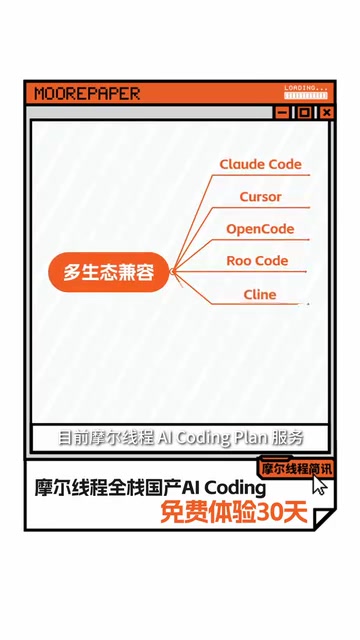
The compatibility between AI coding tools and IDEs (Integrated Development Environments) fundamentally relies on standardized API interface protocols. The most prevalent standard in the industry today is the OpenAI API-compatible format, which most AI coding tools and IDE plugins use for communication. Additionally, the Language Server Protocol (LSP) is an important standard for IDE plugin development, defining the communication specification between editors and language servers. Moore Threads' ability to simultaneously support multiple tools indicates that its backend services have achieved alignment with the OpenAI-compatible format at the API level, significantly lowering the barrier to entry for developers. Notably, VS Code, with its open-source ecosystem and massive plugin marketplace, currently holds approximately 70% of the global IDE market share, making it the platform that AI coding tools must prioritize.
This means developers don't need to change their existing development habits or toolchains — they simply configure the appropriate plugin in their familiar IDE to access Moore Threads' AI coding capabilities. This "seamless switching" design dramatically reduces migration costs and is a key factor in attracting developers to try the service.
You might not have noticed, but the fact that Moore Threads has achieved compatibility with Cursor — one of the hottest AI coding tools today — demonstrates that it has aligned with mainstream standards at the API interface and protocol level.
Business Model: Tiered Plans + 30-Day Free Trial
For its commercialization strategy, Moore Threads has adopted a tiered plan approach, offering different service levels for individual developers and enterprise users.
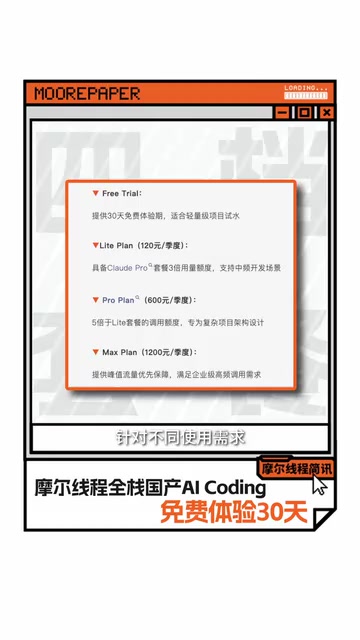
More importantly, Moore Threads offers new users a 30-day free trial, which is quite generous among domestic AI coding services. The free trial period allows developers to thoroughly evaluate core metrics like code completion quality and response speed at zero cost, and also reflects Moore Threads' confidence in its product's competitiveness.
For enterprise users, Moore Threads also provides enterprise-tier upgrade options, suggesting deeper support in areas such as data security, private deployment, and customized services — precisely where domestic solutions hold a natural advantage over overseas competitors.
Industry Significance: The Path Forward for Domestic AI Coding Tools
From a broader perspective, the launch of Moore Threads' AI Coding Plan carries landmark significance. The current AI coding market is primarily dominated by overseas products like GitHub Copilot and Cursor, with underlying dependencies on NVIDIA GPUs and models from OpenAI/Anthropic. Moore Threads has demonstrated the viability of a self-controlled alternative path using the combination of domestic chips and domestic models.
The strategic value of this path is particularly prominent in the current international environment. Since 2022, the U.S. Department of Commerce has repeatedly escalated chip export controls targeting China, placing high-end AI chips like NVIDIA's A100 and H100 on the restricted list. Even the "downgraded" A800 and H800 versions designed for the Chinese market were subsequently further restricted. On the software side, API services from companies like OpenAI and Anthropic have access restrictions for Chinese users, further highlighting the necessity of model-layer domestication. Against this backdrop, Moore Threads' construction of AI coding tools using domestic GPUs and domestic LLMs is not merely a commercial competitive move — it's a strategic initiative to establish self-controlled capabilities in critical technology domains. For enterprise users dealing with sensitive code assets (such as those in finance, defense, and government sectors), a full-stack domestic solution offers irreplaceable value in terms of data sovereignty and supply chain security.
Of course, the product's ultimate competitiveness still needs to be validated by the market. Code generation accuracy, response speed, understanding of Chinese programming scenarios, and long-context code handling capabilities are all core metrics that developers care about. The 30-day free trial period is precisely Moore Threads' window for market validation.
As the broader trend toward domestic technology alternatives continues, AI coding tools — as one of the most frequently used AI applications in developers' daily workflows — deserve ongoing attention for their domestication progress.
Key Takeaways
- Moore Threads launches AI Coding Plan, achieving a full-stack domestic AI coding solution with domestic GPU (MTT S5000) + domestic LLM (GLM-4)
- Already compatible with mainstream programming tools including VS Code, Cursor, and Open Code, enabling seamless developer migration
- Offers a 30-day free trial and tiered plan options, serving individual developers through enterprise users
- Marks a milestone proving that domestic compute is capable of handling the high-complexity demands of AI coding applications
- Employs a proprietary inference acceleration engine to optimize response speed, addressing the strict low-latency requirements of AI coding tools
Related articles
 Product Reviews
Qoder vs Cursor Real-World Comparison: Which $20/Month AI IDE Is Better?
Hands-on comparison of Qoder vs Cursor AI IDEs: Agent autonomy, human interaction count, and architecture decisions. Qoder needed only 2 interactions vs Cursor's 8.
 Product Reviews
Cursor Cloud Agent Demo: Eliminating Bottlenecks Across the Entire Software Development Lifecycle
Deep analysis of Cursor's Cloud Agent demo showing how cloud VMs, automated test artifacts, and a full-chain control plane systematically eliminate human bottlenecks across the software development lifecycle.
 Product Reviews
Cursor 3.0 Deep Dive: Multi-Agent Parallelism, Design Mode, and Best-of-N Model Comparison
Cursor 3.0 evolves from an AI coding assistant into an Agent fleet command center. Explore multi-agent parallelism, Design Mode, and Best-of-N model comparison.