Notion MCP Challenge Winners Breakdown: AI Agents Redefine Note-Taking Tools
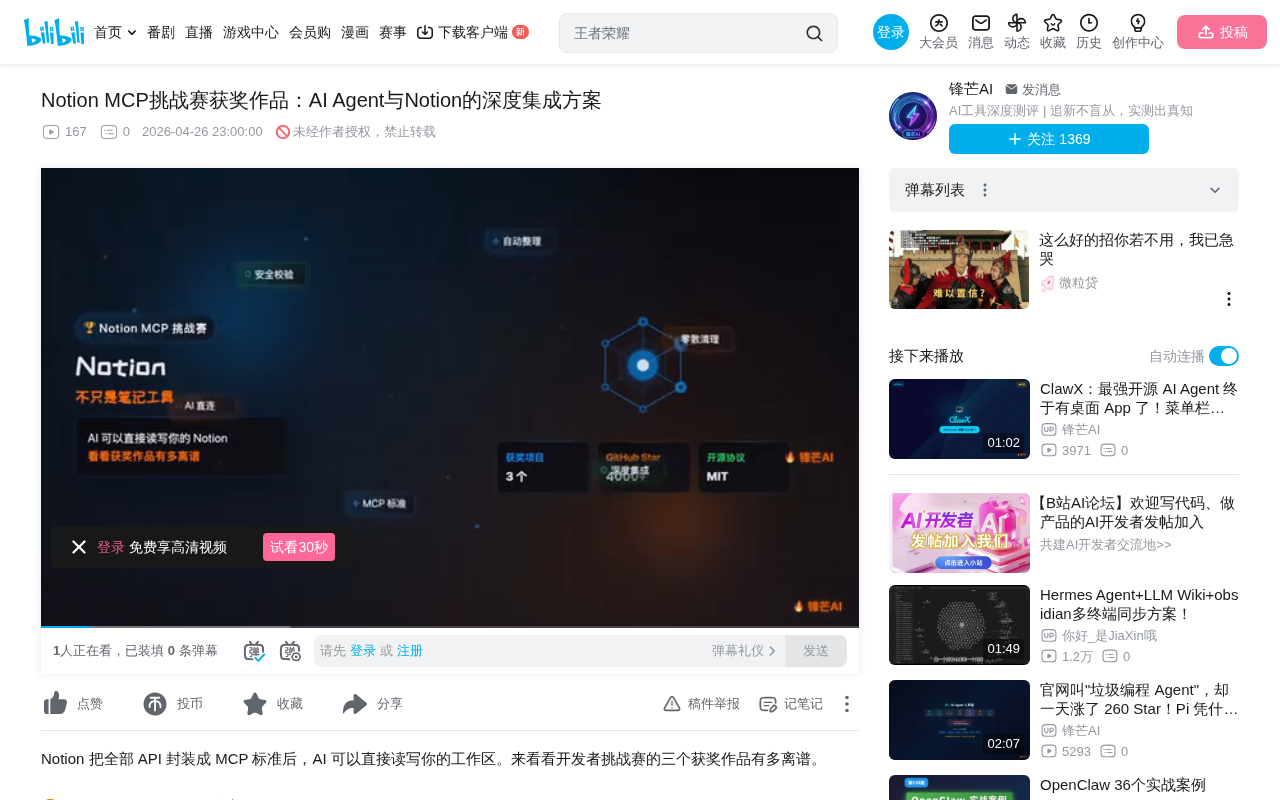
Notion's MCP standard enables direct AI read/write access, and challenge winners showcase deep Agent integration.
Notion wrapped its entire API into the MCP standard protocol, enabling AI to read and write Notion workspaces in real-time without vector database intermediaries. Three developer challenge winners demonstrate key applications: champion Note Runway uses a hybrid architecture to turn Notion into an AI command center; runner-up Deaf Notion auto-generates weekly reports via a three-Agent pipeline; runner-up Relay autonomously records incident timelines using the ReAct framework. These cases reveal a shift from 'humans operating tools' to 'AI operating tools, humans making decisions.'
Notion is no longer just a note-taking tool. Three months ago, Notion wrapped its entire API into the MCP (Model Context Protocol) standard, enabling AI to directly read from and write to your Notion workspace. The developer challenge that followed showcased the stunning potential of deep AI Agent integration with Notion.
What Is Notion MCP?
MCP is a standardized protocol proposed and open-sourced by Anthropic in late 2024, designed to solve the "last mile" integration challenge between AI models and external tools. It draws inspiration from LSP (Language Server Protocol)—the same protocol that allows editors like VS Code to support hundreds of programming languages without building separate plugins for each one. MCP extends this concept to the AI domain: tool providers only need to implement an MCP server once, and all MCP-compatible AI clients (such as Claude, Cursor, etc.) can call it directly, completely breaking down the fragmentation in the AI tool ecosystem.
In the traditional development model, making AI interact with Notion required developers to write their own API adaptation layers, handle authentication, error handling, and other tedious work. The introduction of the MCP standard fundamentally changed this—a single MCP server handles all integration, making AI tools truly plug-and-play.

More critically, with MCP you no longer need a separate vector database to build a knowledge base. Traditional RAG (Retrieval-Augmented Generation) architectures typically require chunking documents and storing them in vector databases (like Pinecone or Weaviate), then using semantic retrieval to provide context for AI—with document updates requiring re-triggering of embedding and indexing pipelines, resulting in data synchronization delays. Notion MCP bypasses this intermediate layer entirely: AI reads Notion's original documents in real-time through the MCP protocol. The moment a document is modified, AI immediately perceives the change without any sync pipeline. The official Notion MCP server has already earned 4,000+ stars on GitHub, is released under the MIT open-source license, and its community ecosystem is growing rapidly.
First Place: Note Runway — Turning Notion into an AI Command Center
The champion project Note Runway has a bold design philosophy: upgrading Notion from a passive information storage tool into an AI command center.

Its core highlight is the hybrid architecture design. Bulk read operations use direct API connections for efficiency, while write operations go through MCP for security validation—balancing both performance and safety. This architectural choice reflects mature engineering thinking: not all operations need to go through the same path; choosing the optimal approach based on the scenario is the right answer.
Additionally, Note Runway can automatically organize scattered pages and forgotten key information, essentially giving your Notion workspace a 24/7 digital butler.
Runner-Up: Deaf Notion — Curing Monday Standup Amnesia
Every Monday standup, can you remember what you did last week? Deaf Notion was built to solve exactly this pain point.
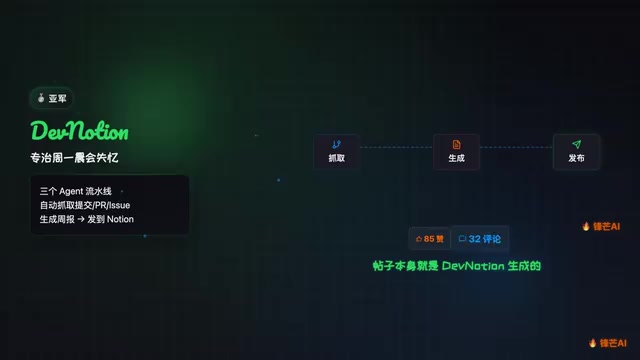
It employs a three-Agent pipeline collaboration architecture, a textbook implementation of the "Agentic Orchestration" pattern. Unlike a single Agent handling all tasks, the pipeline architecture decomposes complex tasks into sub-tasks with single responsibilities, where each Agent focuses only on its own "domain of expertise." This aligns closely with the "Single Responsibility Principle" in software engineering and is the core paradigm promoted by current Agent frameworks like LangGraph and CrewAI:
- Agent 1: Automatically fetches commit records, PRs, and Issues from code platforms (such as GitHub, GitLab)
- Agent 2: Organizes and summarizes raw data, extracting key work achievements
- Agent 3: Writes weekly reports in first-person perspective and automatically publishes them to Notion
The most interesting part? The project's competition submission post itself was automatically generated by Deaf Notion—using the product to prove the product. That's genuinely hardcore. For development teams, this means saving at least 30 minutes per week on writing weekly reports, without missing any important code contributions.
Runner-Up: Relay — The Intelligent Scribe for Production Incidents
The other runner-up, Relay, targets a high-value scenario: production incident handling.
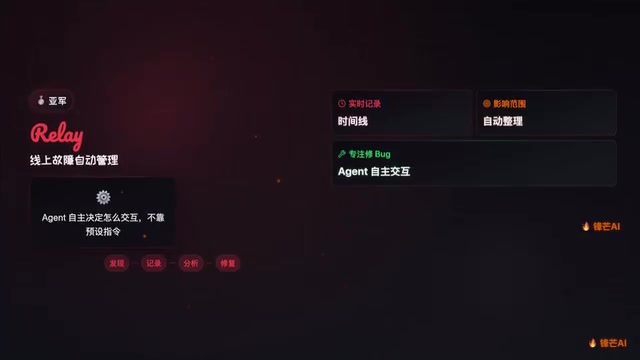
When a production incident occurs, the last thing engineers want to do is fix bugs while simultaneously writing incident reports. Relay's solution: let the Agent automatically record the incident timeline and organize the impact scope, so engineers can focus solely on fixing the problem.
Relay's most noteworthy technical feature is Agent-autonomous decision-making for interaction methods, without relying on preset instructions. This is powered by reasoning frameworks like ReAct (Reasoning + Acting)—at each step, the Agent first "thinks" about the current situation, then decides on the next action, forming a perception-reasoning-action loop. This means it can distinguish the fundamental difference between "database connection timeout" and "site-wide 5xx errors," dynamically adjusting its recording strategy based on the actual nature of the incident—whether it's a simple service degradation or a large-scale data anomaly, the granularity and focus of the records are completely different. This capability is beyond what traditional rule-based automation scripts (like PagerDuty's fixed alert templates) can achieve, and it's precisely the core capability that distinguishes AI Agents from traditional automation scripts.
Why These Cases Matter
These three winning projects reveal an important trend: productivity tools are shifting from "humans operating tools" to "AI operating tools, humans making decisions."
The Significance of the MCP Standard
MCP's value lies not just in simplifying API integration, but in establishing a standardized interaction protocol between AI and tools. Specifically:
- Developers no longer need to separately adapt the Notion API for each AI model
- Any AI tool supporting MCP can seamlessly connect to Notion
- Security validation and permission control have a unified processing layer
From Note-Taking Tool to Knowledge Hub
When Notion becomes a knowledge base that AI can directly read from and write to via MCP, its positioning undergoes a fundamental shift. Documents are no longer static information storage—they become the working memory and output terminal for AI Agents. This transformation has implications for the entire SaaS industry: the future competition among productivity tools is essentially a competition over "who can be better utilized by AI."
Practical Recommendations
For developers looking to try Notion MCP, here's a suggested path:
- Start by deploying the official MCP server from GitHub and familiarize yourself with basic read/write operations
- Begin with simple scenarios, such as automatically organizing meeting notes or daily reports
- Gradually introduce multi-Agent collaboration to handle more complex workflows
Interestingly, MCP is still in its early stages, and production use requires thorough testing for security and stability. As the original author put it: follow the hype, but don't follow blindly—real testing reveals real insights.
Related articles
 Product Reviews
Qoder vs Cursor Real-World Comparison: Which $20/Month AI IDE Is Better?
Hands-on comparison of Qoder vs Cursor AI IDEs: Agent autonomy, human interaction count, and architecture decisions. Qoder needed only 2 interactions vs Cursor's 8.
 Product Reviews
Cursor Cloud Agent Demo: Eliminating Bottlenecks Across the Entire Software Development Lifecycle
Deep analysis of Cursor's Cloud Agent demo showing how cloud VMs, automated test artifacts, and a full-chain control plane systematically eliminate human bottlenecks across the software development lifecycle.
 Product Reviews
Cursor 3.0 Deep Dive: Multi-Agent Parallelism, Design Mode, and Best-of-N Model Comparison
Cursor 3.0 evolves from an AI coding assistant into an Agent fleet command center. Explore multi-agent parallelism, Design Mode, and Best-of-N model comparison.