One Person, One Month: Building a Chinese Writing Community from Scratch with AI Development Tools

One developer built a Chinese writing community "YouTi" in a month using AI coding tools
An independent developer used AI programming tools like Cursor and Claude to build a Chinese writing community called "YouTi" from scratch in just over a month. The platform centers on a "prompt-response" mechanism, featuring historical college entrance exam essay prompts and user-generated topics, while maintaining a pure writing experience with no ads, no algorithmic recommendations, and manual content review. This case demonstrates how AI tools dramatically expand indie developers' capabilities and reflects a return to authentic expression in an era flooded with AI-generated content.
One Person, One Month, One Writing Community
As AI programming tools continue to mature, the capability boundaries of independent developers are being constantly expanded. A Bilibili content creator shared his practical experience—in just over a month, working entirely alone and leveraging AI development tools, he built a Chinese writing community called "YouTi" (有题, meaning "There's a Prompt") from scratch.
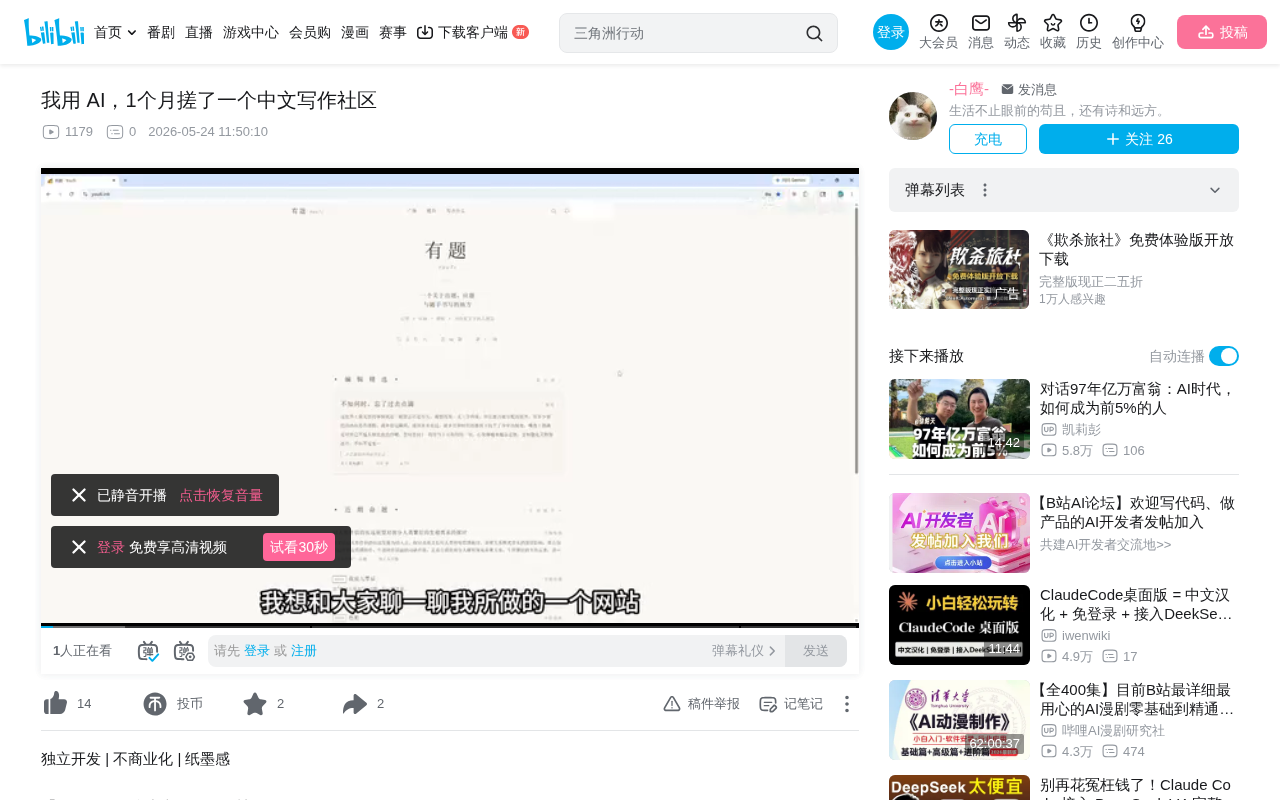
The starting point for this project was remarkably simple: he frequently saw users sharing life experiences and expressing views on reality across social media, with no shortage of beautifully written content—but these pieces often drowned in the information feed. This sparked an idea: create a pure writing platform where people could focus on expression itself, free from advertising distractions and algorithmic recommendation systems.
The Product Design Philosophy Behind "YouTi"
Core Concept: Someone Poses a Prompt, Someone Responds
YouTi's slogan is quite compelling: "We hope someone poses prompts, someone responds to them, and every user can write casually." This design cleverly solves a classic challenge in writing communities—users not knowing what to write about.
The "prompt-response" mechanism simultaneously addresses two core problems in writing community product design: the "cold-start content dilemma" and "insufficient creative motivation." From a user psychology perspective, open-ended prompts lower the psychological barrier to creation—users often experience "writing anxiety" when facing a blank page, while specific topics provide a clear creative framework. Using college entrance exam essay prompts as seed content is particularly clever: these topics are designed by professional exam committees, possess openness and dialectical depth, and have natural cultural resonance for Chinese users. Similar mechanisms have been validated on international platforms like Reddit's writing section (r/WritingPrompts), which has over 15 million subscribers. Through the "prompt-response" interaction mechanism, the community naturally possesses a driving force for content production.
Feature Module Breakdown
From the video demonstration, the website's functional architecture is quite comprehensive:
- Homepage: Includes editor's picks, recent prompts, and recently active writers, balancing content discovery with community atmosphere
- Plaza: All user-published articles converge here, categorized by genre—prose, classical poetry, five-character verse, modern poetry, narrative, and other major categories, each with subcategories like free writing and prompted compositions
- Prompt Plaza: This is the most distinctive module. The platform includes a large collection of historical college entrance exam essay prompts while also supporting user-generated prompts, with options to set deadlines and genre restrictions
- Writing Interface: After logging in, users can enter the writing page, select a genre, fill in a title, compose their text, and submit for manual review
You might not have noticed, but the creator chose manual review rather than AI-automated moderation to control content quality. Content moderation is one of the core infrastructure components of community platforms. AI-automated moderation (based on text classification models or large language models) has advantages in speed and scalability, capable of processing massive content in real-time with extremely low marginal costs as content volume grows; however, its limitations lie in limited understanding of context, metaphor, and literary expression, prone to misjudgments, and difficulty grasping a community's content "tone." Manual review is the opposite—slow and expensive, but capable of making nuanced content judgments. For a niche writing community that emphasizes literary quality, manual review is not just a quality control mechanism but also a product signal: communicating to users that "content here is taken seriously." In an environment flooded with AI tools, this approach actually feels especially thoughtful—he clearly wants to maintain the community's content standards.
How AI Programming Tools Are Changing the Independent Development Paradigm
The Capability Leap for Independent Developers
The most noteworthy aspect of this case isn't how complex the website's features are, but the development paradigm shift it represents. One month, one person, one complete community product—this would be almost unimaginable under traditional development models. Even for an experienced full-stack engineer, completing frontend interfaces, backend logic, database design, user systems, content moderation systems, and all other modules within a month would be an extremely challenging task.
Current mainstream AI programming tools include GitHub Copilot, Cursor, Claude, and others, built on large language models (LLMs) that can understand natural language requirements and generate corresponding code. Cursor, as an AI-native IDE, allows developers to describe feature requirements through conversation, with AI directly generating complete code modules; models like Claude excel at handling complex architectural design problems. The core capability of these tools has evolved from "code completion" to "feature generation"—developers no longer need to write code line by line but instead describe business logic while AI handles implementation details. The intervention of AI development tools fundamentally changes the conversion efficiency from "idea to product." For developers with clear requirements but lacking experience in certain tech stacks, AI fills the skill gap; for full-stack developers, AI dramatically compresses time spent on repetitive coding.
The proliferation of AI tools is giving rise to a new developer demographic—"Indie Hackers" or "Vibe Coders." This group is characterized by: possessing basic technical background or product thinking, leveraging AI tools to compensate for tech stack shortcomings, and turning ideas into usable products at extremely low cost and in extremely short cycles. According to data from the Indie Hackers community, over 70% of developers who joined after 2023 stated that AI tools were the key factor enabling them to independently complete product development. The deeper implication of this trend is that the competitive moat for software products is shifting from "whether it can be built" to "whether you truly understand user needs," further amplifying the value of product insight and user empathy.
From "Can It Be Done" to "Should It Be Done"
When technical barriers are significantly lowered by AI tools, the core question facing independent developers has shifted from "can I build this" to "should I build this, and how do I build it well." YouTi's design choices reflect this thinking:
- No ads, no algorithmic recommendations: Maintaining content purity under commercial pressure
- Incorporating college entrance exam prompts as seed content: Lowering the creative barrier for users while giving the platform a unique positioning
- Manual review mechanism: Sacrificing efficiency for quality control
These decisions reflect deep thinking about product positioning—and this is precisely the part that AI cannot replace.
Challenges and Opportunities for Chinese Writing Communities
Chinese writing communities are nothing new. This space has gone through three distinct development phases: the early 2000s BBS-style communities represented by Rongshuxia and Tianya Literature, emphasizing pure literary creation atmosphere; the 2010s light-blogging platforms represented by Jianshu and Douban Reading, introducing social relationship chains and content monetization mechanisms; and post-2020, the rise of content platforms like WeChat Official Accounts and Xiaohongshu deeply binding writing with traffic distribution, with algorithmic recommendations becoming the dominant logic for content distribution. YouTi's design philosophy is in some sense a rebellion against the third phase, attempting to return to the purity of the first. From the early Rongshuxia and Tianya Literature, to later Jianshu and Douban, to today's various creation platforms, this space has no shortage of predecessors. As a personal project, the challenges YouTi faces are obvious: user acquisition, content cold-start, community atmosphere maintenance, and long-term operational costs.
But from another perspective, precisely because it's lightweight enough and carries no commercialization baggage, it can focus on serving a small but beautiful writing community. In an era flooded with AI-generated content, a community that encourages authentic human-written originals with manual review oversight may precisely address some users' need for "genuine expression."
The creator mentioned at the end of the video that if people are interested, he's willing to produce a dedicated video introducing the complete website development process. This attitude of open sharing is itself the most valuable part of the AI programming community—not just building products, but passing experience on to more people.
Related articles
 Product Reviews
Qoder vs Cursor Real-World Comparison: Which $20/Month AI IDE Is Better?
Hands-on comparison of Qoder vs Cursor AI IDEs: Agent autonomy, human interaction count, and architecture decisions. Qoder needed only 2 interactions vs Cursor's 8.
 Product Reviews
Cursor Cloud Agent Demo: Eliminating Bottlenecks Across the Entire Software Development Lifecycle
Deep analysis of Cursor's Cloud Agent demo showing how cloud VMs, automated test artifacts, and a full-chain control plane systematically eliminate human bottlenecks across the software development lifecycle.
 Product Reviews
Cursor 3.0 Deep Dive: Multi-Agent Parallelism, Design Mode, and Best-of-N Model Comparison
Cursor 3.0 evolves from an AI coding assistant into an Agent fleet command center. Explore multi-agent parallelism, Design Mode, and Best-of-N model comparison.