OpenAI Codex Personal Activity Profile Feature Explained: Data Visualization and Gamification Design
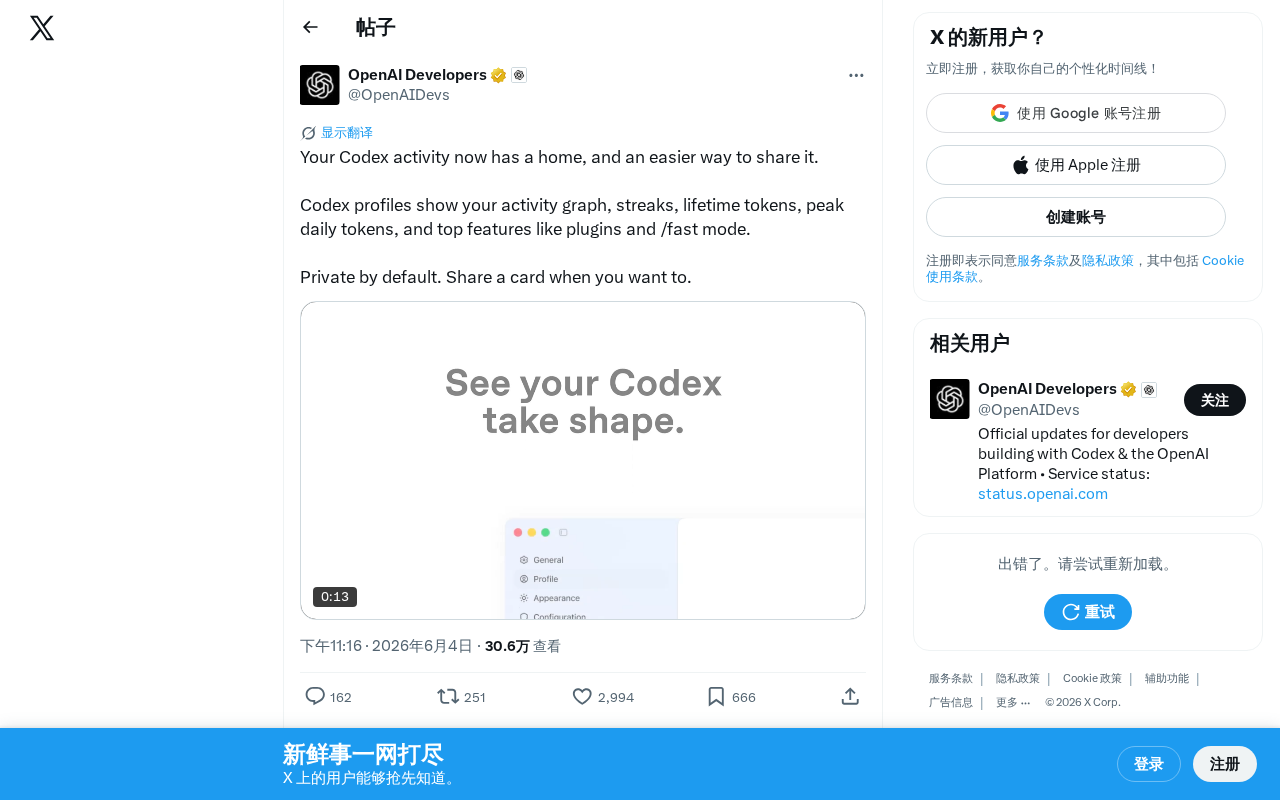
OpenAI Codex launches gamified user profiles with activity graphs, streaks, and token usage stats.
OpenAI Codex has introduced a personal activity Profile feature offering data visualization including activity graphs, usage streaks, lifetime token consumption, and top features. The privacy-first design keeps data private by default. The feature leverages gamification strategies to boost retention and enables social sharing for organic growth, reflecting the intensifying competition in the AI programming tool market.
Codex Introduces User Profile Page
OpenAI's AI programming assistant Codex recently launched a brand-new personal activity Profile feature, providing users with a centralized "homepage" to showcase their coding activities. This update allows developers to more intuitively track their AI-assisted programming journey and easily share their achievements when desired.
Overview of Codex Profile Core Features
Activity Data Visualization
The Codex profile page integrates multiple key data metrics to help users comprehensively understand their usage patterns:
- Activity Graph: A visual display similar to GitHub's contribution graph, intuitively showing daily usage frequency
- Streaks: Records the number of consecutive days a user has used Codex, encouraging consistent coding habits
- Lifetime Tokens: Displays the total number of tokens consumed throughout the user's history
- Peak Daily Tokens: Records the highest single-day usage
- Top Features: Statistics on frequently used features, including plugin usage and /fast mode
It's worth explaining that a token is the basic unit by which large language models process text. In natural language processing, a token is not equivalent to a single word or character—it's the smallest semantic fragment produced when the model splits text using tokenization algorithms (such as BPE, Byte Pair Encoding). For English, one token corresponds to approximately 4 characters or 0.75 words; for Chinese, a single character is typically encoded as 1-2 tokens. In AI programming scenarios, token usage directly reflects the depth of user-model interaction—including the code context provided as input, natural language instructions, and the code output generated by the model, all of which consume tokens. Therefore, cumulative token usage essentially reflects the degree of a user's reliance on and intensity of AI programming capabilities, and is also the core metric for API billing.
Privacy-First Design Philosophy
You might not have noticed, but Codex profiles are set to private by default. All user activity data is visible only to the user themselves, and a shareable card is generated only when the user actively chooses to share. This "privacy-first" design approach reflects OpenAI's emphasis on user data security—after all, coding activity data may indirectly reveal sensitive information such as project progress and work habits.
Product Logic Behind the Feature
Gamification Incentives to Boost User Retention
From a product design perspective, the Codex profile draws on mature gamification strategies. Elements like streaks and activity graphs are virtually identical to GitHub's contribution graph and Duolingo's learning streaks. These quantifiable achievement metrics effectively increase user stickiness, giving developers an additional sense of accomplishment when using AI programming tools.
The theoretical foundation of gamification comes from Self-Determination Theory in behavioral psychology, which posits that human behavior is driven by three intrinsic needs: Autonomy, Competence, and Relatedness. Streaks satisfy the need for competence, activity graphs provide visual evidence of progress, and sharing features fulfill the need for relatedness. Real-world cases show that Duolingo improved next-day user retention by approximately 20% through learning streaks, while GitHub's contribution graph has become a standard display item on developer resumes. These success stories prove that even highly rational technical user groups are significantly influenced by gamification mechanisms.
Social Sharing and Community Building
The shareable card feature hints at OpenAI's strategy for community building. When developers share their Codex usage data on social media, they are essentially providing word-of-mouth promotion for the product. This type of organic user sharing is more persuasive than any advertisement and helps foster cultural identification with AI programming tools within the developer community.
AI Programming Tool Industry Trend Observations
This feature update reflects a new dimension of competition in the AI programming tool market. As basic code completion and generation capabilities gradually converge, differentiation at the product experience level becomes increasingly important. Competitors like GitHub Copilot and Cursor are also continuously optimizing user experience, while Codex simultaneously targets both "user retention" and "social distribution" through its profile feature, demonstrating its product team's deep thinking about growth strategy.
The current AI programming tool market has formed a multi-layered competitive landscape. GitHub Copilot, as the first mover, holds a dominant position leveraging the GitHub ecosystem and VS Code's massive user base, with over a million monthly active developers. Cursor has entered the market as a standalone IDE, winning a large number of paying users through deep multi-model integration and innovative interaction methods (such as Composer multi-file editing). Additionally, there are differentiated players like Codeium (focused on a free strategy), Amazon CodeWhisperer (deeply tied to the AWS ecosystem), and Tabnine (emphasizing code privacy and local deployment). OpenAI's Codex initially served developers in API form, later evolved into programming capabilities within ChatGPT, and is now redefining its market positioning through an independent productization path. Against the backdrop of increasingly homogenized underlying code generation capabilities, product experience, ecosystem integration, and user operations have become the new competitive focal points.
For developers, while this type of feature doesn't directly improve coding efficiency, it provides a way to quantify the depth of their AI tool usage and offers reference data for team managers evaluating AI tool ROI. ROI (Return on Investment) assessment is a key decision-making basis for enterprises deciding whether to adopt AI programming tools at scale. According to GitHub's 2023 research data, developers using Copilot completed tasks an average of 55% faster, though this figure varies significantly across different task types and developer experience levels. When evaluating AI programming tool ROI, enterprises typically need to consider multiple dimensions: direct development efficiency gains, code quality changes (including bug rates and maintainability), developer satisfaction and retention, and licensing costs versus infrastructure investment. The quantitative data provided by Codex profiles—such as token consumption trends and feature usage frequency—offers objective data support for such evaluations, enabling technical managers to make decisions based on actual usage patterns rather than subjective impressions.
Key Takeaways
Related articles

OpenAI Codex Powers Black Hole Simulation: 1000x Algorithm Speedup Brings First-Ever Black Hole Video Within Reach
The EHT team used OpenAI Codex to speed up black hole plasma simulation algorithms by 1000x, from ten days to minutes. Learn how Codex is enabling the first-ever black hole video.

OpenAI's Stargate Lands in a Small Texas Town: How Ranches and Data Centers Coexist
OpenAI's Stargate data center lands in Buffalo Gap, Texas, boosting local restaurant traffic by 20% and revitalizing a small ranching community.

Firestore Enterprise Edition Query Engine: A Deep Dive into Full-Text Search, Subqueries, and Pipeline Operations
Deep dive into Firestore Enterprise Edition's new query engine covering full-text search, subquery Joins, and pipeline operations with practical recipe app examples.