OpenClaw vs Hermes: In-Depth Comparison and Selection Guide for Open-Source AI Agent Frameworks

OpenClaw vs Hermes: a comprehensive comparison of two AI Agent frameworks—outward connection vs inward growth.
OpenClaw and Hermes are both open-source AI Agent frameworks but with fundamentally different design philosophies. OpenClaw positions itself as a cross-platform AI assistant gateway, using a multi-runtime scheduler architecture to connect 27+ messaging platforms with transparent file-based memory and Human in the Loop mechanisms. Hermes positions itself as a self-improving Agent with a single-loop architecture, fully automated Curator for memory and skill management, and deep IDE integration for developer workflows. They differ in authentication, plugin ecosystems, and channel distribution, and developers should choose based on their specific scenarios.
Introduction: Similar Names, Divergent Directions
In the open-source AI Agent framework space, OpenClaw and Hermes are two projects that have attracted significant attention. Both are MIT-licensed, and their names might suggest they're direct competitors—but in reality, they differ fundamentally in design philosophy and architectural positioning.
An AI Agent framework refers to software infrastructure designed for building AI systems capable of autonomous decision-making, tool invocation, and complex task completion. Unlike traditional chatbots, Agents possess planning capabilities, tool-use abilities, and memory persistence, maintaining context across multiple interactions while autonomously advancing tasks. Between 2024 and 2025, open-source Agent frameworks experienced explosive growth—from LangChain and AutoGPT to more specialized vertical frameworks—making selection increasingly difficult for developers. In this context, understanding the core differences between each framework becomes especially important.
This article dissects the core differences between these two frameworks across multiple dimensions—positioning, architecture, memory systems, authentication mechanisms, plugin ecosystems, and channel distribution—to help developers make informed choices.
Positioning: Outward Connection vs Inward Growth
OpenClaw's official self-description is: "Your own personal AI assistant, any OS any platform, the lobster way." It positions itself as a cross-platform personal AI assistant gateway, with its core value being connecting your Agent to the various messaging platforms you use daily—Telegram, Slack, WeChat, iMessage, etc.—letting you invoke your AI assistant from anywhere.
Hermes's official positioning is: "The self-improving AI agent built by Noose Research." It emphasizes self-learning and continuous growth, automatically creating Skills from usage patterns, self-iterating, and deepening its understanding of the user to achieve continuous evolution across sessions.
In short: one connects outward to everything; the other grows wisdom inward. These represent two fundamentally different product philosophies.
Runtime Architecture: Scheduler vs Single Loop
The most informative difference lies in the runtime architecture. In the Agent framework context, "runtime" refers to the execution environment that actually performs model inference and tool invocation. Understanding the design differences at this layer is key to determining which scenarios each framework suits.
OpenClaw: Multi-Runtime Scheduler
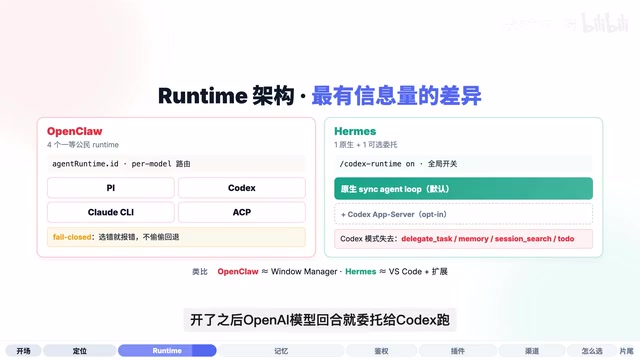
OpenClaw treats runtimes as first-class citizens, with four built-in runtimes—Codex, Claude, CLI, and external Agents connected via the ACP protocol. ACP (Agent Communication Protocol) is a standardized protocol for inter-Agent communication that allows Agents built with different frameworks to discover each other, negotiate capabilities, and collaborate on tasks. It's similar to gRPC or REST APIs in microservice architectures, but specifically designed for AI Agents' asynchronous, multi-turn, stateful interaction patterns. Through ACP, OpenClaw can treat external Agents as local runtimes for scheduling, enabling cross-framework Agent orchestration.
Each model can specify which runtime to use via the agent.runtime.id field in configuration. For example, selecting an OpenAI model with Codex routes that turn to the Codex CLI AppServer; selecting Anthropic with Claude CLI routes it through Claude CLI. Its failure mode is Fail Close—when the system cannot confirm a safe state, it refuses service rather than degrading gracefully. If your specified runtime can't be found, it throws an error directly without silently falling back. This strategy is standard practice in finance and security domains; OpenClaw brings it into Agent scheduling to ensure completely predictable behavior.
Hermes: Single Loop with Optional Extensions
Hermes is completely different—it has only one native Sync Agent Loop running all models. The Codex AppServer is an optional runtime added later, controlled via slash commands and a global toggle. When enabled, OpenAI model turns are delegated to Codex for execution.
To use an analogy: OpenClaw is like a Window Manager that doesn't run the Agent Loop itself but schedules multiple independent processes; Hermes is like VS Code with a Codex extension installed—it can run on its own, with Codex serving only as an optional Plan B.
This architectural difference directly impacts their extension models: OpenClaw naturally supports multi-Agent collaboration (each runtime can be an independent Agent), while Hermes is better suited for single-Agent deep execution scenarios.
Memory Systems: Transparent Files vs Intelligent Retrieval
OpenClaw: What-You-See-Is-What-You-Get File Memory
OpenClaw's memory is entirely plain Markdown files. Long-term memory goes in Memory.md, and daily working memory goes in date-named MD files. The official statement is quite direct: "The model only remembers what gets saved to disk. There is no hidden state." You can open these files directly, edit them by hand—completely transparent and controllable.
The advantage of this design is that debugging and auditing are extremely simple—you can open a file at any time to see what the Agent "remembers," and you can directly edit files to correct the Agent's cognition. The downside is that as memory volume grows, a pure file-based approach will hit bottlenecks in retrieval efficiency.
Hermes: Multi-Layer Memory Architecture
Hermes's memory system is considerably more complex. The base layer consists of Memory.md plus User.md files, wrapped in an outer layer of SQLite with FTS5 full-text search for the session database, plus 8 optional external Memory Providers (MEM, Hanqiu, SuperMemory, Hindsight, etc.), each Provider bringing its own toolset—essentially connecting the Agent to third-party memory cloud services.
SQLite is an embedded relational database that requires no separate server process, storing data in a single file, making it ideal for local applications. FTS5 (Full-Text Search 5) is SQLite's full-text search extension module, supporting inverted index construction on text content for millisecond-level keyword and phrase searches. Using SQLite+FTS5 in an Agent memory system means you can perform efficient semantic retrieval on historical conversations and session data without depending on external services, balancing the lightweight nature of local deployment with retrieval efficiency.
The Fundamental Opposition in Memory Upgrade Mechanisms
The most interesting detail here is how each handles "upgrading Agent observations to long-term memory":
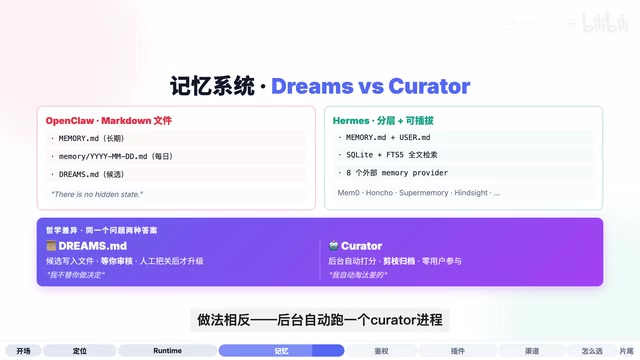
OpenClaw adopts Human in the Loop: It has a Dreams.md file where a background Sweep process organizes daily observations into candidates, but these don't automatically upgrade to long-term memory—instead, they wait for user review before entering Memory.md.
Human in the Loop (HITL) is a core pattern in AI system design, referring to preserving human review and intervention capabilities at critical decision points in automated workflows. In Agent systems, this means AI can autonomously complete most work, but requires human confirmation for irreversible operations, high-risk decisions, or knowledge consolidation. OpenClaw's introduction of HITL at the memory upgrade stage fundamentally reflects the belief that "what's worth remembering long-term" is a judgment that shouldn't be entirely delegated to machines.
Hermes adopts Fully Automated Curation: In the Curator Release version, a background Curator process runs automatically, scoring the Agent's own Skills, depreciating them, and archiving them—with zero user involvement. This design assumes the Agent itself has sufficient judgment to manage its own knowledge base, closer to the human brain's forgetting curve mechanism—infrequently used memories naturally decay while frequently used memories are reinforced.
Same problem—how to handle observations accumulated by the Agent? OpenClaw says "I won't decide for you; here's a candidate list, you decide." Hermes says "I'll score and automatically eliminate; you don't need to worry about it." This is a fundamental divergence in design philosophy.
Authentication: Centralized Management vs Delegated Governance
OpenClaw stores all authentication centrally in a single authprofiles.json file (officially called TokenSync)—unified storage, unified management, then distributed to each runtime. A single file can simultaneously hold ChatGPT subscription OAuth Tokens, OpenAI API Keys, Anthropic Keys, and Claude CLI local auth. This centralized management is similar to a password manager approach—single-point storage, unified encryption, on-demand distribution.
Hermes takes the Delegate route: Hermes's own hermes auth login command handles basic authentication, but once the Codex Runtime is enabled, the Codex portion's authentication is entirely handed off to Codex CLI's own auth.json, bypassing Hermes. This delegation model follows the principle of least privilege—each component manages only the credentials it needs, without interfering with others.
Both approaches have merit: OpenClaw's centralized storage is convenient for management and auditing, but all security responsibility falls on it—if authprofiles.json leaks, all credentials are exposed. Hermes's delegation to individual CLIs reduces the attack surface (a single-point leak doesn't affect other components), but you need to maintain login states separately and refresh tokens individually when they expire.
Plugin Ecosystem: Multi-Format Compatibility vs Open Standard Alignment
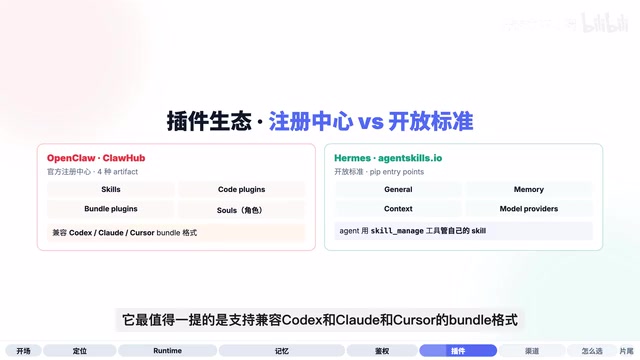
OpenClaw has an official registry called CloudHub, with four artifact types: Skills, Code Plugins, Bundle Plugins, and Source role packages. Beyond CloudHub, you can also directly install NPM packages, Git repositories, or local links. Most notably, it supports Bundle formats compatible with Codex, Claude, and Cursor—meaning one plugin works across multiple client systems. This multi-format compatibility strategy reduces maintenance costs for plugin developers and lets OpenClaw quickly leverage existing ecosystems.
Hermes uses PIP Entry Points discovery mechanism, also with four subcategories: General, Memory, Context, and Model Providers/Skills. PIP Entry Points is a plugin discovery mechanism in Python's package management system—developers declare entry_points in their package's setup.cfg or pyproject.toml, and after installation, the framework can dynamically discover all registered plugins via importlib.metadata without hardcoding import paths. This mechanism is widely used in projects like pytest and Flask, with the advantage that plugin installation and discovery are completely decoupled—users just need to pip install a package, and the framework automatically identifies and loads its functional modules.
Hermes aligns with the AgentSkills.io open standard rather than binding to a proprietary format, enabling interoperability with other tools compatible with that standard. Additionally, Hermes's Agent has a skills_manage tool that can create, modify, and delete its own Skills—perfectly aligned with its Self-Improving positioning. The Agent doesn't just use Skills; it can autonomously generate new Skills based on emerging needs during execution, forming a positive capability accumulation loop.
Channel Distribution: Horizontal Breadth vs Vertical Depth
OpenClaw dominates in channel coverage: supporting 27+ messaging platforms, from mainstream ones like Discord, Telegram, and Slack, to Chinese platforms like WeChat, Yuanbao, and Faceu, to iMessage and even direct phone calls via Technics. Add WebChat, a Control UI panel, and companion apps for Mac/iOS/Android, and the horizontal spread is extremely wide. The core logic behind this strategy: users shouldn't have to change their communication habits to use AI—AI should appear where users already are.
Hermes covers 19+ messaging platforms, including Telegram, Discord, Slack, WhatsApp, Signal, and other common platforms. But Hermes goes deeper on another dimension: it has ACP protocol integration, connecting Agents to IDEs like VS Code and JetBrains, and provides an OpenAI-compatible API Server. OpenAI-compatible API means any client supporting the OpenAI API format (such as Chatbox, TypingMind, etc.) can directly connect to Hermes without additional adaptation.
In short: OpenClaw spreads wider horizontally; Hermes connects deeper vertically, especially in developer workflows.
Selection Recommendations: Match Framework to Requirements
Choose OpenClaw when:
- You need a unified AI entry point across various messaging platforms
- You use ChatGPT or Claude subscription authentication
- You prefer local transparency and control, willing to manually maintain config files
- You value Human in the Loop memory management
- Your team uses different platforms and needs a unified Agent access layer
Choose Hermes when:
- You need a self-learning Agent that runs for extended periods
- You have heavy IDE integration needs (VS Code/JetBrains)
- You want the system to automatically manage the Skill library with minimal manual intervention
- You need complex memory retrieval and external Memory Providers
- You prefer the Python ecosystem and are comfortable with pip install workflows
The two aren't mutually exclusive—you can absolutely install both for comparison. But it's best to settle on one as your primary entry point—after all, session databases and memory systems are managed separately, and mixing them will prevent both from running properly. Looking at long-term evolution, OpenClaw is more likely to develop toward an Agent orchestration platform (managing collaboration between multiple Agents), while Hermes is more likely to evolve toward single-Agent ultimate intelligence (one Agent becoming increasingly smart).
Key Takeaways
- OpenClaw positions itself as a cross-platform AI assistant gateway (outward connection), while Hermes positions itself as a self-learning Agent (inward growth)—fundamentally different design philosophies
- Runtime architecture differs significantly: OpenClaw acts like a Window Manager scheduling multiple independent runtimes; Hermes is a single Agent Loop with an optional Codex extension
- Memory system philosophies are opposed: OpenClaw uses a Human in the Loop transparent file approach; Hermes uses fully automated Curation with zero user involvement
- Channel distribution has different emphases: OpenClaw covers 27+ platforms horizontally; Hermes goes deep vertically into developer workflows and IDE integration
- The two aren't mutually exclusive but shouldn't be mixed—choose your primary entry point based on use case (multi-platform access vs self-learning Agent)
Related articles
 Product Reviews
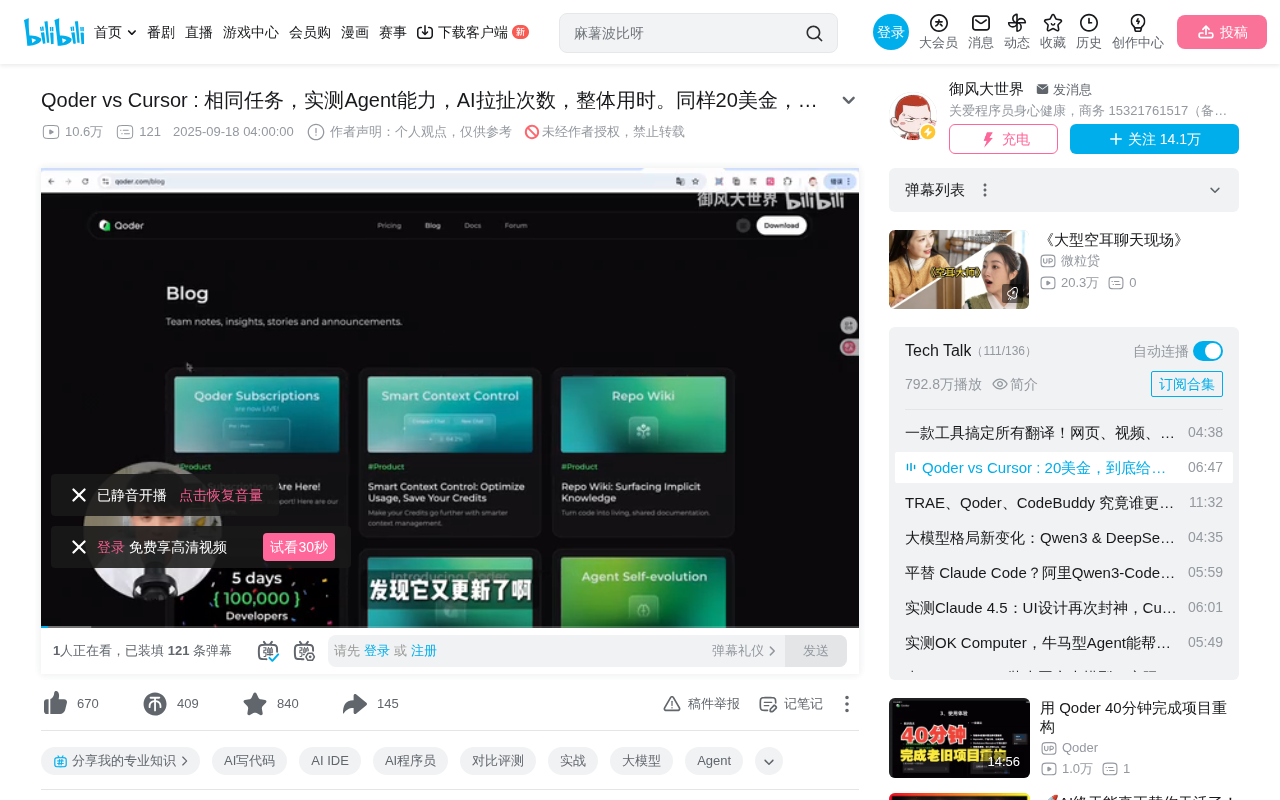
Qoder vs Cursor Real-World Comparison: Which $20/Month AI IDE Is Better?
Hands-on comparison of Qoder vs Cursor AI IDEs: Agent autonomy, human interaction count, and architecture decisions. Qoder needed only 2 interactions vs Cursor's 8.
 Product Reviews
Cursor Cloud Agent Demo: Eliminating Bottlenecks Across the Entire Software Development Lifecycle
Deep analysis of Cursor's Cloud Agent demo showing how cloud VMs, automated test artifacts, and a full-chain control plane systematically eliminate human bottlenecks across the software development lifecycle.
 Product Reviews
Cursor 3.0 Deep Dive: Multi-Agent Parallelism, Design Mode, and Best-of-N Model Comparison
Cursor 3.0 evolves from an AI coding assistant into an Agent fleet command center. Explore multi-agent parallelism, Design Mode, and Best-of-N model comparison.